


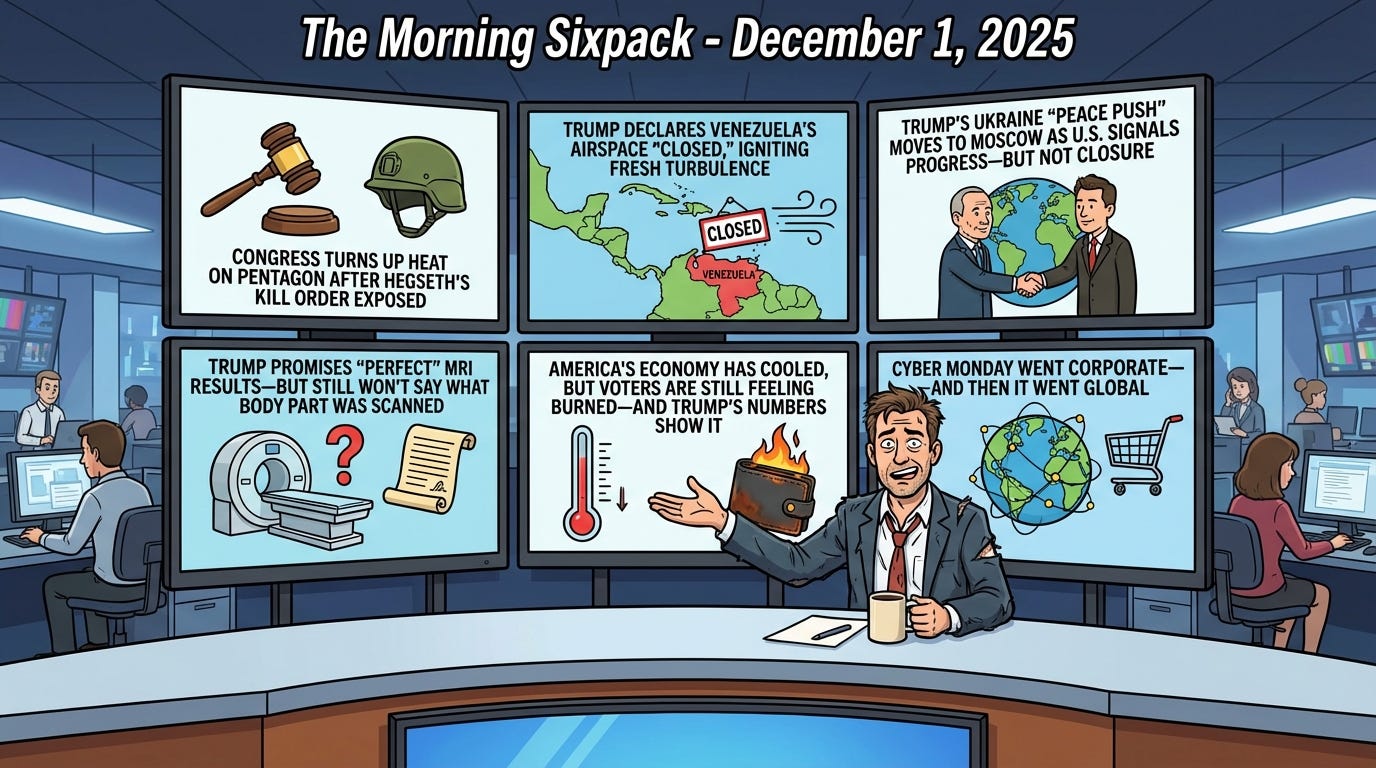
Congress Turns Up the Heat on Pentagon After Hegseth’s Kill Order Exposed
Republican and Democratic leaders are now circling the Pentagon after a report revealed Defense Secretary Pete Hegseth issued a spoken order to kill every crew member on a suspected drug-running vessel.
Lawmakers in both chambers—yes, even the ones usually taking dictation from the Trump administration—are demanding answers after The Washington Post revealed that a second missile strike was ordered to finish off two survivors clinging to wreckage in the Caribbean. Seven sources confirmed the account, all speaking anonymously because the situation is radioactive even by Washington standards.
The Senate Armed Services Committee chairs, Sens. Roger Wicker and Jack Reed, say they’ve launched inquiries and intend to conduct “vigorous oversight” of what went down. House Armed Services leaders followed with their own bipartisan statement, insisting they want a full accounting—finally signaling that Congress might remember it has a job beyond rubber-stamping executive whims.
Hegseth, of course, fired back on X—attacking “fake news” and defending the strikes as righteous counterterrorism. But the Pentagon’s refusal to bring lawyers to briefings, provide intelligence, or release legal justifications has irritated even Republicans. Two previously undisclosed letters show Senate leaders warning the Defense Department it has blown past legal deadlines to turn over records, including the order to kill all aboard and the strike video itself.
Meanwhile, former military attorneys and law-of-war experts say the campaign—which has killed more than 80 people—is unlawful. As one group bluntly put it: “Violations of these obligations are war crimes, murder, or both. There are no other options.” And Rep. Seth Moulton cut through the spin with a line that deserves to be framed: “The idea that wreckage from one small boat in a vast ocean is a hazard to marine traffic is patently absurd, and killing survivors is blatantly illegal.”
Source: The Washington Post
Editor: Congress suddenly discovering oversight only after a kill-everyone order leaks is the legislative equivalent of waking up after the fire has already burned down the house and demanding to know who left the stove on.
Trump Declares Venezuela’s Airspace “Closed,” Igniting Fresh Turbulence in the Caribbean
President Trump has now unilaterally declared Venezuela’s airspace “closed,” a move the U.S. has no legal authority to enforce but every ability to destabilize.
In a social media blast aimed at “Airlines, Pilots, Drug Dealers, and Human Traffickers,” Trump insisted the entire airspace above and around Venezuela should be treated as off-limits. That kind of presidential decree—divorced from international law—creates instant uncertainty for carriers already navigating a volatile region. And of course, the White House declined to clarify what exactly he meant, because clarity would spoil the vibe.
This all comes as Washington ramps up its military footprint in the Caribbean, deploying the USS Gerald Ford and roughly 15,000 troops—the biggest U.S. presence near Venezuela since the 1989 Panama invasion. Officially, it’s about “combatting drug trafficking.” Unofficially, it’s everything Venezuela’s government has feared: a pressure campaign aimed at Maduro, who’s already banned six major international airlines after they refused to resume flights on his timeline.
The FAA has already warned of “heightened military activity,” and U.S. forces have launched at least 21 deadly strikes on boats they claim were carrying drugs—without offering proof. Meanwhile, Washington has slapped the label of “foreign terrorist organization” on the so-called Cartel de los Soles, which it alleges is run by Maduro’s inner circle. Venezuelan officials say the cartel is imaginary, a convenient narrative imported from D.C.
The State Department insists the cartel is very real and deeply embedded in Venezuela’s institutions. What’s also real: the geopolitical brinkmanship now escalating with every statement, every strike, and every carrier forced to weigh whether flying near Venezuela is worth the risk.
Source: MSN/BBC
Editor: Trump declaring another nation’s airspace “closed” is like someone slapping a RESERVED sign on a seat they don’t own—loud, pointless, and guaranteed to start an avoidable fight. Anti-war president—right!
Trump’s Ukraine “Peace Push” Moves to Moscow as U.S. Signals Progress—but Not Closure
Trump says there’s a “good chance” for a peace deal, but the plan now heads straight into the Kremlin’s hands, where optimism usually goes to die.
After what the U.S. delegation called “very productive” talks with Ukraine’s revamped negotiating team, Trump’s envoy Steve Witkoff is off to Moscow to sell the updated peace proposal. Putin, who last week claimed he’s ready for a “serious” conversation, has shown no appetite for budging from the hardline demands that shaped Trump’s original 28-point plan—one widely viewed as tilted toward the Kremlin.
Before the Moscow trip, Witkoff, Jared Kushner, and Secretary of State Marco Rubio met in Florida with Ukraine’s delegation now led by Rustem Umerov, following Kyiv’s corruption-related shake-up of its top negotiator. Rubio struck an upbeat tone afterward, saying the session “made additional progress” and stressing that the talks were “not just about the terms that ends fighting, it’s about also the terms that set up Ukraine for long-term prosperity.”
Umerov echoed that sentiment in his own statement, saying “substantial progress” had been made toward a “dignified peace” and alignment with Washington’s position. Zelenskyy, never one to oversell, called the session “very constructive” while noting that “tough issues” remain—diplomatic shorthand for “nothing is agreed until everything is agreed.”
Trump, speaking aboard Air Force One, couldn’t resist injecting a familiar theme, calling Ukraine’s “corruption situation” “not helpful” even as he insisted there is still a “good chance” at a deal. The subtext: Kyiv should take the deal Washington is pushing, even if it leans closer to Moscow’s preferences than Ukrainians would like.
Now the baton passes to Putin—never the easiest audience—and Ukraine’s future may hinge on how much ground the Kremlin is willing to give, and how much Trump’s team is willing to let Kyiv sacrifice.
Source: MSN/NBC News
Editor: Any “peace plan” that needs a sales pitch in Moscow before being shown to the Ukrainian people tells you exactly who holds the leverage—and who’s expected to swallow the bill.
America’s Economy Has Cooled, But Voters Are Still Feeling Burned—and Trump’s Numbers Show It
Inflation may not be roaring anymore, but the price level is still hammering households, and the political fallout has landed squarely on Trump’s desk.
Let’s start with what the data actually say: headline inflation sits at roughly 3% as of September 2025—down from the 8%+ days of 2022—but food’s still rising 3.1%, energy 2.8%, and every price hike is stacked on top of the already-inflated post-pandemic baseline. In other words, the fire isn’t spreading, but the house is still too hot for comfort.
Real wages? Barely inching forward. Most workers saw less than a 1% real pay bump over the past year. Modest gains, yes, but nowhere near enough to ease the sting of grocery bills 25% higher than 2020 and rents that seem allergic to gravity. Millions feel like they’re jogging in place on a treadmill they didn’t ask for.
And voters have noticed. Trump’s economic approval numbers are deep underwater—about 37–39% approve while 60–62% disapprove. Even Fox’s own polling puts him squarely in the red. Only a quarter of Americans think he’s doing a good job managing the cost of living. For a president who promised to “crush inflation,” that’s an ugly spread.
Meanwhile, the financial stress on the ground is unmistakable: 27% of Americans say they’re “just getting by” or worse. Nearly one in three feel poorer than a year ago. Two-thirds are living paycheck-to-paycheck. And auto-loan delinquencies? They’re blowing past Great Recession levels, with subprime delinquencies hitting a record 6.6%—a sign of real strain in households that can’t absorb another bump.
None of this should shock a White House that anchored its message to economic competence. Inflation cooling isn’t the same as life becoming affordable—and voters intuitively understand that.
Source: RealClearPolling, BLS, Reuters, CBS News, Fed
Editor: If Trump wants voters to feel the economy is “great,” he may have to first persuade them they’re hallucinating their grocery receipts, their rent hikes, and the repo truck circling the block. Until then, the numbers aren’t lying—and neither are the people living them.
Cyber Monday Went Corporate—and Then It Went Global
Cyber Monday didn’t just pop out of the algorithm; it was a marketing invention that consumers happily turned into a retail institution.
Back in 2005, the National Retail Federation cooked up the term after spotting a spike in online shopping the Monday after Thanksgiving—mostly because workers had faster office internet than whatever dial-up dinosaur was hissing at home. Turns out, nothing drives ecommerce adoption quite like people sneaking in purchases on the company clock.
As Black Friday devolved into an annual spectacle of parking-lot brawls and predawn stampedes, Cyber Monday emerged as the calmer, couch-friendly alternative. Retailers leaned in hard, offering big online-only discounts and turning the day into a clickathon that avoided the whole getting-trampled-for-a-TV problem.
By the mid-2010s, Cyber Monday wasn’t just big—it was the U.S.’s single largest online shopping day of the year. Mobile shopping surged, deals expanded, and consumers discovered that buying things on your phone while ignoring your emails is a far superior holiday tradition.
Today, Cyber Monday sits inside a congested calendar of retailer-made “micro-holidays,” all engineered to keep consumers in a constant state of discount hunger. And globally? It’s been handily eclipsed by China’s Singles’ Day—a capitalist typhoon that makes even the most aggressive U.S. markdowns look timid.
Cyber Monday’s future is less about a single day and more about a long, shapeless “Cyber Season.” Retailers will use AI to nudge shoppers every hour, mobile commerce will keep eating the calendar, and the original one-day digital shopping spree will fade into a perpetual sales cycle.
Source: National Retail Federation, Business Insider, Adobe, CNBC, YouTube
Editor: Cyber Monday started as a clever PR stunt—now it’s a month-long avalanche of “limited-time deals” that somehow never end. At this point, the only real scarcity is our patience.
Trump Promises to Release “Perfect” MRI Results—But Still Won’t Say What Body Part Was Scanned
Trump now says he’ll release the results of an MRI he took in October, even as the White House refuses to explain why he had it—or what it was for.
Speaking to reporters on his flight back from Florida, the president waved off concerns by insisting the imaging showed “perfect” results. But the White House has repeatedly declined to say what prompted the MRI during his October physical, and press secretary Karoline Leavitt has stuck to the vague line that it was simply “advanced imaging” done as part of a routine exam.
The odd part? Trump himself claims he has “no idea” which part of his body was scanned. “It was just an MRI,” he told reporters. “What part of the body? It wasn’t the brain because I took a cognitive test and I aced it.” Acing a cognitive test has become one of his favorite self-certifications—an unofficial medical credential he hands out to himself on demand.
Leavitt says the president remains in “exceptional physical health,” but refusing to specify what was tested is an easy way to invite speculation, not tamp it down. If the MRI was routine, the White House could simply say so—and name the body part. They choose not to.
Whether Trump ultimately releases the scan results—or releases only what he wants the public to see—remains an open question. What’s clear is that transparency isn’t the driving force here.
Source: AP News
Editor: When a president claims he doesn’t know which body part got MRI’d, it’s less “routine exam” and more “don’t look behind the curtain.” Hard to ace that test. Trump’s brain is COOKED.