


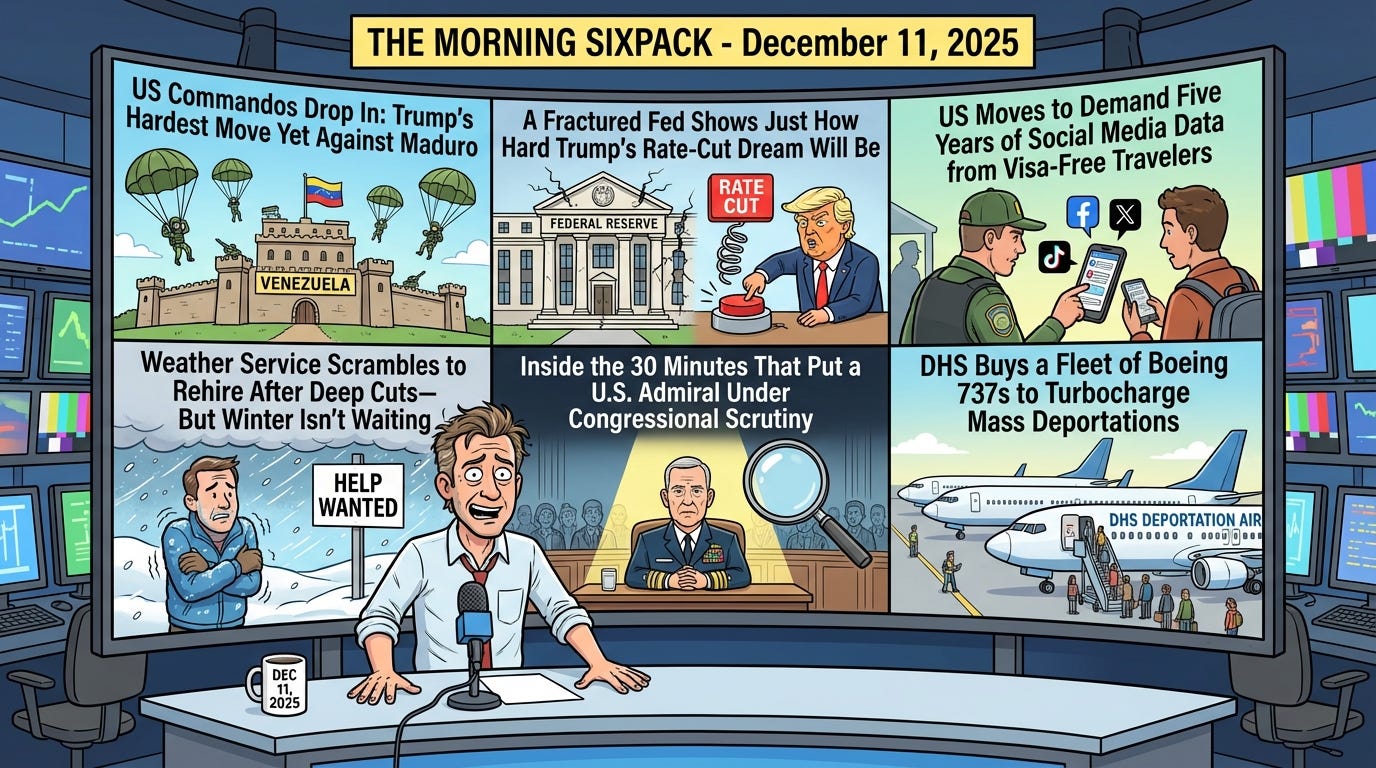
US Commandos Drop In: Trump’s Hardest Move Yet Against Maduro
US commandos fast-roping onto a Venezuelan-linked oil tanker isn’t just a dramatic clip on X—it’s Trump’s most aggressive step yet in his grinding showdown with Nicolas Maduro.
Footage posted by Pam Bondi shows the moment helicopters hover over the tanker and troops rappel down like a well-oiled machine, sweeping the deck with high-powered rifles as they execute a federal seizure warrant. Agencies from the FBI to Homeland Security to the Coast Guard all teamed up for this one, signaling that Washington clearly wanted the world to watch.
Trump, never one to underplay a moment, announced: “We’ve just seized a tanker on the coast of Venezuela, a large tanker, very large, largest one ever seized, actually.” Then came the classic Trump ambiguity-with-menace: Maduro should know that “other things are happening.” Translation: don’t get too comfortable.
This isn’t just another strike on a narco-boat. It’s the first time American personnel have hit a target that isn’t tied directly to drug trafficking, and it lands right in the middle of Venezuela’s already-volatile oil economy. Asian buyers have been demanding deeper discounts on Venezuelan crude for months; now, with a U.S. military presence visibly yanking tankers off the water, those nerves won’t settle anytime soon.
And while Trump insists each escalation is about stopping narcotics, nobody misses the bigger picture—Maduro is under the cosh, terrified enough to rotate beds nightly and communicate like a fugitive. Meanwhile, Trump keeps tightening the vise and reminding the Venezuelan strongman that his “days are numbered.” Whether this tanker grab is a one-off flex or the first brick in a naval blockade is anyone’s guess, but the trajectory isn’t subtle.
Source: The Sun
Editor: If you’re Maduro, watching U.S. commandos slide onto tankers like it’s an action movie has to feel like the universe tapping its watch and asking what your exit plan is.
A Fractured Fed Shows Just How Hard Trump’s Rate-Cut Dream Will Be
Jerome Powell pushed through a rate cut that nearly a third of his own policymakers didn’t want—and that alone tells you Trump won’t simply will lower rates into existence.
The split was the widest of Powell’s tenure: three formal dissents, plus four more officials quietly signaling they wouldn’t have cut at all. That’s seven voices effectively saying “not so fast,” even as Trump fumes that the move wasn’t larger and auditions candidates to replace Powell in May. His line this week—“Our rate should be much lower”—lands differently when the people who actually vote on policy are increasingly planting their flags in the opposite direction.
Powell keeps pointing to cooling inflation and softening job gains as justification for easing, but he refused to hint at more cuts ahead. And the Fed’s own projections show why: seven officials want no cuts next year, four want at most one. Whoever Trump installs in the chair won’t be walking into a compliant room. They’ll be walking into a committee split between doves worried about recession risk and hawks flashing 1970s déjà vu.
Trumpworld knows these constraints—yet keeps pressing the fences anyway. His advisers have questioned regional Fed presidents’ legitimacy, floated residency requirements that would boot some of them, and even explored removing Biden-nominated governors on dubious technical grounds. One strategist likened it to “raptors…testing the fences,” and frankly, that’s a fitting metaphor for an administration probing for structural weak spots.
But the cold reality is that the next big shift in rates won’t hinge on who Trump picks—it’ll hinge on the data. If inflation stays sticky, the hawks will hold their line. If the job market cracks—and Powell warned recent revisions may wipe out months of employment gains—cuts might come, but for reasons no president wants attached to his legacy. A weaker economy can hand you lower rates, sure. It also hands you political pain.
Source: WSJ (gift article)
Editor: The White House may fantasize about a Fed chair with a big red “CUT” button, but this week showed the institution still has teeth—and isn’t afraid to bite back.
US Moves to Demand Five Years of Social Media Data from Visa-Free Travelers
The U.S. is poised to turn a quick, visa-free trip into a far more intrusive screening process—one that reaches deep into visitors’ digital lives and even their DNA.
Under a new proposal from Customs and Border Protection, anyone entering the U.S. through the Visa Waiver Program—think travelers from the U.K., Germany, Japan, Australia, Israel and dozens more—could soon be required to hand over up to five years of social media accounts, plus a decade’s worth of email addresses and a long trail of phone numbers. ESTA, the form that was once considered the “easy lane” into America, is suddenly looking like an autobiography with metadata.
The government isn’t stopping there. CBP says it wants to add “high-value data fields,” which is bureaucratic shorthand for everything but your browser history. That includes metadata from photos you upload, deep personal details about your family members, and potentially biometric identifiers such as fingerprints, iris scans and—yes—DNA. For a program designed to avoid embassy interviews, this is a breathtaking pivot into maximal data capture.
This all traces back to a Trump executive order demanding heightened vetting to keep out perceived national-security threats, though no one is saying what, exactly, officials expect to uncover in five years of tweets and TikToks. It’s worth remembering: social-media disclosure has been optional on ESTA since 2016, and mandatory only for non-waiver countries. This proposal slams the door on optionality.
The Biden administration kept the old Trump-era requirements; Trump’s return is now accelerating them. Travelers have 60 days to comment before this becomes policy, but good luck convincing DHS to scale back anything it has already labeled “high-value.” Once the government gets a taste for more information, it rarely decides it needs less.
Source: Al Jazeera
Editor: At this rate, visitors will have to submit a memoir, a family tree, and their high-school MySpace login just to see the Grand Canyon.
Weather Service Scrambles to Rehire After Deep Cuts—But Winter Isn’t Waiting
The National Weather Service is trying to rebuild the workforce the Trump administration gutted—but with just 80 new hires accepted so far, the agency is heading into winter with forecast offices running on fumes.
After roughly 550 positions were cut earlier this year by DOGE, Congress and the public pushed back hard, forcing approval to rehire 450 staff. But the math still doesn’t work: even a full hiring sweep won’t restore the agency to its pre-cut strength, and rehiring meteorologists isn’t like restocking printer toner. Experience lost is experience lost.
On the ground, that means critical offices are limping along. A fully staffed 24/7 forecast office needs 13 meteorologists; many are down to 10 or 11. Some, like Goodland, Kansas, are missing more than half their bench. Rapid City and Cheyenne aren’t far behind. And though new hires are trickling in, they’re not yet in place—and even when they arrive, they won’t bring “the centuries of experience” that former NOAA head Rick Spinrad says walked out the door.
The operational consequences are already showing. Hanford, California can’t run 24/7 at all. Nine forecast offices are down to one weather-balloon launch per day instead of the standard two, meaning less upper-air data feeding the models that drive storm predictions. When winter storms are measured in hours and minutes, missing data isn’t just inconvenient—it’s dangerous.
NOAA insists it’s “properly staffed” for the coming season, but even internal officials admit the gaps are real. The agency is rushing to post openings, sift through a flood of applicants and redistribute staff, aiming to finish the 450 hires by the end of fiscal 2026. Even then, NWS will still be smaller than it was at the start of Trump’s second term.
Experts are blunt: understaff the people who warn America about blizzards, and the warnings will suffer. And when timing, accuracy and delivery degrade, the vulnerabilities don’t stay on a spreadsheet—they show up on highways, in emergency rooms, and in the very outcomes the NWS exists to prevent.
Source: CNN
Editor: Maybe—and hear me out here—America shouldn’t repeatedly play Jenga with the agency responsible for telling us when the sky is literally trying to kill us.
Inside the 30 Minutes That Put a U.S. Admiral Under Congressional Scrutiny
A U.S. admiral’s decision to order a second strike on two battered survivors clinging to boat debris has become the legal and moral flashpoint of Trump’s expanding “narco-terror” campaign.
Adm. Frank Bradley was overseeing a Sept. 2 operation near Trinidad when a laser-guided bomb killed nine suspected smugglers and left two men alive, struggling atop wreckage “roughly the size of a dining room table.” The larger mission—authorized in advance by Defense Secretary Pete Hegseth—was clear: kill the crew, sink the boat, destroy the drugs. But real life rarely follows the PowerPoint. When the smoke cleared and the survivors waved their arms skyward, Bradley had to decide whether they were still lawful targets or now “shipwrecked” under the law of armed conflict, which would have rendered them protected and out of the fight.
Bradley told lawmakers he weighed that question with real-time legal advice in hand, but his retelling left members of Congress unsettled. Uncertainty clouded every piece of the picture: Were there drugs under the wreckage? Could the men call for help? Were they attempting to surrender? He ordered a second strike anyway, killing both. The Pentagon insists lawful authority was intact; experts in the law of war fiercely disagree, noting that distress at sea—not active hostility—is the defining condition. And the video, still unreleased, reportedly shows the men waving moments before the Griffin missile hit.
The larger problem is structural. Trump’s second-term framing of drug traffickers as “enemy combatants” has allowed lethal force where traditional law enforcement once applied, and Bradley leaned heavily on that interpretation in his defense. Yet neither international law nor battlefield norms were designed for killing alleged criminals bobbing in open water. Legal scholars argue that even if the men were combatants initially, once shipwrecked, the U.S. had a duty to attempt rescue before re-engaging. Instead, the military had no assets on hand to save them—despite simulations that predicted survivors were possible.
Congress is now fractured. Some Republicans appear satisfied after classified briefings and want the matter closed. Democrats want more documentation, including the legal opinion Bradley sought before firing again. Hegseth, meanwhile, is attempting to support Bradley while distancing himself from the fallout, and Trump has waffled on releasing the footage—first signaling yes, then punting the decision back to the Pentagon.
This wasn’t an isolated incident, either. The strike was the first in a now-months-long campaign that has killed nearly 90 alleged drug traffickers on more than 20 boats—most ferrying cocaine, much of it bound for Europe or Africa, not the U.S. The administration may call it a war, but on Sept. 2, the men on that boat almost certainly did not know they were combatants in one. And waving for help—whether or not it “counted” as surrender—may have been the only language they had left.
Source: WaPo (gift article)
Editor: Hard to call it a clean strike when the survivors were clinging to debris and waving at the sky. If this is the new definition of “combat,” the line between warfare and execution is getting dangerously thin. Bradley is a murderer, plain and simple.
DHS Buys a Fleet of Boeing 737s to Turbocharge Trump’s Mass-Deportation Agenda
The Department of Homeland Security is buying six Boeing 737s for ICE deportation flights—because nothing says “scaling up” like your own in-house airline for mass removals.
The nearly $140 million deal, first reported by The Washington Post and confirmed by DHS, is part of the administration’s push to hit its ambitious target of 1 million deportations this year. DHS spokeswoman Tricia McLaughlin framed the purchase as a savvy taxpayer win, claiming the move will save $279 million by allowing ICE to ditch pricier charters and use more efficient flight routes. In other words: if you’re going to fly people out of the country at historic volumes, you might as well optimize the logistics.
The contract flows through Daedalus Aviation, whose top executives also helm Salus Worldwide—an outfit already holding a nearly $1 billion agreement with DHS for “voluntary self-deportation” programs. That overlap is raising eyebrows, though DHS is leaning into the narrative that this is all part of a bold, cost-cutting system upgrade. And Secretary Kristi Noem is loudly crediting Trump’s “One, Big, Beautiful Bill” for funding the expansion.
This shift marks a notable evolution in ICE operations. Deportation flights have long been farmed out to private charter firms; owning the fleet means DHS now controls scheduling, routing, and capacity at a scale not seen before. And with Trump publicly demanding massive removals of “criminal illegal aliens,” the infrastructure is quickly taking shape to match the rhetoric.
Critics will question the incentives and the optics. Supporters will point to the supposed taxpayer savings. But let’s be honest—the headline here isn’t the airplanes or the procurement details. It’s the unmistakable direction of federal policy: an immigration enforcement machine not just expanding, but industrializing.
Source: CNBC
Editor: Buying six 737s for deportations is the kind of move you’d expect from an administration treating immigration like a volume business—because apparently we’re now running ICE like Southwest Airlines, minus the free pretzels.