


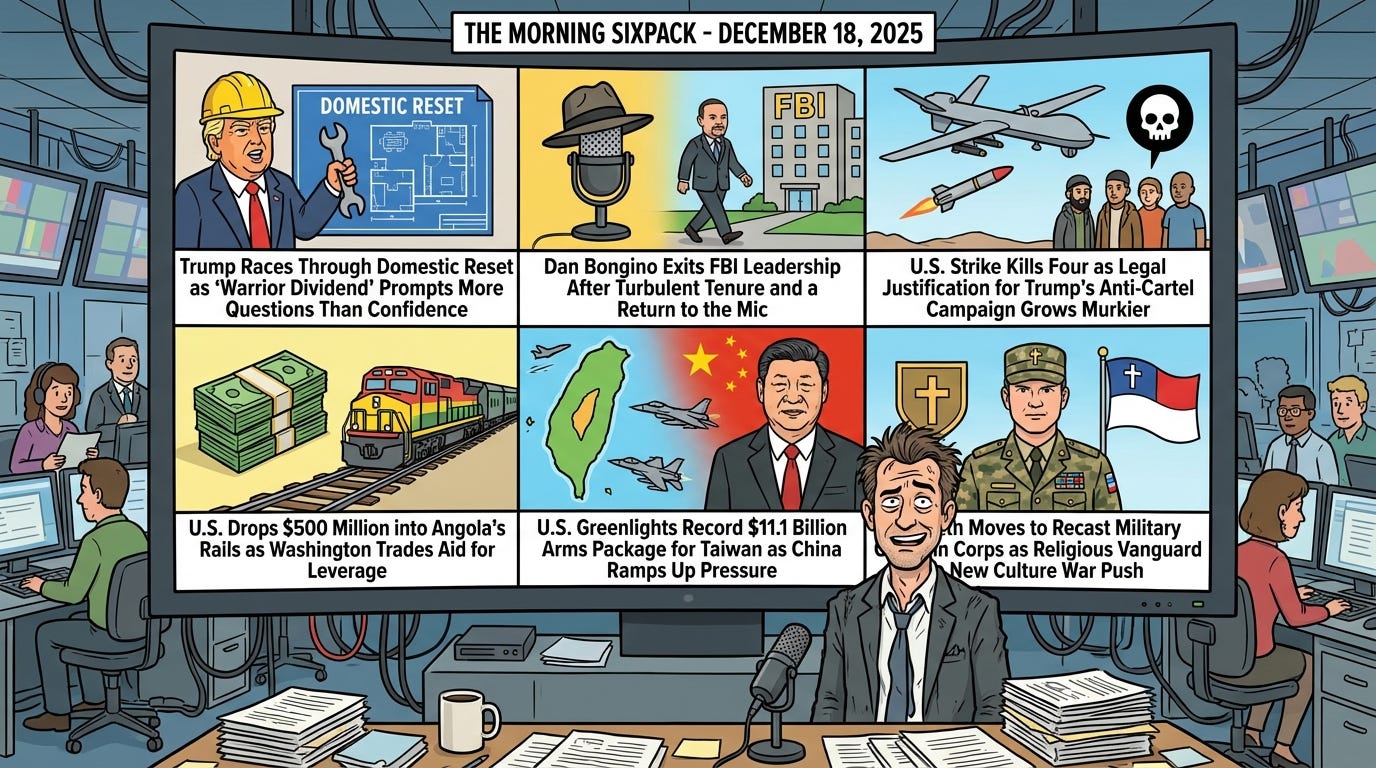
Trump Races Through Domestic Reset as “Warrior Dividend” Prompts More Questions Than Confidence
Trump barreled through an 18-minute White House address that tried to reboot his political standing but mostly revealed how far he still has to go with frustrated Americans.
Mixing applause lines with grievances, the president ricocheted between claiming the country was “dead” a year ago and insisting it’s now “the hottest country anywhere in the world.” The performance felt less like a reset and more like a sprint past unresolved problems, especially on the economy, where voters remain unconvinced.
“One year ago, our country was dead. We were absolutely dead,” Trump said. “Our country was ready to fail. Totally fail. Now we’re the hottest country anywhere in the world.” The self-congratulation landed awkwardly against persistently high inflation and sagging public approval.
Trump’s headline promise—a $1,776 “Warrior Dividend” check for military members—was announced as if it had been dreamed up moments earlier. Funding? Unclear. Congressional approval? Also unclear. And with Congress leaving town for the year, the timeline is more fantasy than policy.
The president avoided the simmering Venezuela crisis entirely, instead rattling off everything from drug prices to reopening 1,600 power plants to picking a new Fed chair. It was classic Trump: maximalist, breathless, and uninterested in the details voters increasingly care about. His advisers want him to focus on affordability; instead, he continues to tout stock markets and tariff magic.
As Trump nears the one-year mark of his return to power, his poll numbers remain underwater, his base is restless, and even his own chief of staff is quoted describing him as having an “alcoholic’s personality.” Yet he insists, “After just one year, we have achieved more than anyone could have imagined.” Some imaginations, it seems, are doing heavier lifting than others.
Source: WaPo (gift article)
Editor: Hard to claim the country’s “the hottest anywhere in the world” when your own poll numbers are colder than a January driveway. Announcing a $1,776 bribe with no plan to fund it? Peak Trump.
The Bulwark gave their take on this. I don’t have one; I didn’t watch it—I was without internet and power… and fortunate I wasn’t tempted to watch the shitshow.
Dan Bongino Exits FBI Leadership After Turbulent Tenure and a Return to the Mic
Dan Bongino is leaving his post as FBI deputy director just eleven months after taking the job, closing a chapter that was controversial from the moment his appointment was announced.
In a farewell post on X, Bongino thanked President Trump, Attorney General Pam Bondi, and FBI Director Kash Patel for the opportunity “to serve with purpose,” notably skipping any explanation for his abrupt departure. The former podcast host and longtime Trump loyalist was always an unconventional pick for a role historically held by career Bureau professionals—one reason FBI agents had opposed the appointment from the start.
Trump, ever eager to turn personnel decisions into applause lines, said Bongino “did a great job” and simply “wants to go back to his show.” Translation: this was not exactly a shock to those watching his rocky tenure. Bongino had entered the job with a history of spreading conspiracy theories about the 2020 election and the Jan. 6 pipe bomb case. Yet once inside the Bureau, he pivoted hard—calling the pipe bomb investigation a priority and ultimately backing the conclusion that Jeffrey Epstein died by suicide, a stance that enraged segments of Trump’s base.
Director Patel praised him as “the people’s voice for transparency” and credited him with “major breakthroughs” in long-stalled cases, including the pipe bomb investigation. Convenient timing, given the recent arrest of an unaffiliated suspect nearly six years after the devices were planted at party headquarters.
If Bongino’s term was meant to rehabilitate his image, it only partly succeeded. He embraced the institution he once attacked—until it clashed with the conspiratorial expectations of the audience that made him famous. That tension reportedly boiled over, including a contentious meeting with Bondi after the Epstein memo contradicted popular MAGA lore.
Still, Bongino signed off by thanking “my fellow Americans” and blessing the country he once described as under siege by shadowy forces. A full-circle moment, if not exactly a tidy one.
Source: BBC
Editor: Amazing how “serving with purpose” somehow ends right when the heat from both sides gets uncomfortable. And going back to the podcast circuit? Nothing like retreating to a studio where the only “investigations” are sponsored by mattress companies.
U.S. Strike Murders Four More Venezuelans
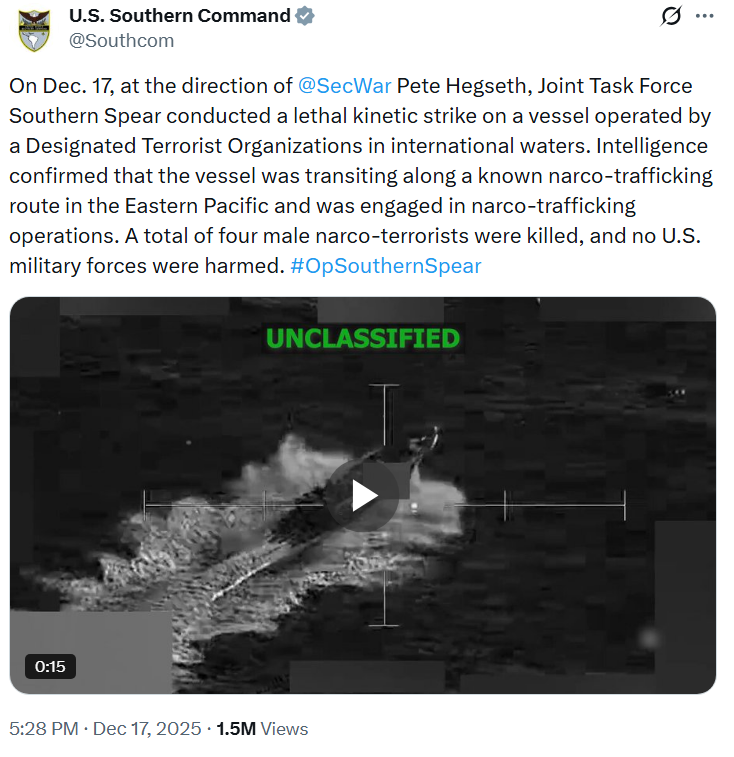
The United States murdered four more people in another boat strike Wednesday, adding to a months-long campaign that has now left 99 dead and raised louder questions about whether the White House is waging an undeclared war.
U.S. Southern Command announced the “lethal kinetic strike” on X, saying the targeted vessel in the eastern Pacific was operated by a Designated Terrorist Organization. But once again, the administration offered no evidence tying the boat to narcotics—or even identifying which alleged terrorist group was involved. Defense Secretary Pete Hegseth ordered the strike, continuing an operation that critics say is sliding far outside legal boundaries.
Intelligence officials claim the vessel was following a known narco-trafficking corridor and “engaged in narco-trafficking operations.” That assertion now needs a footnote. According to Sen. Chris Murphy, lawmakers were privately told the boats weren’t carrying fentanyl—the substance Trump theatrically labeled a weapon of mass destruction this week—but cocaine, and weren’t even headed for the United States. As Murphy put it, “The administration had no legal justification for these strikes, and no national justification for these strikes.”
This marks at least the 26th strike since Sept. 2, a blistering tempo that has drawn warnings from human rights groups, U.N. experts, and even Colombia’s president Gustavo Petro, who bluntly calls the killings murder. The administration insists the campaign is lawful because Trump designated 10 gangs and cartels as terrorist organizations earlier this year, claiming a wartime footing against them—an argument held together mostly by its own self-assertion.
Complicating everything is the growing U.S. military presence near Venezuela and Trump’s newly ordered naval blockade of its oil shipments. You don’t need a geopolitical decoder ring to see where this can go. The Caribbean is getting crowded, and the White House appears more interested in escalation than explanation.
SOUTHCOM released a 15-second black-and-white video of the strike showing a fast-moving boat erupt in flames—a clip that raises more questions than it answers. Transparency, it seems, has been reduced to grainy footage and a caption.
Source: UPI
Editor: If your legal rationale for blowing up boats requires a classified briefing and a shrug, it might not be the ironclad strategy you think it is. And calling cocaine-bound vessels a national security crisis? That’s policy drift with a splash of performance art.
U.S. Drops $500 Million into Angola’s Rails as Washington Trades Aid for Leverage
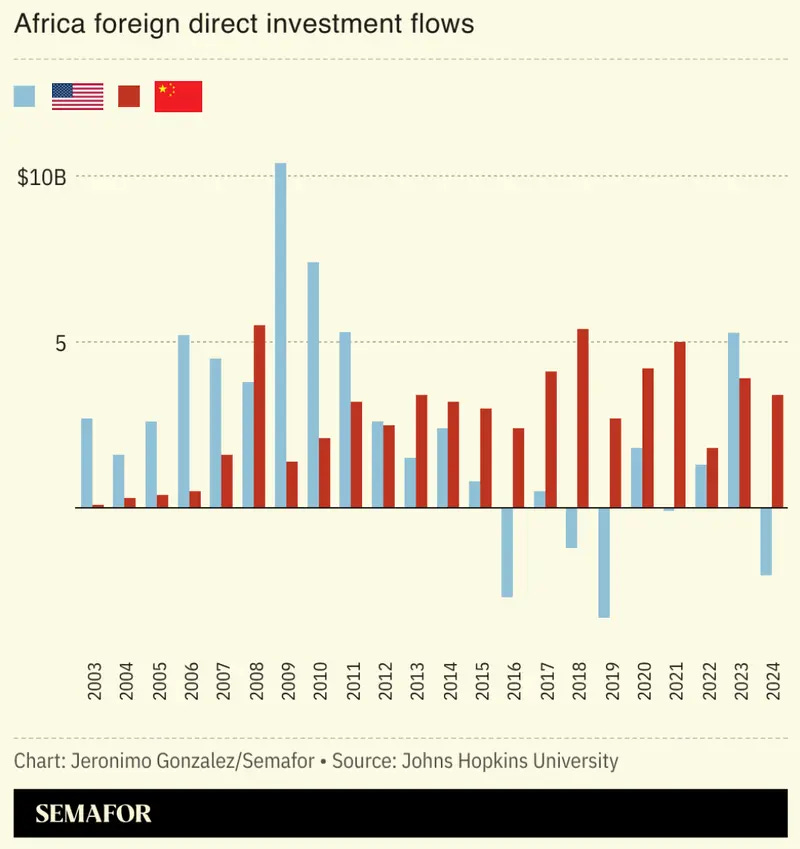
Washington just signed off on a $500 million loan to Angola—less about charity, more about geopolitics, and very much about minerals.
The money targets a major overhaul of the Lobito Corridor, a rail lifeline meant to shuttle copper, cobalt, and other strategic minerals from central Africa to Angola’s Atlantic coast. This isn’t benevolence; it’s part of the White House’s sharpened push to counter China’s grip on the continent and reassert U.S. influence in regions long treated as afterthoughts in foreign policy circles.
The shift is unmistakable. For decades, the U.S. framed Africa through an aid-first lens. Now it’s “trade, not aid”—a slogan that sounds great on a podium but leaves several African nations scrambling to replace evaporating support. The Angola deal is the new model: finance projects that serve U.S. strategic interests and hope local governments can fill in the budgetary potholes left behind.
Once complete, the Lobito Corridor could significantly reshape mineral flows out of Africa, giving Washington more leverage in global supply chains. It also sends a message to Beijing: the U.S. is finally showing up with something more substantive than speeches about partnership.
Still, a $500 million loan doesn’t erase the reality that many African nations depended on the aid model Washington is abruptly discarding. Pivoting from humanitarianism to geopolitics has consequences—and not just for the maps in think-tank PowerPoints.
Source: My Daily Grind News
Editor: Trump finally remembers Africa exists—and shows up with a loan application instead of a development plan. Nothing says “partnership” like charging interest on a geopolitical strategy.
U.S. Greenlights Record $11.1 Billion Arms Package for Taiwan as China Ramps Up Pressure
Washington just approved the largest Taiwan arms sale in U.S. history—$11.1 billion worth of rockets, missiles, drones, and artillery meant to send a message Beijing can’t possibly miss.
The package, the second under Trump’s current term, arrives as China intensifies its military and diplomatic squeeze on Taiwan. Taipei, which has zero interest in accepting Beijing’s sovereignty claims, welcomed the deal as part of its fast-moving push toward asymmetric defense—leaner, mobile systems that punch far above their weight.
The eight-item bundle includes HIMARS rocket systems, howitzers, Javelin anti-tank missiles, Altius loitering munitions, and parts to keep Taiwan’s older gear humming. Taiwan’s defense ministry said the package is now at the Congressional notification phase, though lawmakers—on both sides—rarely balk at arming Taipei. The Pentagon framed the sale as vital to U.S. security interests, saying it helps Taiwan maintain a “credible defensive capability” and modernize for the threat environment they now inhabit.
Taipei isn’t waiting around. President Lai Ching-te recently rolled out a supplementary $40 billion defense budget stretching into the next decade, bluntly stating there is “no room for compromise on national security.” Beijing, predictably, responded with outrage. Foreign ministry spokesperson Guo Jiakun accused Washington of “bringing fire upon itself” and declared efforts to “contain China” through Taiwan are “absolutely doomed to fail.”
U.S. officials, however, say the opposite: this record-breaking package is meant to deter conflict by ensuring Taiwan—and the U.S.—maintain military overmatch in the region. Weapons like HIMARS, now battle-tested in Ukraine, would be crucial in repelling a Chinese invasion force. As Rupert Hammond-Chambers put it, this historic bundle is both an answer to Beijing’s escalations and to Trump’s demand that allies do more for their own defense.
What’s left unsaid is the diplomatic dance behind the scenes. Taiwan’s foreign minister quietly visited Washington last week, and Trump is preparing a visit to Xi Jinping next year—two parallel tracks that often move in tension. Still, for now, the U.S. is accelerating arms to Taipei, not dialing them back.
And that, more than any speech or strategy memo, is what China will pay attention to.
Source: MSN
Editor: Beijing keeps insisting these sales “undermine peace” while surrounding Taiwan with warships. And we’re poking the bear.
Hegseth Moves to Recast Military Chaplain Corps as Religious Vanguard in New Culture War Push
Defense Secretary Pete Hegseth says he’s done with chaplains being treated like “emotional support officers,” launching a cultural crusade to put faith back at the center of military life.
In a four-minute video posted to X, Hegseth laid out what he called a “top down cultural shift” inside the Pentagon—one that elevates “spiritual well-being” to the same priority level as mental and physical health. It’s a move that fits neatly into the administration’s broader push to infuse public institutions with religious identity, and one that critics will read as yet another bid to funnel culture-war politics into the armed forces.
Hegseth argued that decades of “political correctness and secular humanism” stripped chaplains of their historic ministry role. “In recent decades, its role has been degraded in an atmosphere of political correctness and secular humanism, chaplains have been minimized, viewed by many as therapists, instead of ministers,” he said. “Faith and virtue were traded for self-help and self-care.” Franklin Graham quickly cheered him on—no surprise there.
The Chaplain Corps traces back to George Washington, and over time has expanded to reflect a broader array of faith traditions. That evolution seems squarely in Hegseth’s crosshairs. His exhibit A: the Army’s recent Spiritual Fitness Guide, which he blasted as “unacceptable and unserious” because it mentions “God” once—but “feelings” 11 times and “playfulness” nine. For an administration that treats emotional intelligence as a suspicious concept, this critique practically wrote itself.
Hegseth didn’t specify what reforms he plans, but he did cite a 1956 Army Chaplain’s manual proclaiming the chaplain “the pastor and the shepherd of the souls entrusted to his care.” That’s the model he wants restored—one that hinges on chaplains having “the freedom to boldly guide and care for their flock.” What this means for inclusivity inside a pluralistic military force remains an open question.
For now, the message is clear: the Pentagon’s culture war turn isn’t slowing down; it’s being canonized—literally.
Source: UPI
Editor: Nothing like a 1956 manual to chart the future of a 21st-century military. If we’re going backward for doctrine, maybe next week the Pentagon will unveil its new cutting-edge musket program.