


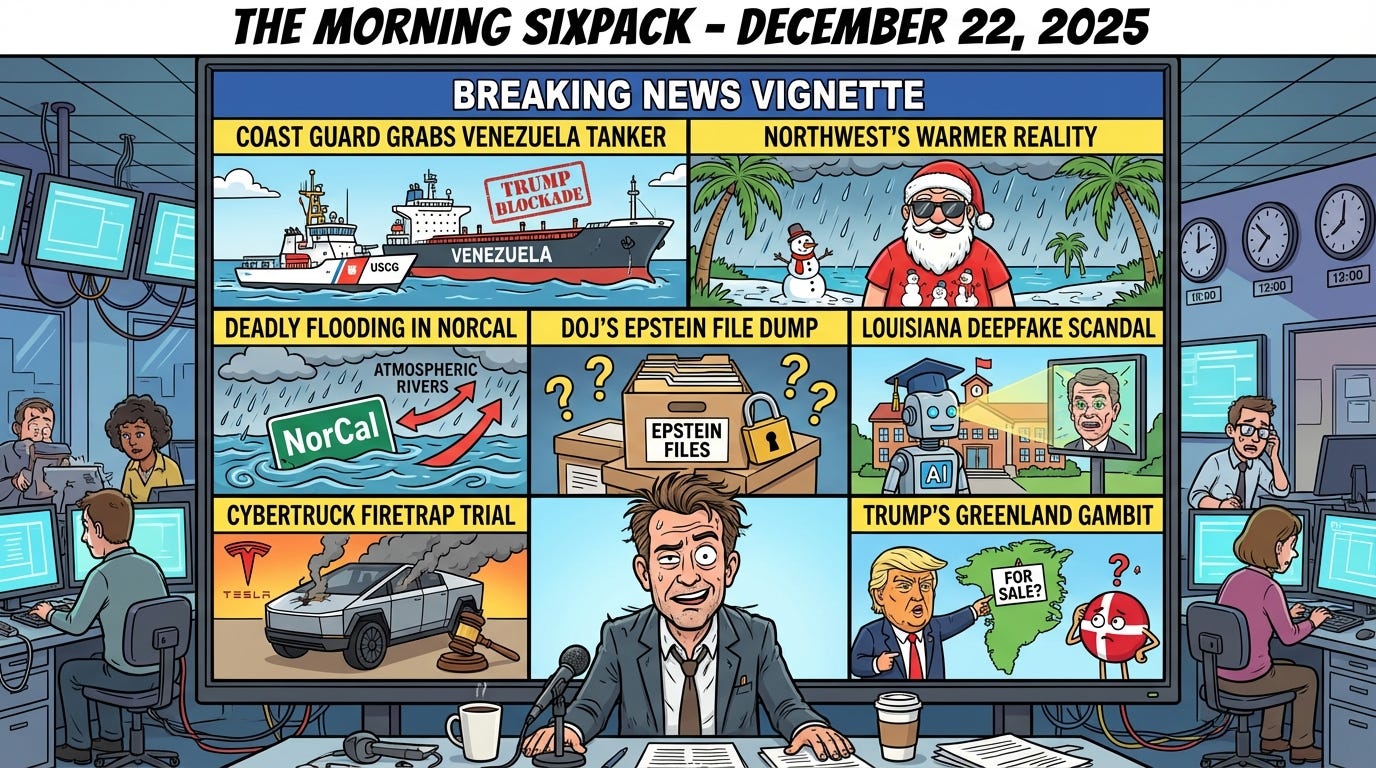
Coast Guard Grabs Another Venezuela-Linked Tanker as Trump’s Blockade Gambit Expands
The Coast Guard’s latest pre-dawn grab in the Caribbean shows the U.S. is no longer just chasing sanctioned tankers—it’s scooping up anything that even smells like Maduro’s oil trade.
Homeland Security Secretary Kristi Noem confirmed that U.S. forces intercepted an oil tanker in international waters near Venezuela, noting the vessel had last made port there. Her message was blunt: the U.S. is hunting the “illicit movement of sanctioned oil” that funds narco-terror networks. As she put it, “We will find you, and we will stop you.” Subtlety clearly did not make the voyage.
Defense Secretary Pete Hegseth quickly piggybacked on Noem’s announcement, tying the operation to President Donald Trump’s self-described blockade of sanctioned tankers moving in and out of Venezuela. Hegseth reminded everyone that the pressure won’t ease until Nicolás Maduro coughs up “every stolen American asset,” which in Washington speak means: brace for more seizures.
What makes this bust notable is that the tanker wasn’t actually on any sanctions list—U.S., EU, U.K., or UN—according to Kpler’s tracking data. It’s the second vessel seized this month, following the Dec. 10 takedown of The Skipper, which was on the naughty list. So either enforcement is expanding or the definition of “illicit” is getting a little…interpretive.
Trump, meanwhile, is selling the operation like a maritime reality show. He proclaimed Venezuela “surrounded by the largest Armada ever assembled in the History of South America”—because of course he did—promising it will grow even bigger. Maduro, never one to pass up a counterpunch, insisted Venezuela will “never, never, never” bow to regime-change pressure or become anyone’s colony.
Source: ABC News
Oh, and get this—US reportedly pursuing third oil tanker linked to Venezuela
Editor: If we’re now seizing non-sanctioned ships because they might be tied to Maduro, someone should warn Carnival Cruise Lines—those buffets are about to get real political.
Christmastown’s Holiday Magic Meets a Warmer, Wetter Reality in the Northwest
Two weeks of atmospheric-river beatdowns turned Leavenworth’s peak season into slush, outages and lost revenue—and showed just how fast “normal” is disappearing.
In Leavenworth, Washington’s self-styled “Christmastown,” Santa arrived not on a glittering blanket of snow but dodging puddles and slogging through mud. After two weeks of warm, punishing storms, the town finally saw a trickle of holiday tourists return, but the damage was already done. As one business owner put it, the weather has become “more uncertain and more volatile,” and this season delivered that message with a sopping-wet bow.
State officials warned residents to set aside the usual Northwest bravado. Atmospheric rivers aren’t just rain—they’re firehoses of tropical moisture slamming into the Cascades, and this month’s systems hit with unnerving speed. Emergency crews carried out more than 600 water rescues, and Gov. Bob Ferguson didn’t mince words: “You may think you know what this is. This is much worse.” The science backs him up: as the region warms, these storms will be more frequent and far less forgiving.
For Leavenworth, the timing couldn’t be worse. The Bavarian-themed village depends on its holiday window for 40 percent of annual revenue. Power outages, debris-choked streets and days of closures blew a hole straight through that. The Leavenworth Reindeer Farm alone took $70,000 in damage and refunded $170,000 in holiday bookings—another hit after years of wildfire smoke made fall festivals a gamble. And with U.S. Highway 2 potentially closed for months, even reaching Christmastown has become part of the challenge.
The irony is that Leavenworth was born from reinvention. When logging collapsed, the town doubled down on Bavarian kitsch and built a tourism powerhouse—3 million visitors a year come for nutcrackers, alphorns and postcard fantasy. But climate volatility doesn’t care how charming your lederhosen are. As Mayor Carl Florea put it, “We have been told to expect climate change…This is our first extreme example.” If winter can’t be counted on, then the town’s signature season will need to stretch, adapt and maybe hand Santa an umbrella.
Climate scientists say this is the future: drier summers, harsher storms, shrinking snowpack and longer wildfire seasons. Leavenworth’s business owners are already rethinking strategy—expanding outreach beyond Puget Sound, investing in resiliency and hoping weather doesn’t yank the rug out from under their biggest month again. Because being “Christmastown U.S.A.” only works if December feels like December.
Source: The New York Times
Editor: When your winter economy depends on snow but the atmosphere keeps delivering hot rain buckets, it might be time for Christmastown to diversify—maybe add a climate-resilient festival or two before Santa starts arriving by boat.
Deadly Flooding Slams Northern California as Atmospheric Rivers Line Up for Christmas Week
A relentless parade of atmospheric rivers has turned Northern California into a flooded maze of rescues, outages, and rising danger—with more storms already inbound.
Redding Mayor Mike Littau confirmed that one person died as heavy rain and fast-moving floodwaters swept through the region, forcing police, firefighters and utility crews into nonstop emergency responses. Roads vanished under water, vehicles were stranded across multiple counties and rescue teams waded into neighborhoods to pull people to safety. When the sheriff’s swift-water team is your most in-demand holiday service, you know the week’s off to a rough start.
More than 30 million Californians remain under flood watches, and the outlook isn’t exactly improving. The West Coast is being hammered by repeat atmospheric rivers—warm, moisture-packed systems that dump heavy rain faster than the ground can absorb it. Northern California is taking the initial beating, with 4 to 6+ inches expected in some areas, but the real twist is what comes next: Southern California will take the brunt of a Christmas Eve storm that forecasters warn could bring significant flash flooding, mudslides and debris flows. Burn scars may once again become disaster zones.
Communities across the northern half of the state spent Sunday watching their streets and drainage systems lose the battle. Public works teams and Redding Electric Utility crews scrambled to clear blocked roadways and restore power as outages spread. In a storm cycle like this, even basic infrastructure becomes part of the triage.
Forecasters warn that the broader pattern isn’t temporary—this is a shift. And if SoCal begins sliding, flooding and shoveling mud this week, the statewide impacts could stretch well beyond Christmas. California has always had a flair for dramatic weather, but this year it’s leaning hard into the theme.
Source: ABC News
Editor: California asked for a white Christmas; the atmosphere delivered a brown, sludgy one instead. And with another storm queued up like it’s waiting for concert tickets, the state might want to rethink where it parks its holiday cheer.
DOJ’s Epstein File Dump Raises Big Questions—and Answers Almost None
Nearly 4,000 newly released Epstein documents landed with a thud on Friday, heavy on bizarre photos and redactions, light on accountability—and even lighter on anything resembling closure.
The Justice Department’s first batch of Epstein Files Transparency Act disclosures is more tease than truth. Yes, there are thousands of images, handwritten notes, inventories, and travel logs. But what’s missing—or blacked out into oblivion—says far more than what’s included. Lawmakers are already blistering DOJ for withholding large chunks of its archive, and honestly, they have a point: if this is transparency, it’s transparency run through a blender.
Volume 1 is a tour of Epstein’s Manhattan townhouse and Virgin Islands compound, displaying everything from a painting of Bill Clinton in that infamous blue dress to redacted baby photos, muddled signatures, and odd financial records involving Leon Black. The redactions are so inconsistent you could turn them into a drinking game. One note hides a name while another frame shows it. It’s bureaucratic whack-a-mole, and nobody’s winning.
Volume 2 offers images of Epstein and Ghislaine Maxwell with a star-studded cast—Michael Jackson, Kevin Spacey, Chris Tucker, Keith Richards—none doing anything incriminating. Clinton shows up repeatedly, including shirtless in a pool alongside redacted women and Maxwell. His spokesperson insists this “isn’t about Bill Clinton.” Fine—but the DOJ certainly didn’t mind putting him in the slideshow.
Volume 3 digs into group vacations, including photos from alleged trips to Thailand, China, Paris, Morocco, and more. One image shows a man resembling Prince Andrew sprawled on the laps of four women. Other photos appear to come from victims themselves, handed to investigators—including a disturbing Disney World trip photo with Epstein, a child, and an unidentified man. There’s even a scrapbook that reads like the world’s most disturbing YA novel, complete with captions about a “clueless little girl” eventually traveling the world with Epstein. This is the point where you wonder how much the DOJ didn’t release.
Volume 4 catalogs mass amounts of physical evidence: sex toys, massage tables, BDSM books, retail receipts, and endless “ITEM WAS NOT SCANNED” pages that hint at tapes, disks, interviews, and recordings still withheld. Some items are flagged as CSAM and barred from publication, as they should be. But the sheer volume of unanalyzed, unreleased, or deliberately obscured material shows how far this story is from fully told.
In the end, this “transparency release” confirms what everyone already suspected: the DOJ holds far more than it’s ready—or willing—to show. If this is the appetizer, the entrée must be enormous. The question is whether we’ll ever be allowed to order it.
Source: WIRED
Editor: The DOJ dumping thousands of photos but dodging the actual substance feels a lot like photocopying the table of contents and calling it a novel. At this rate, we’ll learn more from the redactions than the revelations.
A Louisiana Deepfake Scandal Shows How Schools Are Now Colliding With AI’s Dark Side
A 13-year-old girl begged adults to stop AI-generated nude images from spreading through her middle school—but help never came until she snapped.
In Lafourche Parish, Louisiana, an eighth grader found herself trapped in a nightmare that adults kept insisting wasn’t real. The AI-created nude images circulating among classmates weren’t just humiliating—they were invisible to the very people tasked with protecting her. Snapchat made the evidence vanish, the school counselor brushed off the claims, and the principal openly doubted the girls’ story. Meanwhile, the harassment worsened by the hour.
When she boarded the school bus and saw a boy flashing the fake images to his friends, she hit her breaking point. She lashed out, and other kids followed. The fight earned her more than ten weeks in an alternative school—while the boy she and others accused of spreading the images didn’t accompany her there, according to her attorneys. Only later did the sheriff’s department charge two boys under Louisiana’s new law criminalizing the dissemination of AI-generated sexual images of minors.
Her case exposes the yawning gap between the speed of AI-driven harm and the glacial, often skeptical response of the institutions meant to shield kids from it. Experts say schools have barely begun grappling with AI’s role in cyberbullying. As researcher Sergio Alexander put it, “When we ignore the digital harm, the only moment that becomes visible is when the victim finally breaks.” And break she did—after hours of taunts, disbelief, and officials who seemed more bothered by procedural boxes than a child in distress.
While the district insists it followed protocols, those protocols were built for a world where bullying leaves a footprint. In this case, AI erased the trail, and the adults mistook the missing evidence for missing truth. The girl, meanwhile, spiraled: skipping meals, falling behind in her alternative program, sinking into depression and anxiety until her father got her into therapy. By the time her appeal was heard, she could technically return—but not before being told she’d remain on probation, miss sports, and continue bearing the consequences of a mess she didn’t create.
The school board ultimately acknowledged the obvious: she’d been victimized twice—first by the deepfakes, then by the system reacting blindly to them. She returned to school Nov. 7, though the personal cost lingers. Basketball season is lost. Trust is shattered. And her father believes the school derailed the healthy, ordinary middle-school experience she deserved.
Source: AP News
Editor: If schools can’t recognize AI-generated abuse when it’s shoved in their faces on a bus, we’re already in trouble. Pretending it’s “just rumors” isn’t a policy—it’s an abdication.
A Cybertruck Crash Became a Firetrap—And Now Tesla’s Design Is on Trial
Three young passengers survived the initial Cybertruck crash—but not the minutes spent trapped behind “armor glass” and power-dependent doors as fire closed in.
The deadly 2024 Piedmont, California, wreck now sits at the center of wrongful-death lawsuits arguing that Tesla’s design philosophy—marketed as futuristic, bulletproof and apocalypse-ready—created an escape-proof coffin when seconds mattered. The surviving friend, Matthew Riordan, described racing toward 10-foot flames only to find the Cybertruck’s electronic push-button doors frozen, its stainless-steel shell and shatter-resistant windows turning a rescue attempt into a nightmare. He smashed out a window with a tree branch, but by the time he reached the trapped passengers, the cabin had become an inferno.
Tesla’s sleek flush handles and powered door mechanisms—long touted for aerodynamics and aesthetics—have raised concern for years, but the Cybertruck takes those choices to their extreme. The suit argues that the very features Tesla brags about: stainless-steel armor, multilayer glass, and rugged exteriors, made it nearly impossible for passengers or rescuers to escape once fire cut the power. Federal investigators have already reviewed numerous cases since 2019 involving people unable to exit Teslas during emergencies, including other fatal Cybertruck fires.
The company insists the truck met safety standards and that drivers are warned of the risks—though many of those warnings exist only in dense manuals or unlabeled emergency pull-cords hidden behind trim. Attorneys counter that if a vehicle can survive a Tommy Gun blast, maybe a firefighter shouldn’t need a PhD in Tesla engineering to open the rear doors when the battery is in thermal runaway. As expert Phil Koopman put it, Tesla had “four chances to make it easy to get outside of a car during a crash, and they got all four wrong.”
This isn’t Tesla’s first brush with fire-related litigation, nor the first time its design decisions have overshadowed the crash itself. In Piedmont, investigators say the driver was impaired, but attorneys emphasize that the victims survived the impact. They died because they couldn’t get out. And with over 60,000 Cybertrucks on the road and owners openly wondering how anyone would free them in a catastrophe, the stakes aren’t theoretical.
Tesla’s chief designer has hinted at a redesign combining manual and electronic release mechanisms into a single intuitive motion. That’s welcome—but far too late for the families who now argue that “tough on the outside” shouldn’t translate to “trapped on the inside.”
Source: The Washington Post
Editor: When you build a truck to shrug off bullets, maybe pause and ask whether firefighters—or your own passengers—can get in or out when it’s on fire. Tesla’s obsession with indestructibility seems to have forgotten the people inside the steel cocoon.
Trump’s Greenland Gambit Reignites a Diplomatic Brushfire Denmark Thought It Had Extinguished
Trump’s appointment of Louisiana governor Jeff Landry as “special envoy to make Greenland a part of the US” landed like a diplomatic grenade in Copenhagen and Nuuk.
The announcement revived the administration’s long-running fixation with acquiring Greenland—a semi-autonomous Danish territory that has repeatedly, unequivocally said “no thanks.” Denmark and Greenland responded with a joint statement hammering home what should be obvious to any world leader: national borders aren’t optional, and sovereignty isn’t something you can annex because it looks good on a security briefing. Their message: respect our territorial integrity, please and thank you.
Landry, for his part, didn’t even try to sand down the edges. On X, he declared it an “honor” to serve in a volunteer role “to make Greenland a part of the US.” That phrasing alone sent Danish officials into full diplomatic eye-roll mode. Foreign minister Lars Løkke Rasmussen said he was “deeply upset”—not about the envoy position itself, but about the stated mission behind it. Greenland’s prime minister echoed that sentiment, reminding Washington that Greenlanders decide their own future, not a governor from Baton Rouge moonlighting as an Arctic acquisition agent.
Greenland’s strategic value isn’t in dispute—missile defense, Arctic positioning, minerals. That’s why Trump keeps circling it like a real estate prospect he can’t let go of. But Danish leaders have tried to tamp down tensions by beefing up Arctic defense cooperation, hoping to blunt the White House’s recurring claim that the region is underprotected. No amount of goodwill, however, was enough to offset Landry’s public embrace of Trump’s goal.
Greenlandic lawmakers were blunt: having a U.S. envoy is fine; having one tasked with essentially taking their country is not. Copenhagen and Nuuk are united on this—Greenland stays in the Kingdom of Denmark until Greenland itself chooses otherwise. Washington can send envoys, but it can’t send foreclosure papers.
Source: The Independent
Editor: Appointing a “special envoy to acquire Greenland” is like naming a Secretary of Real Estate Fantasies—and somehow it still manages to insult an entire kingdom. Even by Trump-world standards, this is geopolitical cosplay at its finest.