


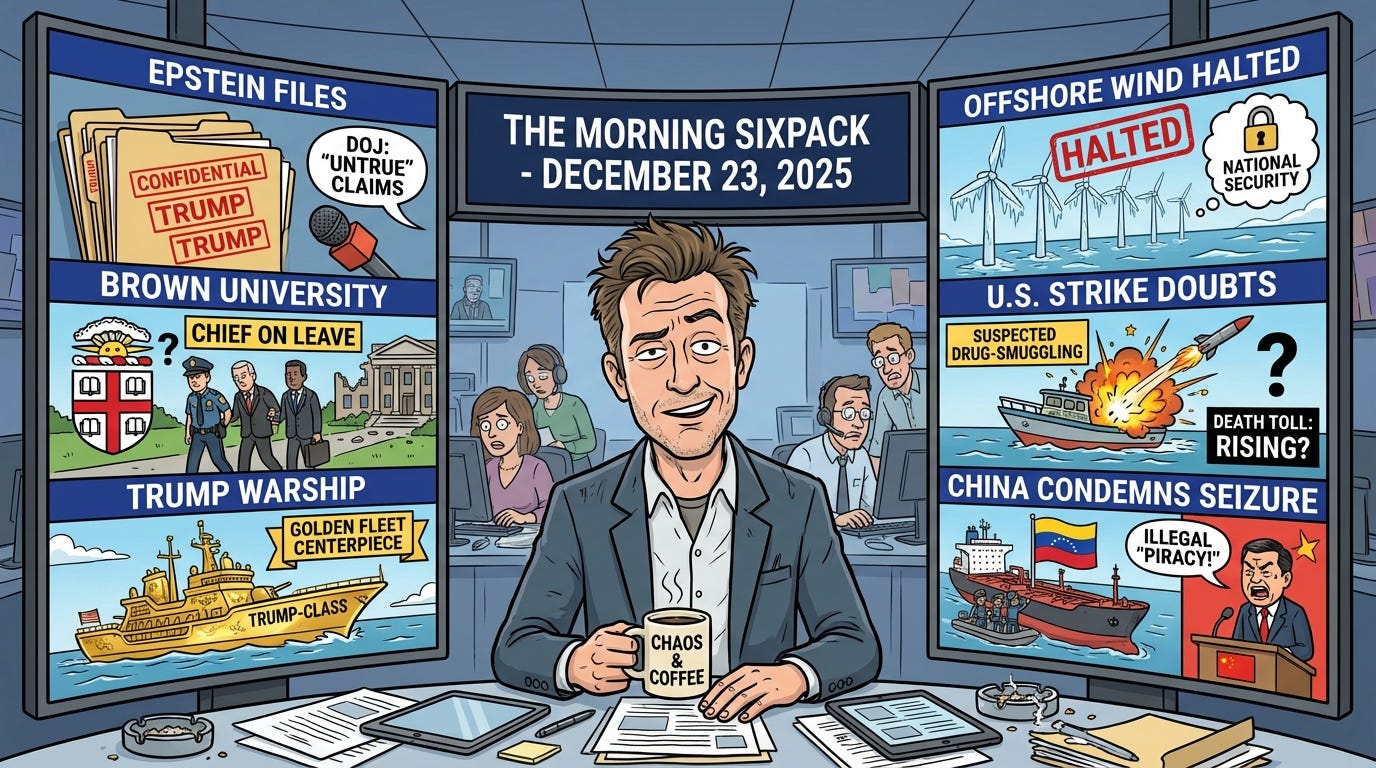
Trump Mentioned Repeatedly in New Epstein Files as DOJ Denounces “Untrue” Claims
A second, far larger batch of Epstein documents dropped—and this time Trump’s name shows up everywhere the first release tiptoed around.
Three days after a thin initial release that somehow managed to dodge most Trump references, the Justice Department posted thousands more documents that make clear just how intertwined Trump once was with Epstein’s world. The DOJ insists some of the claims inside are “unfounded and false,” but the volume alone tells its own story—and Capitol Hill critics who blasted the first release for being too Trump-light now have plenty to read.
The files show prosecutors subpoenaed Mar-a-Lago in 2021 for records tied to the Maxwell case and noted multiple Trump flights on Epstein’s jet—including one carrying only Trump, Epstein and a 20-year-old woman. The FBI also logged a series of tips about Trump’s involvement at early-2000s parties, though there’s no indicator any were corroborated. As the DOJ put it: “Some of these documents contain untrue and sensationalist claims made against President Trump.”
The trove briefly vanished from the DOJ website Monday before quietly reappearing hours later—because nothing inspires confidence like a disappearing document dump. The White House had nothing to say, and the DOJ offered no explanation for the digital Houdini act. Meanwhile, Trump kept insisting he barely knew Epstein, despite prosecutors noting at least eight shared flights in the ’90s and Maxwell’s presence on several of them.
The documents also offer a grim window into Epstein’s final weeks in federal custody, including accounts of guards discovering him with a makeshift noose and even a brief plan to house him with Cesar Sayoc, the Trump-obsessed mail bomber. There’s also the DOJ’s 22-page memo to the U.K. seeking a voluntary interview with Prince Andrew—helpfully reminding everyone that the Epstein orbit was not exactly a chamber of innocence.
Trump brushed questions aside at Mar-a-Lago—right after unveiling a Navy battleship named after himself—calling Epstein inquiries a distraction from his “tremendous success.” But the DOJ is releasing documents because a law Congress passed last month requires it. Trump signed the measure, then immediately complained about the results. Funny how transparency is admirable right up until it isn’t.
Source: WaPo (free)
Editor: Bold move releasing files that read like an uninvited reunion of everyone Epstein ever touched politically—followed immediately by Trump’s insistence that none of this has anything to do with him while he’s literally standing at Mar-a-Lago. The DOJ might want to invest in a website that doesn’t treat public records like limited-edition sneakers.
BREAKING: CBS Yanks 60 Minutes Prison Episode—But Canada Saw It Anyway

For a report supposedly “not ready,” it sure looked ready when Canadians found 13 uninterrupted minutes of it streaming on Global TV’s website and app. The postponed episode dug into El Salvador’s CECOT mega-prison and the Trump administration’s deportation pipeline feeding into it—hardly light fare, and apparently too hot for CBS executives’ comfort.
Brown University Police Chief Placed on Leave as Officials Confront Fallout From Campus Shooting
Brown University’s leadership has finally hit pause on its own police force after a mass shooting shattered campus safety—and exposed deep operational failures.
More than a week after the attack that killed two students and injured nine others, President Christina Paxson announced that campus police chief Rodney Chatman has been placed on immediate leave. She called it part of a “standard” safety review, though nothing about this moment feels standard to a community still grieving and asking how a gunman could fire 44 rounds inside an academic building without swift identification or capture.
Six days after the shooting, authorities named the suspect as 48-year-old former Brown student Claudio Neves Valente—only to reveal he was already dead in a New Hampshire storage unit. Officials now believe he also murdered an MIT professor two days after the Brown attack. Paxson praised responding officers’ “bravery, dedication and commitment,” but acknowledged the obvious: the campus is steeped in “anxiety, fear and stress,” and the system meant to protect students didn’t function the way anyone expects from an elite institution.
The Department of Education has launched its own review of Brown’s response, a rare and pointed move. And while Trump jumped in to criticize the university for lacking security cameras, Paxson countered that the campus already has 1,200 of them—proof that tools aren’t useful if the overall safety posture isn’t keeping pace with real threats.
The attack targeted a building housing engineering and physics programs, where Valente opened fire on students. The victims—19-year-old second-year student Ella Cook of Alabama and 18-year-old first-year Uzbek American student Mukhammad Aziz Umurzokov—were studying in spaces meant for innovation, not violence. Their loss underscores why this review can’t become another bureaucratic box-check.
The university’s highest governing body will now examine both the shooting response and overall safety policies. Whether that leads to accountability or just institutional self-soothing remains to be seen, but Brown no longer has the luxury of slow introspection.
Source: BBC
Editor: Leadership calling this a “standard review” after a mass shooting is like handing out umbrellas after the flood. Students don’t need platitudes—they need a campus that doesn’t treat security as an afterthought in the first place.
Trump Greenlights a “Trump-Class” Warship as Centerpiece of His Golden Fleet
Trump is now branding U.S. warships like luxury condos—complete with a “Trump-class” battleship he claims will outgun anything in naval history.
The president unveiled his plan for a sweeping rebuild of America’s fleet, anchored by the USS Defiant, the first in a series of hulking vessels he insists are “100 times more powerful than any battleship ever built.” Construction, he says, begins “almost immediately,” because apparently the only thing faster than a Trump timeline is a Trump promise. This Golden Fleet concept isn’t new—he’s been grumbling for years that the Navy’s destroyers look “terrible” and “covered in rust”—but now he’s essentially designing his own line of maritime monuments.
At the announcement, flanked by Defense Secretary Pete Hegseth and Navy Secretary John Phelan, Trump expanded the plan to include a new aircraft carrier class as well. Details? Not really his thing. Scale and spectacle? Always. The ships will be massive—30,000 to 40,000 tons—and loaded with nuclear cruise missiles, hypersonic weapons and the “future stuff” that gets defense contractors salivating. Shipbuilders are thrilled; analysts, less so. One former admiral called the plan “exactly what we don’t need,” noting each ship will cost at least $5 billion and seems engineered more for presidential aesthetics than for countering actual Chinese naval threats.
Still, the Navy has signed off on the design direction, framing it as an evolution of the next-generation destroyer already in early development. And Trump, never shy about personal branding, treated the rollout less like a defense briefing and more like a product launch. He even revived his old crusade for steam-powered carrier catapults—because when in doubt, go retro.
The Golden Fleet would combine these giant warships with a new line of smaller frigates, replacing a program Trump killed last month. The Coast Guard-inspired frigates have critics of their own, including experts who say they lack essential systems and might be tactically toothless. But in the Trump era of naval planning, “cool-looking ship” is apparently an operational requirement.
What’s clear is that America’s fleet is aging, the Navy is eager for new tonnage and Trump is determined to build big—and build with his name etched into the steel. Whether these ships strengthen deterrence or just strengthen the president’s legacy wall remains the open question.
Source: WSJ (free)
Editor: Only Trump could look at a 40,000-ton warship and think, “Needs branding.” If the Navy ends up launching vessels that resemble floating casino hotels, we’ll know exactly how much design input he provided.
Trump Halts the Largest U.S. Offshore Wind Project, Freezing East Coast Builds Over “National Security” Claims
Trump just slammed the brakes on America’s biggest offshore wind build-out—five major projects paused at once, and an entire industry jolted off balance.
The administration on Monday halted Coastal Virginia Offshore Wind (CVOW) and four additional projects stretching from Massachusetts to Long Island, instantly wiping billions off developers’ valuations and kneecapping enough clean-power capacity to supply over 2 million homes. Interior Secretary Doug Burgum cited Pentagon-flagged national security concerns, alleging turbine blades and “highly reflective towers” interfere with radar—though this sudden panic arrives years into permitting and construction.
CVOW alone is a 176-turbine behemoth meant to power 600,000 Virginia homes and feed a region bursting with AI-driven electricity demand. Dominion Energy warned that halting the project threatens grid reliability for “war fighting, AI, and civilian assets,” not to mention energy prices and thousands of jobs. Even Virginia’s split politics couldn’t shake support: GOP Gov. Glenn Youngkin backed it, and incoming Democratic Gov. Abigail Spanberger campaigned on expanding renewables to lower soaring bills.
The ripple effects devastated developers abroad: Ørsted slid 11%, Equinor dipped, and Dominion fell nearly 4%. For a sector already battered by inflation and supply chain turmoil, Washington’s newly triggered pause reads less like oversight and more like open hostility toward wind—especially given Trump’s long-standing personal crusade against turbines. Since day one of his second term, he’s frozen all new wind leases and permits pending federal review.
Democrats didn’t mince words. Sen. Chuck Schumer blasted the decision as “unhinged, irrational, and unjustified,” warning it will raise energy bills just as data-center demand squeezes states like Virginia. And a federal judge recently ruled Trump’s earlier wind moratorium “arbitrary and capricious,” a legal rebuke that now feels like foreshadowing.
Interior insists the pause is temporary while it works with developers to mitigate radar concerns. But let’s be honest: if the administration wanted these projects to succeed, they wouldn’t be gumming up the gears at the one moment the grid desperately needs new generation.
Source: CNBC
Editor: It’s hard to take the “national security” argument seriously when the Pentagon has managed decades of radar clutter from storms, birds, and commercial ships—but somehow wind turbines are the existential threat. Feels less like safety planning and more like settling a vendetta with an entire energy sector. And remember—this is a Biden initiative.
Another U.S. Strike on Suspected Drug-Smuggling Boat Raises Death Toll and Doubts
The U.S. military has carried out yet another lethal strike on a small vessel in the eastern Pacific—this time killing one person and deepening questions about Trump’s expanding shadow war at sea.
U.S. Southern Command said the targeted “low-profile vessel” was operating along known narco-trafficking routes and “engaged in narco-trafficking operations,” though, once again, it offered no evidence. That omission is becoming its own pattern. The accompanying video shows water splashes bracketing the boat, a fire igniting at the stern, and the vessel drifting while flames engulf it. Recent strike footage has shown missile-like projectiles raining down, underscoring just how militarized these interdictions have become.
The administration insists the campaign is designed to choke off drug flows into the U.S. and squeeze Venezuela’s Nicolás Maduro. But the body count tells another story: at least 105 people killed across 29 known strikes since early September. Lawmakers and human rights groups say the White House has failed to substantiate its claims that these boats are drug smugglers and warn the operations look a lot like extrajudicial killings dressed up as counternarcotics.
Meanwhile, the U.S. Coast Guard is ramping up interdictions of oil tankers in the Caribbean, another pressure point in Trump’s crusade against Maduro. The administration’s appetite for lethal force at sea appears to be growing faster than its willingness to show evidence.
Source: AP News
Editor: When your anti-drug strategy produces more explosions than indictments, maybe it’s time to reassess the intel—or at least produce some. Right now these strikes feel less like law enforcement and more like maritime whack-a-mole MURDER with no accountability.
China Condemns U.S. Seizure of Venezuela-Linked Tanker as Illegal ‘Piracy’
China is blasting the U.S. for intercepting a China-bound oil tanker off Venezuela’s coast, accusing Washington of trampling international law to enforce Trump’s self-declared blockade.
Beijing’s foreign ministry said Monday that the U.S. seizure of another country’s ships amounted to a “serious violation of international law,” rejecting what it called Washington’s “unilateral and illegal” sanctions regime. The rebuke came after the U.S. Coast Guard stopped the Panama-flagged Centuries in international waters—days after Trump announced a blockade on all sanctioned tankers entering or leaving Venezuela.
Documents show the Centuries loaded 1.8 million barrels of Venezuelan Merey crude under the false name “Crag,” part of Venezuela’s increasingly convoluted shadow-fleet logistics. A White House spokesperson said the vessel “falsely flagged” sanctioned oil and was an arm of PDVSA’s illicit network supplying Chinese refiners. Caracas fired back, calling the interception “a serious act of international piracy.”
China, the largest buyer of Venezuelan crude, isn’t pretending this is anything less than geopolitical escalation. Beijing emphasized Venezuela’s sovereign right to conduct foreign relations—a not-so-subtle message that Trump’s blockade is being interpreted abroad as Washington attempting to strong-arm global energy flows.
For an administration already juggling missile strikes on alleged drug boats and a regional economic squeeze on Maduro, the optics of maritime seizures in international waters aren’t doing it any favors. The more Washington calls this enforcement, the more the rest of the world seems content to call it something else.
Source: Reuters
Editor: When both Beijing and Caracas start using the word “piracy,” maybe it’s time to ask whether a blockade announced at a microphone is actually a legal framework—or just a dare to the rest of the world.