


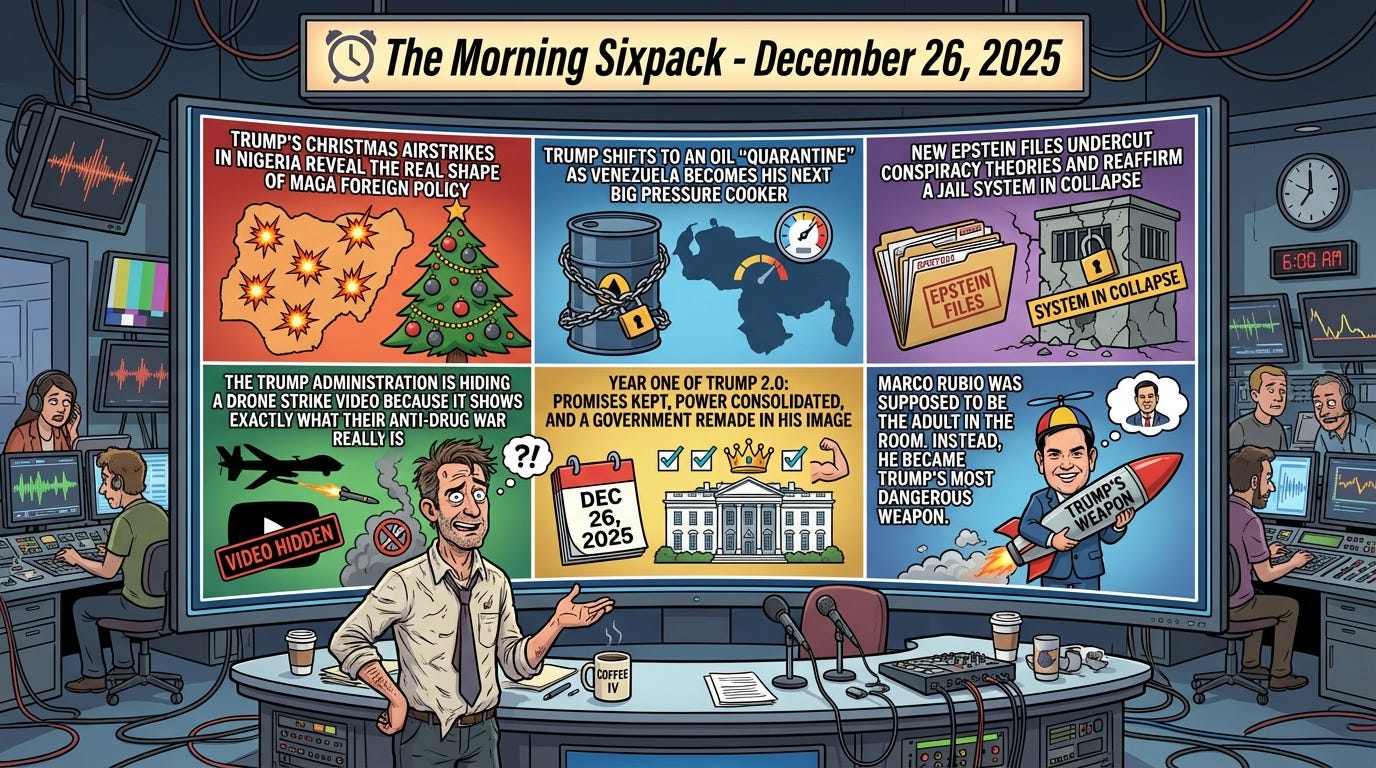
Trump’s Christmas Airstrikes in Nigeria Reveal the Real Shape of MAGA Foreign Policy
Trump marked Christmas not with carols but with Tomahawks—an unmistakable signal that his second-term foreign policy is whatever his political base needs it to be.
President Donald Trump ordered more than a dozen Tomahawk missiles into two ISIS-linked camps in Nigeria, a move he framed as retaliation for the killing of Christians worldwide. It was the culmination of months of threats in which he promised to go “guns-a-blazing” if Nigeria’s government failed to protect its Christian population.
Trump leaned in hard on that theme, accusing ISIS of “targeting and viciously killing, primarily, innocent Christians at levels not seen for many years, and even Centuries!” And yes—he typed it exactly like that. This wasn’t a sudden moral awakening; it was a political message crafted for the most attentive corner of his coalition.
The irony is rich: the self-proclaimed opponent of foreign entanglements keeps finding new places to entangle America. From Nigeria to Venezuela, Trump continues to contradict his own stated doctrine whenever an intervention aligns neatly with domestic MAGA priorities—whether that means stopping migrants, backing culture-war allies abroad, or in this case, championing persecuted Christians.
Meanwhile, Nigeria’s crises are very real. Boko Haram’s long-running insurgency, sectarian violence, and draconian blasphemy laws have created combustible conditions that Washington’s airstrikes will not meaningfully alter. But global problem-solving was never the core objective—domestic messaging was.
Source: Vox
Editor: A Christmas missile strike is one way to say “Happy Holidays,” I suppose. Nothing like weaponized piety to keep the base toasty.
Trump Shifts to an Oil “Quarantine” as Venezuela Becomes His Next Big Pressure Cooker
The White House has quietly ordered U.S. forces to enforce a Venezuelan oil “quarantine,” an economic chokehold dressed up as foreign policy restraint.
For the next two months at least, the Pentagon’s marching orders are to choke off Venezuela’s oil exports—Washington-speak for starving Nicolás Maduro’s government until it buckles. Publicly, Trump toys with ambiguity. Privately, he’s pressuring Maduro to flee.
Officials predict Venezuela faces economic calamity by late January if it doesn’t comply with U.S. demands. Meanwhile, Trump keeps linking the country to drug flows into the U.S., using narcotics rhetoric to justify everything from CIA activities to bombing suspected drug boats—actions critics rightly call extrajudicial.
The so-called quarantine is anything but gentle. The Coast Guard has already seized two Venezuelan tankers and is readying a third. The military build-up—an aircraft carrier, 11 warships, F-35s, 15,000 troops—looks a lot more like preparation for coercive force than mere sanctions enforcement.
And the language games are almost comical. The administration prefers “quarantine,” a 1962-style euphemism, because “blockade” sounds too much like war. The U.N. has already called the policy “illegal armed aggression,” because everyone can see what’s happening.
Source: Reuters
Editor: Call it a quarantine, call it a blockade—call it whatever helps you sleep.
New Epstein Files Undercut Conspiracy Theories and Reaffirm a Jail System in Collapse
The newly released Jeffrey Epstein documents don’t rewrite the cause of death—they just make the government’s failures look even worse.
The latest DOJ files on Epstein’s final weeks reveal no hidden killers, no secret plot, nothing that contradicts the suicide finding. What they do show is a federal detention system that couldn’t keep basic procedures intact even for the most high-profile inmate in America.
The records describe negligence at every turn—missed rounds, falsified logs, staff asleep or shopping online, and a previous near-suicide incident handled with stunning incompetence. Epstein should never have been left alone; he repeatedly was.
New interview notes show Epstein claiming his cellmate tried to kill him, reporting he hadn’t slept in weeks, and later insisting suicide violated his religion. None of these statements were properly followed up. The MCC was malfunctioning long before August 10.
Internal emails expose frantic second-guessing among psychologists, bureaucratic confusion, and a total inability to maintain humane or stable housing conditions. Epstein ping-ponged between special units, complained of dehydration, and had essential items withheld.
The simplest answer remains the truest: not murder, but a system too broken to protect the inmates it holds—especially the ones it most needed to supervise.
Source: The Washington Post
Editor: The real conspiracy is that federal detention runs on duct tape, crossed fingers, and logbooks filled in after the fact.
The Trump Administration Is Hiding a Drone Strike Video Because It Shows Exactly What Their Anti-Drug War Really Is
The Pentagon won’t release the September 2 strike video because it shows the U.S. military killing shipwrecked survivors, not cartel combatants.
Trump first promised transparency, claiming he had “no problem” releasing the footage. Then Pete Hegseth stepped in and slammed the door, insisting the video was too “sensitive”—which is odd, given he could declassify it instantly.
Lawmakers who’ve viewed the footage say the excuses are nonsense. The Pentagon has already released more than a dozen similar strike videos. The real concern is political fallout: the tape reportedly shows two unarmed men clinging to wreckage before being blown apart by a second missile.
The administration’s shifting justifications are telling. First it was navigation hazards. Then hypothetical radios. Then the idea the survivors were trying to rescue cocaine from a boat that had just exploded. Witnesses say none of these claims hold up when watching the tape.
Under the Law of War, shipwrecked individuals are protected persons—not targets. The footage apparently makes this painfully obvious, and that’s exactly why Hegseth wants it buried.
Trump, Cotton, and their cohort want Americans to believe drug smuggling constitutes an “armed attack,” allowing the U.S. to kill suspects without due process. The unreleased video reportedly shows what that theory really produces: executions at sea.
Source: Reason
Editor: Amazing thing about cameras—sometimes they record what actually happened, not the fantasy version officials wish they’d scripted.
Year One of Trump 2.0: Promises Kept, Power Consolidated, and a Government Remade in His Image—NOT.
Trump’s return to the Oval Office has been a year-long sprint to prove that every campaign promise was a warning, not a metaphor.
Immigration crackdowns defined his first year: over 600,000 deportations, 1.9 million self-deportations, and asylum and refugee restrictions unprecedented in modern history. Border crossings dropped sharply—but so did adherence to basic legal standards, with federal judges repeatedly intervening.
On the economy, Trump declared inflation “stopped.” Reality is doesn’t lie. Growth is up, gas prices slightly down, but food and energy costs continue rising. He treats affordability concerns as political sabotage, not legitimate struggles. Unemployment is higher than in the past few years, reaching raw levels of the Great Recession.
Foreign policy is where Trump’s bravado really clashed with limits. His claim he’d end the Ukraine war “in a day” met reality. His meetings with Zelensky and Putin generated headlines, not peace. Elsewhere, he trumpeted diplomatic “victories” whose substance is anything but victory.
Domestically, he signed massive tax extensions for the uber wealthy, added trillions to the debt, and granted sweeping pardons to Jan. 6 criminals—more than 1,500 individuals—cementing his revisionist narrative of that day. Culture-war executive actions followed: bans on transgender athletes, gutting DEI efforts, redefining federal recognition of sex. You know, rolling back civil rights to the ‘50s. You decide which century.
Trump didn’t just return to power. He returned with a blueprint to restructure the federal government around his ideological priorities—and he has executed it with startling speed and incompetence.
Source: The Hill
Editor: Nothing says “normal presidency” like rewriting institutions in twelve months and pretending the grocery bill is a deep-state hoax.
Marco Rubio Was Supposed to Be the Adult in the Room. Instead, He Became Trump’s Most Dangerous Weapon.
Rubio didn’t moderate Trump’s chaos—he professionalized it, weaponizing the State Department to crack down on dissent and steer the U.S. toward conflict.
Democrats confirmed Rubio because he seemed safe, sane, and un-Bannon. Instead, his competence made him more dangerous. He has overseen the detention and deportation of foreign students for engaging in peaceful political speech, disappearing some of them into unmarked cars. He called it national security.
He championed deportations to El Salvador’s superprison, even for people with no convictions. He praised Bukele’s proposal as “extraordinary friendship,” ignoring the brutality the policy unleashed.
On Ukraine, Rubio now echoes Moscow talking points he once denounced, pressuring Kyiv to concede to Russia and crafting settlements without Ukrainian consent. He’s also backed escalatory strikes on Iran and upped tensions with China.
But his pet project is Venezuela. Rubio is the architect of the escalating pressure campaign aiming at regime change—justified with fabricated drug-trafficking claims. His anti-socialist crusade, rooted in his family history, is driving the U.S. toward another avoidable conflict.
The Rubio of 2016 warned America about Trump’s authoritarian instincts. The Rubio of today enables them. It wasn’t a fall from grace; it was an unveiling.
Source: The New Republic
Editor: So much for the “adult in the room”—turns out he was just waiting for the chance to run the machine more efficiently. Toward what end is the scary part.
Couldn't agree more. The way domestic political calculus consistently overrides genuine foreign policy stratgey is truly insightful and disheartening.