


Health Insurance Costs Are Set to Jump as Congress Dithers on ACA Subsidy Deal
Millions of Americans are staring down higher health insurance bills because Congress can’t get its act together.
In less than a month, the Affordable Care Act subsidies that have kept premiums tolerable for 24 million people will vanish unless lawmakers extend them—and right now, that looks unlikely. With the average benchmark plan already up about 26 percent for 2026, Washington’s current posture of finger-pointing and foot-dragging is a luxury families can’t afford.
Senate Republicans had promised Democrats a mid-December vote on an extension to end the government shutdown, but Democrats still haven’t released a plan, and Republicans aren’t lining up to support any version anyway. As Sen. Brian Schatz put it, “I can’t even get 13 people to say they’re open to it.” That’s a pretty brutal measure of just how far this discussion is from bipartisan.
Instead of coalescing around a fix, Republicans are splintering into camps—moderates who want a trimmed-down extension and conservatives who want to blow up the current structure entirely. House Republicans from swing districts are pushing their own proposals out of pure political survival instinct, while Speaker Mike Johnson won’t commit to putting anything meaningful on the floor. The White House floated a plan but shelved it after GOP pushback, because apparently even trying to lower health costs is now grounds for offense.
Democrats are gearing up to make this a 2026 election bludgeon if Republicans let the subsidies lapse. Sen. Amy Klobuchar summed up the party’s posture: they’ll either get the votes, wedge the extension into something else, or take it to the ballot box. Unfortunately, none of that helps families who will be hit with bigger bills in January because Congress once again chose brinkmanship over governing.
Source: WaPo (gift article)
Editor: Congress treating health care like a political Kickstarter—lots of promises, no delivery—is exactly how you guarantee higher premiums and deeper cynicism. Maybe someone should remind them that “doing nothing” is a policy choice, and a costly one.
Trump Escalates Anti-Somali Rhetoric as ICE Targets Minnesota Community
Donald Trump is ratcheting up his attacks on Somali immigrants—and especially Rep. Ilhan Omar—just as his administration readies a sweeping ICE operation in Minnesota’s Somali community.
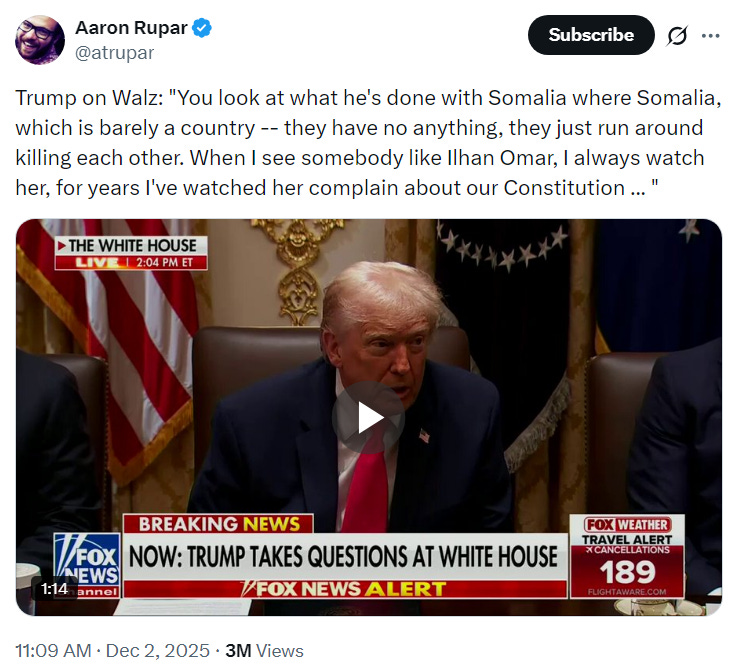
At a televised cabinet meeting and later in an extended press conference, Trump leaned fully into language that would once have been relegated to fringe message boards, declaring he does not want Somali immigrants in the United States and urging them to “go back to where they came from.” He claimed the US would “go the wrong way if we keep taking in garbage into our country,” a remark echoed again when he singled out Omar and her supporters as “garbage.” The message was unmistakable: he sees an entire community as a liability, not neighbors or citizens.
The timing isn’t subtle. Immigration authorities are preparing a major enforcement operation in the Twin Cities—home to one of the largest Somali communities in the world. Officials in Minnesota say the sweep could easily snare people who are, in fact, US citizens. Even local Republican-leaning voices are uneasy, and Democratic state leaders are openly condemning what they describe as a politically driven stunt masquerading as public safety. As state Sen. Zaynab Mohamed put it, ICE will quickly discover that “almost all of us are US citizens.”
Trump escalated his rhetoric even further, insisting Somalia “is barely a country” and that its people “contribute nothing,” while tying the entire community to an ongoing federal fraud case involving a small number of individuals. He seized the opportunity to attack Gov. Tim Walz and Rep. Omar, calling her “incompetent,” “a real terrible person,” and someone who “hates everybody.” Omar’s response? A succinct, cutting retort: “His obsession with me is creepy. I hope he gets the help he desperately needs.”
Layered on top of this verbal blitz is a broader crackdown: threats to end Temporary Protected Status for Somali residents in Minnesota, talk of targeting visa fraud, and a DHS posture that insists none of this is based on race—despite the President’s own words making that claim impossible to take seriously. When Minneapolis Mayor Jacob Frey warns that an ICE operation “means due process will be violated,” it’s hard to disagree given the rhetoric from the top.
What we’re watching is no longer coded politics but a president attempting to turn an entire diaspora into a campaign foil—flattening nuance, stoking fear, and betting that cruelty plays well in certain zip codes. It’s as predictable as it is corrosive.
Source: My Daily Grind News, RawStory
Editor: Trump’s strategy is basically “blame an entire community and hope nobody notices the facts.” Minnesota’s Somali Americans aren’t props in his campaign drama—though he sure treats them like expendable set pieces.
The U.S. Quietly Stacks the Caribbean With Firepower as Trump Turns Up the Heat on Venezuela
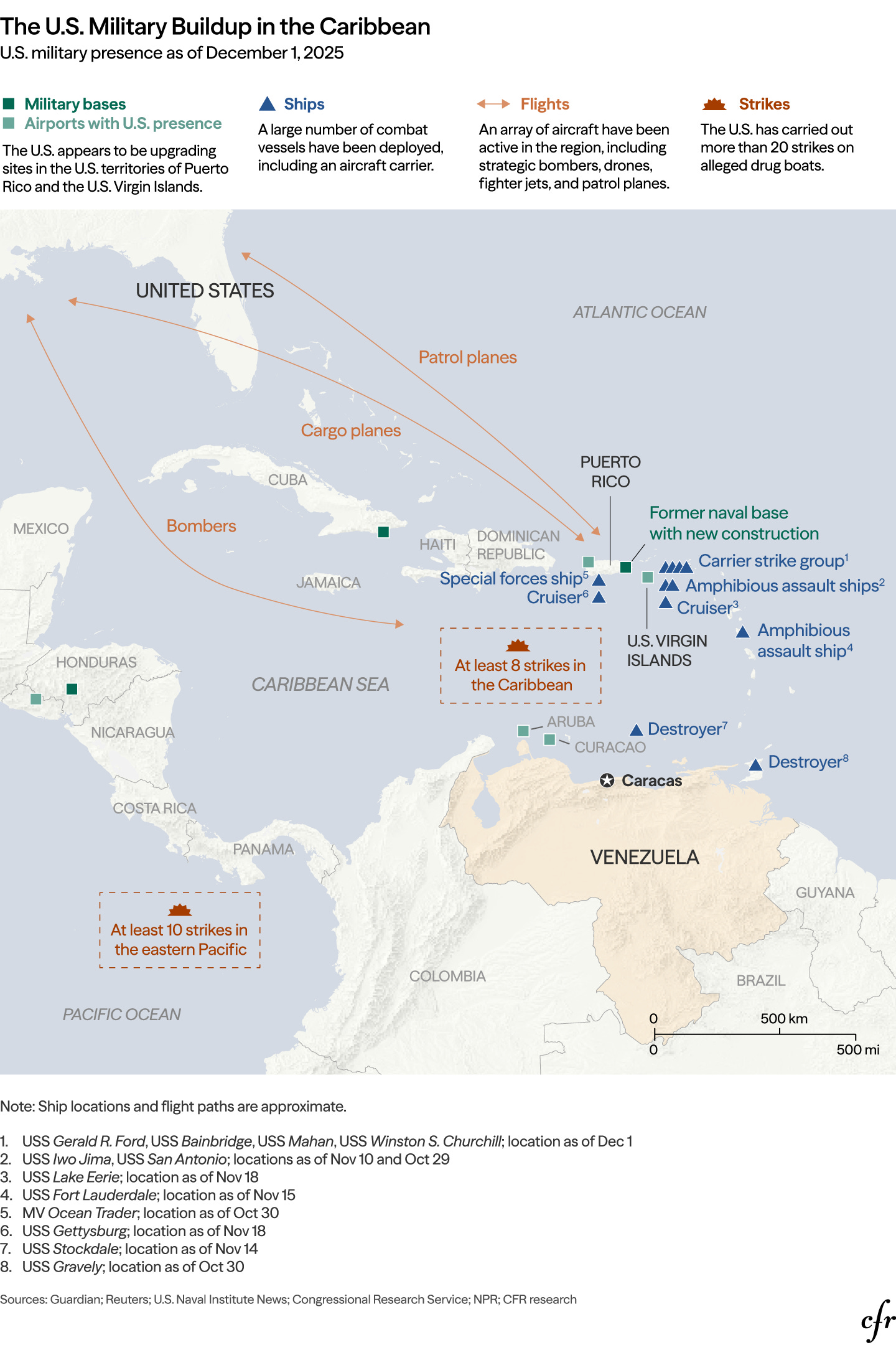
The United States is massing enough military muscle near Venezuela to make “pressure campaign” sound like an understatement.
In the last few months, Washington has flooded the Caribbean with air and naval assets—an aircraft carrier, destroyers, cruisers, amphibious assault ships, special operations support, bombers, drones, fighters, patrol aircraft, the whole catalog—while boosting capacity at airports and mothballed U.S. bases in Puerto Rico and the U.S. Virgin Islands. It’s the kind of buildup that usually precedes something big, even if the White House won’t say the quiet part out loud.
Trump isn’t exactly discouraging that interpretation. In a recent call, he reportedly told Nicolás Maduro to step down immediately, and at a cabinet meeting doubled down: the United States would start striking drug operations “on land, too,” insisting, “we know where they live.” This follows more than twenty maritime attacks on alleged drug boats since September 2, which have already killed at least eighty-three people. Legal scholars—including CFR’s own Matthew Waxman—are waving red flags, arguing the administration is blurring the lines between policing, interdiction, and war.
Meanwhile, experts note that Venezuela is barely a player in the trafficking of fentanyl and plays only a limited role in the cocaine trade. The military footprint looks less like “drug interdiction” and more like preparation for coercive regime change—something Trump has openly pushed for years, even authorizing covert CIA activity in the country. A CSIS analysis says the assets on deck could support strikes on Venezuela, though a full invasion would require far more troops than the roughly ten thousand service members and six thousand sailors currently deployed.
Yet the endgame remains murky. This might be a pressure gambit designed to force Maduro out without firing a shot—or it could be the prelude to something Washington hasn’t publicly admitted. Either path risks plunging a collapsing country, already hollowed out by economic freefall and mass migration, into deeper chaos. U.S. war games in Trump’s first term projected prolonged instability with “no possibility of ending it” after a forced ouster of Maduro. That’s the part no one seems eager to discuss.
Source: Council on Foreign Relations
Editor: For an administration that loves to conflate “toughness” with strategy, this looks like classic overreach—an expensive way to prove a point without a realistic plan for what happens when the point blows up in your face.
Hegseth Faces Career-Threatening Firestorm After Survivor Strike Off Venezuela
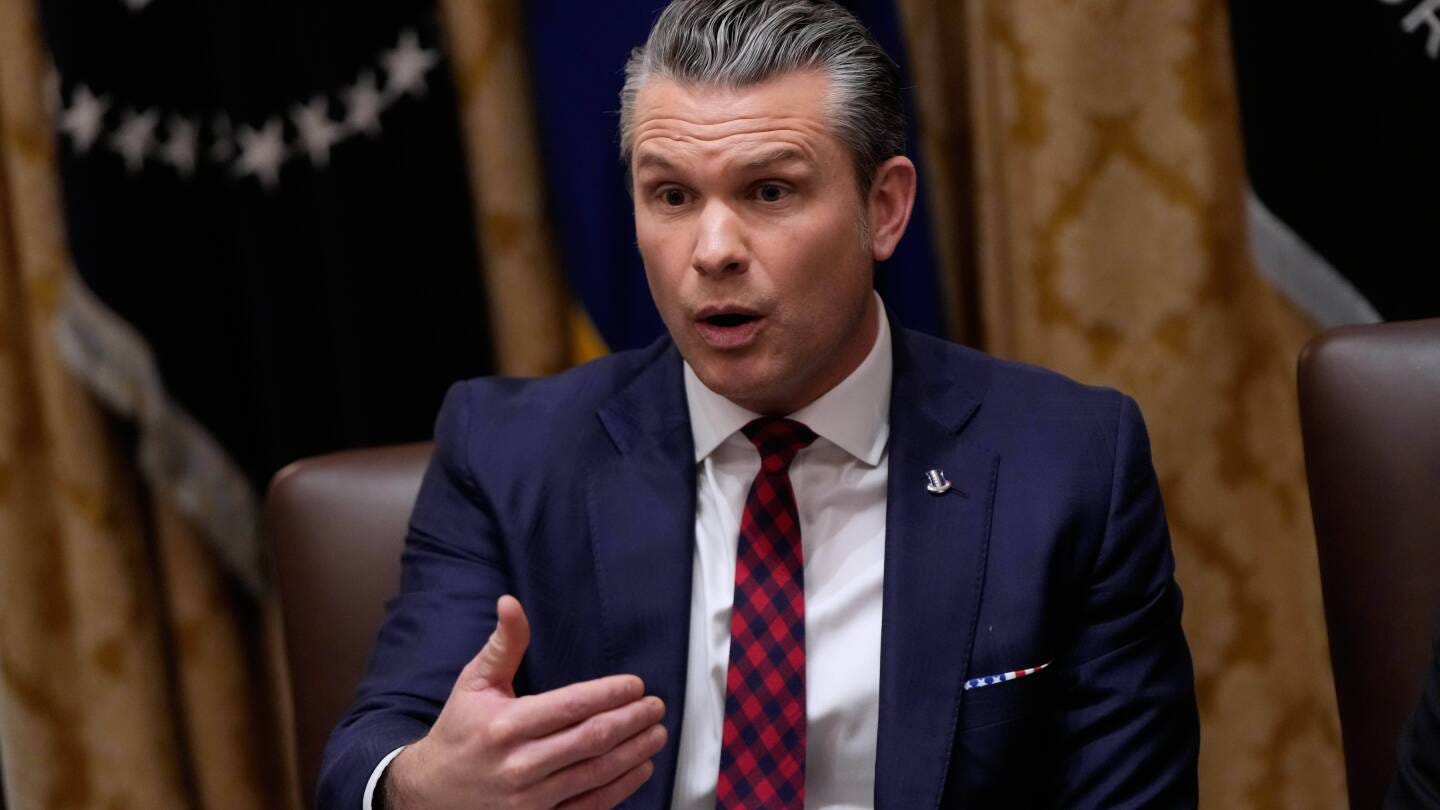
Pete Hegseth is discovering the hard way that swagger isn’t a substitute for competence—especially when a botched follow-up strike may have crossed into war-crime territory.
Three months into his already-rocky tenure as defense secretary, Hegseth is now battling a crisis that makes his messy confirmation and “Signalgate” look quaint. A special operations team allegedly attacked survivors of a U.S. strike on a supposed drug boat near Venezuela, prompting bipartisan outrage and a fast-moving congressional investigation. Even Republicans who reluctantly backed him are suddenly questioning whether the Fox-News-host-turned-Pentagon-chief should have ever been put anywhere near the chain of command.
Hegseth insists it was all the “fog of war,” claiming he saw no survivors and blasting critics as weak-kneed. But this wasn’t a one-off blunder—it was the logical extension of his publicly embraced “warrior culture,” his vow to ditch what he calls “stupid rules of engagement,” and his push to rebrand the Pentagon as the Department of War. As Sen. Chris Van Hollen bluntly put it: “Secretary Talk Show Host may have been experiencing the ‘fog of war,’ but that doesn’t change the fact that this was an extrajudicial killing amounting to murder or a war crime.”
Congress is now flexing its oversight muscles after months of frustration with Hegseth’s secrecy, antagonism toward lawmakers, and a Pentagon increasingly shaped by Trump’s maximalist approach to the drug war in the Caribbean. The chairs of the Armed Services Committees—alongside their Democratic counterparts—are preparing to question Navy Vice Adm. Frank “Mitch” Bradley, who reportedly ordered the second strike. Meanwhile, Hegseth’s decision to post a meme of a cartoon turtle firing on a boat only deepened the sense that the nation’s top defense official isn’t taking any of this seriously.
Trump and his allies are circling wagons around him for now. Senate Majority Leader John Thune says Hegseth serves at the pleasure of the president, and Vice President JD Vance—whose tiebreaking vote confirmed him—is loudly defending him. But even sympathetic Republicans are hedging, aware that Hegseth’s mounting controversies are becoming harder to dismiss as media spin or Washington snobbery.
The deeper question is whether Congress trusts Hegseth with the immense power he’s been handed. As Sen. Tim Kaine notes, the confirmation concerns about his judgment, personal conduct, and management failures didn’t magically disappear once he took the oath. They simply became far more dangerous. And now, with potential war-crime allegations in play, the stakes for Hegseth—and for U.S. credibility—couldn’t be higher.
Source: AP News
Editor: If this is the “warrior culture” Hegseth promised—cartoon memes, chaotic decision-making, and congressional investigations—maybe the Pentagon should stick with the boring, competent types next time. Competence may not trend on social media, but it sure avoids war-crimes hearings.
Admiral Bradley Becomes the Fall Guy in Trump’s Legally Murky Caribbean War
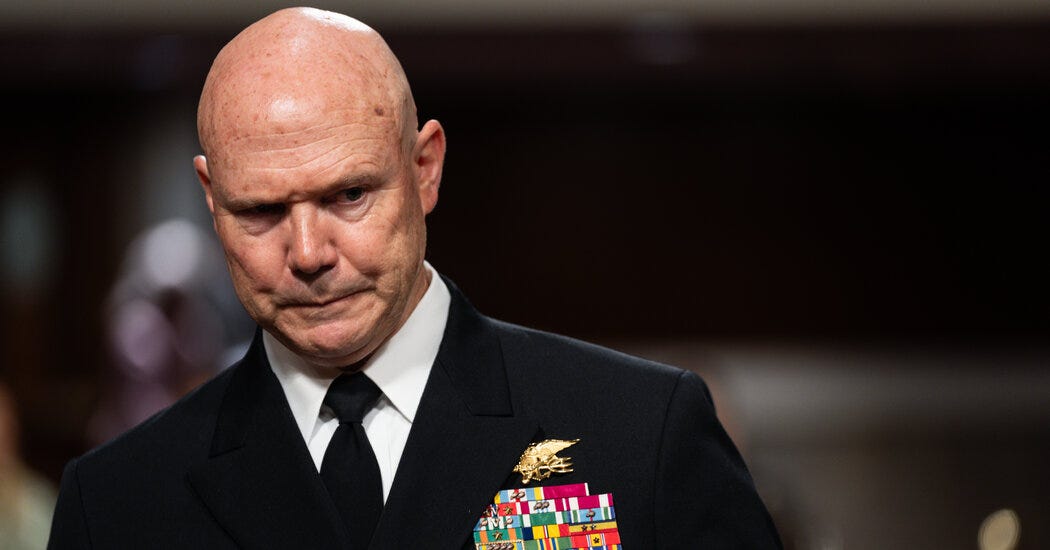
Adm. Frank “Mitch” Bradley spent decades executing America’s hardest missions—now he’s standing alone in the line of fire as the White House scrambles to dodge responsibility for a deadly second strike off Venezuela.
Bradley, a cerebral and highly respected SEAL with a spotless reputation inside the Special Operations world, is suddenly the public face of a legally dubious campaign the Trump administration insists is an “armed conflict” with drug cartels—despite Congress never authorizing such a war. On Sept. 2, Bradley ordered a second strike on two survivors clinging to the wreckage of a blown-up drug boat, an action his superiors now claim they never told him to take. That second strike is what pushed him from shadow operator to potential defendant.
What makes this moment so precarious for Bradley is the political calculus surrounding him. Trump says he “wouldn’t have wanted” a follow-up strike, Pete Hegseth now claims he wasn’t watching when it happened, and the White House insists Bradley “worked well within his authority.” But that combination—disavowal wrapped in endorsement—leaves one person holding the legal bag. As national security scholar Carrie Lee put it: “Trying to walk this middle line where you are saying, ‘Well, I agree with his decisions, but if they violated the law, then we’re going to leave him swinging,’ goes against any kind of ideas of responsible command.”
Bradley is heading to Capitol Hill this week for closed-door questioning, becoming the first uniformed example of the ethical trap created by Trump’s attempt to apply counterterrorism rules to a counternarcotics campaign. In conventional law-of-war terms, you cannot deliberately target civilians or suspected criminals who pose no imminent threat. The administration argues that’s irrelevant because the president has declared a conflict with cartels—something Congress has never endorsed, and something outside military lawyers loudly reject.
The irony is that Bradley is exactly the kind of officer the Pentagon usually holds up as the gold standard. A Naval Academy physics grad, Team 6 leader, Iraq and Afghanistan veteran, Karzai protector, and two-time Navy Postgraduate School scholar, he’s widely regarded across the SEAL community as disciplined, ethical, and almost ascetic. Colleagues describe him as the last person who would cavalierly ignore the rules of engagement. Yet he’s now caught between a president who demands “maximum lethality,” a defense secretary eager to erase limits altogether, and a Congress that’s suddenly rediscovering its oversight powers.
In a different administration, Bradley’s long record might shield him. In this one, it risks becoming the moral contrast that makes the whole operation look even more reckless. Whether he emerges intact depends less on what happened on Sept. 2 and more on how badly the White House needs someone else to pay for it.
Source: NY Times
Editor: If you’re looking for the moment America’s “war on cartels” jumped the rails, here it is—an elite SEAL with a spotless record left twisting while his civilian bosses pretend they barely know him. Nothing says accountability like pointing at the nearest uniform and saying, “Him.”
Costco Joins the Corporate Pile-On Against Trump’s Tariffs as Supreme Court Signals Trouble Ahead
When even Costco decides it’s had enough of Trump’s tariff crusade, you know the legal walls are starting to shake.
The retail giant has become one of the largest companies yet to sue the Trump administration over its sweeping import duties—tariffs that now hang in the balance as the Supreme Court weighs whether Trump even had the authority to impose them. During oral arguments last month, justices didn’t exactly hide their skepticism. Lower courts have already said Trump improperly stretched emergency economic powers to slap levies on nearly all imports, and if the high court agrees, the whole tariff regime could unravel.
Plenty of companies saw this coming and quietly filed lawsuits months ago—Revlon, Bumble Bee, Kawasaki, and a long roster of smaller firms that couldn’t absorb the costs. But Costco marks a shift. Trade law expert Marc Busch says it’s the first time major players are “taking their heads out of the sand publicly,” a sign that confidence in the legality of Trump’s trade agenda is evaporating. And Costco has good reason to worry: roughly a third of its U.S. goods are imported, meaning its tariff bill is no rounding error.
The company’s complaint doesn’t list how much it’s already paid, but it’s concerned that even if the Supreme Court strikes the tariffs down, it could still lose out on refunds—an expensive lesson in what happens when a president governs by improvisation. Businesses don’t mind a tough trade policy; what they hate is uncertainty. And right now, Trump has given them volatility with a side of legal chaos.
If the Supreme Court rules against him, the tariff tower collapses. If it doesn’t, companies could be stuck eating losses indefinitely. Either way, the steady drip of lawsuits suggests the corporate world is done pretending the emperor’s trade war has clothes.
Source: NPR
Editor: Costco doesn’t sue presidents lightly. When the warehouse club famous for $1.50 hot dogs decides the real inflation threat is coming from the Oval Office, maybe it’s time for someone in Washington to admit this tariff experiment has gone off the rails.
BONUS Tweet of the Day
The story about Somalia... Doesn't it seem eerily like Iraq and WMDs? Like, Afghanistan was directly involved in 9/11 but then George W. Bush blamed Iraq and we went into a 20-year war with them.
A dude from Afghanistan shot two National Guards enlistees (one of which DIED) and Trump is blaming... Somalia.