


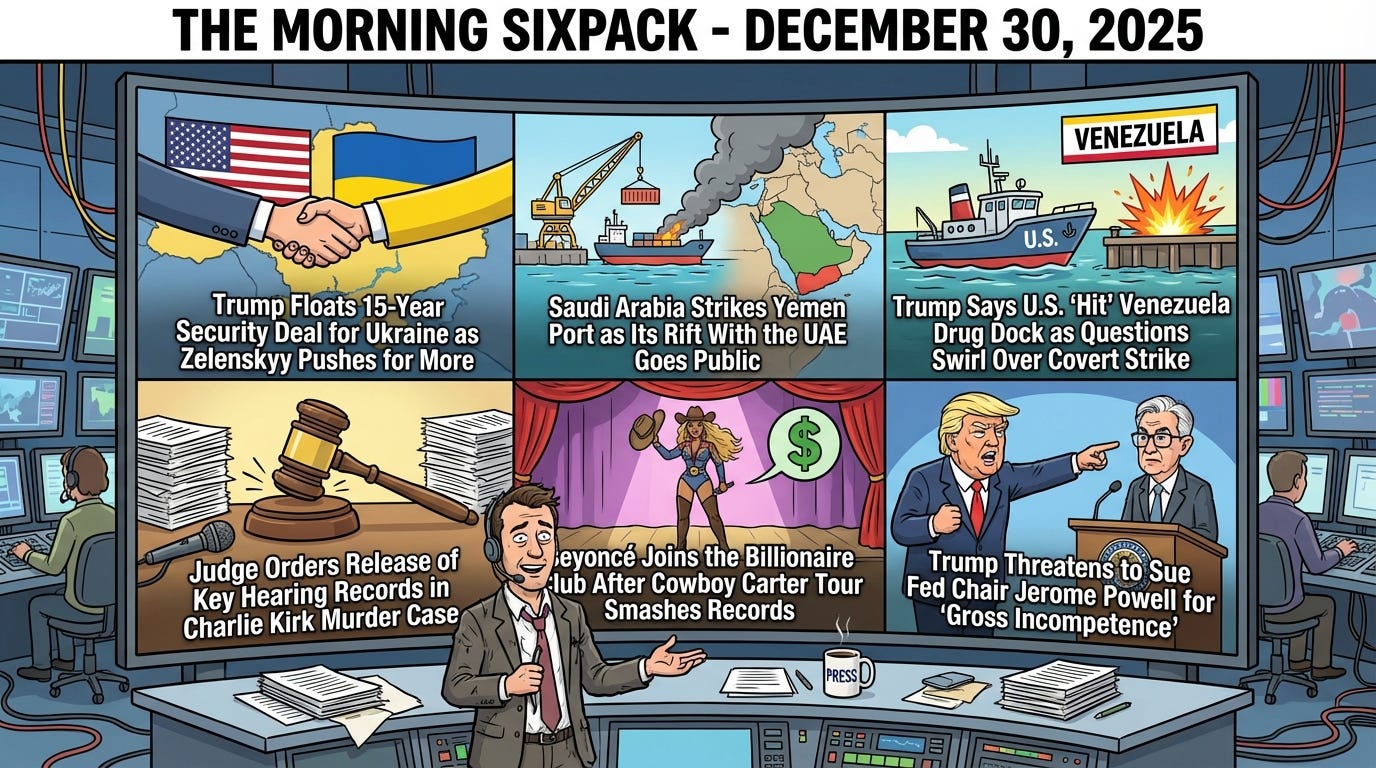
Trump Floats 15-Year Security Deal for Ukraine as Zelenskyy Pushes for More
Washington may be ready to lock in a 15-year security guarantee for Ukraine—but Zelenskyy is already signaling that’s not nearly long enough.
Ukrainian President Volodymyr Zelenskyy revealed that the U.S. proposal is on the table as part of a broader peace plan, but he’s eyeing something closer to half a century to keep Russia in check. Honestly, given Moscow’s track record since 2014, it’s hard to blame him for wanting a guarantee that outlives multiple presidential cycles.
At Mar-a-Lago, President Trump boasted that Ukraine and Russia are “closer than ever before” to ending the war, though negotiators are still grinding away on the hard stuff—troop withdrawals, the Zaporizhzhia nuclear plant, and who enforces what. And Trump himself admitted the whole thing could still fall apart. Zelenskyy didn’t mince words either: “Without security guarantees, realistically, this war will not end.”
The contours of the deal remain opaque, but Zelenskyy says the package involves monitoring mechanisms and the “presence” of partners—language that surely set off alarms in Moscow, which has already rejected any NATO-country troops on Ukrainian soil. Meanwhile, Putin hasn’t even agreed to speak to Zelenskyy, though a Trump-Putin call is reportedly in the works. Make of that what you will.
France is corralling Kyiv’s allies for a January meeting in Paris to nail down who commits what. And Trump, according to Zelenskyy, is open to extending the guarantee beyond 15 years—though Congress and other partner parliaments would have to sign off. Zelenskyy wants the entire 20-point plan ultimately approved via a national referendum, a democratic flourish that can’t happen without a 60-day ceasefire. Moscow, unsurprisingly, isn’t offering one.
Source: NPR
More: My Daily Grind News
Editor: A 15-year guarantee? That’s barely a strategic coffee break. If Washington wants lasting peace, maybe it should stop acting like geopolitical stability comes with an Amazon Subscribe & Save button.
Saudi Arabia Strikes Yemen Port as Its Rift with the UAE Goes Public
Saudi warplanes hit a Yemeni port controlled by a UAE-backed separatist faction, and the message couldn’t be clearer: the Gulf rivalry is no longer subtle.
Riyadh framed the strike as a targeted operation, but it lands in the middle of an already-simmering competition with Abu Dhabi—one that stretches from finance to energy to influence over the region’s shadow wars. Yemen, as usual, becomes the battlefield for someone else’s ambitions.
The two powers have been quietly jostling for years, yet their geopolitical split is now widening in full view. They back opposing forces in Yemen. They’re pulling in different directions on Sudan, with Saudi Arabia pushing for an end to the civil war while the UAE faces accusations—denied, of course—of supporting a paramilitary faction. This isn’t just a disagreement; it’s a divergent worldview playing out in real time.
And then there’s the Somaliland wrinkle. Israel’s recognition of the breakaway region instantly exposed how far apart Riyadh and Abu Dhabi really are. Dubai owns a key port there, while Saudi Arabia joined more than 20 Arab and African nations in rejecting Israel’s move. When port ownership becomes foreign policy, you know the rift has institutional momentum.
What looks like a single strike on a Yemeni port is really a flare lighting up the fractured map of Gulf ambitions. Don’t expect détente anytime soon.
Source: Semafor
Editor: The Saudi-UAE “brotherhood” is holding together about as well as a bargain-bin yacht in monsoon season. Everyone swears they’re aligned—right up until the bombs start doing the talking.
Trump Says U.S. “Hit” Venezuela Drug Dock as Questions Swirl Over Covert Strike
President Trump claimed the U.S. carried out an operation that blew up a Venezuelan dock used for drug shipments—without saying who actually pulled the trigger.
At a West Palm Beach appearance, Trump described “a major explosion in the dock area where they load the boats up with drugs,” adding, “We hit all the boats, and now we hit the area…it’s the implementation area. That is no longer around.”
Classic Trump flourish, but the details? Foggy at best. He refused to say whether the CIA was behind it, though he noted he knew exactly who did it. CNN reported that the CIA carried out a drone strike on a remote port used by the Tren de Aragua gang—suggesting this wasn’t just rhetorical improvisation.
Yet neither the CIA, the White House, nor the Pentagon will confirm anything, maintaining a silence that only amplifies the intrigue. Venezuela’s government is also quiet, and with no independent reporting out of the area, it’s unclear what—if anything—was actually hit. A fire at a chemical plant nearby on Christmas Eve sparked rumors, but the company denied any link and insisted it was a minor incident. Still, residents reported an explosion and the smell of chlorine, which doesn’t exactly reassure anyone.
This all unfolds as Washington ramps up covert and semi-covert operations against Maduro’s government. Reuters has already reported a new phase of action on deck, with covert ops leading the way. And Congress is watching—closely—after past U.S. strikes on suspected drug-trafficking vessels killed at least 100 people. One September strike that left survivors who were then killed in a second strike has lawmakers questioning whether U.S. officials are following international law or simply hoping no one asks too many questions.
With more than 15,000 U.S. troops now deployed in the Caribbean, the “drug war” is looking a lot more like a shadow conflict with a geopolitical storyline. Whether this latest explosion was a genuine hit or political theater remains hidden where U.S. covert operations like to live: behind a curtain no one admits exists.
Source: Reuters
Editor: Nothing says accountability like bragging about a strike your own agencies won’t acknowledge. If this is the new transparency standard, we’re all going to need stronger reading glasses—and a lie detector.
Judge Orders Release of Key Hearing Records in Charlie Kirk Murder Case
A Utah judge has ordered the release of a redacted transcript and audio from a closed-door hearing in the case of Charlie Kirk’s accused killer, pushing the proceedings back into public view.
Judge Tony Graf ruled Monday that the transcript from an October 24 hearing—focused on whether 22-year-old Tyler Robinson could appear in court in plain clothes and without shackles—must be made public with limited redactions. The transcript is expected immediately; the audio will follow in about two weeks once security-related redactions are complete. Graf wasn’t persuaded by defense arguments for broader secrecy, rejecting attempts to scrub details already reflected in Robinson’s charges.
He was blunt about it: “If this information poses a risk of violating defendant’s right to a fair trial, defendant’s first line of defense is found in the rules of evidence in criminal procedure.”
In other words, open court isn’t the problem; defense counsel just needs to do its job. The judge also rebuffed a request to treat the media as a “limited party” entitled to advance alerts about future sealed hearings, though he did say parties must notify outlets in certain circumstances.
The case has triggered a fierce transparency fight. Robinson’s attorneys insist that cameras and intense coverage could poison the jury pool and undermine his right to a fair trial. Media organizations—and Erika Kirk, the widow of Charlie Kirk—counter that secrecy only erodes public trust. Utah prosecutors have charged Robinson with aggravated murder and six additional counts after Kirk was fatally shot in the neck while speaking at Utah Valley University on September 10.
Investigators uncovered casings engraved with references to meme culture and antifascist themes, along with court filings outlining Robinson’s alleged conversations about retrieving a rifle. The state intends to seek the death penalty. President Trump loudly called for it, but Utah County Attorney General Jeff Gray stressed the decision was made “independently.”
Robinson’s next hearing is set for January 16, and now the public will hear more of what’s been happening behind closed doors.
Source: The Hill
Editor: If this case gets any more opaque, we may need night-vision goggles. Sunshine doesn’t guarantee fairness—but secrecy guarantees suspicion.
Beyoncé Joins the Billionaire Club After Cowboy Carter Tour Smashes Records
Beyoncé has officially crossed the billionaire threshold, cementing herself as one of the very few artists whose empire is as formidable as their talent.
Forbes confirmed the milestone, crediting her blockbuster Cowboy Carter tour—the highest-grossing tour of 2025—as the final push that put her over the top. She now stands alongside Jay-Z, Taylor Swift, Bruce Springsteen, and Rihanna in music’s ten-figure stratosphere. Not bad company for someone who started in a girl group at age nine.
The numbers behind her ascent are enormous. Forbes estimates she pulled in $148 million before taxes this year from her tour and merch alone. That success follows a decades-long crescendo: Destiny’s Child, then a solo career that snowballed into juggernaut status with each release. The $500 million Renaissance tour in 2023 and this year’s triple-Grammy-winning Cowboy Carter album laid the perfect runway for her 2025 blowout, which grossed more than $400 million.
Her business acumen sharpened the edge. Parkwood Entertainment, founded in 2010 to give her full control of her creative and financial destiny, continues to be the engine behind her ownership model. Add in her ventures—a hair-care brand, whiskey label, and clothing line—and you see a portfolio built with intention, not accident. But Forbes notes the crown jewel remains her music catalog, described as “enormously valuable,” especially because she bankrolls her own tours and reaps the returns directly.
Three and a half decades after she first stepped into a studio, Beyoncé hasn’t just shaped pop culture—she’s rewritten the economics of superstardom.
Source: UPI
Editor: And somewhere in a boardroom, a half-dozen executives are wondering how Beyoncé keeps out-earning their entire companies. The answer is easy: she owns her work—something the industry still treats like a radical idea.