


Pentagon Watchdog Says Hegseth’s Signal Chat Put Troops at Risk
The nation’s top defense official casually dropping real-time strike details into a group chat is the kind of operational malpractice you’d expect from a bad political thriller, not the Pentagon.
A new report from the Pentagon’s acting inspector general concludes that Defense Secretary Pete Hegseth’s use of a private Signal chat to discuss imminent U.S. airstrikes in Yemen earlier this year created a serious risk to American forces. According to people familiar with the findings, the IG determined that sharing sensitive, time-specific military plans on an unsecured app could have compromised missions if intercepted by foreign adversaries.
The probe zeroed in on a chat that only became public because a journalist—accidentally added by then–National Security Adviser Michael Waltz—reported on it. In that thread, which included Vice President JD Vance, Secretary of State Marco Rubio, and White House adviser Stephen Miller, Hegseth circulated a detailed timeline of strikes on Houthi fighters just two hours before bombs fell on March 15. As one participant realized far too late, group-chat etiquette doesn’t include “don’t add the editor of The Atlantic.”
The inspector general also noted that Hegseth refused to sit for an interview, offering only a brief written statement. A classified version of the report was delivered Wednesday to select members of Congress in a secure facility—presumably one with better access controls than a Signal chat.
The whole episode is a reminder that in national security, discipline isn’t optional. It’s the job. And when the defense secretary opts for convenience over protocol, the margin for error evaporates.
Source: NYT
Editor: If your comms strategy hinges on “hope no one accidentally adds a reporter,” you don’t have a comms strategy—you have a liability wearing a Cabinet badge.
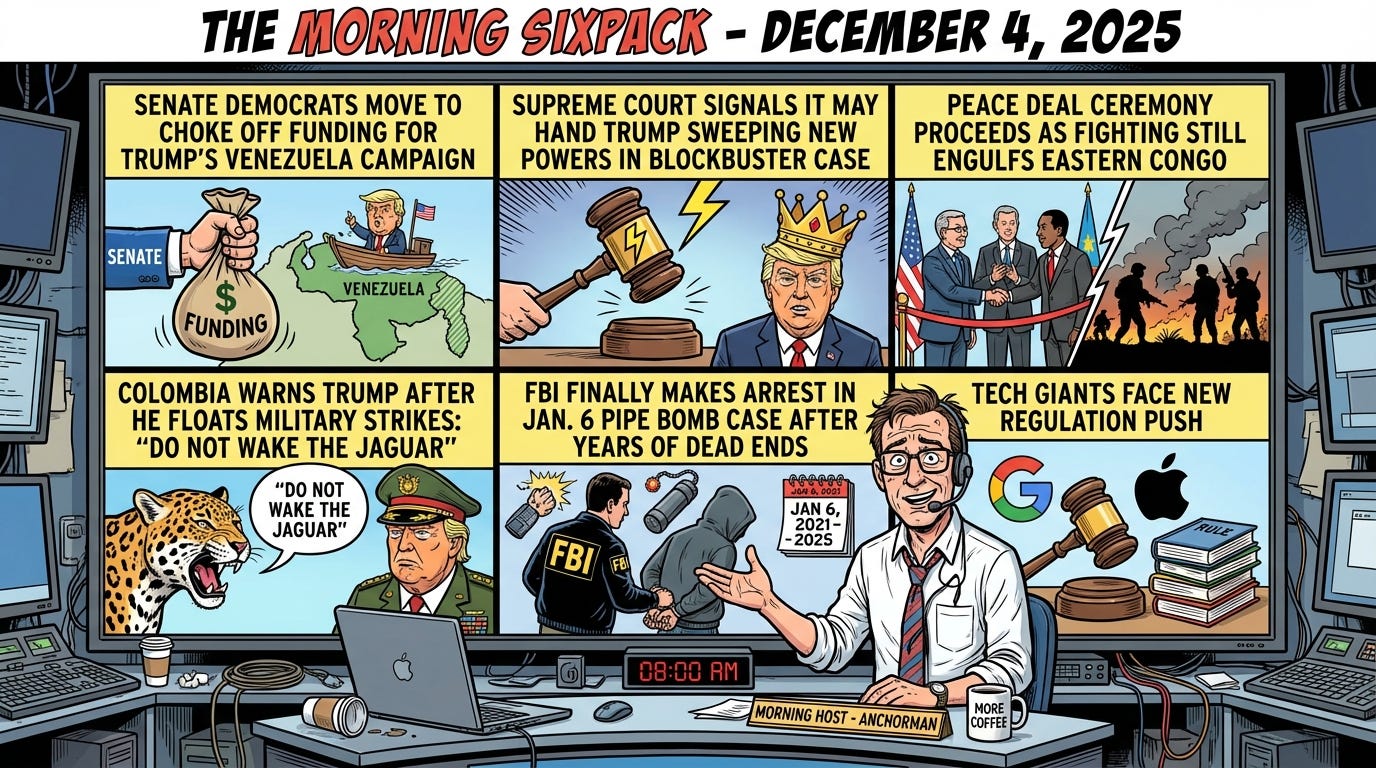
Peace Deal Ceremony Proceeds as Fighting Still Engulfs Eastern Congo
Washington can host all the handshakes it wants, but a peace deal doesn’t mean much when shells are still landing in Kamanyola.
Congolese President Felix Tshisekedi and Rwanda’s Paul Kagame are set to ink their peace accord—again—this time in Washington at the newly christened Donald J. Trump Institute for Peace. The Trump administration is eager to brand the moment as the capstone to decades of U.S. peace-brokering, but the reality on the ground in eastern Congo is far less tidy. M23 rebels, backed by Rwanda, continue battling Congolese forces even as the leaders celebrate “peace” thousands of miles away.
The ceremony itself is pure optics. The actual agreement was signed in June after Congo and Rwanda nearly spiraled into full-scale war earlier in the year, when M23 fighters—bolstered by thousands of Rwandan troops—seized two of eastern Congo’s largest cities. Trump hailed that summer deal as “a glorious triumph” and even claimed it ended 30 years of war. The problem? Neither side has met its core obligations. Rwanda is supposed to withdraw troops and stop supporting M23; Congo is meant to dismantle the FDLR militia. Neither has happened.
Still, leaders are projecting confidence. “This peace accord will, I hope, bring a real peace, true peace to our countries,” Tshisekedi told supporters, insisting Rwandan forces must finally exit Congo. Rwanda’s government, for its part, continues denying any military presence in the DRC—denials long contradicted by UN investigators and confirmed by the U.S., which has documented Rwandan surface-to-air missiles deployed inside Congolese territory. As Rwanda’s spokesperson put it, “The peace deal is not a magic wand,” which is certainly true, though it’s harder to make progress when the wand is being waved over active front lines.
Layered on top is the economic dimension. Congo’s mineral wealth—cobalt, copper, lithium, tantalum—remains an irresistible draw for Washington, and the U.S. is preparing to announce a new economic partnership as part of the peace package. But Congolese officials stress that none of the promised development will materialize until security commitments are actually honored. Right now, the fighting is doing far more talking than the diplomats.
Inside Congo, criticism is mounting. Opposition leaders and civil-society groups argue the deal has produced zero tangible results, and they want the Trump administration to finally lean on Rwanda to pull its forces out. Until then, a choreographed ceremony in Washington is just that—choreography, not peace.
Source: NPR
Editor: Celebrating a peace deal while the combatants are still shooting is like throwing a housewarming party while the roof is on fire—great photo op, lousy strategy.
Senate Democrats Move to Choke Off Funding for Trump’s Venezuela Campaign
Congress is finally testing whether it still has a say in matters of war or if the White House can simply muscle its way into another conflict.
Senate Democrats—with a cameo assist from Rand Paul—are rolling out a fresh effort to block President Donald Trump’s expanding military campaign in Venezuela. Sens. Jeff Merkley and Tim Kaine are introducing a bill that would bar the Pentagon from spending a dime on unauthorized action there, attempting to force a vote by unanimous consent. It’s a long shot, but the point is to put every senator on record as Trump signals he may escalate beyond strikes on alleged drug boats in the Caribbean.
The legislation is the latest volley in a larger push to rein in the administration’s operations, which have already sparked bipartisan discomfort. Schumer, Schiff, Kaine, and Paul are also advancing a resolution to block Trump from engaging in hostilities against Venezuela—another measure unlikely to pass but sure to make Republicans squirm as concerns arise within their own ranks. As Merkley put it, “Donald Trump cannot be trusted, and we must say no to another endless war, reckless regime change, and lethal operations—which are essentially extrajudicial killings—and do nothing to make the American people safer.”
Unease on Capitol Hill has only grown following reports of a second strike on a suspected drug vessel that killed survivors. Meanwhile, the administration remains unmoved, brushing off congressional attempts to “handcuff” military decisions and doubling down on pressure against Venezuelan leader Nicolás Maduro, whom U.S. officials continue to cast as a cartel kingpin.
Trump’s advisers believe he is inching toward a more forceful bid to oust Maduro altogether. The president signaled as much this week, telling reporters the U.S. may launch land strikes against drug traffickers “very soon,” leaving open the question of whether those strikes would occur directly inside Venezuela.
Regardless of how far Trump intends to push, Democrats—and a handful of Republicans who still remember Congress has war powers—are attempting to draw a line. The question is whether the line holds once the administration decides it won’t.
Source: My Daily Grind News
Editor: Congress rediscovering its constitutional backbone only after the bombs start dropping is peak Washington—late to the party and shocked the music’s already loud.
Colombia Warns Trump After He Floats Military Strikes: “Do Not Wake the Jaguar”
If Trump wanted Latin America’s attention, threatening to bomb Colombia will do it—but he may not like the response he’s getting.
Colombian President Gustavo Petro hit back hard after President Donald Trump suggested Colombia could be a target in his widening “war on drugs.” During a Tuesday cabinet meeting, Trump said land strikes inside Venezuela would “start very soon” and openly mused about extending military action to Colombia, alleging it manufactures cocaine destined for the U.S. Petro didn’t mince words, warning that Trump risked “waking the jaguar” and that any attack would amount to a declaration of war.
Petro doubled down publicly, inviting Trump to Colombia to watch authorities destroy drug labs—something he noted they do “daily” to stop cocaine from reaching the U.S. His message was equal parts rebuke and dare: if Trump wants proof, he’s welcome to come see the work on the ground rather than threaten a two-centuries-old diplomatic relationship from afar.
Bogotá’s Foreign Ministry also blasted Trump’s remarks as a “threat of external aggression that violates the dignity and integrity of the Colombian people.” It’s not the first time the administration has taken aim at Petro; Trump previously accused him of being “an illegal drug dealer” and has floated sanctions and aid cuts, turning bilateral relations into a rolling pressure campaign.
Meanwhile, Trump is escalating on multiple fronts. He’s already declared Venezuelan airspace closed and launched strikes on vessels accused of transporting drugs in the Caribbean and eastern Pacific. Nearly 15,000 U.S. naval personnel have been deployed since August, with the operations leaving more than 80 people dead—an extraordinary tally for a mission marketed as counter-narcotics enforcement.
Trump’s comments weren’t subtle: “Anybody that’s doing that and selling it into our country is subject to attack.” The problem is, when your foreign policy broom sweeps that broadly, you end up hitting allies along with adversaries—and Colombia is making it abundantly clear that it won’t play target practice for Washington.
Source: Express
Editor: Maybe—just maybe—declaring open season on partners who already bust drug labs daily isn’t the masterclass in diplomacy the White House thinks it is.
Supreme Court Signals It May Hand Trump Sweeping New Powers in Blockbuster Case
The conservative supermajority looks poised to rewrite the balance of power in Washington—exactly the outcome Trump has been angling for.
The Supreme Court hears Trump v. Slaughter on Monday, and if early signals are any indication, the six-justice conservative bloc appears ready to grant President Donald Trump a dramatic expansion of executive authority. As Slate put it, this is “a case whose outcome feels preordained,” one that could shift a massive share of governing power from Congress to the Oval Office—right into Trump’s hands.
At issue is the conservative legal movement’s beloved “unitary executive” theory. Trump’s lawyers argue that the Constitution gives the president near-total control of the executive branch, including the freedom to fire officials who provide any independent check on presidential action. Historians have torched the theory as an ahistorical legal fable, debunking its supposed lineage with, as Slate noted, “devastating precision.” But in a world where ideology outweighs evidence, the majority seems ready to bless it anyway.
If the Court greenlights this reinterpretation, Trump would gain the authority to sweep aside federal officials who stand between him and whatever agenda he’s chasing. The ruling could strip away long-standing guardrails meant to keep presidents from turning the executive branch into a personal command center—precisely why critics warn this will “inflict profound damage on the separation of powers, democracy, and individual rights.”
This is the kind of ruling that doesn’t just reshape government—it redefines it. A decision for Trump would elevate the presidency above its coequal branches, allowing future presidents to steamroll statutory limits and dismantle independent oversight with the flick of a wrist. It’s government by unitary executive myth, powered by a Supreme Court willing to pretend the Constitution says what its majority wishes it did.
And the political stakes couldn’t be clearer. Trump has made no secret of his desire for more direct control over the federal bureaucracy. Now, with Slaughter, the Court may hand him the keys he’s been eyeing for years—while leaving Congress and the public to grapple with the consequences.
Source: RawStory
Editor: If giving a president unilateral power is the answer, the Court might want to double-check the question—because this looks less like constitutional interpretation and more like wish fulfillment for one man’s agenda.
FBI Finally Makes Arrest in Jan. 6 Pipe Bomb Case After Years of Dead Ends
Nearly five years after the nation watched an unidentified figure plant pipe bombs near both major political parties’ headquarters, the FBI may at last have its suspect in hand.
Federal agents arrested a Virginia man Thursday in connection with the two viable pipe bombs left outside the DNC and RNC on the night of Jan. 5, 2021. His name hasn’t yet been released, but officials say this is the first breakthrough after one of the most exhaustive domestic investigations in bureau history. The bombs were discovered the next day, just as rioters were breaching Capitol barricades—an ominous overlap that has fueled years of speculation and conspiracy theories.
Investigators spent years combing through 39,000 video files, conducting more than 1,000 interviews, and knocking on over 1,200 doors to trace the suspect’s movements. Surveillance footage showed a masked individual weaving through Capitol Hill, leaving one device by a park bench at the DNC and another in an alley by the RNC. Both devices were capable of killing or seriously injuring anyone nearby, but neither detonated. What they did instead was hang like a ghost over every unanswered question about Jan. 6.
Inside the FBI, the case became a priority for Deputy Director Dan Bongino, a former right-wing podcaster whose arrival in government raised eyebrows but who insisted he wanted “answers on this.” He and Director Kash Patel brought in new teams, even flying in outside detectives to reexamine every piece of the bureau’s work. That shake-up appears to have paid off—though don’t expect critics to stop spinning theories anytime soon.
The long stall in the investigation gave oxygen to endless online rumor mills, including claims that the suspect was someone inside law enforcement—accusations Bongino loudly dismissed as “grossly inaccurate.” With an arrest now made, some of those narratives may finally begin to deflate, though history suggests they’ll never fully disappear.
For now, the central question is simple: Does this arrest lead to real clarity about what happened and why? After nearly five years of darkness, the country is overdue for more than just an answer—it deserves the truth.
Source: Wall Street Journal (gift article)
Editor: Amazing what the FBI can accomplish once management decides to step away from Twitter feuds and actually solve crimes.