


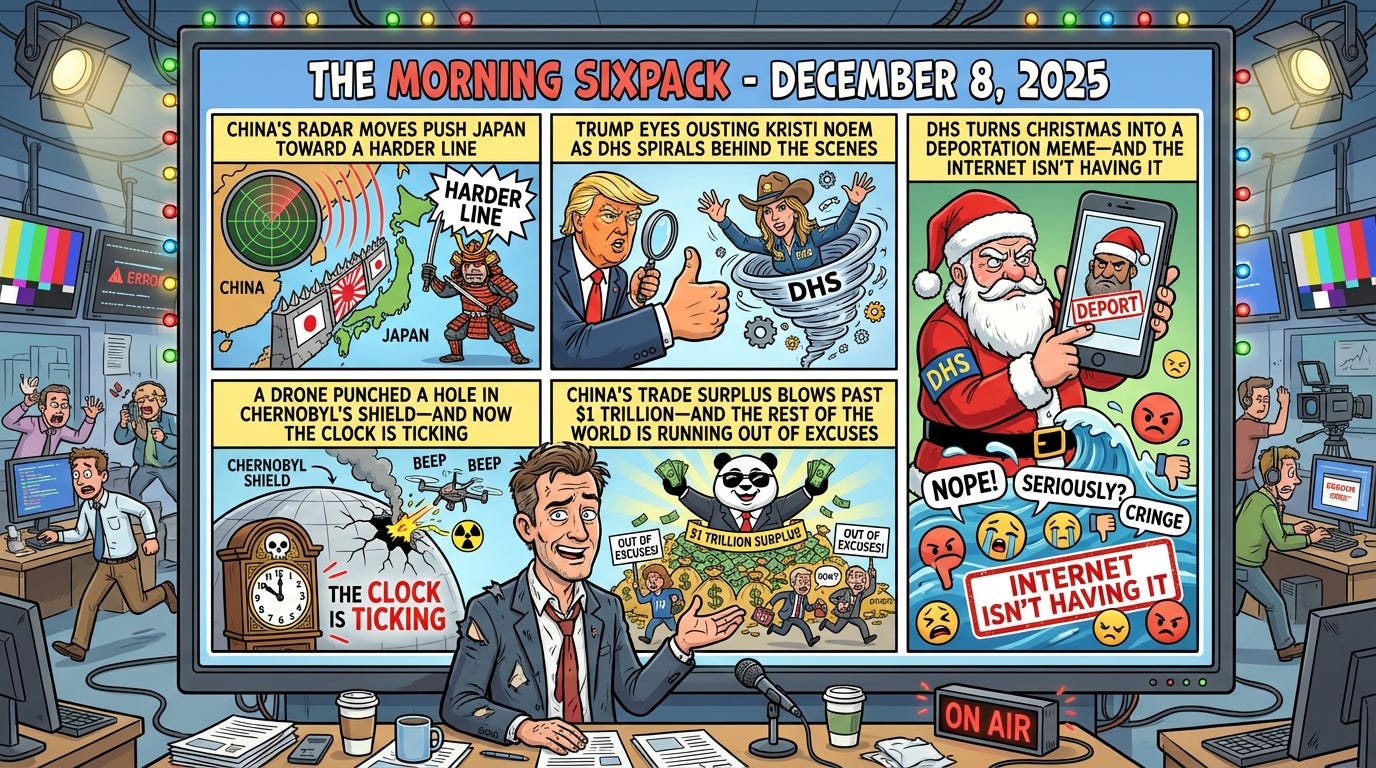
China’s Radar Moves Push Japan Toward a Harder Line
Chinese fighter jets painting Japanese aircraft with radar near Okinawa is the clearest sign yet that Beijing is ready to test Tokyo’s limits.
Japan says two separate radar illuminations from Chinese J-15s amounted to dangerous escalations in airspace that’s already packed with tension. Prime Minister Sanae Takaichi didn’t mince words, calling the moves “extremely regrettable” and lodging a formal protest while vowing Japan would not be cowed. Beijing, for its part, rejected the entire account and accused Japan of barging into its drills.
As Defense Minister Shinjiro Koizumi met Australia’s Richard Marles in Tokyo, the two presented a united front—Japan promising to respond “resolutely and calmly,” Australia warning it was “deeply concerned.” That’s diplomatic code for: this is not normal. And it isn’t. Radar illumination is the kind of button-pushing that forces pilots into split-second decisions no one wants to test in real life.
Beijing’s counter-narrative came swiftly. Colonel Wang Xuemeng insisted Japanese aircraft “repeatedly approached and disrupted” China’s carrier drills east of the Miyako Strait. He demanded Japan “immediately stop slandering and smearing” and warned the Chinese Navy would “resolutely safeguard its own security and legitimate rights and interests.” Translation: we’re not backing down, and we think this is your fault.
All of this is unfolding against the backdrop of frayed China-Japan ties after Takaichi warned Japan could respond to a Chinese move on Taiwan. And remember—Taiwan sits just 110 km from Japan’s Yonaguni Island. Add a silent Washington, a Trump administration building up military posture but publicly keeping its head down, and China’s massive naval deployments across East Asian waters, and you’ve got a region where every misread radar ping can become its own headline.
Japan says the J-15s involved launched from the Liaoning carrier, operating south of Okinawa with destroyers in tow. Japan scrambled F-15s. It’s not the first time either side has accused the other of locking radar—just the most consequential in years. And it’s happening while Taiwan warns of “psychological warfare” from Beijing and Chinese ships conduct “search-and-rescue drills” that just happen to line up with high-traffic maritime chokepoints.
Source: Reuters
Editor: Beijing and Tokyo treating the Miyako Strait like a geopolitical staring contest would be comical if both sides weren’t armed to the teeth. Maybe everyone should stop pretending “search-and-rescue drills” explain 100-plus ships milling around the region.
Trump Eyes Ousting Kristi Noem as DHS Spirals Behind the Scenes
Trump weighing whether to dump Homeland Security Secretary Kristi Noem tells you everything about how chaotic DHS has become on his watch.
Two former DHS officials who served under both Biden and Trump say the president is “indeed considering moving on from Noem”—and possibly soon. A third source called the situation “fluid,” which is Washington-speak for everyone is scrambling and no one knows who’s in charge. Trump may personally like Noem, but senior White House officials are fed up, especially over the heavy hand of Corey Lewandowski, who’s reportedly playing an “outsized role” inside DHS. (Lewandowski, naturally, says none of it is true.)
Meanwhile, there’s already chatter about who could replace her: Virginia Gov. Glenn Youngkin, who’s out of office in mid-January and apparently willing to take any Cabinet post that sounds important, even if he’d rather be tinkering with the economy than dealing with immigration fires. For a guy who once tried to sell himself as a data-driven suburban dad, he sure seems eager to dive into Trump World’s most combustible department.
Noem, to her credit or detriment, is working overtime to telegraph loyalty. In a cabinet meeting, she told Trump, “You made it through the hurricane season without a hurricane…You kept the hurricanes away, we appreciate that.” A line so widely mocked it could qualify as its own tropical depression. When the boss wants flattery, Noem brings barometric enthusiasm.
But the real story is the internal meltdown. One former DHS official relayed the view from inside: “‘It’s horrible. They’re going to destroy this place. I’m just hoping the new secretary gets here in time.’” When your own staff is praying for a leadership swap, the ship isn’t just taking on water—it’s already halfway underwater.
And yet, Trump’s team seems to think swapping one embattled secretary for a term-limited governor will fix the carnage. Sure. Because nothing stabilizes a crisis like installing someone who wasn’t even interested in the job portfolio in the first place.
Source: Mediaite
Editor: If DHS is truly “fucked,” maybe the answer isn’t musical chairs with Cabinet secretaries. But hey, why repair the engine when you can just rotate the driver every few exits?
Moscow Cheers Trump’s New Security Strategy—and Europe Wonders What Planet Washington Is On
When the Kremlin is applauding a U.S. national security strategy, you don’t need a think tank to tell you something is off.
Kremlin spokesperson Dmitry Peskov all but beamed in an interview with TASS, saying the Trump administration’s revised strategy is “largely consistent with our vision” and calling it “a positive step.” Anytime Moscow is this happy with U.S. policy, European officials start metaphorically checking for smoke under the door—because something’s burning. And this document gives them plenty to worry about.
The strategy softens language toward Russia, pins blame on the EU for blocking U.S. efforts to end the war in Ukraine, and urges Washington to “re-establish strategic stability to Russia” as a way to “stabilise European economies.” It even encourages U.S. efforts to shape European politics directly, prioritising “resistance to Europe’s current trajectory within European nations.” That’s diplomatic jargon for meddling with a smile. The document also indulges in apocalyptic cultural panic, claiming Europe will be “unrecognisable in 20 years or less” and warning of “civilisational erasure.” Someone clearly spent too much time doomscrolling before drafting policy.
It goes further by celebrating “patriotic European parties”—a euphemism for the far-right—and declares that America “encourages its political allies in Europe to promote this revival of spirit.” EU officials, now trying to negotiate a Ukraine peace framework with Washington, are understandably rattled. Germany’s foreign minister, Wadephul, tried to keep things polite but didn’t hide his discomfort: freedom of expression and “the organisation of our free societies” have no business in a security strategy, he said. Translation: keep your culture-war manifesto out of NATO.
Not everyone bothered with diplomacy. Former Swedish PM Carl Bildt slammed the document as “to the right of the extreme right,” saying its language resembles “bizarre minds of the Kremlin.” Hard to argue when Moscow is offering five-star reviews. And this comes as the U.S. cozies up to Germany’s AfD—the same AfD that German intelligence labels extreme right. Apparently “America First” now includes auditioning for Europe’s fringe parties.
Beyond Europe, the strategy flexes its muscles against drug-trafficking boats in the Caribbean and eastern Pacific, floats possible military action in Venezuela, and demands sharper defense spending increases from Japan, South Korea, Australia and Taiwan. Democrats in Congress are sounding alarms: Rep. Jason Crow called the plan “catastrophic,” while Rep. Gregory Meeks said it “discards decades of value-based, US leadership.” When lawmakers use that tone, they’re not brainstorming improvements—they’re preparing sandbags.
If Moscow thinks this document is a gift, and Europe thinks it’s a warning siren, the Trump administration may want to ask itself who exactly this strategy is meant to reassure. Because right now, the answer seems to be: nobody you’d want on your side.
Source: My Daily Grind News
Editor: If your national security blueprint gets glowing reviews from the Kremlin while freaking out your allies, congratulations—you’ve drafted a strategy fit for a geopolitical funhouse mirror.
DHS Turns Christmas Into a Deportation Meme—and the Internet Isn’t Having It

When your federal agency is posting AI-generated holiday gun squads with the caption “YOU’RE GOING HO HO HOME,” you’ve already lost the plot.
DHS’s social media team decided the season called for deportation-themed Christmas imagery—ICE officers wrapped in twinkle lights, rifles in hand, posing beside armored vehicles and gift boxes like they’re shooting the world’s bleakest holiday catalog. One image even features a riot shield stamped “Merry Christmas,” because nothing says goodwill toward men like festive tactical gear. And just to underline the absurdity, the agency followed up with a GIF of Trump riding a sleigh in a Santa hat, as if North Pole militarization were now official policy branding.
The internet erupted. Sure, part of the MAGA crowd loved it, calling for DHS raises and asking how to join “the federal content intern team.” Some eagle-eyed viewers noted the armored trucks depicted are Canadian-made, with profits benefiting Ukrainian manufacturing—a detail that makes this whole production even stranger. But critics weren’t amused. “Sick,” “cruel,” and “unreal,” they wrote, with one retort capturing the mood: “YOU’RE GOING TO HE HE HELL.”
Immigrant-rights groups, already livid over DHS’s holiday-themed “self-deportation” push earlier this month, said the campaign wasn’t just tone-deaf—it was openly manipulative. And the context is clear: deportations are surging. Nearly 200,000 people were removed in the first seven months of 2025, putting ICE on track for its highest total in more than a decade. Hard to celebrate Christmas when the government is turning yuletide into a removal operation.
Worse, DHS has been repeatedly caught using altered or AI-generated images in official communications, blurring the line between public information and propaganda. This latest batch—digitally immaculate, implausibly staged—fits that pattern. If the agency wants credibility, maybe stop assembling holiday-themed tactical fan fiction and passing it off as outreach.
But the posts remain up, festive assault rifles and all. At this point, it seems DHS is not just doubling down—it’s hanging ornaments on the collapse of its own communications judgment.
Source: My Daily Grind News
Editor: If your taxpayer-funded holiday message requires both a rifle and a ring light, maybe step away from the upload button and rethink your life choices.
A Drone Punched a Hole in Chernobyl’s Shield—and Now the Clock Is Ticking
A stray drone strike tearing into Chernobyl’s New Safe Confinement should have been a once-in-a-century nightmare scenario, yet here we are pretending it’s just another item on the nuclear to-do list.
Reports say the February 2025 hit—likely accidental—blew a hole in the massive arch, sparked a fire, and damaged protective cladding. Since then, the IAEA has been politely but firmly sounding alarms. As Director General Rafael Mariano Grossi put it, “Limited temporary repairs have been carried out on the roof, but timely and comprehensive restoration remains essential to prevent further degradation and ensure long-term nuclear safety.” Translation: patch jobs aren’t going to cut it for a structure designed to stand 100 years.
Ukraine pointed the finger at Russia; Russia denied everything on cue. Radiation levels haven’t risen, which is the good news. The bad news? The NSC can no longer guarantee the airtight containment it was engineered to deliver. A weakened shell means dust, moisture, and time—not radiation—are now the true threats. And once moisture starts creeping in, corrosion begins its slow, destructive campaign.
Built between 2016 and 2019 for €1.5 billion, the NSC was supposed to be the world’s most overbuilt insurance policy: keep radioactive material sealed, keep water out, and maintain stable conditions for dismantling the wreckage of Reactor 4. But damaged cladding and broken weatherproofing leave the arch vulnerable. It isn’t collapsing—the load-bearing elements are intact, according to the IAEA—but its long-term performance is compromised. That’s the nuclear equivalent of hearing the doctor say, “You’re fine for now, but don’t ignore this.”
The bigger picture: the NSC sits atop the aging 1986 sarcophagus, meaning Chernobyl’s reactor remains are still sealed under multiple layers. The purpose of the NSC was slow, safe dismantling—not emergency containment. But when war pressures infrastructure, “slow and safe” quickly becomes “delayed and risky.” Repairs are planned for 2026, with a larger renovation phase after that, once international funding, war logistics, and nuclear-safety bureaucracy finally synchronize.
For a structure meant to outlast generations, it’s unsettling how fast geopolitical chaos can shorten the timeline.
Source: Interesting Engineering
Editor: If a rogue drone can force a billion-euro nuclear shield into early retirement, maybe Europe should stop treating infrastructure like it’s optional DLC for wartime budgets.
China’s Trade Surplus Blows Past $1 Trillion—and the Rest of the World Is Running Out of Excuses
China crossing the $1 trillion trade-surplus threshold isn’t just an economic milestone—it’s a flashing red warning light for every country still pretending their industrial policies are working.
For the first 11 months of the year, China exported $3.4 trillion worth of goods while importing just $2.3 trillion, yielding a record $1.08 trillion surplus. No country in recorded history has ever hit a figure like that. It’s the payoff of decades of industrial planning, relentless capacity building, and a willingness to scale faster than the rest of the world can even schedule a committee meeting. What began with cheap wigs and Christmas lights is now a juggernaut spanning EVs, solar panels, semiconductors, and essentially anything that can be assembled, stamped, welded or shipped in a container.
And those containers tell the real story. Jens Eskelund of the EU Chamber of Commerce says that by volume, Europe sends one container to China for every four containers China sends back. In other words, the trade imbalance isn’t just big—it’s baked into the physical flow of global commerce. Even as Trump revived his tariff crusade earlier this year—jacking Chinese import duties up past 100% before settling at around 37%—Beijing simply rerouted exports. Shipments to Africa are up 26%, to Southeast Asia 14%, and to Latin America 7.1%. Meanwhile, exports to the U.S. plunged 29% in November, yet China’s total exports still rose nearly 6% because the rest of the world picked up the slack.
Europe is feeling the squeeze most acutely. French President Emmanuel Macron returned from a cordial summit with Xi Jinping only to warn that Europe may soon have to impose tariffs if China doesn’t restrain its industrial overdrive. “China is hitting the heart of the European industrial and innovation model,” Macron said—a diplomatic way of admitting European automakers, tech firms, and even luxury houses are being eaten alive by cheaper, faster, and increasingly higher-end Chinese competition.
Economists don’t expect this to slow down. Morgan Stanley estimates China’s share of global goods exports will hit 16.5% by decade’s end, powered by its ability to anticipate demand shifts and marshal resources at staggering speed. Meanwhile, a weakening yuan makes Chinese products even more competitive abroad, amplifying the imbalance far beyond the headline $1 trillion number.
Trade complaints are piling up—from the U.S. and EU to Latin America, Southeast Asia, and the Middle East. Eskelund warns the world could soon “get to a point where things snap.” That’s the moment when countries stop grumbling about China’s export machine and start breaking glass to find the emergency trade tools.
If you think geopolitical tensions are bad now, wait until governments try to force a correction in the global supply-and-demand system China currently anchors.
Source: Wall Street Journal (gift article)
Editor: A trillion-dollar surplus is less an achievement than a scoreboard. China is playing industrial chess while everyone else is still arguing over who gets to be white or black.