


Listen to the podcast:
Republicans’ ‘War on Waste’ is Just Political Theater—And the Numbers Don’t Add Up
House Republicans, led by Bleach-Blonde, Bad-Built, Butch Body Rep. Marjorie Taylor Greene, kicked off their so-called “war on waste” with a hearing that was heavy on dramatic speeches and light on actual solutions.
The newly minted Department of Government Efficiency (DOGE)—a Trump-Musk creation that sounds more like a joke cryptocurrency than a serious policy initiative (because it is)—claimed to uncover shocking examples of government “waste.”
But here’s the reality: The so-called "fraud" they dug up amounts to a rounding error in the federal budget, and most of their claims are either misleading, cherry-picked, or outright nonsense.
Meanwhile, Democrats like Rep. Melanie Stanbury pointed out the obvious: “While we're sitting here, Donald Trump and Elon Musk are recklessly and illegally dismantling the federal government, shuttering federal agencies, firing federal workers, withholding funds vital to the safety and well-being of our communities, and hacking our sensitive data systems.”
Among DOGE’s so-called bombshells:
$32,000 spent on a transgender comic book in Peru (which, context matters, was part of a larger international arts program)
$1.5 million for workplace diversity in Serbia (also part of a diplomatic outreach effort).
Oh, and let’s not forget the GOP’s favorite boogeyman—aid to migrants—framed as a sinister plot instead of basic humanitarian assistance.
The truth? These numbers don’t even register next to the actual drivers of the deficit, like tax cuts for the ultra-rich and unchecked military spending.
But that didn’t stop Greene from railing against "government waste," while conveniently ignoring the billions in taxpayer money Trump’s administration funneled to his own businesses.
Stephen Whitson of the Foundation for Government Accountability made the case for gutting Medicaid oversight, claiming that improper payments are out of control. Does this even make sense? If improper payments are “out of control,” don’t we need MORE Medicaid oversight?
But the real issue? DOGE is pushing for rules that make it easier to deny healthcare to vulnerable Americans.
Their solution? Let Trump fire career public servants at will and give billionaires even more power to dismantle the programs Americans actually rely on. If this is what “efficiency” looks like, it’s no wonder the GOP had to bring in Musk for a distraction.
Source: MDGN
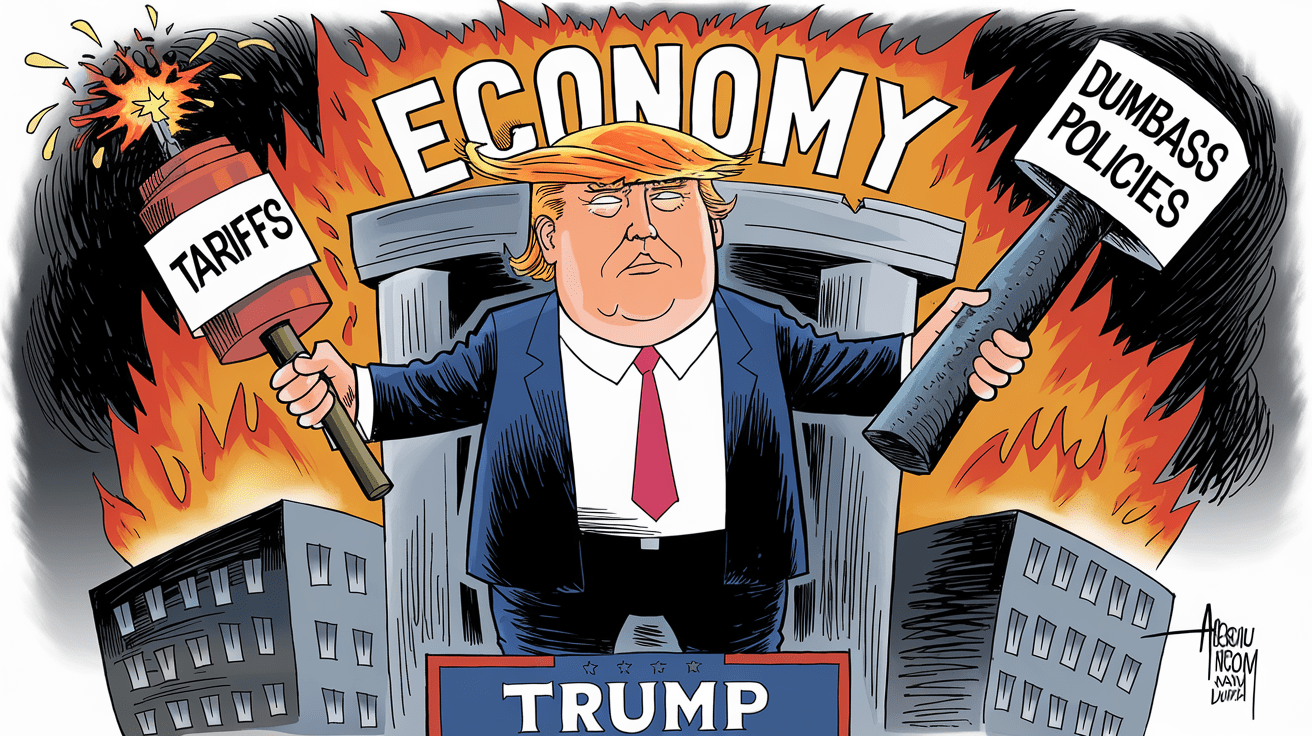
Trump's Reciprocal Tariffs: Leveling the Playing Field or Fueling Inflation?
We know the answer.
President Donald Trump is set to announce today a sweeping economic measure: reciprocal tariffs designed to equalize the duties that foreign countries impose on U.S. goods. While the administration argues this move will create fairer trade conditions, economists warn it will lead to higher inflation, complicating the economic landscape.
Reciprocal tariffs aim to mirror the tariffs that other nations place on American products. For instance, if a country imposes a 10% tariff on U.S. cars, the U.S. would reciprocate with a 10% tariff on cars from that country. However, implementing this policy is complex, as different countries levy varying tariffs on different goods. Goldman Sachs economists outline three potential approaches:
Country-level reciprocity: Imposing the same average tariffs that trading partners apply to U.S. goods.
Product-level reciprocity by country: Matching tariffs on a product-by-product basis for each trading partner.
Reciprocity including non-tariff barriers: Addressing additional factors like inspection fees and value-added taxes, making it the most intricate approach.
If past performance/behavior is any indication, Trumpco will choose the easiest and most reckless option.
Economists caution that these tariffs are often passed on to consumers through higher prices, potentially increasing inflation.
Deutsche Bank estimates that a 3.3 percentage-point rise in the effective tariff rate could lead to a 0.5 percentage-point annual increase in core personal consumption expenditures, the Federal Reserve's preferred inflation measure. This uptick will hinder the Fed's ability to cut interest rates, a move typically favored to stimulate economic growth.
As the administration moves forward with these tariffs, the balance between achieving fair trade and managing domestic economic impacts remains a critical concern.
Source: Forbes
House Republicans Unveil Ambitious Budget: $4.5 Trillion in Tax Cuts, Deep Spending Reductions
House Republicans have introduced a budget proposal aiming to implement $4.5 trillion in tax cuts over the next decade while also seeking to reduce federal spending by $1.5 trillion.
The plan includes a $4 trillion increase in the federal debt limit and allocates an additional $300 billion for border security and national defense. This blueprint reflects the GOP’s commitment to advancing President Trump’s domestic priorities.
The proposal outlines significant spending cuts across various sectors:
Agriculture: $230 billion
Education and Workforce: $330 billion
Energy and Commerce: $880 billion
Financial Services: $1 billion
Natural Resources: $1 billion
Transportation and Infrastructure: $10 billion
These reductions total approximately $1.45 trillion. Conversely, the budget proposes increases in spending for:
Armed Services: $100 billion
Homeland Security: $90 billion
Judiciary: $110 billion
Oversight and Government Reform: $50 billion
The Ways and Means Committee is authorized to implement tax changes that could increase the deficit by up to $4.5 trillion, paving the way for substantial tax cuts.
Critics argue that the proposed tax cuts only benefit the wealthy and will exacerbate the federal deficit and national debt.
Rep. Brendan Boyle, the top Democrat on the House Budget Committee, stated, “Their plan blows up the deficit and sticks the middle class with the bill, whether through higher prices, deep cuts to essential programs, or both.”
As the budget proposal advances, it is expected to face significant debate within Congress, highlighting the ongoing tension between MAGA and the need to fund essential government services.
Source: Mother Jones
From Suplexes to Schools: Trump Taps WWE’s Linda McMahon for Education Secretary
In a move straight out of WrestleMania, President Donald Trump has nominated Linda McMahon—yes, the same Linda McMahon who helped build World Wrestling Entertainment (WWE) into a billion-dollar empire—to lead the Department of Education.
With a background in body slams and powerbombs rather than pedagogy, McMahon’s qualifications for shaping America’s education system are, well, unorthodox. But if you squint, you might see the logic—after all, she did serve two years as head of the Small Business Administration in Trump’s first term.
Because if you can run a business, surely you can run an entire national education system, right? But that’s definitely NOT the point. They want to shutter the Department of Education.
Because, you know, a dumb electorate will keep voting for idiots.
McMahon’s education experience is as thin as a wrestling storyline. She had a brief stint on Connecticut’s State Board of Education, and she recently voiced support for expanding school choice and vocational training.
However, her confirmation hearing is expected to center on Trump’s larger goal—gutting the Department of Education altogether. The administration has already slashed funding for research and sent department staffers packing, signaling an intent to dismantle the agency piece by piece. If confirmed, McMahon will be overseeing the very agency Trump wants to put through a proverbial table.
Expect fireworks at her Senate confirmation hearing, where critics will likely grill her on whether she’s there to reform education or to pile-drive it into oblivion.
As one Democratic aide put it, “If she runs the Department of Education the way WWE scripts its matches, we’re in for a real circus.” Stay tuned.
Source: NPR
Senate Poised to Confirm Vaccine Skeptic RFK Jr. as Health Secretary: What Could Possibly Go Wrong?
In a plot twist no one saw coming (or perhaps everyone did), the Senate is set to vote on the confirmation of Robert F. Kennedy Jr., a prominent vaccine critic, as the nation's Health Secretary.
Backed by President Donald Trump, Kennedy is poised to oversee a $1.7 trillion budget covering vaccines, food safety, and health insurance programs for nearly half the country. Despite some Republicans expressing reservations about his controversial views, Kennedy's confirmation seems all but certain.
Kennedy, 71, has long been a polarizing figure, gaining notoriety for his populist—and often extreme—stances on food, chemicals, and vaccines. His influence surged during the COVID-19 pandemic, as he led a nonprofit organization that sued vaccine manufacturers and spearheaded social media campaigns to erode public trust in vaccines and the government agencies that promote them.
Now, with the backing of the Trump administration, Kennedy believes he is "uniquely positioned" to restore faith in public health institutions like the FDA, CDC, and NIH.
I have to admit—he is uniquely positioned!
While Republican senators have largely embraced Kennedy's vision, adopting his "Make America Healthy Again" slogan with gusto, some have required assurances regarding his stance on existing vaccine recommendations.
Democrats, on the other hand, remain skeptical, pressing Kennedy during hearings to disavow the debunked theory linking vaccines to autism—a stance he has yet to renounce.
Concerns have also been raised about potential conflicts of interest, given Kennedy's financial ties to law firms suing vaccine makers.
Nevertheless, barring any last-minute surprises, it appears the Senate is ready to place the nation's health in the hands of a man who has spent much of his career questioning the very science that underpins it.
Source: AP News
Trump's 'Art of the Deal' Diplomacy: Chatting Up Putin to End Ukraine War
In a move that surprised absolutely no one, President Donald Trump announced he had a "lengthy and highly productive" phone call with Russian President Vladimir Putin, during which they agreed to kickstart negotiations to end the ongoing war in Ukraine. Trump also dialed up Ukrainian President Volodymyr Zelenskyy, who, according to Trump, "wants to make PEACE."
U.S. Defense Secretary Pete Hegseth chimed in, labeling Ukraine's pre-2014 borders as an "unrealistic objective" and dismissing NATO membership for Ukraine as a pipe dream. He suggested that chasing these "illusionary goals" would only prolong the war and cause more suffering.
Critics are already sounding the alarm, warning that Trump's approach might be more about appeasing Putin than achieving a fair peace. German officials have labeled the concessions as "regrettable," while Ukrainian President Zelenskyy insists he won't accept any agreements that sideline his country.
Source: ABC News