


Listen to the podcast:
Trump’s Bold Air Force One Makeover: Musk to the Rescue
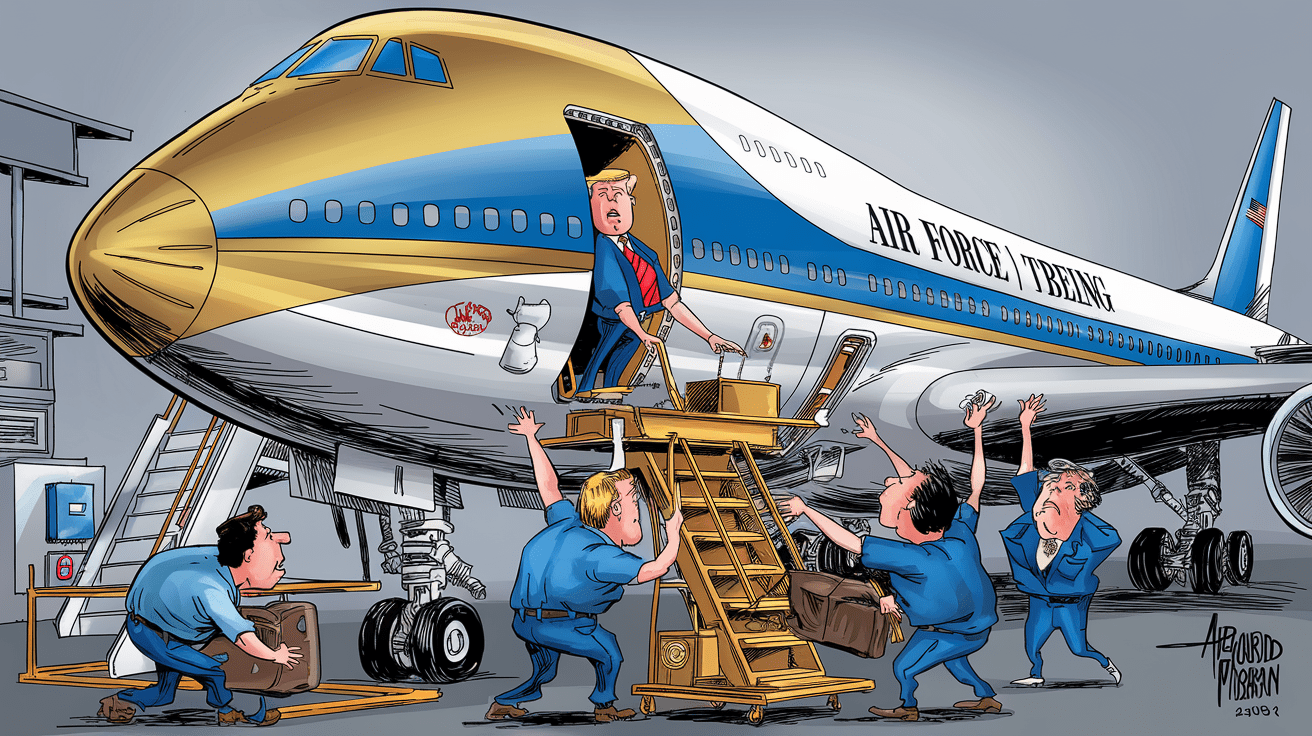
In a stunning shakeup, President Trump is putting Elon Musk in charge of speeding up the delivery of new Air Force One jets—despite safety concerns.
Tired of Boeing’s delays and the high stakes of presidential travel, Trump is betting that if Musk can launch rockets, he can certainly get a plane airborne.
We already know Leon spends most of his time high as a kite.
Frustrated with Boeing’s inability to meet the original 2024 deadline, Trump has turned to the billionaire entrepreneur to cut through red tape and risky protocols.
Musk isn’t just promising faster production; he’s considering scrapping some of the strict testing requirements and even lowering security clearances to get more hands on deck.
This radical approach has officials nervous, with one insider noting, “The [safety] requirements could be scrubbed down and more risk can be assumed,” as a stark reminder of the potential hazards involved.
Hey, I say, do whatever it takes to get those planes on the tarmac! Risk mitigation doesn’t matter.
The plan, commissioned back in 2018 as part of a $3.9 billion contract, now risks becoming a high-stakes gamble that could leave the president vulnerable.
Musk’s audacious promise to complete at least one jet within a year is drawing both skepticism and cautious optimism.
Source: MDGN
Trump Expands Presidential Control Over Independent Agencies
In a bold move to consolidate power, President Trump signed an executive order granting him greater authority over independent regulatory bodies, a shift aimed at enforcing loyalty and tighter control over the government.
The new directive mandates that agencies submit future regulations to the White House, establish liaison offices, and maintain regular consultations with the executive branch. By extending this control, Trump aims to dismantle longstanding barriers that kept these agencies largely independent from direct presidential influence.
The order, which notably excludes the Federal Reserve’s Board of Governors and Open Market Committee, represents a significant escalation in the administration’s efforts to reshape regulatory oversight.
As law professor Daniel Farber observed, “Given Trump's insistence on complete loyalty to him on the part of all government employees, this move is designed to extend his grip on the government to areas that previously have been nonpartisan.”
This shift has already led to the dismissal of key officials from agencies like the Equal Employment Opportunity Commission and the National Labor Relations Board, sparking debates and potential legal challenges over its legality.
Anchored in the conservative Heritage Foundation’s Project 2025 blueprint, this executive order builds on previous policy changes that attempted to curb the independence of regulatory agencies, fundamentally altering the stability of sectors such as finance, labor, and trade.
With experts warning of potential regulatory whiplash, the long-term impact of these changes remains to be seen.
Source: NPR
Trump Targets Chips Act Workforce Amid Tech Tensions
President Donald Trump is shaking up America's semiconductor strategy by planning significant staff cuts at agencies managing the $53 billion CHIPS Act.
Nearly 500 workers at NIST, including those overseeing an $11 billion semiconductor R&D program, are reportedly on the chopping block—a move that could delay funds for domestic chip fabs and R&D projects.
Reports from Axios and Bloomberg indicate that these layoffs will also hit the US AI Safety Institute, potentially impairing evaluations of emerging AI models.
With NIST’s leadership in transition—following the departure of Director Laurie E. Locascio and the recent appointment of Acting Director Craig Burkhardt—the Trump administration’s strategy appears aimed at curbing the agency's role in disbursing crucial CHIPS Act funds, all while fostering a narrative of American technological supremacy.
The administration's moves come as Trump teases imposing tariffs of 25% or more on imported semiconductors, further complicating the chip landscape.
During an October 2024 appearance on the Joe Rogan Experience podcast, he labeled the CHIPS Act “so bad.” Of course, with Trump, his cult followers just suck it all in, never asking probing questions as simple as “How bad?”
Meanwhile, swirling rumors suggest that rival chip giants like Broadcom and TSMC are eyeing a breakup of Intel, adding yet another layer of uncertainty to an already tumultuous sector.
Source: MDGN
Bolsonaro Accused of Approving Poison Plot Against President Lula
Brazil’s former president Jair Bolsonaro is facing bombshell allegations that he knew of and approved a plan to poison his successor, President Luiz Inácio Lula da Silva, as part of a failed coup attempt to remain in power.
Prosecutor-General Paulo Gonet formally charged Bolsonaro on Tuesday, detailing a conspiracy that allegedly included an assassination attempt on Supreme Court Justice Alexandre de Moraes, a key opponent of the former leader. The accusations come amid a broader crackdown on efforts to undermine Brazil’s democracy following Bolsonaro’s 2022 election defeat.
Gonet’s report claims that Bolsonaro and his allies developed a plot called "Green and Yellow Dagger" to dismantle democratic institutions and maintain power illegally.
“The members of the criminal organization structured at the presidential palace a plan to attack institutions, aiming to bring down the system of the powers and the democratic order, which received the sinister name of ‘Green and Yellow Dagger,’” Gonet stated, emphasizing that Bolsonaro was fully aware of the plan.
The prosecutor’s case builds on an 884-page report from Federal Police, which alleges a systematic campaign to erode trust in the electoral system, pressure military leaders into supporting the coup, and incite riots in the capital.
Sound familiar?
Despite the damning allegations, Bolsonaro denies any wrongdoing. “I have no concerns about the accusations, zero,” he told reporters, dismissing the claims as baseless.
The Supreme Court will now review the charges, and if accepted, Bolsonaro could face trial for attempting to overthrow Brazil’s democratic order.
Source: AP News
Microsoft Claims Breakthrough in Quantum Computing with a New State of Matter
In a major leap forward for quantum computing, Microsoft has announced the creation of a new state of matter that could revolutionize the field.
The company’s researchers say they have successfully built a "topological qubit," a fundamental building block for quantum computers that could dramatically accelerate advancements in fields ranging from artificial intelligence to medicine.
This breakthrough positions Microsoft at the forefront of the race to develop practical quantum computing, a technology that has the potential to outperform even the most powerful supercomputers in solving complex scientific and mathematical problems.
On Wednesday, Microsoft detailed its achievement, explaining that its new qubit design relies on an exotic combination of semiconductors and superconductors cooled to extreme temperatures.
"We view this as something that is years away, not decades away," said Chetan Nayak, a Microsoft technical fellow leading the research.
Unlike other quantum systems, which are notoriously unstable and prone to errors, Microsoft’s approach is designed to be more resilient, potentially overcoming a key hurdle that has slowed quantum computing’s progress.
However, some experts remain skeptical about whether the company has truly achieved a functional topological qubit, as verifying such claims remains a challenge.
The implications of a successful quantum computer are enormous.
Not only could it unlock solutions to previously unsolvable problems, but it also raises security concerns, as quantum computers could break modern encryption methods.
The global competition is fierce—while Microsoft and Google lead the charge in the U.S., China has committed $15.2 billion to its own quantum research, with the European Union following at $7.2 billion.
"If everything works out, Microsoft’s research could be revolutionary," said Philip Kim, a physics professor at Harvard.
As Microsoft pushes forward, the world watches to see if this new state of matter will truly deliver the quantum revolution.
Source: NYT
Trump Administration Plans to Invoke Title 42 Again, Citing Public Health Concerns
The Trump administration is preparing to issue a public health order that would further restrict immigration at the U.S.-Mexico border, citing disease risks.
The order, expected as early as this week, would label migrants as potential carriers of communicable diseases, echoing the controversial Title 42 policy first enacted during the COVID-19 pandemic.
While the specifics of the new order remain unfinalized, sources say it will reference illnesses such as measles and tuberculosis as justification for border expulsions.
This move comes despite migrant crossings already plummeting due to existing border measures.
The Centers for Disease Control and Prevention (CDC) is responsible for determining whether such a public health threat exists, though former officials argue that this is a political maneuver disguised as a health measure. Because, of course, it is.
“Given what’s happened in Texas, I hope we protect the Mexicans from ourselves,” said Dr. Michael Osterholm, director of the Center for Infectious Disease Research and Policy at the University of Minnesota.
Critics, including immigration advocates and legal experts, argue that Title 42 does not meaningfully deter crossings and instead encourages repeat attempts.
Legal challenges are expected, with the ACLU previously suing to overturn its prior implementation.
Title 42, which was used nearly 3 million times before expiring in May 2023, allowed border authorities to swiftly expel migrants without legal proceedings, bypassing asylum protections.
Stephen Miller (aka, Baby Goebbels), a key architect of Trump’s immigration policies, has long pushed for reinstating Title 42, stating in 2023 that the administration could justify its use by citing “severe strains of the flu, tuberculosis, scabies, other respiratory illnesses like R.S.V., and so on.”
With a measles outbreak in Texas and ongoing fears of mass migration, the administration appears set on reviving one of its most controversial policies, ensuring immigration remains a major flashpoint heading into the midterms in 2026.
Source: MDGN