


Listen to the podcast:
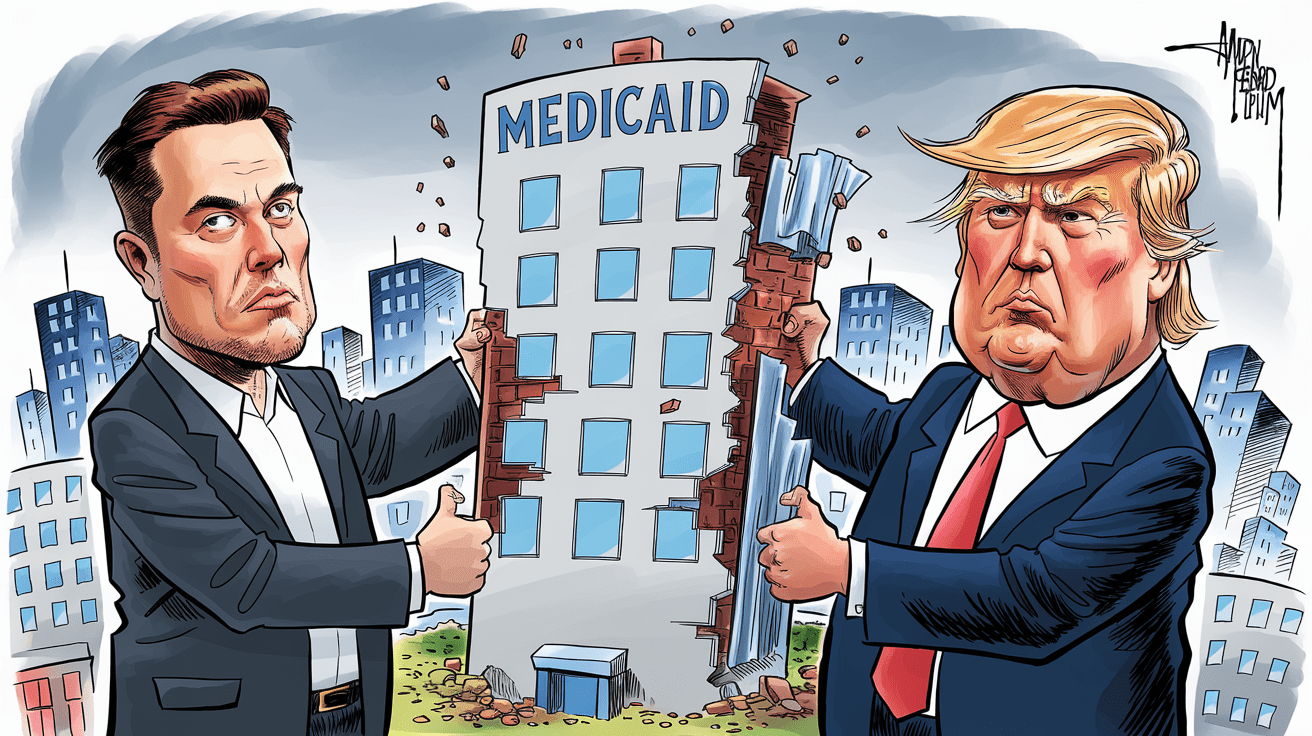
Trump’s Medicaid Cuts: Millions Face Losing Lifesaving Care
Jonathan Riviera lost his leg in January, but now he fears losing something even more critical—his health coverage.
Living in Florida, a state that refused Medicaid expansion, Riviera relies on Medicaid for the prosthetics and medical care he needs to survive.
But with House Republicans pushing for hundreds of billions in Medicaid cuts at Trump’s urging, millions like Riviera could be left stranded, unable to access even basic medical treatment. His wife, also disabled, and their autistic son depend on the same fragile safety net. “Getting kicked off it,” Riviera says, “would probably destroy me.”
Trump’s Medicaid rollback is a direct echo of his first-term attacks on the program. Nearly 70 million Americans rely on Medicaid, with 20 million only covered because of the ACA’s expansion. In states like Florida, where over a million low-income residents have already been denied coverage, the situation is dire.
Experts warn that further cuts will devastate disabled individuals, pregnant women, and children—populations Medicaid is legally bound to protect. Meanwhile, right-wing figures like Elon Musk and Speaker Mike Johnson fuel baseless narratives about Medicaid fraud, ignoring the fact that two-thirds of working-age Medicaid recipients are employed but earn too little to afford private insurance.
If Trump’s cuts proceed, states will likely impose harsher eligibility rules, roll back essential services, and introduce punitive work requirements that disproportionately harm the disabled.
Arkansas’ brief experiment with work requirements in 2018 led to 18,000 people losing coverage.
Georgetown professor Edwin Park warns, “The work requirements don’t include exemptions for people with SSI, let alone all the other people with disabilities who are covered by Medicaid.”
As states scramble to balance budgets, hospitals will close, provider rates will drop, and millions will be forced into medical debt—or worse.
“The right’s attacks on Medicaid,” says policy expert David Machledt, “seem to be designed to trip people up and then blame them for falling.”
Source: Mother Jones
Trump’s Funding Freeze Puts the Colorado River—and Millions of Lives—at Risk
The Colorado River is dying, and now the federal funds meant to keep it flowing have been cut off.
On his first day back in office, Trump signed an executive order halting all Inflation Reduction Act funding, including $4 billion allocated to keeping the river from drying up completely.
This river isn’t just a picturesque landmark—it supplies drinking water for 40 million people, supports agriculture across the Southwest, and generates hydroelectric power. Without this money, conservation efforts stop, water levels drop, and the risk of total collapse inches closer.
As water policy expert Anne Castle warns, “Having this appropriated funding suddenly taken away undoes years and years of very careful collaboration among the states in the Colorado River Basin and threatens the sustainability of the entire system.”
The crisis isn’t hypothetical—Lake Mead and Lake Powell, the nation’s two largest reservoirs, are already at record lows due to decades of drought. If they drop much further, they won’t just stop generating hydropower; they won’t be able to send water downstream at all.
Farmers, Native American tribes, and cities that depend on federal conservation payments are now left scrambling, unsure how they’ll afford to keep the water flowing.
“If there’s no funding,” said California irrigation board member Bart Fisher, “there will be no conservation.”
Without these programs, farmers will use every drop they can to stay in business, accelerating the river’s decline.
The consequences will ripple far beyond the Southwest. A collapsed Colorado River system means mass water shortages, skyrocketing food prices, and the potential for entire communities to become uninhabitable.
Conservation groups, already stretched thin, say they cannot fill the gap left by the federal freeze. The clock is ticking, and every day of inaction brings the region closer to an irreversible catastrophe.
“Our economy is going to be impacted,” said former Eagle River Watershed Council director Holly Loff. “It’s just far-reaching. And I really can't think of how anyone can avoid being impacted.”
Source: NPR
Putin to US: Want Some Stolen Ukrainian Minerals? No Problem!
Vladimir Putin is now moonlighting as a minerals salesman, offering the US access to rare earth deposits—including from Ukrainian land Russia has forcibly occupied.
In a move that would be hilarious if it weren’t so brazen, Putin told state TV that Russia is open to joint mining projects with American partners, including in its so-called "new territories" (a.k.a. the parts of Ukraine it illegally annexed).
Meanwhile, Trump has been pressuring Ukraine to fork over its mineral wealth in exchange for US aid, with negotiations reportedly close to a deal.
Putin, never one to miss a chance to troll both Ukraine and the West, reassured everyone that Russia has “significantly more resources of this kind than Ukraine” and is happy to do business.
This latest Kremlin stunt comes after years of Putin railing against Western exploitation of Russian resources, warning that the US wanted to “dismember” Russia for its natural wealth.
Now, he’s practically waving a “Going Out of Business” sign over Ukraine’s mineral deposits while making a play for economic cooperation with the very country he claims is out to destroy him.
His offer even includes aluminum production in Siberia—because apparently, after years of sanctions and economic isolation, Russia is looking for any excuse to get back into global markets. Kremlin spokesman Dmitry Peskov hyped up the potential deal, reminding the world that the US “needs rare earth minerals and Russia has a lot of them.”
Meanwhile, Ukraine is still fending off Trump’s demand for a minerals-for-aid deal, with President Zelensky reportedly pushing for security guarantees in exchange. Ukraine holds about 5% of the world’s critical raw materials, but Russia’s invasion has already cut deeply into that supply.
As European officials seek their own mineral agreements with Kyiv, the situation has become a surreal geopolitical bidding war, with Russia crashing the party uninvited.
If nothing else, Putin’s latest move makes one thing clear: when it comes to pillaging Ukraine, he’s happy to share—just as long as he gets to set the price.
Source: BBC
Countdown to War? Iran on High Alert as U.S. and Israel Threaten Strikes
Iran is bracing for what could be a devastating military confrontation, placing its nuclear sites on high alert amid growing fears of an attack by Israel and the United States.
General Amir Ali Hajizadeh, commander of the IRGC Aerospace Force, acknowledged gaps in Iran’s missile defense, stating, “In recent events, we suffered damage in this area, which shows a deficiency in the country’s ballistic defense sector.”
Tehran is now scrambling to deploy a new anti-ballistic system by March, as Prime Minister Netanyahu vows to “finish the job” with Trump’s backing. With regional allies collapsing and internal dissent rising, Iran faces its most precarious moment in years.
The stakes couldn’t be higher. Trump’s return to power has reignited his "maximum pressure" campaign, aiming to crush Iran’s economy and halt its nuclear ambitions.
Meanwhile, Israel has been steadily dismantling Tehran’s regional influence, dealing blows to Hamas and Hezbollah while watching Syria’s Assad regime—one of Iran’s closest allies—fall apart.
Analysts warn that while Israel alone may struggle to destroy Iran’s nuclear infrastructure, a U.S.-led coalition could attempt to do just that.
Trump has hinted at preferring a diplomatic deal, but his administration has also made it clear that military action is firmly on the table if Iran refuses to comply.
A full-scale conflict between Iran and its adversaries wouldn’t just shake the Middle East—it could trigger a chain reaction across the globe.
If Israel strikes, Iran will retaliate, and with missiles capable of hitting U.S. bases and regional targets, escalation is nearly inevitable.
The world has seen this script before, but this time, nuclear facilities are in the crosshairs. With each passing day, the window for diplomacy shrinks, and the shadow of war looms ever larger.
Source: Telegraph
UK Slams Russia With Its Harshest Sanctions Yet—And Hits North Korea Too
Marking the third anniversary of Russia’s invasion of Ukraine, the UK has unleashed its most extensive sanctions package since the war began, targeting not just Russian companies but global suppliers helping to fuel Putin’s military machine.
The new measures blacklist firms providing microprocessors, electronics, and machine tools essential to Russia’s weapons systems—many based in Turkey, India, China, and Central Asia. The sanctions also extend to North Korean Defense Minister No Kwang Chol over Pyongyang’s deployment of forces to Russia, as well as Kyrgyzstan’s Keremet Bank.
The British government insists these measures will choke Moscow’s war effort.
"Every military supply line disrupted, every rouble blocked, and every enabler of Putin’s aggression exposed is a step towards a just and lasting peace," said UK Foreign Minister David Lammy.
Among the most high-profile names targeted is Russian billionaire Roman Trotsenko, while a further 40 vessels suspected of helping Russia evade oil sanctions have also been added to the blacklist.
London’s move has triggered diplomatic backlash—China, in particular, has condemned the sanctions, calling them unjustified and in violation of international law.
"China firmly opposes this and has made solemn representations to the UK side," the Chinese embassy declared.
The Russian embassy in London has so far remained silent.
As Western governments tighten the noose around Russia’s economy, the big question remains: Will these measures be enough to cripple Moscow’s war machine, or will Putin find new ways to circumvent them?
With reports of increased military cooperation between Russia and its allies—including North Korea—the geopolitical chessboard is becoming even more dangerous. Meanwhile, the UK’s latest sanctions show that, three years in, the economic war against Russia is far from over.
Source: Reuters
Farmers Sue USDA After Climate Data Vanishes From Government Websites
The Trump administration’s Agriculture Department is facing a lawsuit after critical climate data used by farmers and researchers was mysteriously erased from its websites.
According to the suit, filed Monday in the U.S. District Court for the Southern District of New York, the USDA ordered the removal of references to climate change on January 30—scrubbing datasets, interactive tools, and funding information essential for agricultural planning.
Within hours, decades of long-term weather trends and adaptation strategies were gone, leaving farmers in the dark.
Peter Lehner, an attorney for Earthjustice, warned, "The pages being purged were crucial for farmers facing risks linked to climate change, including heat waves, droughts, floods, extreme weather, and wildfires."
Adding insult to injury, the USDA also froze funding promised to businesses and nonprofits for conservation and climate resilience programs—while simultaneously deleting records about those programs.
The lawsuit, filed by Earthjustice and the Knight First Amendment Institute, argues that this purge effectively denied farmers access to resources they rely on to secure owed funds.
Groups such as the Northeast Organic Farming Association and the Natural Resources Defense Council, which depend on USDA climate data for research and advocacy, are among the plaintiffs demanding transparency and restoration of the deleted materials.
For farmers already struggling with unpredictable weather, losing access to critical climate models and funding sources is a financial and logistical nightmare.
The move has raised alarm bells among environmental advocates who see it as part of a broader effort to dismantle climate policy at the federal level
Whether this is bureaucratic incompetence or a deliberate effort to suppress climate data, one thing is clear—farmers and researchers are fighting back.
Make no mistake: This is deliberate.
Source: MDGN