


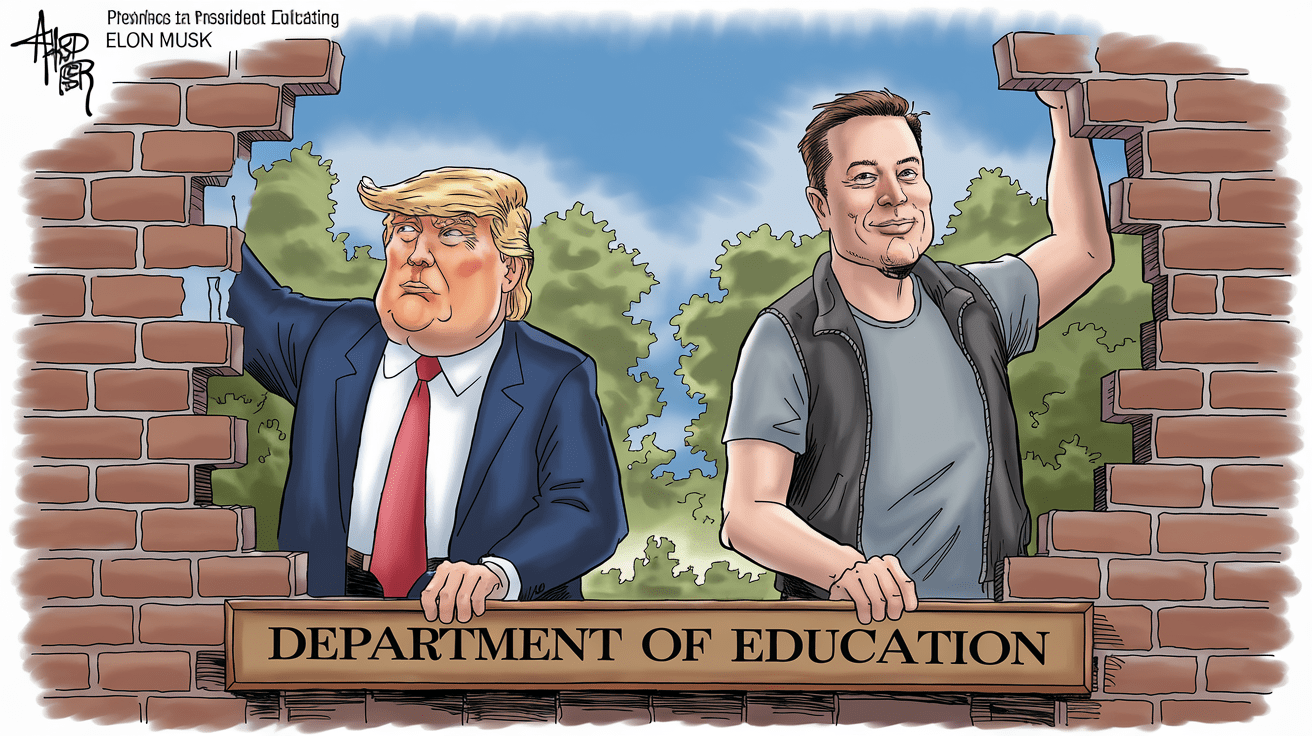
Trump Moves to Dismantle Education Department Amid Congressional Hurdles
President Donald Trump is preparing an executive order aimed at dismantling the U.S. Department of Education from within, despite congressional authority being required to shut it down entirely. According to sources briefed on the order, the administration has already begun cutting staff by placing employees on administrative leave and encouraging voluntary resignations. Additionally, about 20 members of Elon Musk’s “Department of Government Efficiency” (DOGE) have entered the agency, reviewing spending and personnel while reportedly gaining access to sensitive financial aid data. The effort aligns with Trump’s longstanding campaign promise to eliminate the department, though legal and political barriers make full dissolution unlikely.
The executive order, expected later this month, will direct the department to draft a legislative proposal for Congress while also reducing its workforce and operations in the meantime.
Conservative policy group Project 2025 has outlined plans to relocate key functions—such as moving the federal student loan program to the Treasury Department and shifting civil rights enforcement to the Justice Department—though these changes also require congressional approval. “Effectively shutting down the Department of Education through Executive Order or mass firings is a recipe for chaos,” said Aaron Ament, president of the National Student Legal Defense Network. Despite skepticism about its feasibility, Trump’s move signals a broader push to shrink federal oversight in education and test the limits of executive authority.
Republicans in Congress remain divided on the approach, with past efforts to abolish the department failing to gain enough support even within the party. A 2023 House vote on the matter saw 60 Republicans join Democrats in opposition. Representative Tim Walberg (R-MI), chairman of the House Education Committee, acknowledged the uphill battle, stating, “I would not hold my breath that [closing the department] would ultimately become law.” Instead, some GOP lawmakers are focusing on strategies to weaken the agency’s influence, such as budget cuts and staff reductions. Meanwhile, legal experts predict that any attempt to move education programs without legislative approval will face immediate court challenges. As Trump tests the boundaries of executive power, education policy remains a battleground for ideological and legal fights.
Source: Washington Post
Before you ask: Yes, they do realize what they’re doing is wrong and will have severe negative impacts. That is the point.
Oh, and if you EVER believed Trump “knew nothing” about Project 2025—you’re a dumbass.
Trump Admin Reverses Course on Air Traffic Controller Buyouts After Deadly Crashes
After initially offering buyouts to nearly 2 million federal employees, including air traffic controllers, the Trump administration has now exempted controllers from the program following two catastrophic aviation disasters. The decision comes after an American Airlines flight collided with a U.S. Army Black Hawk helicopter near Ronald Reagan National Airport, killing 67 people, and a medical transport jet crashed in Philadelphia, resulting in seven deaths and 19 injuries. The buyout plan, which grants eight months of severance pay to those who voluntarily resign, is part of Trump’s broader effort to reduce the federal workforce. However, aviation safety concerns quickly forced officials to clarify that air traffic controllers would not be eligible for early retirement.
Transportation Secretary Sean Duffy confirmed the exemption, stating, "We’re going to keep all our safety positions in place, no early retirement. We’re all going to stay and work and make sure our skies are safe." This announcement follows a report from the National Transportation Safety Board, which revealed that only one air traffic controller was on duty at Reagan Airport when the fatal collision occurred—a staffing shortage that experts say has become alarmingly common. A New York Times analysis found that 285 of 313 U.S. air traffic control facilities remain understaffed, an issue exacerbated by pandemic-era hiring slowdowns and workforce attrition.
Despite growing concerns, the Trump administration has attempted to shift blame, with Duffy suggesting that diversity, equity, and inclusion (DEI) initiatives have distracted from core safety priorities—though no evidence supports this claim. Meanwhile, hiring efforts continue, with the FAA reporting 1,512 new controllers added in 2023. However, critics argue that the long-term workforce shortage remains an urgent issue that cannot be resolved through short-term policy shifts. As investigations into the crashes continue, the administration faces mounting pressure to address systemic staffing failures rather than focusing solely on workforce reductions.
Source: Fortune
These guys are nothing if not complete idiots. They don’t know how to govern. BUT THAT’S THE POINT.
They think, if they can’t do it (because they’re so fucking smart), NOBODY can do it and therefore, it’s not necessary. That’s it. That’s the entire ballgame.
Tesla Pays Zero in Federal Taxes Again—While GOP Pushes for More Corporate Tax Cuts
Tesla, the world’s most valuable automaker, paid zero federal income tax in 2024 despite reporting $2.3 billion in U.S. income, thanks to a combination of tax loopholes and deductions. Over the past three years, the company has reported $10.8 billion in U.S. income but paid only $48 million in federal taxes—an effective tax rate of just 0.4 percent, far below the standard 21 percent corporate tax rate. The company benefited from accelerated depreciation, executive stock option deductions, and unspecified U.S. tax credits, all of which allowed it to wipe out its tax obligations. Meanwhile, Republicans are pushing to lower the corporate tax rate even further to 15 percent, a move that critics say would allow massive companies like Tesla to contribute even less while shifting the tax burden onto working Americans.
The 2017 Tax Cuts and Jobs Act, signed by then-President Donald Trump, played a major role in Tesla’s ability to avoid federal taxes by slashing corporate tax rates and expanding deductions. “When you don’t focus on safety and you focus on social justice or the environment, bad things happen,” said Transportation Secretary Sean Duffy, attempting to deflect criticism of corporate tax loopholes. But progressive lawmakers argue that the real issue is an outdated tax code that enables the wealthiest corporations and billionaires—like Tesla CEO Elon Musk, whose net worth exceeds $400 billion—to pay little to no income tax while public services remain underfunded. With Tesla’s three-year tax rate at just 0.4 percent compared to the 13.3 percent paid by average American workers, the disparity in the tax system has become a rallying point for reform advocates.
Proposed solutions include a minimum corporate tax rate to prevent companies from dodging taxes through loopholes, closing the accelerated depreciation provision that allows corporations to write off assets faster than they actually lose value, and implementing a billionaire minimum tax on unrealized capital gains. While the GOP pushes for further corporate tax cuts, progressive leaders insist that it's time for the ultra-wealthy and highly profitable corporations to pay their fair share. As Congress debates the future of tax policy, the battle over corporate taxation could define economic inequality in the years ahead—determining whether the system continues to favor billionaires and corporations or shifts toward a more equitable tax structure.
Source: Nation of Change
The lesson? Really wealthy companies and people should never pay taxes because taxes are for the Common Man.
CDC Webpages Disappear as Trump Admin Purges Public Health Information
Key Centers for Disease Control and Prevention (CDC) webpages tracking critical public health data have gone dark in recent days, raising alarms over the Trump administration’s efforts to censor or erase vital health resources. Websites focused on HIV prevention, sexually transmitted infections (STIs), contraception, and gender-affirming care have either disappeared or reappeared with significantly reduced content. Additionally, the National Institutes of Health (NIH) has scrubbed pages on women’s health research and funding, while the CDC’s long-running Youth Risk Behavior Survey, a key tool for understanding teen health trends, remains largely inaccessible. Experts fear the erasure of such data will have serious consequences for public health, scientific research, and policymaking.
Harvard epidemiologist Nancy Krieger sounded the alarm, stating, "Science is disappearing from U.S. websites, the work of government-sponsored science is disappearing, the datasets are disappearing."
According to a New York Times analysis, more than 8,000 pages from various government health sites were removed in just a few days. While some have returned, they are often stripped of critical details or contain broken links. The administration claims the deletions align with executive orders mandating the removal of diversity, equity, and inclusion (DEI) initiatives and any references to gender identities beyond “male” and “female.” However, public health experts warn that the purge could obstruct medical professionals, researchers, and policymakers who rely on government data to address pressing health crises.
The loss of these resources has prompted emergency efforts to preserve disappearing information, with researchers scrambling to archive data before it vanishes permanently. “Suppressing or limiting access to facts weakens our ability to address urgent health challenges—from infectious disease outbreaks to mental health crises. Hiding the facts puts lives at risk,” said Dr. Tom Frieden, former CDC director under the Obama administration. Meanwhile, doctors worry about the long-term consequences, with OB-GYN Dr. Rachel Jensen warning, “To think about an entire generation of doctors not having access to that information is frightening.” As public health experts and researchers fight to salvage disappearing data, the Trump administration’s moves signal a deeper battle over science, censorship, and the future of public health policy in America.
Source: The Guardian
They are literally erasing science. Next up: History!
Trump’s Tariffs Set to Drive Car Prices Up by $3,000 Amid Auto Industry Turmoil
President Donald Trump’s new tariffs on Canada and Mexico are poised to shake up North America’s auto industry, threatening production and pushing already high vehicle prices even higher. With nearly a quarter of a trillion dollars in trade at risk, automakers are warning that the added costs will trickle down to consumers, potentially raising car prices by an average of $3,000.
The move comes as inflation-weary buyers are already struggling with record-high vehicle costs, and industry experts caution that the tariffs could further disrupt supply chains, leading to production delays and layoffs.
The impact is expected to hit both domestic and foreign automakers that rely on North American trade for critical components. “This is going to be a direct tax on consumers,” said a senior auto executive who requested anonymity. Manufacturing hubs in Mexico and Canada play a vital role in U.S. vehicle production, and the new tariffs could force companies to rethink supply chains, pass costs onto buyers, or cut back on production altogether. With the global auto industry still recovering from pandemic-related supply shortages, these tariffs add another layer of instability to an already fragile market.
The political stakes are high, as Trump’s trade policies were a cornerstone of his first presidency and remain a key focus of his second term. However, industry leaders warn that these tariffs could have unintended consequences, including job losses in U.S. manufacturing and a slowdown in vehicle sales. Meanwhile, consumer advocacy groups are raising alarms over the affordability crisis, with some calling for government intervention to offset the financial strain on American buyers. As the auto sector braces for impact, all eyes are on whether automakers will absorb the costs or pass them directly to consumers at the dealership.
Source: Bloomberg
I guess when you have nearly a trillion dollars of your own and you’re just a part-time CEO of Tesla, it doesn’t matter that your companies’ profits go down the shitter.
Elon Musk's Unchecked Power Grab: A Threat to American Democracy
Elon Musk, the world's second richest man (we all know Putin has more money and that’s why Leon (sic) sucks up to him so hard), has transcended his role as a tech mogul to become a central figure in President Donald Trump's administration, wielding unprecedented influence over federal operations. Through the newly established and fake Department of Government Efficiency (DOGE), Musk has assumed the authority to override congressional spending decisions and access private information about every U.S. taxpayer. This consolidation of power raises significant concerns about the erosion of democratic norms and the potential for autocratic governance.
In a bold move, Musk unilaterally canceled hundreds of millions of dollars in government grants after gaining access to the U.S. Treasury's vast payment system. This action led to the abrupt resignation of a senior Treasury official who opposed Musk's overreach. Boasting on his social media platform, X, Musk claimed he was "rapidly shutting down... illegal payments" after a list of grants to Lutheran organizations was posted online. (apnews.com)
It's important to note that DOGE is not an official department authorized by Congress but rather the creation of an executive order signed by Trump. This advisory group is usurping powers constitutionally granted to Congress, particularly the power of the purse. Last week, Trump issued a memo to freeze federal funding for programs like Medicaid and SNAP, only to retreat in the face of public protest and an adverse court decision. Under the Constitution, Congress alone controls federal spending, while the president is obligated to "faithfully execute the laws." Trump's attempt to withhold funds already allocated by Congress constitutes "impoundment," a practice forbidden by longstanding legal precedents.
Waleed Shahid, a Democratic Party strategist, encapsulated the alarming scope of Musk's power grab: "Not with tanks in the streets or militias at government buildings, but with spreadsheets, executive orders, and a network of loyalists embedded in the federal bureaucracy. In just the past few days, Musk's hand-picked agents have seized control of Treasury's $6 trillion payment system, the Office of Personnel Management (OPM), and the General Services Administration (GSA)—institutions that, together, function as the central nervous system of the U.S. government... In any other country, experts would call it state capture, a textbook coup." (apnews.com)
By infiltrating key federal agencies, Musk and his DOGE team have gained access to an astonishing amount of public data, including Social Security numbers and information on government benefits received by citizens. This unprecedented access to sensitive information poses significant risks to individual privacy and the integrity of governmental operations.
Musk's nebulous status as both a private citizen and presidential crony has allowed him to exploit data that can easily be abused. Coming from Silicon Valley, Musk knows that data is power. Now he has access to the full data set of the federal government, which he is both hoarding to himself and preventing the public from seeing. Many government websites have already been shuttered, allegedly as a temporary measure during the Trump/Musk reorganization, including public health datasets and census data.
Most disturbingly, Musk and his DOGE team lack proper congressional authorization. As University of Denver political scientist Seth Masket notes, "Elon Musk is not a federal employee, nor has he been appointed by the President nor approved by the Senate to have any leadership role in government. The 'Department of Government Efficiency,' announced by Trump in a January 20th executive order, is not truly any sort of government department or agency, and even the executive order uses quotes in the title. It's perfectly fine to have a marketing gimmick like this, but DOGE does not have power over established government agencies, and Musk has no role in government. It does not matter that he is an ally of the President. Musk is a private citizen taking control of established government offices. That is not efficiency; that is a coup." (apnews.com)
The end goal of this coup is to give Trump and Musk control over the spigot of Treasury spending—in other words, control over the heart of the federal government that ensures the flow of money. Economist Nathan Tankus has assembled alarming reports indicating that Musk and his DOGE team are working toward control of Treasury's computer network system.
Tankus spells out the new power this would give Trump and Musk: "Without political control of the payment's heart, the Trump administration and Elon Musk must chase down every agency and bend it to their will. They are in the process of doing that, but bureaucrats can notionally continue to respect the law and resist their efforts. They are helped in this effort by court injunctions they can point to. This is bureaucratic trench warfare. But if Musk and Trump can reach into the choke point, the Bureau of the Fiscal Service, they could possibly not need agency cooperation. They can just impound agency payments themselves. They could also possibly stop paying federal employees they have forced on paid administrative leave, coercing them to resign. These possibilities are what every Treasury expert I've talked to instantly thought of the moment they read the Washington Post reporting and are incredibly alarmed about." (apnews.com)
Is anyone prepared to end this coup?
Describing an action as unconstitutional does little good if the system of checks and balances breaks down. Paraphrasing Joseph Stalin's famous quip about the powerlessness of moral leaders such as the Pope, one might ask, "How many divisions does the Constitution have?" There are likely to be court challenges, some of which will roll back parts of Musk's coup. But the courts are a fickle—and in any case non-democratic—remedy. Musk's abuse of power is a massive encroachment on congressional authority, but there is little reason to expect Congress will fight back.
Congressional Republicans have shown themselves to be abjectly servile to Trump, which makes remedies such as impeachment moot. Nor do Democrats at this moment have any fighting spirit.
Instead, Senate Majority Leader Chuck Schumer has adopted the stance that it is best to keep the Democrats' powder dry for future battles. He is SUCH a nimrod!
Schumer told The New York Times, "We're not going to go after every single issue. We are picking the most important fights and lying down on the train tracks on those fights."
It's a bit distressing that even in this fantasy scenario, Schumer is not imagining rallying the public to counter Trump's destruction of democracy. Instead, Schumer daydreams about Democrats tying themselves to the metaphorical train tracks, which he apparently believes (all evidence to the contrary) will excite the mercy of the Republicans to stop the train. This is the dream life of the willfully self-defeating—people whose only hope is that the bully will at some point get tired of beating them up.
More vigorous elements of the Democratic coalition haven't given up the fight. The grassroots group Indivisible notes, "The rules of the Senate are designed to protect the rights of the minority, and Democrats have tools at their disposal to grind Senate business to a halt if Republicans try to ram through Trump's extremist agenda.
“The three biggest weapons? Blanket opposition, quorum calls, and blocking unanimous consent—parliamentary guerrilla tactics that can slow, stall, and obstruct at every turn." (apnews.com)
If an unelected billionaire can seize control of Treasury’s payment system, what else can he and Trump take over?
What Happens Next?
Legal challenges are inevitable, and some elements of Musk’s power grab may be blocked in the courts. However, history shows that relying on the judicial system to rein in an overreaching executive branch is a risky bet. Remember, the DOJ couldn’t put Trump behind bars for leading a coup and stealing top secret documents.
Court rulings often take months, if not years, to materialize, and Trump has already stacked the judiciary with loyalists who may be reluctant to rule against him.
The real fight will have to happen in Congress and, ultimately, among the American people. While Senate Democrats are hesitant to act decisively, progressive activists and some lawmakers are already calling for immediate hearings and investigations. Indivisible and other grassroots organizations are pushing for aggressive congressional oversight, including subpoenas for Treasury officials involved in Musk’s takeover. Some Democratic lawmakers are even discussing using the Senate’s procedural tools to slow down Trump’s legislative agenda in protest.
But resistance from within the system will not be enough. If Musk’s seizure of government power is to be reversed, there must be a broad public outcry. Polling data suggests that Musk’s once-sterling reputation is already in decline. His approval rating has dropped significantly in recent months, with more Americans viewing him unfavorably than favorably. This presents an opportunity for his opponents to frame him not as a genius innovator, but as a dangerous oligarch intent on undermining democracy.
Public pressure will be key. As history has shown, mass mobilization—whether in the form of protests, boycotts, or sustained political pressure—can force even the most powerful figures to back down. If Musk becomes a political liability for Trump, the president may be forced to distance himself from his billionaire ally.
The Stakes Have Never Been Higher
At its core, this is about more than just Elon Musk or Donald Trump. It’s about whether the United States will continue to function as a constitutional democracy or slide further into oligarchy. The idea that a single unelected billionaire can access sensitive government data, override congressional spending decisions, and control federal financial operations should alarm every American, regardless of political affiliation.
Musk’s power grab is not an isolated incident—it is a test case for a broader effort to centralize control over government functions within the executive branch and its billionaire allies. If this coup is allowed to stand, it will set a dangerous precedent for future administrations. Today, it’s Musk and Trump. Tomorrow, it could be another ultra-wealthy figure with their own agenda, operating outside the bounds of democratic accountability.
The question is no longer who will stop Elon Musk’s coup?—it’s will anyone stop it at all?
Source: The Nation
Elon Musk is right on course to become a real-world supervillain.