

Editor: Happy New Year! I hope your 2026 is filled with joy, success, and safety. It’s got to be better than 2025, right? RIGHT?
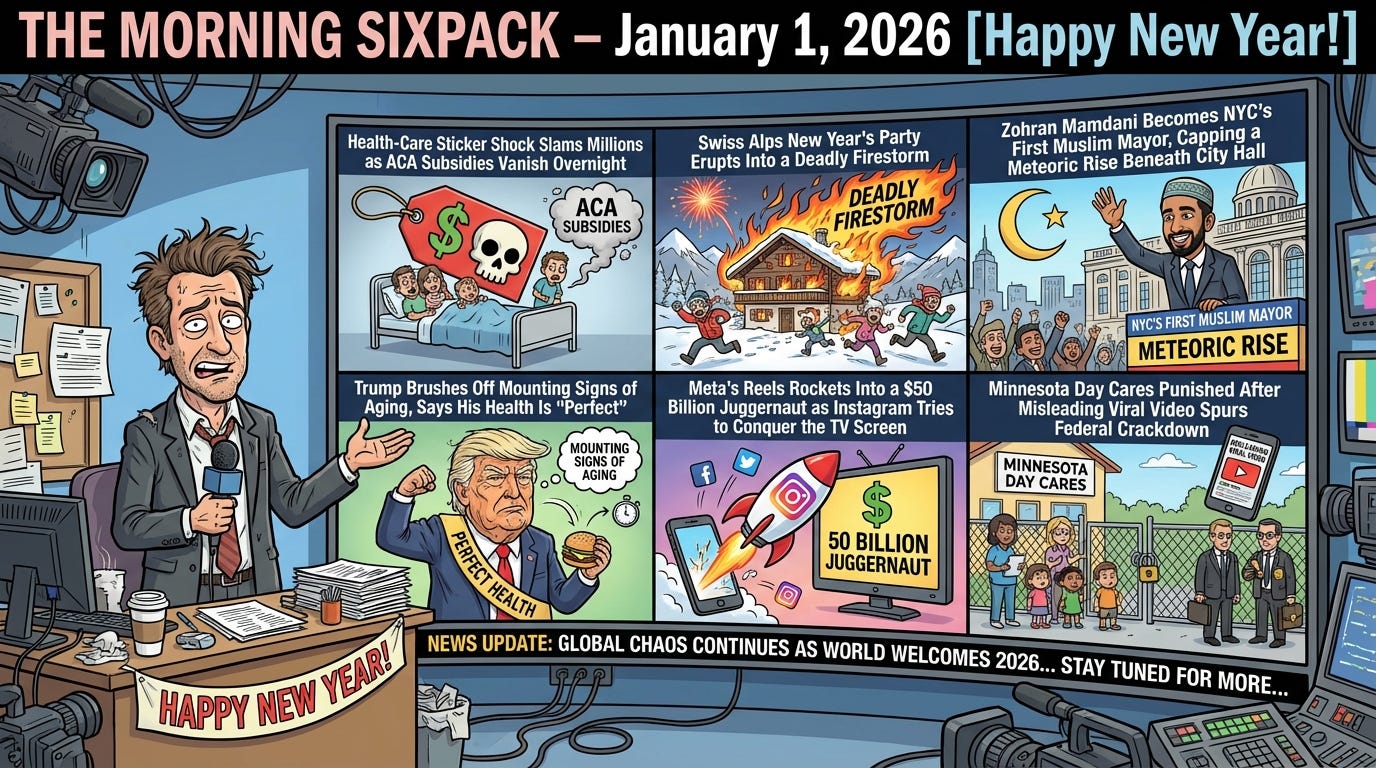
Health-Care Sticker Shock Slams Millions as ACA Subsidies Vanish Overnight
Millions of Americans woke up to a new year and instantly higher health insurance bills—because Congress once again couldn’t get its act together.
Enhanced tax credits that had buffered Affordable Care Act enrollees from rising premiums quietly expired at midnight, locking in steep cost hikes for more than 20 million people. Democrats shut down the government for 43 days trying to force a deal. Moderate Republicans begged for a fix to save their own hides in 2026. Trump teased a compromise, then fled the scene when his right flank growled. And here we are—families footing the bill for congressional brinkmanship.
The hardest hit? The very people who don’t have an employer plan or government coverage: freelancers, farmers, small business owners, and the self-employed. Premiums are jumping an average of 114% this year, according to KFF, with some families seeing their rates double or triple. As 37-year-old single mom Katelin Provost put it,
It really bothers me that the middle class has moved from a squeeze to a full suffocation, and they continue to just pile on and leave it up to us.
The political fallout will be enormous. The 2026 midterms loom, and health-care affordability is at the top of voters’ grievance lists. Analysts warn that millions—especially younger, healthier Americans—may simply drop coverage, further destabilizing the system and driving costs even higher for those who remain. One projection estimates 4.8 million people could walk away from ACA plans this year.
Lawmakers had months to avert this mess and still came up empty. The Senate killed dueling partisan bills in December. The House may take another swing in January after a small group of centrist Republicans forced a vote—but even if it passes, the Senate already signaled the idea is dead on arrival. Meanwhile, real people are making brutal decisions: Provost says she may have to drop her own coverage and keep only her 4-year-old daughter insured.
Source: AP News
Editor: Congress treating health care like a seasonal decoration—pack it away, forget about it, and hope voters won’t notice the mess—is exactly how we got here. At some point, pretending to “fix it later” becomes indistinguishable from not caring at all.
And here’s the double whammy: If you don’t have health insurance, you will be penalized when you file your tax return. (Check me on that fact, but in the past, if you didn’t have “Obamacare” or an equivalent, you paid for it on your tax return.)
Swiss Alps New Year’s Party Erupts into a Deadly Firestorm

A night meant for champagne and countdowns instead became a mass-casualty inferno that ripped through a Crans-Montana bar and shattered an entire Alpine community.
Le Constellation, usually a sleek stop for holiday revelers, became an instant disaster zone as flames raced across a wooden ceiling—reportedly after a bartender lifted a candlelit bottle—and ignited a room thick with combustible gases. Authorities say “several tens of people” are presumed dead, with around 100 more seriously injured. Police Commander Frédéric Gisler described the collective state of the region with a single word: “devastated.”
Survivors recounted scenes that sound cinematic only because real life doesn’t allow fade-outs. Sixteen-year-old Axel Clavier, who lost friends in the blaze, said he felt himself suffocating before smashing his way free: “I am still alive and it’s just stuff.” That’s the kind of line you wish you’d only ever hear in a movie.
Officials emphasize there’s no indication of an attack, but they still can’t safely enter the ruins—an unsettling reminder of how violently the fire tore through the structure. The local hospital was maxed out almost immediately, which tells you everything about how fast this catastrophe unfolded. As Valais regional government chief Mathias Reynard put it, “This evening should have been a moment of celebration and coming together, but it turned into a nightmare.”
Crans-Montana, normally selling serenity by the postcard, is now grappling with collective grief not felt since a fatal bus crash in 2012. Even Switzerland’s newly sworn-in president shelved his New Year’s address—because there’s no festive message that pairs with families waiting for final confirmations that won’t bring relief.
Source: My Daily Grind
Editor: If this doesn’t finally push regulators to rethink how packed holiday venues manage open flames and ventilation, then we’re really just praying the next tragedy picks a different address.
Zohran Mamdani Becomes NYC’s First Muslim Mayor, Capping a Meteoric Rise Beneath City Hall
In the quiet minutes after midnight, Zohran Kwame Mamdani stepped into history—sworn in as New York City’s 112th mayor and its first Muslim leader, in a modest ceremony tucked beneath City Hall in a long-closed subway station.
The moment marked the culmination of a year that felt ripped from a political thriller: a little-known backbench assemblymember transforming into the mayor of America’s largest city. With his trademark grin, Mamdani thanked supporters and wished New Yorkers a Happy New Year as Attorney General Letitia James administered the oath. The big show comes later today on the City Hall steps, where Bernie Sanders and Alexandria Ocasio-Cortez are expected to rally the faithful.
Mamdani’s rise is also an immigrant’s win. Born in Uganda to parents of Indian descent, he came to power just as the Trump administration aggressively tightened immigration restrictions—especially for Muslims and people from African nations. Critics, including Trump and many establishment Democrats, attacked his DSA membership and his criticism of Israel and the Gaza war. Trump went so far as to call him a “communist” and “a disaster waiting to happen.” But voters didn’t buy it: Mamdani beat Andrew Cuomo by nearly ten points. As he said on election night, “The future is in our hands… New York will be the light.”
Affordability became the spine of his campaign. Free buses, universal child care, government-run groceries, a rent freeze—Mamdani pitched a city that works for people priced out of the status quo. And surprisingly, he built broad coalitions to get there, even earning endorsements from influential Jewish leaders. After the election, Trump’s tone shifted abruptly; in their Oval Office meeting, he told the mayor-elect, “I expect to be helping him, not hurting him—a big help.”
But charm and momentum won’t pay for ambitious promises. Many of his proposals require tax hikes on corporations and the wealthy, which means threading needles in Albany where centrists still hold real sway. Governor Kathy Hochul has already nodded toward supporting his childcare agenda, but other fights will be bruising. And while Mamdani’s transition team includes seasoned pros—he’s even keeping NYPD Commissioner Jessica Tisch—there have been stumbles, including an appointee forced to withdraw over resurfaced anti-Semitic posts.
Still, the symbolism of that underground ceremony lingers: a new mayor rising from beneath the city he now leads, carrying expectations as heavy as the moment is historic.
Source: NPR
Editor: If Mamdani can translate campaign poetry into governing prose without Albany sanding off half his agenda, it’ll be a plot twist no one in New York politics saw coming—not even the folks already claiming they always believed in him.
Trump Brushes Off Mounting Signs of Aging, Says His Health Is “Perfect”
At 79, President Trump is confronting increasingly visible signs of aging—but insists he’s fine and mostly blames the scrutiny on everyone else.
According to aides and medical staff, Trump has been ignoring or bending doctors’ guidance: taking far more aspirin than recommended, ditching compression socks for swollen ankles because he “didn’t like them,” and regretting he ever agreed to a CT scan because it fueled questions about his fitness.
“In retrospect, it’s too bad I took it because it gave them a little ammunition,” he told the Journal. “Well, nothing’s wrong.”
In public and private, though, age is doing what age does. He struggles at times to keep his eyes open during televised events, strains to hear during meetings, bruises easily, and relies on a diet that looks like it was curated by the McDonald’s corporate office. His doctors say he’s in “exceptional health,” and Trump—ever the loyalist to his own lore—chalks it all up to “good genetics.” Mehmet Oz, now overseeing Medicare and Medicaid, vouched that Trump stays “with it on some fairly complex topics,” a statement that tries very hard to sound casual.
Behind the scenes, staffers have encouraged him to slow down, pare back meetings, and keep his eyes open during public appearances to avoid looking like he’s dozing. They even persuaded him to spend two weeks in South Florida over the holidays, a soft intervention disguised as vacation. Trump, meanwhile, denies nodding off and says the photos capturing him with closed eyes merely caught him “blinking, blinking.”
Really LONG blinking. But BLINKING, DAMN IT!
Where the picture gets more complicated is on the medical side. Trump has chronic venous insufficiency causing leg swelling—common in older adults—and a habit of taking 325mg of aspirin daily despite doctors preferring he drop to the standard low dose. His sleep patterns remain chaotic; he peppers aides with 2 a.m. texts and keeps staff awake on Air Force One. Even his delicate skin has become an issue, with Attorney General Pam Bondi once nicking his hand during a high-five and causing it to bleed.
None of it seems to faze Trump, who still rejects exercise as “boring,” boasts energy levels he attributes to his parents, and has zero plans to swap the Big Mac–Filet-O-Fish combo for a salad. He’s demanding his own staff hype his vigor more aggressively, saying, “My health is perfect.” The White House even circulated a Mayo Clinic AI-assisted readout claiming his cardiac age is 65.
Source: The Wall Street Journal (free)
Editor: If your staff is begging you to keep your eyes open, maybe the “perfect health” line needs a second draft. Genetics may be great, but even great genetics can’t outrun four fast-food combos and a 2 a.m. tweet schedule.
Meta’s Reels Rockets Into a $50 Billion Juggernaut as Instagram Tries to Conquer the TV Screen
What began as a TikTok knockoff is now printing Coca-Cola–level revenue—and Meta wants your living-room TV next.
Five years ago, Reels looked like Instagram’s awkward attempt to copy a rival it didn’t understand. Internal documents even admitted that “most Reels users have no engagement whatsoever.” Fast-forward to 2026, and Mark Zuckerberg is bragging on earnings calls that Reels has surpassed a $50 billion annual run rate. For context, that’s more than YouTube’s projected ad revenue and triple TikTok’s haul. Not bad for a feature that launched with zero revenue and a reputation for being the try-hard of short-form video.
What changed? Meta’s AI recommendation systems finally clicked, feeding users fresher, punchier content instead of recycled clips from accounts they already followed. Instagram’s average user now spends 27 minutes a day on Reels—more than YouTube Shorts users—and the platform’s creators are noticing. The shift required overhauling Instagram’s very identity, moving from a “follow-your-friends” model to TikTok’s “we know what you like better than you do” approach. It took years, but the algorithm eventually found its footing.
With momentum on its side, Meta is charging into the next frontier: your television. Instagram for TV just rolled out on Amazon Fire devices as a test, and the logic is obvious—people already mirror their phones onto big screens to watch Reels together, so why not go native? YouTube dominates TV viewership now, and Meta clearly wants a slice of that ad-rich pie. New features like Blend, which merges friends’ algorithms into a joint feed, aim to make watching Reels a social experience rather than just a thumb-driven habit.
The bet is that people want more control over what they see—more puppies, fewer botched gender-reveal disasters—and Instagram is finally offering that. If Meta gets its TV expansion right, Reels could stop being seen as TikTok’s shadow and start looking like the future of Meta’s entire ad empire.
Source: The Wall Street Journal (free)
Editor: Funny how a “TikTok clone” becomes a “core growth engine” the moment Wall Street smells $50 billion. Meta didn’t reinvent the wheel—they just finally learned how to roll it downhill.
Minnesota Day Cares Punished After Misleading Viral Video Spurs Federal Crackdown
A single YouTuber’s drive-by “investigation” has now upended child care funding for Minnesota families—because the Trump administration treated a misleading video like gospel.
Nick Shirley, a conservative activist with a camera and an audience to impress, filmed himself visiting nine Minneapolis day care centers—many run by Somali Americans—and declared them fraudulent because he didn’t personally witness children entering or leaving. It’s the kind of sleight-of-hand internet “reporting” that smells an awful lot like Project Veritas’s greatest hits: show up at the wrong time, cherry-pick footage, package it as a scoop, and let the outrage machine foam. But instead of shrugging it off, the regime froze federal child care funds and slapped the entire country with new documentation requirements.
There’s just one problem: Minnesota regulators had inspected these centers in recent months and actually saw children. Staff said Shirley arrived when they were closed or before opening hours—and that some employees didn’t answer because they thought he and his masked entourage were ICE agents. In one case, parents simply used a back entrance during winter. Meanwhile, the fallout for the actual centers has been brutal: harassment, bomb threats, attempted break-ins, and the looming threat of closure for facilities serving mostly low-income East African families.
Local officials aren’t mincing words. Attorney General Keith Ellison blasted the administration for threatening crucial funding “all on the basis of one video on social media.” Providers say this is less about fraud prevention and more about political targeting—especially given Trump’s recent comments calling Somali immigrants “garbage.” Child care advocates warn that the new national guidelines could choke already stretched providers with paperwork and delay payments that keep their doors open.
The stakes extend far beyond nine centers in Minneapolis. These funds help parents keep jobs and stabilize households; pulling them on the basis of a viral video is governance by YouTube clip, not evidence. As one Minnesota provider put it at a rally, “Let’s be honest about how we really got here: Our president decided he doesn’t like the Somali community and he wants to destroy them.”
Source: The Washington Post
Editor: Funny how a shaky 42-minute video can suddenly outweigh state inspections, regulatory records, and common sense. When politics starts taking cues from clout-chasing YouTubers, don’t be surprised when real families pay the price.