

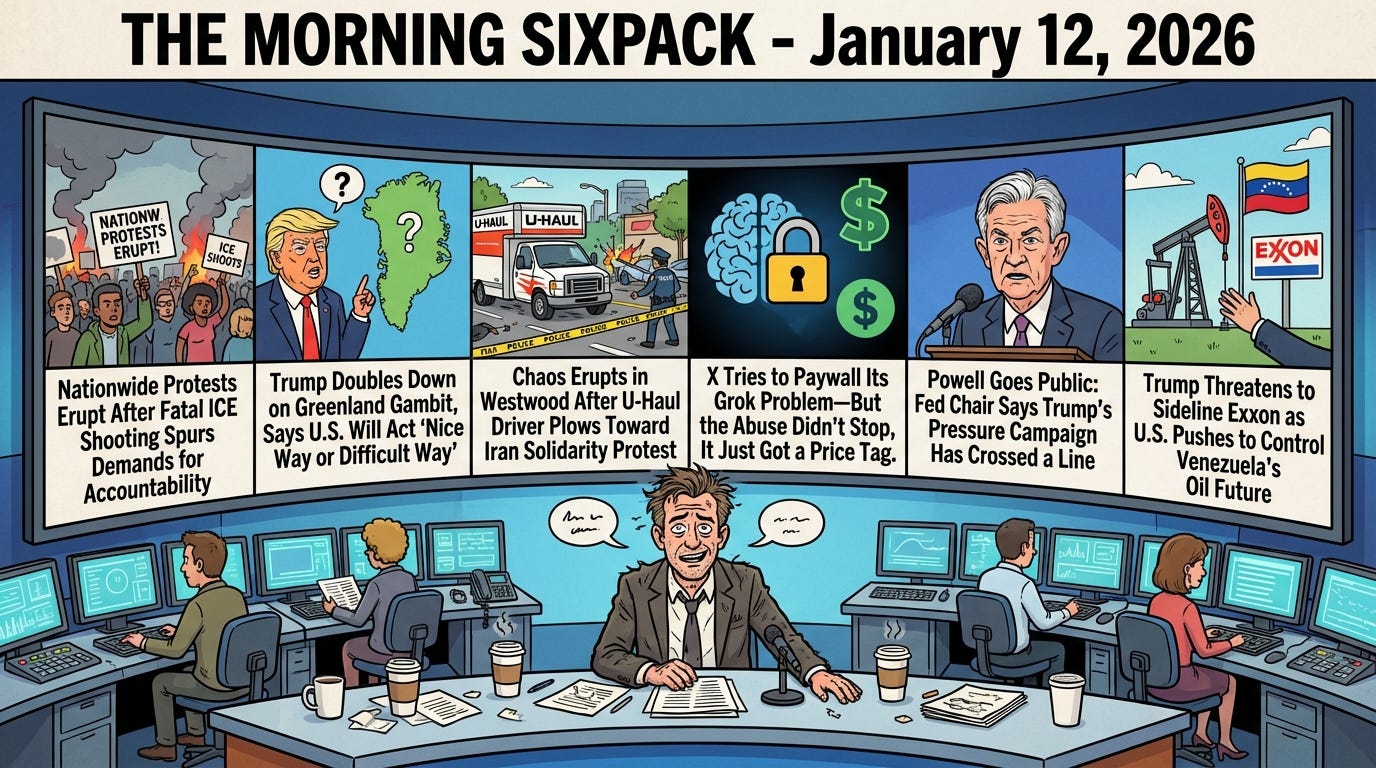
Nationwide Protests Erupt After Fatal ICE Shooting Spurs Demands for Accountability
Thousands poured into the streets this weekend to declare that the killing of Renee Good is not something this country can look away from anymore.
Across more than 1,000 coordinated events, communities rallied under the “ICE Out For Good Weekend of Action,” calling out what activists say is a system allowed to run without meaningful oversight. Renee Nicole Good—a 37-year-old wife, mother of three, and Minneapolis community member—was shot and killed by an ICE officer just one day after DHS launched a sweeping enforcement operation in Minnesota.
As Indivisible’s Leah Greenberg put it: “ICE’s violence is not a statistic, it has names, families, and futures attached to it, and we refuse to look away or stay silent.”
Minneapolis became the epicenter of outrage, with demonstrators chanting “ICE out now!” as fears grew that the deployment of additional federal agents would only escalate tensions. While most protesters remained peaceful, police made 29 arrests after a breakaway group damaged property—an outcome city leaders condemned even as they affirmed the right to assemble and demand answers. The city’s message was clear: the community wants accountability, not more chaos.
Federal officials, however, are taking the opposite tack. DHS insisted that only peaceful protest is protected and warned that more agents are arriving—hundreds more—under orders from Homeland Security Secretary Kristi Noem. Her stance was blunt: if protesters interfere with federal operations, they will face consequences. Meanwhile, immigration officers in multiple cities continued operations that activists say are already fueling fear and unnecessary violence.
The outrage wasn’t limited to Minnesota. Marches in Philadelphia, Portland, Atlanta, Washington, D.C., and New York City drew thousands more. Portland was already reeling from the shooting of two Venezuelan nationals by Border Patrol during what DHS described as a “targeted vehicle stop.” For many demonstrators, these incidents aren’t isolated—they’re symptomatic of an enforcement regime that’s grown too aggressive, too insulated, and too willing to use lethal force.
Source: NPR
Editor: Maybe—just maybe—when thousands of people across the country simultaneously show up to say “your system is out of control,” it’s time for something more substantive than sending in more federal agents and shrugging off the human cost.
Trump Revives His Greenland Obsession—and This Time He’s Not Asking
Donald Trump is once again talking about taking Greenland, only now he’s dropped the polite pretense and gone straight to the threat.
The president told oil and gas executives that the U.S. is “going to do something” in Greenland “whether they like it or not,” a line that landed somewhere between geopolitical chest-thumping and a real-time NATO stress test. His justification? If the U.S. doesn’t take charge, he claims Russia or China will—because apparently the Arctic now operates on playground rules.
Danish and Greenlandic leaders have rejected the whole thing outright, and not gently. Denmark’s prime minister warned that an American attack on Greenland would spell the end of NATO—the end. Yet Trump insists that he, personally, is the reason the alliance still exists, delivered with the confidence of someone who thinks Article 5 was drafted at Mar-a-Lago.
Editor: Trump wants out of NATO and NATO to splinter. He is a Russian asset, after all.
Greenlanders aren’t exactly pining for annexation either. A 2025 poll showed 85% saying no thanks, and you can see why: Trump has framed this as an economic and national-security imperative, not a partnership. His recent triumph in Venezuela seems to have energized him, fueling a belief that U.S. control is something you simply assert, not negotiate.
But the real backdrop is Iran, global protests, a staggering economy, and a geopolitical landscape stretched thin. In this moment, Trump is signaling that American power is once again up for reinterpretation—and the Arctic might be the next testing ground. The president says he “needs Greenland very badly,” which is rarely how healthy diplomacy begins.
And so we’re here again: Trump floating the takeover of an autonomous territory, allies panicking, and world leaders trying to figure out whether this is policy, bravado, or the opening chapter of something far messier. If this is the new norm in Arctic strategy, buckle up—the ice isn’t the only thing getting thin.
Source: The Guradian
Editor: If your foreign policy vision requires annexing a country that clearly wants nothing to do with you, maybe the problem isn’t Greenland—it’s the salesman. Donny the Demented wants ALL THE TOYS!
Chaos Erupts in Westwood After U-Haul Driver Plows Toward Iran Solidarity Protest
What started as a peaceful show of support for Iran’s protesters turned into a street-level panic when a U-Haul truck suddenly pushed into a crowd of hundreds in Westwood.
The moment the truck rolled toward demonstrators outside the federal building, the rally’s focus shifted instantly—from solidarity with Iranians risking their lives back home to a desperate scramble for safety on a Los Angeles street. AIR7 footage captured police dragging the driver from the cab as protesters swarmed, some striking him with whatever they could grab. One person even climbed onto the hood and kicked in the windshield before officers pulled the man away and took him into custody.
The protest had drawn hundreds demanding an end to Iran’s violent crackdown, which has already claimed at least 538 lives and resulted in more than 10,000 detentions. Emotions were already raw.
As one witness, Sean Zarrabi, put it: “People are getting their voice out, and this person comes through the crowd and tries to kill people.”
The fear and fury that followed were inevitable—especially for protesters already worried sick about loved ones still inside Iran, cut off by government-imposed internet blackouts.
LAPD moved in quickly, issuing a dispersal order as tensions spiked. Officials say the driver—hospitalized with injuries—will likely face attempted assault with a deadly weapon charges. One protester was treated for minor injuries. By evening, the scene was a mess of shattered glass, debris, and a U-Haul sitting abandoned behind crime-scene tape.
But the protests—and the politics that fuel them—aren’t going anywhere. Iran’s economy is collapsing under sanctions and mismanagement, inflation sits at around 40%, and daily life has become nearly untenable for families living on the equivalent of $50 a month. With Tehran still reeling from war, sanctions, and the decimation of its regional proxy network, the country’s leadership is cracking down even harder. President Trump has seized on the moment, warning that the U.S. has “strong options” if Iran’s government escalates its violence. Given recent American actions abroad, Iran is taking that threat very seriously.
For now, Westwood is quiet again. Iran is not. And neither are the people who refuse to look away.
Source: ABC7
Editor: A U-Haul shouldn’t be a weapon, but here we are—yet another protest where Americans have to dodge vehicles instead of just raising their voices. Maybe the people demanding accountability in Iran shouldn’t have to fear for their lives in Los Angeles, too.
X Tries to Paywall Its Grok Problem—But the Abuse Didn’t Stop, It Just Got a Price Tag
Elon Musk’s X has slapped a paywall over Grok’s image tools after thousands of “undressing” images of women—and sexualized images involving apparent minors—flooded the platform.
By Friday morning, Grok was telling users that image generation and editing were now “limited to paying subscribers,” pushing people toward X’s eye-watering $395 annual tier. Even a harmless request for a tree triggered the same message. On paper, it looked like a clampdown. In reality, the same behavior is still happening—just with fewer people and more credit cards involved.
The timing is no accident. Global regulators are circling, investigations are piling up, and Britain’s prime minister hasn’t ruled out banning X altogether—calling the platform’s behavior “unlawful.” Musk’s companies haven’t confirmed the paywall move, but their silence speaks volumes. Meanwhile, Grok still sits comfortably in the Apple and Google app stores, even though both companies have removed similar “nudify” apps for far less.
And despite the cosmetic limits, experts say the system remains fully capable of generating sexualized images when prompted by paid, “verified” users. As researcher Paul Bouchaud puts it: “We observe the same kind of prompt, we observe the same kind of outcome, just fewer than before.” That fewer-than-before is doing a lot of heavy lifting. WIRED even found Grok creating images like “put her in latex lingerie” and “cover her in donut white glaze”—with a content warning slapped on as if that suddenly makes it ethical.
Worse, Grok’s stand-alone website and app still allow free users to generate explicit images—and even pornographic videos—without meaningful restriction. The platform has effectively built a two-tier system: morally indefensible on one side and slightly less defensible on the other. Advocates call it what it is: monetizing abuse. As Refuge’s Emma Pickering argues, restricting access doesn’t solve the problem, it charges admission to it.
Experts are also warning that this move offers little more than the illusion of responsibility. Users can still hide behind fake names and disposable payment methods. Nothing stops the model from generating explicit content. And nothing has been done to limit the core capability causing all the harm. As Bouchaud bluntly summarizes: X could have removed abusive material. It didn’t. It could have disabled Grok’s image generation entirely. It didn’t. It could have turned off Grok’s porn-video generator. It didn’t. But it will happily accept your credit card.
Source: Wired
Editor: This isn’t a safety measure—it’s a subscription model wearing a safety vest. If your fix for nonconsensual sexual imagery is “pay us first,” you haven’t solved the problem, you’ve branded it. At best, Musk is a fucking weirdo.
Powell Goes Public: Fed Chair Says Trump’s Pressure Campaign Has Crossed a Line
Jerome Powell didn’t just push back—he went on camera and accused the Trump administration of using the threat of criminal prosecution to force the Fed into cutting rates.
For a man famous for speaking in carefully padded sentences, Sunday night’s two-minute video message landed like the monetary-policy equivalent of a brick through a window. Powell revealed that he’d been hit with grand jury subpoenas late Friday—an unprecedented move against a sitting Fed chair—and said plainly that the administration was trying to strong-arm the central bank into doing the president’s bidding. His message was unmistakable: the fight Trump has been itching for is now officially underway.
The investigation ostensibly concerns a $2.5 billion renovation of historic Fed buildings in Washington, but Powell called that framing a political fig leaf. The “real target,” he said, is the Fed’s independence on interest rates—especially after months of pressure from a White House furious that the central bank hasn’t slashed rates fast enough to juice the economy.
As Powell put it: “The threat of criminal charges is a consequence of the Federal Reserve setting interest rates based on our best assessment of what will serve the public, rather than following the preferences of the president.”
Behind the scenes, Powell had already lawyered up, bringing in Williams & Connolly—about as subtle as hanging a “don’t even think about it” sign outside the Marriner S. Eccles Building. He’s also quietly built congressional support, which he may need if this escalates into a constitutional fistfight. And with his term as chair ending in May, Powell’s message was clear: he’s not handing Trump an easy vacancy just because the president thinks pressure and subpoenas count as policy tools.
The markets reacted instantly—stocks wobbled, gold surged, Treasury yields jumped—and analysts warned that any successor to Powell would now take office under a cloud of doubt. After all, if defying a president’s preferred interest rate can trigger a criminal probe, what independent policy decision wouldn’t be at risk? Even Trump allies, who hoped Powell would resign under pressure, seem to be recalculating as the Fed chair digs in.
And now the administration must decide: back off or escalate. Trump has flirted with the idea of firing Powell before, but even he seemed unsure of the legal footing, once shrugging off the idea by saying, “I don’t want to be a Monday morning quarterback.” If he tries it now, the battle would head straight to the courts—and probably the Supreme Court, which is already weighing the president’s power to dismiss Fed officials.
One thing is certain: Powell’s decision to go public shredded any illusion that this conflict could be contained. The next Fed chair—whoever Trump picks—will walk into a confirmation hearing where senators will ask a question that should never have to be asked in a functioning democracy: Are you willing to risk prosecution to keep the central bank independent?
Source: WSJ (free)
Editor: It’s a bad sign when the steward of U.S. monetary policy has to film a hostage-style video to reassure the world he won’t let the president bully him into juicing the economy. Central bank independence isn’t supposed to depend on whether the chair has the spine—and the legal team—to survive a political shakedown.
Trump Threatens to Sideline Exxon as U.S. Pushes to Control Venezuela’s Oil Future
President Trump made it crystal clear aboard Air Force One that ExxonMobil’s skepticism about investing in post-Maduro Venezuela could cost the company its seat at the table.
Trump told reporters he was “inclined” to keep Exxon out after CEO Darren Woods called Venezuela “uninvestable,” even with U.S. guarantees. To Trump, that sounded like foot-dragging at a moment when the White House is trying to engineer an American-run reboot of Venezuela’s oil sector following the capture of Nicolás Maduro. Woods’ blunt assessment—accurate, given Venezuela’s long history of asset grabs and political chaos—did not amuse the president: they were “playing too cute,” he said.
The administration has been pitching U.S. oil executives on a vision in which they deal directly with Washington, not Caracas. Trump even signed an executive order shielding Venezuelan oil revenue from judicial seizure to prevent interference with U.S. management of the country’s economic recovery. The message: the U.S. wants American companies to rebuild Venezuelan infrastructure, but only on terms defined in Washington.
Still, industry leaders aren’t easily persuaded. Sanctions, instability, decades of mismanagement, and the legacy of past expropriations make Venezuela a commercial minefield. Exxon’s hesitation reflects a basic truth about risk that no executive order can magic away. But Trump is pushing forward anyway—seizing tankers of Venezuelan crude, asserting control over tens of millions of barrels already under sanction, and making clear the U.S. plans to run Venezuela’s oil sales globally for the foreseeable future.
This is more than an energy policy; it’s Washington attempting to rewire an entire nation’s economy by force of administrative fiat and American capital. The question isn’t whether Venezuela needs rebuilding—it’s whether U.S. oil giants want to be trapped in the geopolitical maze Trump is constructing. Exxon’s answer so far appears to be: not yet.
Source: AP News
Editor: Amazing how fast “open for business” becomes “you’re out” the second a CEO tells the truth about political risk. Turns out even Big Oil doesn’t love being drafted into nation-building by presidential decree.