


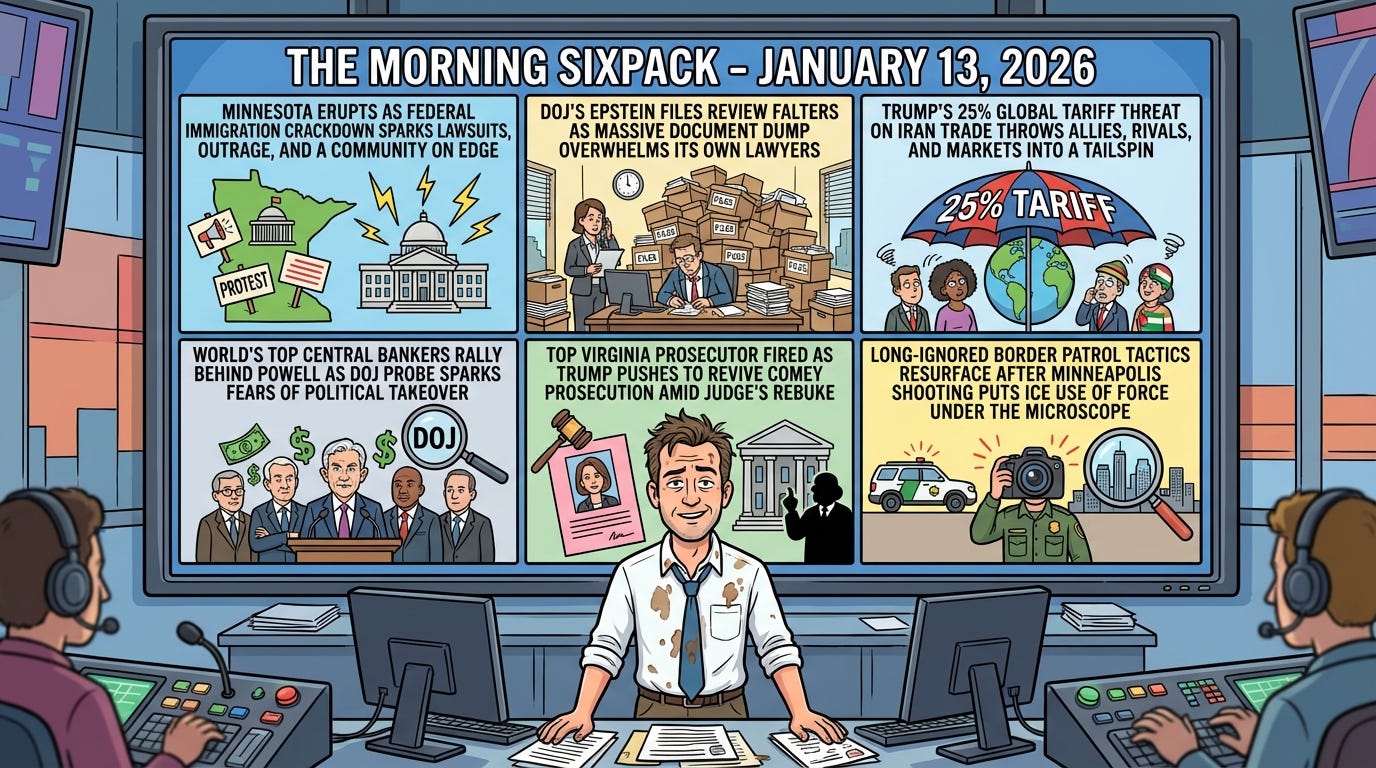
Minnesota Erupts as Federal Immigration Crackdown Sparks Lawsuits, Outrage, and a Community on Edge
Minnesota woke up to the kind of federal muscle-flexing that doesn’t just rattle a state—it ignites it.
Days of escalating protests, legal challenges, and raw grief have pushed the Twin Cities into full-blown confrontation mode after federal agents used tear gas on demonstrators and an ICE officer fatally shot 37-year-old mother of three, Renee Good. State and city leaders didn’t just object—they sued.
The clashes weren’t confined to one neighborhood. Minneapolis saw tear gas deployed as crowds gathered around immigration officers questioning a man. Up in St. Cloud, hundreds rallied outside Somali-run businesses as ICE units arrived. By nightfall, tensions breached the doors of a federal building repurposed as a command hub for what ICE calls its largest enforcement operation ever.
With the Department of Homeland Security planning to flood Minnesota with more than 2,000 additional officers, the state—joined by Minneapolis and St. Paul—filed suit accusing the Trump administration of trampling constitutional rights and singling out a Democratic-leaning, immigrant-welcoming region.
As Attorney General Keith Ellison put it: “This is, in essence, a federal invasion of the Twin Cities in Minnesota, and it must stop.”
The outcry only intensified after the shooting of Good, whose death has become a national rallying point, prompting vigils and protests across the country. The administration insists she posed a threat; state and local leaders who have watched the video say that claim simply doesn’t hold water. A similar crackdown in Illinois—“Operation Midway Blitz”—is now facing its own legal assault, with more than 4,300 arrests prompting accusations of fear-based policing.
And even as Minnesota battles the surge, the Justice Department quietly filed charges in Oregon against a Venezuelan national wounded by Border Patrol after allegedly ramming a federal vehicle—an incident with no available video, unlike the Good case, which only fuels the public skepticism.
Source: AP News
Editor: If your “largest enforcement operation ever” ends with terrified residents, multiple lawsuits, and videos that torpedo your own narrative, maybe rethink the playbook instead of doubling down like it’s a branding exercise.
DOJ’s Epstein Files Review Falters as Massive Document Dump Overwhelms Its Own Lawyers
The Justice Department can’t seem to get its footing as Epstein’s long-buried files finally come due. NOTE: They came due on December 19, 2025. About ONE PERCENT of the files have been released.
A newly expanded DOJ review team—pulled from across the department to meet the Trump administration’s mandated Epstein disclosures—has stumbled out of the gate. Internal messages describe the rollout as chaotic, with more than two-thirds of the 232 Criminal Division staffers failing to hit their required pace of 1,000 pages a day. That’s not a mild miss; that’s a system buckling under its own weight.
An email from a division supervisor bluntly acknowledged that leadership is “well aware that the project got off to a very rocky start and numerous issues continue to be flagged for more concrete guidance.” When managers start using phrases like that in writing, you know the wheels aren’t just wobbling—they’re off. New Criminal Division chief Tysen Duva tried to rally the troops, praising them for collectively breaking the 200,000-page mark on Jan. 8, but also made clear that individual numbers need to rise immediately.
This massive surge in manpower—400 DOJ attorneys reassigned by Attorney General Pam Bondi and Deputy AG Todd Blanche—was meant to salvage the Epstein Files Transparency Act timeline after the stunning discovery of more than two million relevant documents. But diverting lawyers en masse has consequences: national security attorneys must now process two page batches a day before they can touch their actual caseloads, and supervisors have to approve anything labeled “urgent.” It’s the bureaucratic equivalent of handing your firefighters garden hoses and saying, “Good luck.”
Meanwhile, many DOJ attorneys are openly frustrated. They signed up to investigate crimes, not to comb through endless PDFs trying to avoid exposing victims. And all of this follows bipartisan blowback over last month’s botched initial release, which landed with technical glitches and hasty reversals that raised eyebrows everywhere.
The department has yet to answer whether these “numerous issues” mean the remaining disclosures will be delayed—though anyone reading the tea leaves already knows the answer.
Source: Bloomberg Law
Editor: When your legal talent spends more time meeting page quotas than protecting the country, maybe the problem isn’t the pace—it’s the leadership pretending this is a paperwork sprint instead of a credibility crisis. AND let’s not forget: They’ve had 6 or 7 years (see what I did there?) to fix this.
Trump’s 25% Global Tariff Threat on Iran Trade Throws Allies, Rivals, and Markets into a Tailspin
President Trump just declared that any country doing business with Iran will get hit with a 25% tariff and the geopolitical fallout is immediate.
With Iran already staggering under years of sanctions, currency collapse, and the largest protests it has seen in decades, Trump’s declaration on Truth Social landed like a steel boot on an already fractured economy. The order—issued without legal documentation, statutory authority, or even a White House explainer—instantly raised the stakes for every nation still trading with Tehran.
The biggest player in the blast zone is China, which buys 80% of Iran’s oil and has quietly kept the Iranian economy on life support. Beijing already faces a 35% tariff after last year’s trade truce with Washington; adding another 25% would gut manufacturers and derail the fragile U.S.–China détente just months before Trump’s planned April trip. China’s embassy blasted the move, warning it would take “all necessary measures,” while emphasizing its long-held stance that “no one wins in tariff or trade wars.”
Countries like Turkey, Pakistan, and India—major Iranian trading partners facing their own heavy U.S. tariffs—now have to decide whether access to U.S. markets is worth sacrificing billions in trade with Iran. India, already staring down rumors of a 500% tariff over Russian oil purchases, is now navigating trade diplomacy with a blindfold on and a blowtorch at its feet.
Meanwhile, Iran’s economy continues to absorb body blows. Even before Trump’s new edict, sanctions had slashed oil exports by up to 80%, gutted GDP per capita, and routed the rial. Iran’s foreign minister, Abbas Araghchi, responded with a warning that Tehran is “ready for war” if Washington wants to “test” it—hardly the stuff of cooling tensions in a region already on edge after last year’s Israel–Iran conflict and U.S. bombing of an Iranian nuclear facility.
The math is simple: Iran relies on exports—especially fuel—to survive. The politics are not. Trump’s new tariff threat doesn’t just punish Iran; it corners every nation that touches Iranian commerce. Whether this is strategy, brinkmanship, or improvisation masquerading as policy remains anyone’s guess, but the global economic pressure cooker is now set to high.
Source: Al Jazeera
Editor: Threatening the entire global economy with a blanket tariff is one way to project strength—right up until the countries propping up world trade decide they’ve had enough of Washington’s unilateral bravado.
World’s Top Central Bankers Rally Behind Powell as DOJ Probe Sparks Fears of Political Takeover
Global financial leaders just issued a rare, full-throated defense of Federal Reserve Chair Jerome Powell—and the message is unmistakable: hands off the Fed.
Eleven central bank chiefs, including the heads of the Bank of England, the European Central Bank, and the Bank of Canada, released a joint statement declaring “full solidarity” with Powell after the U.S. Justice Department launched a criminal investigation into him. Their argument is simple—Powell has acted with integrity, focused on evidence, and served the public interest. The subtext: this investigation threatens the very foundation of independent monetary policy.
The probe stems from Powell’s Senate testimony about renovations to Federal Reserve buildings, but its timing follows a year of President Trump’s relentless pressure campaign. He’s mocked Powell as a “major loser” and a “numbskull,” demanded lower rates, and has now disavowed knowledge of the DOJ’s investigation as international alarm rises. Powell finally responded over the weekend, warning that the fight isn’t about him personally—it’s about whether U.S. monetary policy becomes a political toy.
“This is about whether the Fed will be able to continue to set interest rates based on evidence and economic conditions,” Powell said.
The backdrop isn’t exactly calm. Inflation remains above target at 2.7%, the Fed has already cut rates three times since September, and policymakers are openly split about what comes next. Now, Republicans themselves are fracturing over the investigation. Senator Thom Tillis says he’ll block Powell’s successor until the matter is resolved; Senator Kevin Cramer says Powell may not be a great chair but certainly isn’t a criminal. Lisa Murkowski labels the probe “an attempt at coercion.” When your own party sees your move as overreach, you’ve overreached.
Powell isn’t standing alone. Three former Fed chairs—Janet Yellen, Ben Bernanke, and Alan Greenspan—have lined up behind him. Yellen didn’t mince words, warning the criminal investigation is “extremely chilling” and a sign that investor confidence should be on high alert. Her sharpest line came with a sting: “It is the road to banana republic.” When a former Treasury Secretary uses that phrase publicly, central bank independence isn’t just under threat—it’s in the crosshairs.
The global signatories—from the UK, EU, Canada, Australia, Korea, Brazil, Sweden, Switzerland, Denmark, and the BIS—closed with a warning of their own: preserving central bank independence is essential to economic stability. And they know exactly what it looks like when a government tries to steer monetary policy by intimidation.
Source: BBC
Editor: If your allies, your former chairs, and half your own party are screaming that you’re turning the Fed into a political chew toy, maybe take the hint before markets decide to offer their own feedback—brutally.
AND let’s not forget that Trump only hires “the best people”—he hired Powell after all.
Top Virginia Prosecutor Fired as Trump Pushes to Revive Comey Prosecution Amid Judge’s Rebuke
A senior federal prosecutor was ousted after resisting the Trump administration’s push to re-indict James Comey, marking yet another flashpoint in the White House’s campaign to punish the former FBI director.
Robert K. McBride, who had barely settled into his role as the top deputy in the Eastern District of Virginia, was dismissed after he balked at leading the renewed Comey prosecution while simultaneously running the office. The administration wanted him to take charge of the case—something his predecessor had refused to bring due to insufficient evidence. Trump then installed Lindsey Halligan in that role through an unusual, and ultimately unlawful, maneuver.
A federal judge later declared Halligan’s appointment invalid and tossed two headline-grabbing indictments she brought, including charges that Comey lied to Congress and that New York Attorney General Letitia James falsified mortgage paperwork. Despite the ruling, Halligan continues to sign filings as though she were the district’s legitimate U.S. attorney, prompting a Richmond judge to demand she explain why that isn’t “a false or misleading statement.” The administration has appealed the ruling, but its legal position is wobbling.
One account of McBride’s firing claims he refused to juggle both leadership of the office and prosecution of Trump’s political targets. Another, more conveniently timed version—offered by someone defending the dismissal—accuses him of quietly lobbying judges to make him U.S. attorney and resisting immigration-related and drug enforcement cases. Yet meeting with judges is a standard part of the job, especially when the supposed U.S. attorney has been ruled unlawfully appointed. And the administration’s pattern is hard to ignore: Trump fired Erik Siebert, Halligan’s predecessor, for refusing to charge Comey and James.
Judges across the country are rejecting similar attempts to install handpicked loyalists. Rulings in New Jersey and upstate New York have blocked Trump-favored interim U.S. attorneys like Alina Habba and John A. Sarcone III, underscoring the courts’ growing intolerance for end-runs around federal appointment law. But inside DOJ, senior officials reportedly believe Halligan can remain because the judge did not explicitly remove her—an argument as thin as tissue paper but politically convenient.
The bottom line: the Comey vendetta continues to warp the Justice Department, displacing seasoned prosecutors while Trump allies cling to positions courts say they were never legally allowed to hold.
Source: NYT
Editor: When your administration’s legal strategy boils down to “the judge didn’t explicitly say we had to stop,” you’re not operating in a gray area—you’re operating in the denial aisle of a very obvious law-and-order supermarket.
Long-Ignored Border Patrol Tactics Resurface After Minneapolis Shooting Puts ICE Use of Force Under the Microscope
A fatal ICE shooting in Minneapolis has revived a decade-old warning that federal agents were trained in ways that all but invited deadly encounters.
The death of 37-year-old Renee Good—shot by ICE officer Jonathan Ross during Trump’s nationwide deportation sweep—has triggered a fresh examination of immigration enforcement tactics. And it didn’t take long for observers to rediscover a buried 2014 report that CBP tried to suppress, one that found agents had stepped into the paths of fleeing vehicles to justify shooting and fired rounds out of sheer frustration at rock-throwers on the Mexican side of the border.
The chilling line from that review still echoes: agents were “intentionally” placing themselves in harm’s way, thereby “creating justification for the use of deadly force.”
That damning assessment, drafted by the Police Executive Research Forum and later exposed by the Los Angeles Times, rejected the idea that vehicle shootings were necessary. CBP’s leadership at the time rejected core recommendations—like banning shots at cars except when occupants are truly trying to kill agents—and argued that limiting gunfire would only embolden smugglers. Mexican authorities, for their part, complained for years that U.S. agents faced little accountability and that investigative findings routinely vanished into a bureaucratic void.
Good’s killing is now the flash point. Homeland Security Secretary Kristi Noem insists Ross “followed his training” and claims Good tried to run him over. But a Washington Post video analysis reveals something far murkier: Ross moved out of the vehicle’s path and fired at least two of three shots from the side as Good’s SUV veered past him. Whether the car ever made contact is unclear—but the pattern described in that 2014 report suddenly feels uncomfortably relevant.
Federal force incidents aren’t isolated to Minneapolis. In Portland last week, a Border Patrol agent shot and wounded two alleged gang associates after authorities said they attempted to run over the officer; the driver now faces aggravated assault charges. These recurring episodes underline a longstanding problem: training and culture that normalize escalation, then rationalize it after the fact.
Except that ICE agents, who have been required to wear bodycams, mysteriously all had them off at the time.
More than a decade ago, U.S.–Mexico policy expert Christopher Wilson warned that without real accountability, the pattern wouldn’t change.
“People are being killed that don’t need to be killed,” he said then.
Today, with the nation’s largest immigration enforcement operation underway, that warning sounds less like a critique and more like a prophecy.
Source: Raw Story
Editor: If your agency has a documented history of stepping into danger to justify pulling the trigger, maybe the problem isn’t the suspects’ cars—it’s the playbook that keeps getting people killed.