


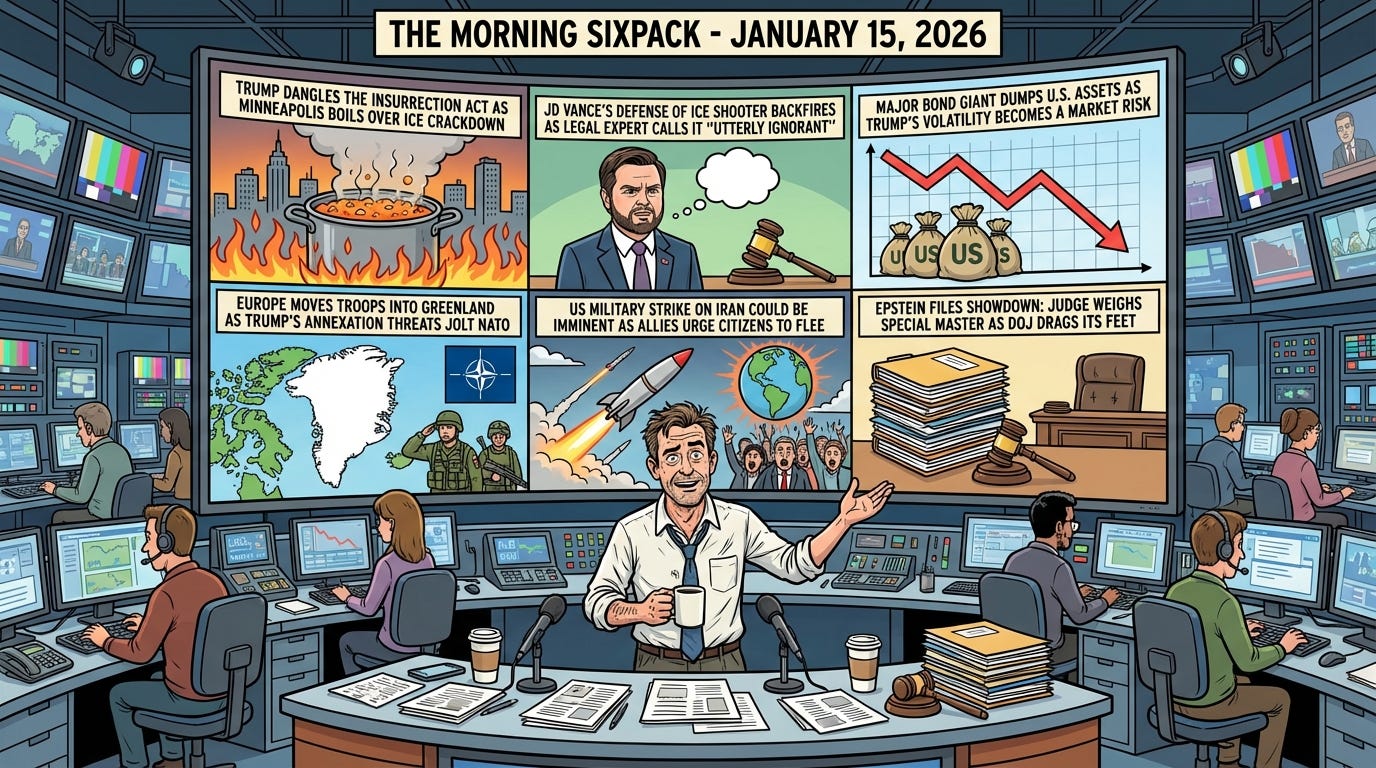
Trump Dangles the Insurrection Act as Minneapolis Boils Over ICE Crackdown
A president threatening to unleash troops on a major American city says everything about where this immigration crusade has dragged us.
Minneapolis is again at the epicenter of national turmoil, this time over the federal immigration surge that has left neighborhoods filled with tear gas, fear and a sense that Washington is playing political roulette with people’s lives. Trump’s latest threat to invoke the 1807 Insurrection Act—yes, the one designed for true insurrection, not policy frustration—landed with the subtlety of a flash bang in a city already on edge.
Protests have only intensified after a federal officer shot a man in the leg during a chaotic confrontation just days after ICE agent Jonathan Ross fatally shot Renee Good. The administration insists these officers are defending themselves; city leaders and civil rights groups see something very different unfolding on their streets. As Minnesota officials push back legally and politically, Trump is framing his threat as righteous law-and-order theater. “If the corrupt politicians of Minnesota don’t obey the law… I will institute the INSURRECTION ACT,” he wrote, hitting every note of grievance politics he can find.
The city, meanwhile, is living in the fallout. Tear gas, flash bangs, and near-nightly standoffs have become a grim routine. Minneapolis Mayor Jacob Frey tried to capture the moment with a line that doubles as a quiet indictment of federal intervention: “This is an impossible situation that our city is presently being put in…” And while residents protest in the streets, the ACLU is in court alleging racial profiling and warrantless detentions—three U.S. citizens among them.
Schools are scrambling, too. With families afraid to send kids out the door, St. Paul and Minneapolis public schools are shifting to temporary online options. Even the University of Minnesota is redrawing the academic calendar to adapt to the unrest. And then there’s the still-unresolved killing of Renee Good, which began when ICE officers boxed in her SUV. Homeland Security claims she weaponized the vehicle; critics aren’t buying it, and the agency’s tight-lipped posture isn’t helping.
Minnesota’s message to Washington is clear: stand down. Washington’s message back? Not a chance. This one is headed to the courts, the streets and—given Trump’s appetite for escalation—possibly the military chain of command. Source: AP News
Editor: Bold move invoking an 1807 law because your immigration dragnet isn’t winning hearts and minds. If only the same energy went into fixing the system instead of lighting matches in a city already soaked in gasoline.
JD Vance’s Defense of ICE Shooter Backfires as Legal Expert Calls It “Utterly Ignorant”
JD Vance managed to defend an ICE agent so clumsily that he may have handed prosecutors a gift.
In the wake of Jonathan Ross’ fatal shooting of Minneapolis mother-of-three Renee Good, the vice president stepped forward swinging—except instead of helping Ross, he may have kneecapped him. Vance insisted Ross fired because he’d previously been “dragged by a vehicle,” essentially arguing that past trauma, not the moment at hand, drove the decision to open fire. That’s not exculpatory; that’s a liability gift-wrapped in a podium seal.
Former federal prosecutor Shanlon Wu dissected the misfire with the precision of someone who has seen too many bad defenses dressed up as righteous indignation. He said Vance’s explanation was “utterly ignorant” of the legal standard, which requires officers to act based on immediate perceived threats—not emotional residue from prior incidents. As Wu put it, Vance is “flagging for everybody that this might make it a bad shooting because the guy’s not actually reacting to what’s in front of him.”
The irony here is rich: while Vance railed at reporters for even asking questions, mainstream outlets were simply trying to piece together the sequence of events. And in that defensiveness, Vance revealed more than Ross’s legal team probably wanted him to. Wu noted on X that the VP’s comments “make the shooting worse,” because they shift the justification from imminent danger to something resembling untreated trauma.
Wu didn’t mince words in his broader analysis either: if Ross acted based on PTSD rather than a real-time threat, the shooting “is unlawful,” and attempting to pre-build excuses before the investigation is even complete only underscores how weak the defense may be. Not exactly the help Ross asked for—assuming he asked for help at all.
Meanwhile, public anger is still rising, and now the vice president has managed to turn one officer’s legal scrutiny into a referendum on whether the administration even understands the rules they claim to be enforcing. Source: RawStory
Editor: If this is the White House’s idea of damage control, they might want to check whether the hose is actually a flamethrower.
Major Bond Giant Dumps U.S. Assets as Trump’s Volatility Becomes a Market Risk
When one of the world’s biggest bond investors says America is now too unpredictable, that’s not a vibes problem—that’s a credibility problem.
PIMCO’s chief investment officer is quietly doing what Washington pretends isn’t happening: steering money out of the U.S. because Trump’s economic zigzags have turned the world’s safest market into a geopolitical stress test. The assault on the Federal Reserve, the tariff whiplash, the casual threats aimed at trading partners—investors can price risk, but they can’t price chaos masquerading as strategy.
The CIO made it plain to the Financial Times: Trump is “unpredictable,” and the fund is shifting into a “multiyear period” of diversifying away from U.S. assets. That’s not a hot take; that’s a structural judgment. When a heavyweight like PIMCO flinches, global markets don’t just observe—they follow.
Citigroup analysts are already calling it the return of the “Sell America” trade, the same pattern that rattled markets after Trump’s so-called “Liberation Day” tariffs. Stocks, the dollar, and bonds could all take hits. America used to be the ballast in global finance; now it’s the source of the tremor.
If this administration’s message to investors is essentially “hang on, it’ll make sense eventually,” PIMCO’s answer is the polite financial equivalent of: no thanks. You don’t have to hate America to cut exposure—you just have to hate instability. Source: Semafor
Editor: Market lesson of the day—if you treat economic policy like a slot machine, don’t be shocked when the high rollers cash out and walk to a different casino.
Europe Moves Troops Into Greenland as Trump’s Annexation Threats Jolt NATO
When multiple European militaries rush into Greenland because the U.S. president keeps hinting he might seize it, you know the crisis is no longer theoretical.
A meeting meant to cool tensions instead confirmed them: U.S., Danish, and Greenlandic officials agreed to a new high-level working group, but failed to bridge the “fundamental disagreement” at the heart of it all—Trump’s ongoing ambition to claim Greenland outright. Denmark’s prime minister didn’t sugarcoat it, calling the talks “not an easy meeting” and warning that Washington’s intentions remain “intact.”
So Europe is doing what Europe does when diplomacy stalls: sending troops. Denmark triggered a major Arctic deployment, complete with aircraft, naval operations, and infrastructure protection drills. The mission, folded under the banner of Operation Arctic Endurance, immediately drew in France, whose first personnel are already en route. Macron’s announcement landed like a marker: Paris is not treating Trump’s rhetoric as empty.
Germany followed with a reconnaissance team headed to Nuuk, pointedly citing “Russian and Chinese threats” but making clear this was a unity show under Danish leadership. Sweden jumped in next, dispatching officers to prepare for upcoming phases of the operation. NATO has trained in Greenland before, but the scale, timing, and participation tell the real story—this isn’t routine; it’s deterrence wrapped in polite phrasing.
French Foreign Minister Jean-Noel Barrot didn’t bother with nuance, publicly stating that Trump’s coercive posture toward a fellow NATO member “must obviously stop.” And while the U.S. maintains its Pituffik Space Base on the island, allied governments moving consulates into Greenland suggests they’re preparing for a longer geopolitical freeze.
For now, Operation Arctic Endurance is officially just an exercise. But when allies mobilize to keep the United States from annexing territory that isn’t theirs, “exercise” feels like the world’s most diplomatic euphemism. Source: UPI
Editor: Imagine driving half the NATO alliance to deploy troops just to keep you from taking their island. Not since middle-school group projects has one person caused this much unnecessary supervision.
US Military Strike on Iran Could Be Imminent as Allies Urge Citizens to Flee
When European governments start telling their people to get out of Iran immediately, you know Washington isn’t bluffing anymore.
Multiple European officials told Reuters that a U.S. military intervention could come within 24 hours, a warning echoed by an unnamed Israeli official who said it appears Trump has “decided to intervene.” No one seems certain about the size or shape of the operation—but the clock is now part of the story. The Pentagon has already begun pulling select personnel from key regional bases, signaling that this isn’t a drill; it’s prelude.
The tension sharpened when Tehran warned regional states—including Saudi Arabia, the UAE, and Turkey—that U.S. bases on their soil will be struck if Washington launches an attack. That’s not subtle diplomacy; that’s a threat map. Within hours, Poland and Italy told their citizens to leave Iran immediately, joining the United States, which has been urging Americans to get out by land if necessary. A country doesn’t tell 600 Italians in Tehran to pack their bags because things are mellow.
Britain is also quietly withdrawing personnel from the massive Al Udeid Air Base in Qatar, mirroring the U.S. posture shift. Although diplomats insist this isn’t a full evacuation, removing people from the Middle East’s largest U.S. base—home to roughly 10,000 service members—speaks louder than any press release. These are the kinds of moves you make when you expect incoming fire.
Diplomacy, meanwhile, is in freefall. Iran has suspended its direct communications with U.S. envoy Steve Witkoff, and Trump proudly advertised that he canceled all meetings with Iranian officials. Tehran says Washington’s escalating threats have made diplomatic engagement pointless, and any talk of nuclear or regional negotiations has evaporated under the shadow of possible airstrikes.
Trump has warned Iran against retaliation, promising a U.S. response at levels “never seen before.” Tehran, for its part, is warning neighbors that they’ll share in the consequences if they host U.S. operations. It’s a classic powder-keg scenario: two sides talking past each other while edging toward a collision they both claim they don’t want.
And yet, here we are—embassies telling citizens to flee, militaries repositioning assets, and governments bracing for the moment when rhetoric becomes impact. Source: The Jerusalem Post
Editor: Hard to believe, but “leave the country immediately” is rarely the prelude to a well-thought-out foreign policy strategy. At some point you have to wonder if the Middle East is allergic to stability or if we just keep tracking muddy boots across the carpet.
Epstein Files Showdown: Judge Weighs Special Master as DOJ Drags Its Feet
When Congress has to ask a judge to babysit the Justice Department, you know the Epstein files are nowhere close to sunlight.
Reps. Ro Khanna and Thomas Massie—two lawmakers who rarely agree on lunch, let alone legal strategy—jointly asked a federal judge to appoint an independent special master to force the Trump administration to cough up the Epstein files it was legally required to release four weeks ago. DOJ has blown past the Dec. 19 deadline with all the urgency of a teenager pretending not to hear chores being assigned, releasing barely 1% of the documents and offering zero clarity on when the rest will appear.
The proposal is simple: bring in an outsider to oversee the release, file reports to the court, and call out any foot-dragging or creative redactions. It’s a pressure valve—and a warning shot. As Khanna and Massie put it, “Absent an independent process…we do not believe the DOJ will produce the records that are required.” Translation: we can all see the stall tactics, and we’re not buying the “millions of documents” excuse the administration keeps waving around like a smoke bomb.
A special master could accelerate disclosure significantly, if only by making it impossible for DOJ to quietly sit on the most explosive materials—like records indicating which Epstein associates faced federal scrutiny. The government says it still has more than 2 million files to review; skeptics say that number may be deliberately inflated to make compliance seem unworkable. Either way, the full release is weeks away at best, and that assumes good faith—something in short supply.
Congress passed the Epstein Files Transparency Act precisely because DOJ refused to release the documents on its own. Since then, we’ve gotten flight logs, photos, and fragments—but none of the substance the public actually wants: who was investigated, who wasn’t, and why. And the law has no punishment mechanism, which means this administration can delay indefinitely unless the courts intervene or a future administration decides to prosecute its predecessors.
For now, the judge has given the Trump administration until Friday to respond and the lawmakers until Tuesday to reply. Which means next week could bring an unusual twist: a special master appointed not to protect the government from disclosure, but to force it. Source: Forbes
Editor: Amazing how the government suddenly remembers “millions of files” only when transparency is required. Funny how that number never comes up when they’re collecting them.