


This is the song that plays in my head every time Trump breathes. It actually helps.
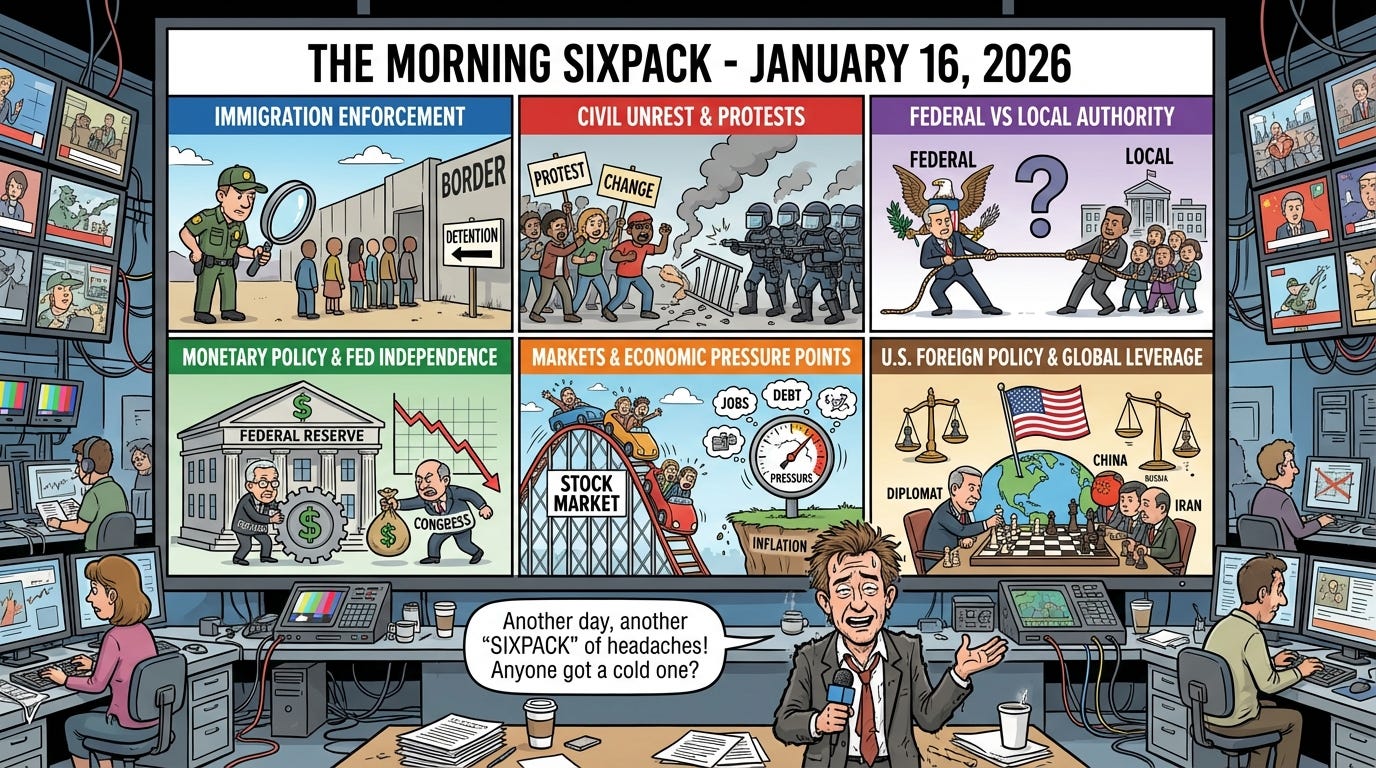
Good morning. If you woke up hoping for “a quiet one,” the country laughed and hit snooze on your optimism. Here are the six stories running the show before breakfast.
1) Minneapolis vs. the Feds: Lawsuits stack up as Trump dangles the Insurrection Act
Minneapolis is still the epicenter of America’s loudest argument: what “law enforcement” looks like when it shows up like an occupying force. After the fatal shooting of Renée Nicole Good during the federal immigration surge known as “Operation Metro Surge,” protests haven’t cooled—they’ve evolved into a rolling confrontation between federal agents and a city that’s openly rebelling.
Now it’s not just street heat. Minnesota, Minneapolis, and St. Paul have sued the federal government, asking a court to stop—or at least restrain—the crackdown. Their argument is basically: this surge is arbitrary, dangerous, and legally busted.
The pressure escalated further when Trump publicly floated invoking the Insurrection Act, the rarely used “I can send troops” button. Even mentioning it changes the dynamics, because it signals the White House is thinking about domestic unrest as a military problem instead of a governance problem.
Local leaders are demanding de-escalation and accountability. Federal officials are defending tactics and insisting they’re targeting criminals. Meanwhile, residents are living in the “between” space where conflicting narratives don’t matter as much as what’s happening in the streets at night.
This is quickly becoming a defining early-2026 fight: federal power vs. local autonomy, enforcement vs. civil liberties, and politics vs. reality. Courts may slow it down, but the momentum is already national.
Sources: AP News, PBS NewsHour, Minneapolis City News Release
Editor: If you’re threatening the Insurrection Act over protests you helped inflame, you’re not “restoring order”—you’re raising the stakes and calling it leadership.
Later today, if time permits, I will publish a “Do the Math” piece on how this will all play out. I fear it won’t be a happy piece.
2) The ACLU jumps in: “Suspicionless stops,” racial profiling, and a courtroom collision course
As Minneapolis boils, the legal front just got sharper. The ACLU filed a major lawsuit accusing federal agencies of racial profiling, unconstitutional stops, and warrantless arrests during the Minnesota enforcement surge.
The suit centers on U.S. citizens—Somali and Latino residents—who say they were detained, questioned, or roughed up without legal justification. It’s the kind of case that turns a policy fight into a constitutional one, because it puts sworn declarations and specific incidents under judicial scrutiny.
The government’s posture is familiar: these operations target illegal immigrants and criminal suspects, and enforcement discretion is necessary. The ACLU’s answer is also familiar: “Not without the Constitution riding shotgun.”
What makes this different is timing and context. You’ve got a city already angry about violence, federal agents already accused of escalating tactics, and now a legal filing designed to force discovery and accountability.
If the courts allow broad fact-finding, this could become a much bigger headache than a nightly protest. Paper trails are stubborn, and sworn testimony doesn’t care about press releases.
Sources: ACLU Case Page, The Guardian, Courthouse News
Editor: Street outrage fades. Lawsuits don’t. If you’ve been operating in the shadows, discovery is the part where the lights come on and everyone starts sweating. Give to the ACLU. They are an organization that looks out for YOU & ME.
3) Fed Chair Jerome Powell vs. the political grinder: global heavyweights circle the wagons
The Fed is supposed to be boring. It is currently not boring. IMF Managing Director Kristalina Georgieva publicly backed Jerome Powell and warned—again—that central bank independence is essential to stability.
That matters because Powell is under investigation pressure tied to claims around renovation cost overruns at Fed buildings—something Powell has framed as a pretext to intimidate the Fed into lowering rates. Whether you buy that or not, the international reaction is a blinking red warning sign.
Global leaders aren’t just defending Powell personally; they’re defending the idea that the Fed can set policy without political retaliation. The dollar anchors the global system, and anything that shakes confidence in U.S. monetary institutions shakes more than just U.S. markets.
Powell himself has addressed the situation in a statement, acknowledging subpoenas and pushing back on the premise. The deeper question isn’t the renovation—it’s whether the investigation becomes leverage.
This story is going to persist because it sits at the intersection of politics, inflation, interest rates, and institutional trust. And trust—unlike rates—is hard to cut once it’s broken.
Sources: Reuters, Federal Reserve, European Central Bank
Editor: You don’t have to “take over the Fed” to damage it. You just have to keep implying the ref is corrupt until the crowd stops believing in the game.
And don’t forget—Ted Cruz wants to abolish the Fed.
4) Verizon’s big outage: “Restart your phone” meets “please don’t break 911”
Verizon says it has resolved a widespread outage that knocked out wireless voice and data service for large numbers of users. If you’re thinking “that seems bad,” yes—because modern life runs on telecom the way lungs run on oxygen.
The outage was big enough to trigger public warnings in some places about emergency calling issues. Regulators noticed, too: the FCC said it will review what happened, which is the polite version of “explain yourself.”
Verizon has attributed the disruption to a software issue and says service has been restored, with guidance for customers to restart devices. That’s a perfectly normal fix for a perfectly abnormal national-scale failure.
The bigger issue is trust and resilience. Outages happen, but when they happen at this scale, it highlights how dependent everything is on a handful of networks—and how thin redundancy can be in the real world.
Expect this story to keep rolling as investigators ask what failed, what safeguards didn’t, and what changes are needed. Also expect customer credits, because nothing says “sorry” like twenty bucks and a shrug.
Editor: When a network goes down, it’s not just “inconvenient.” It’s a reminder that our entire society is one software hiccup away from chaos—and nobody has a backup plan that doesn’t involve yelling at a chatbot.
5) Critical minerals gets the national security treatment: Section 232 enters the chat
The White House has moved to treat processed critical minerals—and their derivative products—as a national security issue, launching negotiations under Section 232. Translation: the administration is setting the stage for trade action if it can’t get what it wants through deals.
The proclamation directs the Commerce Secretary and U.S. Trade Representative to negotiate agreements aimed at reducing reliance on imports that officials say threaten national security. It even nods at “price floors” and other measures—words that make trade lawyers wake up screaming.
This isn’t just policy wonk stuff. Critical minerals feed batteries, weapons systems, chips, energy infrastructure—basically the guts of modern power. If your supply chain depends on geopolitical rivals or fragile routes, you don’t have a supply chain—you have a vulnerability.
Allies will be asked to play ball. Some will. Some will resist. And everybody will pretend it’s purely economic even while waving the national security flag.
If negotiations fail, the administration is explicitly leaving room for stronger steps later. That’s the tell: this is a ramp, not a one-off announcement.
Sources: The White House Proclamation, White House Fact Sheet, Reuters
Editor: National security is the Swiss Army knife excuse—useful, flexible, and often deployed right before tariffs land like a piano from a cartoon.
6) Venezuela optics go full theater: Machado gives Trump her Nobel medal (yes, really)
Venezuelan opposition leader María Corina Machado presented her Nobel Peace Prize medal to President Trump during a White House meeting. Nobel officials were quick to clarify: the medal can move, but the laureate title does not—meaning this was symbolism, not paperwork.
Machado praised Trump’s role in Venezuela’s post-Maduro reality and appeared to be making a calculated play to strengthen her position. But the reporting also suggests Trump has doubts about her viability as the country’s next leader, even as he hosts her and poses with the shiny object.
It’s an odd moment because it’s simultaneously serious and absurd. Venezuela’s future is genuinely consequential, but this gesture turns a global award into a political prop—one that instantly sparks backlash and mockery.
International reaction has been swift, with critics calling it inappropriate and undermining the integrity of the Nobel brand. Supporters frame it as gratitude and messaging. Both can be true—and both can be messy.
This is one of those stories that looks like a sideshow until you remember it’s attached to real policy: recognition, reconstruction, oil access, and who Washington chooses to empower in Latin America.
Sources: Reuters, The Guardian, The Washington Post
Editor: If you have to borrow someone else’s Nobel medal for the photo op, you’re not collecting achievements—you’re collecting vibes. And vibes don’t govern countries.
Editor: Try this new Quiz!
That’s your Morning Sixpack: courts versus crackdowns, the Fed versus politics, telecom reality checks, and foreign-policy theater with a side of tariffs. Same country, new ways to test the guardrails. Drink water. Keep receipts.