


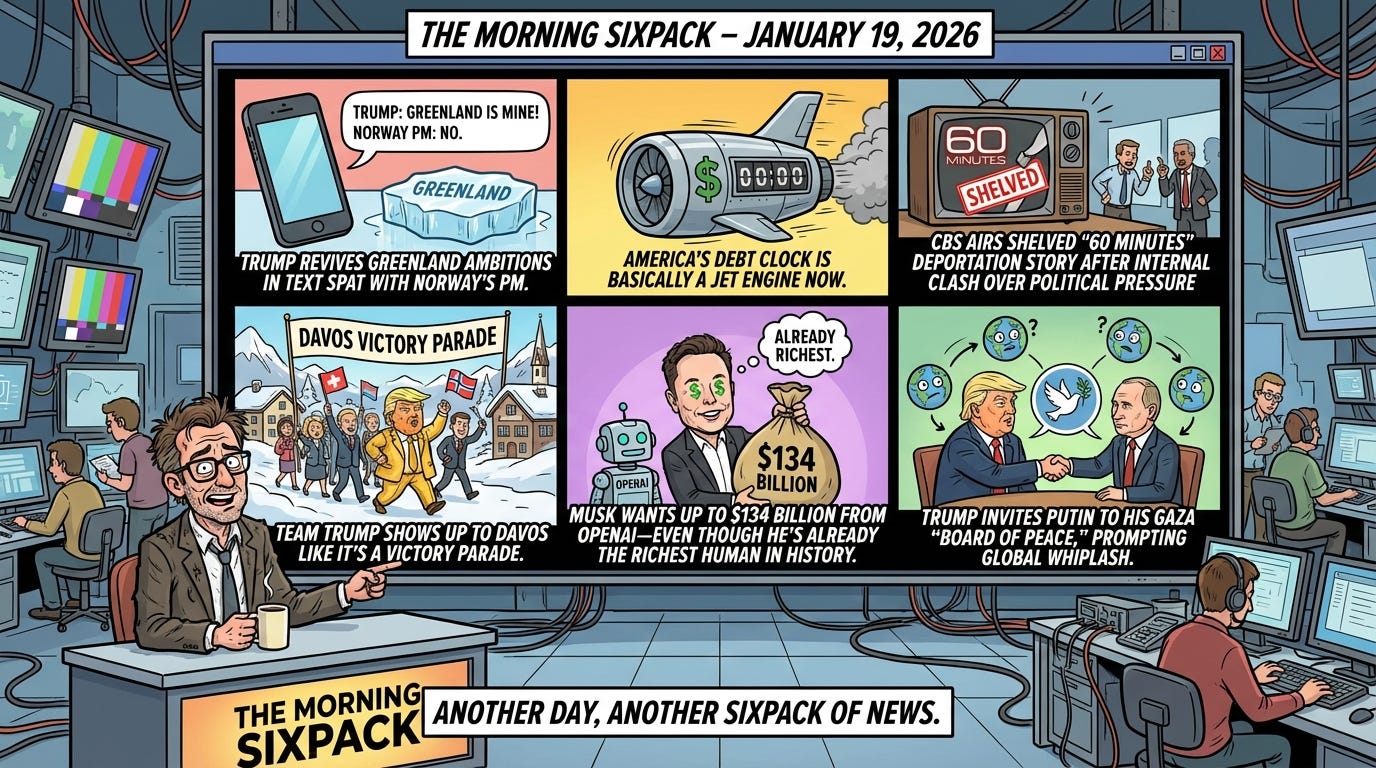
Trump Revives Greenland Ambitions in Text Spat with Norway’s PM
A blunt text exchange between President Donald Trump and Norwegian Prime Minister Jonas Gahr Stoere shows Trump once again eyeing Greenland as a strategic prize—and leveraging everything from NATO to the Nobel Peace Prize to make his case.
Stoere opened with diplomacy, offering a joint call with Finland’s president to cool tensions over tariffs, Greenland, and global conflicts. His message was classic Nordic crisis-management: calm tone, collective responsibility, and a dash of “let’s talk this out before things get worse.”
Then came Trump’s reply—a vintage Trumpian blend of grievance, grand strategy, and creative history. At one point he lamented, “Considering your Country decided not to give me the Nobel Peace Prize for having stopped 8 Wars PLUS…” before pivoting to Greenland, arguing Denmark “cannot protect that land from Russia or China” and questioning whether it even has a legitimate claim.
Trump ended on a NATO pivot worthy of a geopolitical plot twist: since he believes he’s done more for the alliance “than any other person since its founding,” he now expects NATO to do something big for the United States—namely, deliver “Complete and Total Control of Greenland.”
The whole exchange reads less like diplomatic messaging and more like a teaser for the next season of Arctic geopolitics. Stoere wanted a phone call; Trump wanted an island. Hard to say which was the heavier lift.
Here’s the whole thing:
Dear Jonas: Considering your Country decided not to give me the Nobel Peace Prize for having stopped 8 Wars PLUS, I no longer feel an obligation to think purely of Peace, although it will always be predominant, but can now think about what is good and proper for the United States of America. Denmark cannot protect that land from Russia or China, and why do they have a "right of ownership" anyway? There are no written documents, it's only that a boat landed there hundreds of years ago, but we had boats landing there, also. I have done more for NATO than any other person since its founding, and now, NATO should do something for the United States. The World is not secure unless we have Complete and Total Control of Greenland. Thank you! President DJT
Source: Reuters
Editor: Trump’s Greenland fixation is the geopolitical equivalent of someone trying to flip a national park on Zillow. Meanwhile Stoere is just trying to schedule a conference call like a normal adult.
America’s Debt Clock Is Basically a Jet Engine Now
The U.S. national debt is piling up so fast—about $71,800 every second—that the numbers feel less like fiscal policy and more like a runaway slot machine someone forgot to unplug.
As of today, the debt is hovering near $38.5 trillion, racing toward a record-shattering $39 trillion. Treasury data shows the government closed out 2025 with $37.64 trillion on the books, meaning Washington managed to add $2.17 trillion in just one year. That’s not budgeting; that’s binge-spending with congressional approval.
Federal funding expires at the end of the month, which means Congress is once again scrambling to pass a spending bill to avert another shutdown. If this feels familiar, it’s because Washington treats deadlines the way most people treat dental cleanings—only addressed when they’re unavoidable and slightly painful.
Republicans on the Joint Economic Committee are the ones highlighting the $71,800-per-second burn rate. Regardless of who’s doing the math, the trajectory is clear: the debt curve is going up like it’s trying to escape gravity.
And yet, for all the hand-wringing, both parties continue expanding the tab as if future taxpayers were an infinite resource instead of actual humans who might want to retire someday. At this rate, they’ll be lucky if they can afford coffee.
Source: Just the News
Editor: Watching Congress manage the national debt is like watching someone try to put out a grease fire with a Super Soaker—they’re very busy, very serious, and somehow making everything worse.
CBS Airs Shelved “60 Minutes” Deportation Story After Internal Clash Over Political Pressure
A month after CBS abruptly pulled a “60 Minutes” investigation into Trump-era deportations, the network finally aired the segment—quietly sidestepping the internal fight over whether politics influenced its initial disappearance.
Correspondent Sharyn Alfonsi made no mention of the blow-up with CBS News editor-in-chief Bari Weiss, even though she’d previously told colleagues the decision to yank the piece “was not an editorial decision, it was a political one.” Instead, viewers saw a polished report on migrants deported to El Salvador’s infamous CECOT prison—with newly added statements from the White House and DHS.
Weiss had argued the original story lacked sufficient representation of the administration’s views and didn’t reflect reporting done elsewhere. But the piece that aired Sunday kept the core reporting intact, including clips of President Trump praising the prison operators because they “don’t play games,” and press secretary Karoline Leavitt describing deportees as “heinous monsters, rapists, murderers, sexual assaulters, predators who have no right to be in this country.”
Meanwhile, Alfonsi noted that “since November, ‘60 Minutes’ has made several attempts to interview key Trump administration officials on camera… They declined our requests.” She has accused the administration of stonewalling to smother the story—though CBS insists it always planned to air the report once it was “ready.”
That claim is harder to swallow given the misfire in December, when Alfonsi’s original version briefly went live in Canada due to a feed error—giving viewers a chance to compare the pre-Weiss and post-Weiss edits. Aside from a new intro tied to the Jan. 3 U.S. raid that captured Venezuelan President Nicolás Maduro and updated closing comments, the body of the story barely changed.
The broader CBS–Trump relationship has become increasingly visible since Weiss took over. Trump officials have appeared more frequently on the network, and CBS aired a full 13-minute interview with the president last week after Leavitt reportedly warned the network it would “sue your ass off” if anything was cut. CBS says it planned to run it in full from the start. Maybe. Or maybe the legal threat didn’t hurt.
Either way, the message is clear: access comes at a price, and CBS seems willing to pay it—even if it means a flagship program like “60 Minutes” gets caught in the undertow.
Source: AP News
Editor: CBS is starting to look less like a newsroom and more like a hostage blinking in Morse code. When your investigative flagship requires presidential sign-off vibes, something is very off.
Team Trump Shows Up to Davos Like It’s a Victory Parade
Treasury Secretary Scott Bessent touched down in Davos with the swagger of a man convinced the global economy is merely an annex of the United States—and he’s warming up the crowd for President Trump to deliver the main act.
Bessent is meeting Chinese Vice Premier He Lifeng while fronting a U.S. delegation determined to contrast Trump-world priorities—growth, home ownership, and peace-through-strength—with the forum’s usual talk of climate, DEI and, yes, the infamous “eat bugs” narrative Davos gets roasted for. It’s a calculated flex aimed as much at U.S. voters as at the Swiss chalet set.
The Treasury secretary plans daily press conferences blasting “global elites” and championing slogans like “The Smart Money is on America” and “America First Trade is Transforming the World.” He even took an early swipe at Europe, warning it would be “very unwise” to retaliate over U.S. ambitions to take control of Greenland. When your negotiating posture starts with “don’t even think about it,” subtlety is clearly not the strategy.
In prepared remarks, Bessent touts what he calls an era of “Parallel Prosperity”—a decade where Main Street and Wall Street supposedly grow together as America hits its 250th anniversary. Whether that’s an economic vision or a campaign slogan depends on your level of cynicism, but it’s unmistakably themed for domestic consumption.
Trump himself arrives Wednesday, planning to hammer housing and affordability while projecting economic dominance. One administration source summed up the vibe: “Global CEOs are clamoring to get a glimpse of the most powerful man in the world.” Modesty remains in short supply.
Meanwhile, the administration is bypassing traditional media in favor of MAGA-friendly outlets such as Real America’s Voice, which will pump out wall-to-wall coverage. Davos may be a global forum, but for Trump’s team, it’s a stateside campaign rally with better scenery.
Source: Axios
Editor: Davos is supposed to be a sober meeting of global minds, but the Trump crew is treating it like WrestleMania, which fits Trump to a “T.”
Musk Wants Up to $134 Billion from OpenAI—Even Though He’s Already the Richest Human in History
Elon Musk is demanding a staggering $79 billion to $134 billion in damages from OpenAI and Microsoft, a number so outsized it feels engineered more for impact than compensation.
According to Bloomberg, the figure comes from expert witness C. Paul Wazzan, a financial economist with a resume that suggests he’s spent half his life in depositions. Wazzan pegs Musk’s entitlement to a massive slice of OpenAI’s current $500 billion valuation, all stemming from Musk’s original $38 million seed funding and early technical involvement when he co-founded the nonprofit in 2015. Yes, that math implies a 3,500-fold return. Early-stage investing is one thing—this is more like expecting a startup unicorn to show up with a saddle and ask where you’d like to ride.
Wazzan’s calculations put OpenAI’s “wrongful gains” at $65.5 billion to $109.4 billion, and Microsoft’s at another $13.3 billion to $25.1 billion due to its sizable ownership stake. Musk’s team argues that he deserves returns “many orders of magnitude greater” than what he put in, essentially asking the court to treat him like a VC whose stake magically grew even after he walked away.
But here’s the kicker: Musk’s personal fortune is already around $700 billion—so large it eclipses Larry Page’s wealth by about half a trillion dollars. And Tesla shareholders recently approved a $1 trillion pay package. So even if Musk walked out of court carrying $134 billion in a duffel bag, it wouldn’t fundamentally change his life trajectory. It does, however, bolster OpenAI’s argument that the lawsuit is just part of “an ongoing pattern of harassment.”
OpenAI has already warned investors to expect Musk to lob “deliberately outlandish, attention-grabbing claims” as the case heads to trial in April. Considering the request for damages is roughly the GDP of a mid-sized nation, that warning feels less like spin and more like preparation.
The trial will take place in Oakland, just across the bay from San Francisco—a fitting setting for a legal fight over the future of AI, money, and one billionaire’s sense of betrayal.
Source: TechCrunch
Editor: Musk demanding $134 billion from a company he helped create is like asking for royalties on a kid you haven’t parented in a decade. The man’s wealth has entered boss-level DLC territory—this lawsuit feels more like theater than finance.
Trump Invites Putin to His Gaza “Board of Peace,” Prompting Global Whiplash
President Donald Trump has invited Vladimir Putin to join his self-declared “Greatest and Most Prestigious Board ever assembled,” a Gaza reconstruction committee that now reads like the guest list for a geopolitical reality show.
Kremlin spokesman Dmitry Peskov confirmed the invitation, saying Moscow is “reviewing” the offer and wants more details. That alone signals a surreal plot twist: Putin—largely isolated since invading Ukraine—suddenly being courted to help rebuild Gaza. Belarus’ Alexander Lukashenko, Europe’s last dictator and Putin’s favorite tag-team partner, also received an invite and promptly praised the U.S. for recognizing his “noble responsibility.” That’s one way to spin it.
The board is part of a UN-backed American plan to demilitarize and reconstruct Gaza after two years of war. But the cracks are already showing. Ireland’s foreign minister warned the Trump-created body could eclipse the UN’s authority, bluntly reminding everyone that the UN—not a billionaire-led super-committee—holds the mandate for international peace and security.
True to Trump’s flair for superlatives, the board includes Tony Blair, Canadian PM Mark Carney, and Secretary of State Marco Rubio. Invitations have reportedly gone out to Netanyahu, Erdoğan, Milei, el-Sisi, Orbán, and India’s Narendra Modi—many of whom have already waved their letters online like they’ve been accepted into an exclusive club. Whether this is diplomacy or influencer marketing is increasingly unclear.
One notable feature: countries that pony up $1 billion get a permanent seat. Everyone else gets a three-year term. The U.S. insists the funds will go directly to rebuilding Gaza, with “no exorbitant salaries” or bloated bureaucracy. The price tag, though, makes it feel like Trump built an international organization modeled on premium subscriptions.
Putin’s presence—if he accepts—would be extraordinary. Russia’s Gaza involvement has been minimal, though Moscow has cozied up to Hamas and hosted Palestinian factions while avoiding labeling Hamas a terrorist group. Yet now Trump is dangling a diplomatic comeback, potentially giving Putin a pathway back onto the global stage.
In a world where Gaza desperately needs relief and leadership, the Board of Peace may end up being less about peace and more about power brokers carving out their own relevance. And in Trump’s version of global diplomacy, apparently, everyone gets an invite—as long as they can pay the cover charge.
Source: CNN
Editor: A “Board of Peace” that includes Putin and Lukashenko is like launching a Clean Eating Council with the Cookie Monster as chair. And the billion-dollar entry fee? That’s not diplomacy—that’s bottle service.