


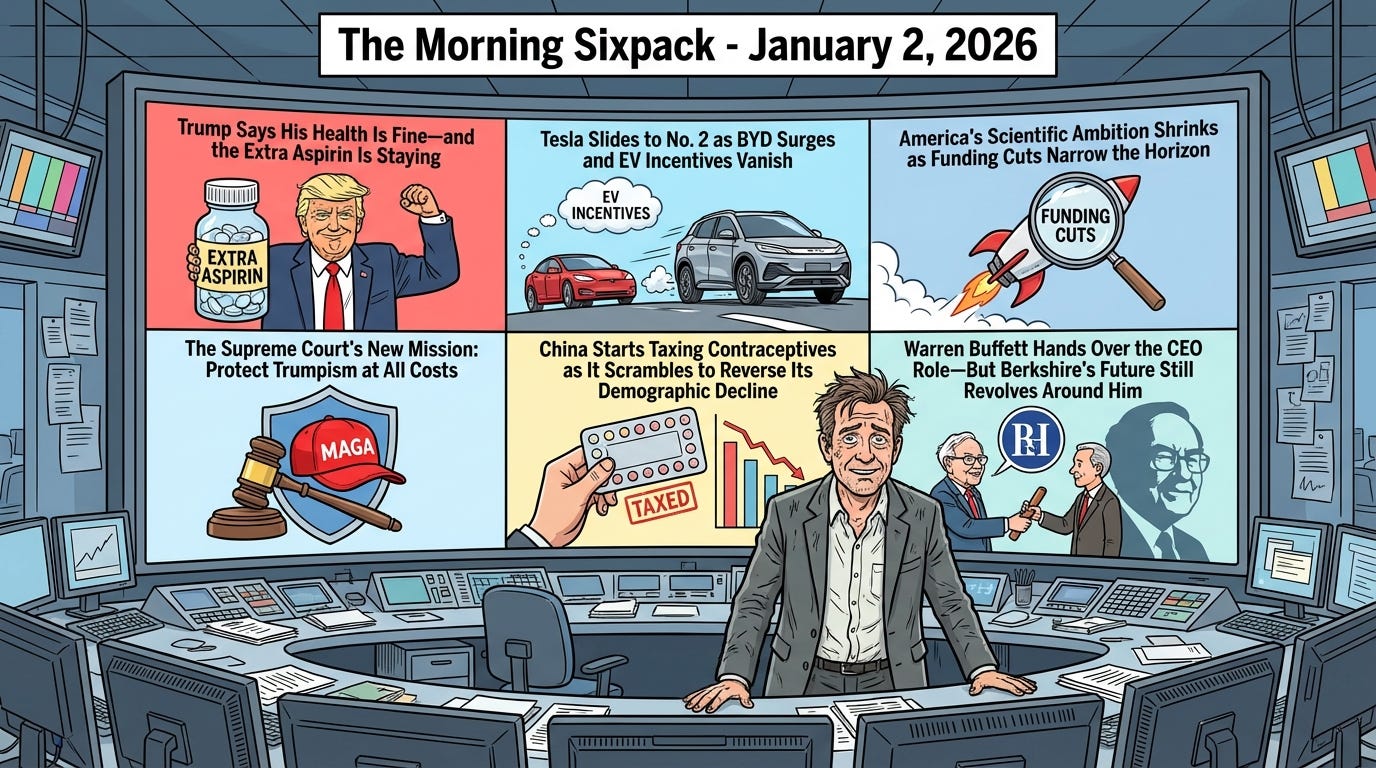
Trump Says His Health Is Fine—and the Extra Aspirin Is Staying
Trump insists he’s in “optimal health,” brushing off scrutiny over scans, swelling, bruising, and his daily mega-dose aspirin habit.
In a new interview with The Wall Street Journal, President Donald Trump laid out his version of events around an October visit to Walter Reed—one that included a CT scan he now says he regretted taking because it “gave them a little ammunition.” He admitted he originally mislabeled it as an MRI and didn’t know which body part was being examined. For a president famously touchy about questions of aging, that’s an oddly casual level of detail.
White House physician Navy Capt. Sean Barbabella said he ordered the imaging to “definitively rule out any cardiovascular issues,” adding the results were “perfectly normal and revealed absolutely no abnormalities.” The White House has since emphasized the exam was “advanced imaging,” a phrase they now say Trump himself clarified only because he “has nothing to hide.” Sure—because nothing says transparency like months of hedging.
Trump also addressed the visible bruising on his right hand and swelling in his ankles, which the White House attributed to chronic venous insufficiency and “frequent handshaking and the use of aspirin.” Trump confirmed he takes 325 milligrams of aspirin daily—more than his doctors prefer—explaining, “I want nice, thin blood pouring through my heart.” Hard to argue with the man’s commitment to viscosity management, even if the FDA might raise an eyebrow.
He dismissed viral clips of him appearing to doze in meetings, saying he was merely resting his eyes. He pushed back on questions about his hearing, insisted he still sleeps very little, and credited his stamina to his genes: “And I have very good genetics.” The self-confidence is abundant; the medical disclosures, less so.
Meanwhile, the president remains sensitive to comparisons with Biden, even as both men face age-related scrutiny. Trump says he’s energized and working full days. Whether voters feel equally energized hearing about compression socks, imaging confusion, and aspirin superstition is another matter.
Source: Fortune
Editor: If your health narrative requires this many clarifications, maybe the issue isn’t the CT scan—it’s the PR triage afterward.
Tesla Slides to No. 2 as BYD Surges and EV Incentives Vanish
Tesla’s second straight annual sales drop cements a rough new reality: the company that once defined the EV era is now chasing the competition.
The numbers tell the story. Tesla’s global deliveries fell 9% in 2025—its second consecutive yearly decline—and fourth-quarter sales slid 16%. With the U.S. tax credit gone and European demand wobbling, the company’s old growth engine finally sputtered. Meanwhile, China’s BYD blew past Tesla with 2.26 million battery EVs sold, a 28% jump that leaves Tesla’s 1.64 million looking awfully 2018.
The quarter held no holiday miracles. Tesla’s 418,227 deliveries came in below analysts’ already muted expectations, even after the company launched stripped-down Model 3 and Model Y variants to stir demand. The U.S. sales pop that came from buyers racing to beat expired subsidies faded quickly—no incentives, no surge. Europe was even grimmer, where registrations fell 39% through November. That’s not a blip; that’s a retreat.
Still, Tesla insists the future isn’t about cars anyway. Musk is steering hard into robotics and autonomy, hyping the Optimus humanoid bot and the steering-wheel-less Cybercab—neither of which exist outside controlled demos. The company logged 49% growth in its energy business, a bright spot, but cars still account for roughly three-quarters of revenue. For now, the math is brutally simple: fewer cars, fewer dollars.
Shareholders, however, remain committed to the Musk Show. They approved a pay package that could make him the world’s first trillionaire—if Tesla hits an $8.5 trillion market cap and a long list of operational milestones. The board calls the package essential to keep Musk focused. Personally, I suspect the only thing that keeps him focused is whatever shiny object he decides to chase that quarter.
Tesla promises “sustainable abundance” powered by AI, robots, and clean energy. Lovely aspiration. But until the Cybercab becomes something more than a vibe, the only abundance that matters is sales—and lately, those are heading in the wrong direction.
Source: WSJ (free)
Editor: It’s hard to disrupt the future when you can’t even beat a company that doesn’t sell cars in your own country. Maybe build the basics before the robot butlers.
America’s Scientific Ambition Shrinks as Funding Cuts Narrow the Horizon
Federal cuts didn’t just slash budgets in 2025—they shrank the country’s imagination about what science is even allowed to pursue.
Yes, some research survived the political whiplash of the past year. Courts reinstated thousands of killed grants, universities negotiated to salvage threatened funding, and Congress vowed to protect the NIH’s $48 billion budget. Breakthroughs still happened: a personalized gene therapy helping a six-month-old baby, and the Vera C. Rubin Observatory finally revealing its first shimmering map of the night sky. But beneath those bright spots sits a darker ledger researchers are still tallying.
The real damage is more structural. As epidemiologist Scott Delaney put it, “all, or nearly all, federal agencies that supported research in some way have decreased the size of their research footprint.” Less money means fewer questions asked, fewer decades-long investigations launched, and fewer leaps into the unknown. Worse, it erodes trust in the scientific compact that held since World War II—government funds in exchange for intellectual freedom and big bets. Now those bets look a lot more like hedges.
The administration insists it’s restoring rigor. Andrew Nixon at HHS wrote that the Biden administration had “politicized NIH funding through DEI-driven agendas,” and that the current approach “prioritiz[es] evidence-based research with real health impact.” Meanwhile, whole domains—transgender health, HIV research, even foundational basic science—have lost federal backing. NASA’s Mars Sample Return mission? Hanging by a thread. The result: labs shrink studies, scrap collaborations, and avoid ambitious projects because no one knows which scientific topics will be deemed taboo next month.
The collateral damage isn’t just halted experiments—it’s people. Grad programs are being downsized, immigration crackdowns have rattled international researchers, and young scientists from diverse backgrounds are openly asking whether academia still wants them. At the same time, some senior scientists are contemplating early retirement rather than navigating a landscape defined by banned words, canceled review meetings, and an increasingly hostile funding model. As Delaney put it, the administration “took two of the best assets that the U.S. scientific enterprise has—the capacity to think long, and the capacity to collaborate—and we screwed them up at the same time.”
Competition and scarcity can sometimes spark innovation, but only up to a point. As Yale biologist C. Brandon Ogbunu said, “comfort and security are key parts of innovation, too.” Right now, American science has neither—just a shrinking appetite for exploration and a growing fear of stepping outside the bounds of what’s politically convenient.
Source: The Atlantic
Editor: Funny how “restoring rigor” always seems to involve cutting the very work that made the U.S. the world’s scientific engine. Hard to win the future when you’re busy unplugging the lab.
The Supreme Court’s New Mission: Protect Trumpism at All Costs
The conservative supermajority spent 2025 proving it will green-light nearly any Trump overreach—even if it means hollowing out American democracy itself.
In his first year back in office, Donald Trump wielded power with a reach no modern president has attempted, and the Supreme Court’s Republican-appointed bloc mostly served as his legal bulldozer. Over and over—often through shadow-docket orders without explanation—the 6–3 majority smoothed the path for Trump’s efforts to kneecap Democratic electoral power, dominate the economy, and launch mass deportations. The one notable exception came only this week, when the Court finally pushed back on Trump’s deployment of the National Guard in Chicago—an aberration that illustrated just how extreme the president’s actions must be before the justices bother to say no.
What changed? As Dahlia Lithwick notes, the supposed “center” of the Court abandoned its reputation for institutional moderation. Instead, it “went all in for Trump, doubling and tripling down on the idea that this administration is like every other administration and any judge who tries to thwart it is a woke liberal.”
That’s the worldview now: If you oppose Trump’s legal theories, you’re suffering from “Trump derangement syndrome.” The Court casts itself as the sober adult in the room—even as it tears down the guardrails meant to restrain presidential power.
Mark Joseph Stern’s argument gets to the heart of it: the justices have merged originalism with Trumpism, elevating the interests of a shrinking political minority over democratic majorities. The Court has again targeted voting rights—the gateway issue that determines whether a democracy remains one. It reinstated Texas’ racial gerrymander, green-lit voter suppression, and is poised to further gut the Voting Rights Act in Callais v. Louisiana. If the goal is ensuring Republicans face as little electoral accountability as possible, the Court is delivering. Because if you can dictate who votes, where they vote, and how their votes are counted, you don’t need the public’s blessing—you just need the power to define the electorate.
And that extends far beyond ballot access. As Stern points out, even the birthright citizenship fight is a democracy case. It’s about who counts—who gets full membership in the polity and who is relegated to “skim-milk citizenship.” When you sort people into tiers of legitimacy, it becomes much easier to justify a political system where some voters matter and others simply don’t.
This is what makes the Court’s trajectory so dangerous: six justices with lifetime tenure appear convinced they must entrench a political regime that otherwise may not survive democratic scrutiny. They know their standing with the public is already in free fall. They know their rulings look nakedly partisan. And they know that if Democrats win power, Supreme Court reform—term limits, court expansion, jurisdiction stripping—will be on the table. So they’re acting now to lock in the system before voters can change it.
The irony? Had the justices slowed Trump down just a bit—“25 percent more losses,” as Stern puts it—they might have preserved the illusion of judicial independence. Instead, they fused themselves so tightly to Trumpism that if his project collapses, they crash with it. That’s why democracy cases feel existential to them: if the electorate is allowed to reset the system, their grip on power could slip. The only way to prevent that is to keep tightening the rules of participation until majorities can’t meaningfully alter the balance.
When a Court becomes invested not in interpreting the Constitution but in safeguarding a political movement, the stakes shift. It’s no longer just about outcomes in discrete cases. It’s about whether the justices will use their authority to preserve a version of America most Americans no longer support.
Source: Slate
Editor: When the branch designed to defend democracy decides its own survival depends on shrinking democracy, you don’t get judicial restraint—you get judicial self-preservation dressed up as constitutional theory.
China Starts Taxing Contraceptives as It Scrambles to Reverse Its Demographic Decline
Beijing has decided the path to higher birth rates runs through the checkout aisle—by slapping a 13% tax on condoms and contraceptive pills.
In a bid to coax more babies into a country that has logged three straight years of population decline, China has ended its decades-old tax exemption on contraceptive drugs and devices. As of January 1, condoms and birth-control pills now carry the standard 13% value-added tax—an unmistakable signal that Beijing is willing to make everyday contraception more expensive if it means nudging fertility upward.
This latest step slots neatly into China’s expanding portfolio of “fertility-friendly” policies. The government has already rolled out childcare subsidies, exempted those subsidies from income tax, and urged universities to promote “love education” that casts marriage, childbirth, and family in a rosier light. Top leaders reiterated at December’s Central Economic Work Conference that boosting “positive marriage and childbearing attitudes” remains a national priority. Translation: please have more kids, and please start soon.
But China’s demographic winter has been decades in the making. The one-child policy’s long tail, rapid urbanization, and soaring costs for housing, childcare, and education have reshaped family life. Young Chinese increasingly look at marriage and parenthood and see financial strain, career disruption, and a slowing economy—not the picture-perfect stability the government keeps advertising.
Taxing contraception may raise eyebrows globally, but at home the logic is painfully simple: Beijing is trying anything and everything to reverse a trend that threatens its future workforce and economic growth. Whether higher prices on condoms move the needle on fertility is another matter entirely. When a generation is hesitating to have kids because life is too expensive and too unstable, adding 13% to a box of condoms feels more like a symbolic gesture than a solution.
Source: Reuters
Editor: If your national birth strategy hinges on making condoms pricier, the problem isn’t latex—it’s the life young people can’t afford to build.
Warren Buffett Hands Over the CEO Role—But Berkshire’s Future Still Revolves Around Him
After six decades at the helm, Warren Buffett finally gave up the CEO title—yet the power, culture, and expectations he built aren’t going anywhere.
Buffett’s last day as Berkshire Hathaway’s CEO marks the end of one of the most remarkable runs in corporate history. What began as the “dumbest” investment of his life—buying a struggling textile mill—became a $1 trillion conglomerate powered by insurance float, disciplined acquisitions, and the kind of patience Wall Street finds borderline heretical. He’s now worth more than $150 billion and has already donated stock valued at $208 billion, with instructions for his children to give away nearly everything else.
But don’t call it retirement. At 95, Buffett is staying on as chairman and says he’ll still show up to Omaha HQ as often as ever, even if he plans to “go quiet…sort of.” Greg Abel, long viewed—correctly—as the successor, now gets the keys. Abel has effectively been running the non-insurance businesses for years, offering a level of discipline and hands-on attention that Buffett himself openly sidestepped. As Buffett once put it, “Our managers like autonomy, but they also get lonesome… I give them the autonomy, but Greg gives them both.” Translation: expect more structure, less mystique.
Berkshire is already shifting. A new management layer was added in December to supervise its 32 consumer-facing subsidiaries—a noticeable pivot from the old gospel of extreme decentralization. Still, the company won’t change overnight. As investor Ann Winblad put it, a new CEO means a different operating style, “but it won’t fundamentally change its strategies.” Buffett’s massive 30% voting control remains a shield—one that deters activists and gives Abel breathing room to build credibility without constant comparison to an impossible standard.
The biggest unknown is what happens to Berkshire’s stock without Buffett as the public-facing embodiment of its value. Investors flinched after his May announcement: A-shares fell from an all-time high of $809,350 to $692,600, before stabilizing at $754,800—good for a 10.9% gain in 2025, but a notable lag behind the S&P’s 17.9% return with dividends. Berkshire’s once-commanding outperformance flipped into a deficit, and with more than $350 billion in cash, unresolved questions loom: Will there be a dividend? More buybacks? A deployment strategy? Buffett’s continued presence all but guarantees none of that gets decided anytime soon.
Meanwhile, an older, sharper commentary echoes in the background. Charlie Munger’s classic demolition of compensation consultants—“I hardly can find the words to express my contempt”—still hangs over Omaha like a warning shot. Buffett even joked that if Berkshire’s board ever hired one, he’d “come back” from beyond. That worldview has insulated Berkshire from the worst instincts of corporate America. But without Buffett as CEO, those pressures will creep back in. Over the long run, Berkshire may have no choice but to become a bit more like the companies it once stood apart from.
Still, it’s hard to imagine the post-Buffett era truly beginning while Buffett is still in the building. Berkshire’s culture is his creation, and until the man himself steps away—or can no longer physically show up—the gravitational pull of his philosophy will remain impossible to escape.
Source: CNBC
Editor: Abel may run the show, but let’s be honest—no one with Buffett sitting 20 feet away is really in charge. Berkshire doesn’t turn the page until the man with the peanut brittle does.