


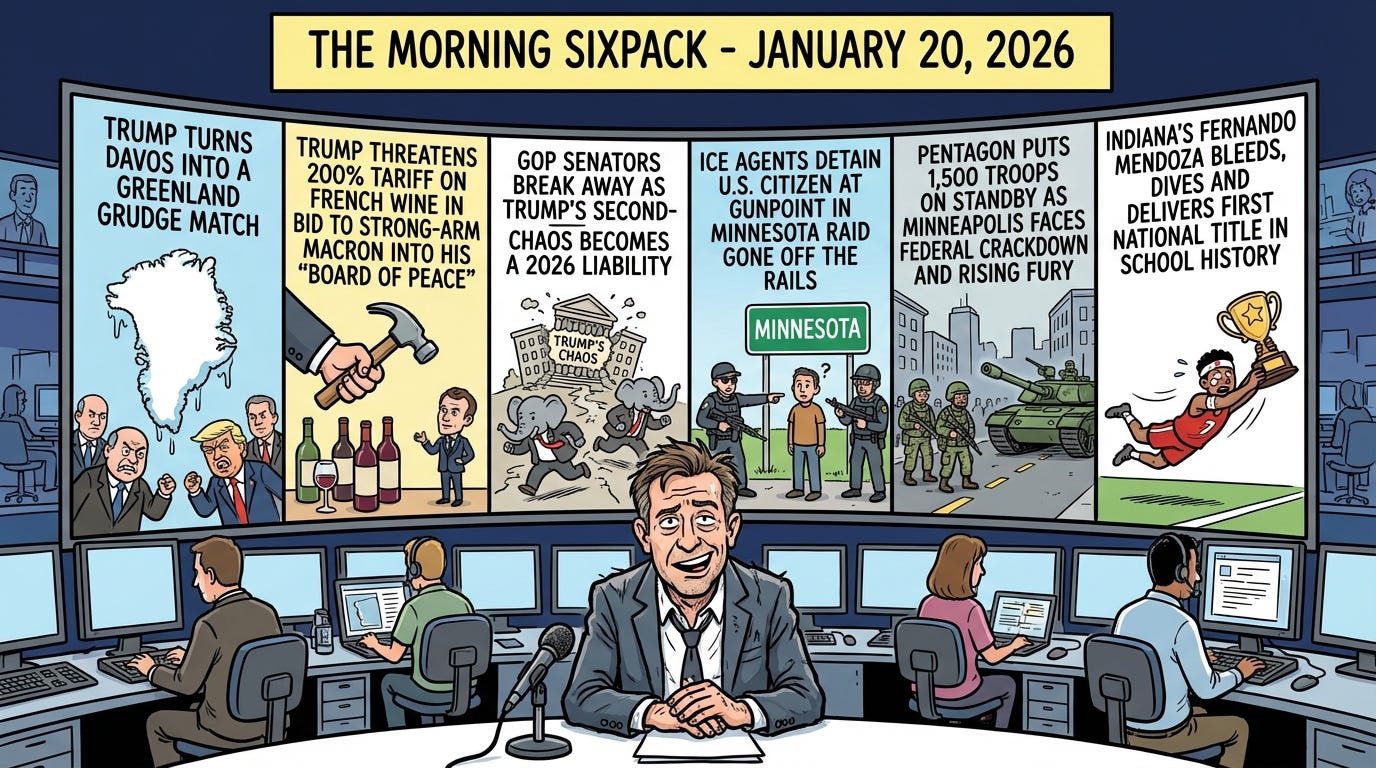
Trump Turns Davos into a Greenland Grudge Match
President Trump’s overnight blast of posts demanding control of Greenland turned the World Economic Forum into an impromptu crisis summit.
European leaders arrived in Davos hoping for polite diplomacy over mulled wine; instead they got a geopolitical food fight. With the U.S. delegation larger and louder than ever, Trump’s renewed fixation on acquiring Greenland has hijacked the week’s agenda and forced rattled allies into scramble mode.
Trump’s social-media spree was the gasoline. He mocked Britain over its decision to transfer sovereignty of the Chagos Islands and even published what appeared to be private texts from European officials. One of them was from French President Emmanuel Macron, who told Trump they were aligned on Syria and Iran but added, “I do not understand what you are doing on Greenland.” That line will echo through every Alpine chalet this week.
From Brussels to London, leaders pushed back. The U.K. defended its Diego Garcia deal and rejected Trump’s accusation of “GREAT STUPIDITY.” EU chief Ursula von der Leyen blasted Trump’s tariff threats as a violation of last year’s agreement and promised an “unflinching united and proportional response.” Meanwhile, NATO officials fretted that the chaos only opens more space for Russia—whose envoy conveniently showed up in Davos despite Moscow’s forum ban.
And yet the U.S. presence is impossible to ignore. USA House—complete with flag-stamped coffee cups, Cabinet secretaries on parade and a sanctuary-turned-stage—has become the hottest venue in town. Trump plans to use the spotlight to push his new “Board of Peace,” a billion-dollar-membership global club that sounds tailor-made to sideline the U.N.
As Trump put it after a call with NATO’s secretary general, “There can be no going back.” Which is exactly what rattles America’s allies: every day it becomes clearer that Trump’s vision for the world is transactional, territorial, and turbocharged—and they’re stuck negotiating in a ski resort while he redraws maps on social media—with a Sharpie, no doubt.
Source: WaPo (free)
Editor: Greenland again? At this point Trump’s foreign policy feels less like strategy and more like a Monopoly game where he insists the rules don’t apply because he’s the banker. Europe brought spreadsheets to Davos—he brought a Sharpie and a dream.
Trump Threatens 200% Tariff on French Wine in Bid to Strong-Arm Macron into His ‘Board of Peace’
Donald Trump’s latest tariff tirade targets French wine and champagne as leverage to drag Emmanuel Macron into his billion-dollar “Board of Peace.”
The president is now openly using economic punishment as an entry fee, declaring he’ll slap a 200 percent tariff on France’s prized exports if Macron refuses to join the new organization that—on paper—was created to oversee Gaza’s reconstruction but, in practice, looks a lot like Trump’s personal audition to replace the United Nations. When asked about France’s reluctance, Trump waved it off with trademark bravado: “I’ll put a 200 percent tariff on his wines and champagnes. And he’ll join. But he doesn’t have to join.” You can practically hear the corks recoiling.
Macron, for his part, isn’t biting. A source close to the French president said France “does not intend to answer favorably,” noting the board’s remit goes well beyond Gaza. Translation: Macron sees the power grab for what it is and isn’t signing on to Trump’s global homeowners association—especially one that demands a $1 billion membership fee and installs Trump as chair-for-life.
Europe is responding with something rare: unity. Leaders across the continent blasted Trump’s escalating tariff threats—on France, Denmark, Germany, the U.K., and others—as “unacceptable,” and German and French finance ministers vowed the EU won’t be bullied into ceding Greenland or anything else. Even U.K. Prime Minister Keir Starmer, typically cautious with Washington, called the idea of settling political disputes through weaponized tariffs “completely wrong.”
The tariff fight is now tangled with Trump’s Greenland fixation, which he’s using as an all-purpose justification for punishing Europe until someone hands him the deed to a giant Arctic island. The international community is watching closely—and nervously—as Europe weighs retaliation while Trump keeps tossing lit matches across the diplomatic landscape.
Trump may think he’s holding all the cards, but Macron summed up the European mood with a simple rebuke: these threats have “no place in this context.” If only Trump believed context applied to him at all.
Source: Irish Star
Editor: Nothing says “peacekeeping visionary” quite like threatening to nuke an entire nation’s wine industry because its president won’t join your geopolitical country club. At this rate, Trump’s foreign policy platform is just: ‘Give me Greenland and maybe your Merlot lives.’ I feel like we’re all HOSTAGES in this shitty made-for-TV movie.
GOP Senators Break Away as Trump’s Second-Term Chaos Becomes a 2026 Liability
Republican senators are quietly—and now not so quietly—distancing themselves from President Trump as his approval slides and his controversies pile up.
Two weeks into 2026 and GOP lawmakers are already exhausted. Trump’s threats to seize Greenland, deploy troops to Venezuela, prosecute Fed Chair Jerome Powell, invoke the Insurrection Act in Minneapolis, and cap credit card fees have created a policy whiplash that even his allies can’t spin anymore. One Republican senator put it bluntly: the president “can’t handle any level of what he considers to be personal criticism,” making substantive disagreement feel like stepping on a land mine.
The cracks are widening. Trump reportedly unleashed a profanity-laced tirade at Sen. Susan Collins for supporting a resolution requiring congressional approval for military action in Venezuela—and then called the four other GOP senators who joined her to berate them, too. Sen. Rand Paul tried reasoning with him, reminding Trump that, “This debate is bigger than me. It’s bigger than him. It’s about the Constitution and who has the prerogative to go to war.” That level of civics talk famously goes over well in this White House.
Behind closed doors, Republicans are jittery. Trump’s economic approval has slipped to 40 percent, support among independents has cratered to 30 percent, and strategists warn the party could be heading into a midterm wipeout. Senate Majority Leader John Thune has already cautioned colleagues about “headwinds,” urging them to sharpen their own message—an unsubtle hint that tying themselves too closely to Trump isn’t the winning play it once was.
Republican resistance is showing up in votes, too. House Republicans defied Trump by extending Affordable Care Act subsidies. Five Republican senators joined Democrats to advance a war powers resolution restricting action in Venezuela, prompting Trump to demand they all be ousted from Congress. And in a rare moment of institutional backbone, lawmakers rejected his proposed cuts to NASA, NOAA, NIST and the NSF, and added language to prevent the administration from ignoring congressional intent.
Perhaps most telling, GOP senators say they’re constantly blindsided by Trump-world bombshells. Sen. Thom Tillis captured the mood: he didn’t know a credit card rate cap was coming, didn’t know the Credit Card Competition Act was suddenly a priority, and “certainly didn’t know that the Fed chair was going to be indicted.” When the president’s advisors are setting off fireworks under their own party, the reelection-year panic writes itself.
Mitch McConnell, never one to waste words, warned that trying to take Greenland by force would “incinerate” NATO alliances and amount to “strategic self-harm.” When McConnell is the calm, reasonable voice in the room, you know the vibes are off.
Source: The Hill
Editor: Trump viewing every disagreement as betrayal isn’t new—but watching Republicans finally inch toward the exits is. Amazing what a looming midterm disaster and a Greenland annexation plan can do for a senator’s moral clarity.
ICE Agents Detain U.S. Citizen at Gunpoint in Minnesota Raid Gone Off the Rails
Federal immigration agents forced their way into a Minnesota home, detained a U.S. citizen at gunpoint without a warrant, and marched him outside in his underwear in subzero weather.
What happened to ChongLy “Scott” Thao in St. Paul isn’t a paperwork mix-up—it’s a civil rights nightmare. Thao says he was jolted awake by banging on the door and told his daughter-in-law not to open it. Moments later, masked ICE agents broke the door down, pointed guns at his family, and dragged him out half-dressed while his 4-year-old grandson screamed. No warrant, no explanation, no attempt to verify his citizenship.
St. Paul’s mayor didn’t mince words. “ICE is not doing what they say they’re doing,” Kaohly Her said, blasting the agency for going after “anyone and everyone in their path.” The videos of the incident back her up: neighbors yelling at agents, whistles blowing, and Thao—an American citizen for decades—being hauled out into the freezing street wearing only sandals, underwear, and a blanket. Mark Goldberg, a community member who witnessed it, said, “I don’t know how anyone could watch that happen to anyone.”
Once detained, the situation somehow got worse. Thao says agents drove him to “the middle of nowhere,” forced him out into the frigid air again for photos, refused to check his ID earlier when he begged them to, then finally realized—after one or two hours—that they had detained the wrong man. They returned him home, made him show ID, and silently vanished. No apology. No replacement door. No accountability.
DHS insists the raid was a “targeted operation” for “two convicted sex offenders,” claiming Thao matched the description and lived with the targets. His family says that is flatly false—and the public record backs them up. No one in the home is in the registry, and the closest listed offender lives blocks away. The agency has not explained who the alleged fugitives were or why they believed they were inside Thao’s home. Instead, ICE appears to have acted on a sloppy vehicle misidentification involving a borrowed car and someone with a similar name.
The indignity hits the family especially hard. Thao’s late adopted mother, Choua Thao, treated CIA-backed Hmong soldiers during the “Secret War” in Laos, risking her life for an American mission. Now her son is planning a civil rights lawsuit because he no longer feels safe sleeping in his own home. “What did I do wrong?” he asks. The answer, of course, is nothing—unless existing while Asian in St. Paul now counts as probable cause.
Source: CBS News
Editor: Kicking in the door of a U.S. citizen, dragging him into the snow in his underwear, then shrugging and walking away is not “immigration enforcement.” It’s government cosplay gone feral—and the bill for that broken door should go straight to DHS, preferably stapled to their conscience forehead.
Pentagon Puts 1,500 Troops on Standby as Minneapolis Faces Federal Crackdown and Rising Fury
The Pentagon has scrambled 1,500 active-duty soldiers to prepare for deployment to Minnesota, escalating a showdown between local leaders and a White House determined to muscle its way into the Twin Cities.
Two battalions from the 11th Airborne Division are now on prepare-to-deploy orders—an extraordinary step for domestic unrest—while the National Guard is already staged across the state. The Trump administration insists this doesn’t mean troops will deploy, but as one White House line put it, the Department of War is “always prepared to execute” the President’s commands. That’s not exactly the language of restraint.
Editor: The 11th Airborne Division is an elite paratrooper and Arctic operation. Think about that.
The move comes as ICE’s sweeping Operation Metro Surge has ignited outrage after aggressive raids, warrantless arrests, and the fatal shooting of Renee Good, a 37-year-old mother of three. Protests have surged across Minneapolis, where agents in riot gear have squared off with demonstrators, neighbors have filmed chaotic arrests, and conservative activists like Jake Lang—who floated burning a Quran—found themselves chased from the streets by counter-protesters. A federal judge has now stepped in with an injunction restricting what tactics federal agents can use, ruling that peaceful protesters cannot simply be rounded up or followed and detained on a whim.
BREAKING: ICE’s Account Is Crumbling as Video Undercuts DHS Narrative in Minneapolis Killing

Editor: This is brutal footage. DO NOT WATCH if you’re squeamish or care about your fellow human beings.
Minnesota’s leaders are blasting what they see as an occupation. Gov. Tim Walz deployed the state National Guard for support but accused federal forces of inflaming tensions. Minneapolis Mayor Jacob Frey was even sharper, calling the Pentagon’s standby orders “clearly designed to intimidate the people of Minneapolis” and labeling the administration’s push toward military involvement “completely unconstitutional.”
His most striking line: “I never thought in a million years that we would be invaded by our own federal government.”
Meanwhile, Trump officials continue to hint at invoking the Insurrection Act—a tool historically reserved for crises far more extreme than the protests currently unfolding. Deputy Attorney General Todd Blanche signaled support, claiming local leaders “are not doing their jobs,” while DHS and Border Patrol officials insist they’re responding to “dangerous rioters.” Federal agents have ramped up team sizes and hardened their posture, saying they must protect themselves from attacks—claims that conveniently sidestep the pattern of excessive force fueling the backlash.
The Insurrection Act: America’s Emergency Switch with a Troubling History

The Insurrection Act is the president’s most powerful domestic weapon—rarely used, often controversial, and born from a fear that the young republic might eat itself alive.
Overlay all of this with new legal warfare: activists suing to block federal overreach, Minnesota and its cities filing their own suit, and now the Department of Justice reportedly investigating Walz and Frey for “obstruction” of federal law enforcement. Neither leader has received so much as a subpoena, but both argue the message is unmistakable—Washington intends to make an example of them.
On the ground, the city feels tense but determined. Protesters huddle around heat lamps; officers push forward in federal black gear; downtown streets are barricaded; and yet the demonstrations—by sheer force of community—remain largely peaceful. As temperatures thaw and tempers flare, Minnesota is becoming the test case for how far the administration is willing to go in turning immigration enforcement into a domestic military campaign.
Source: CNN
Editor: When a mayor starts talking about being “invaded” by his own federal government, something has gone spectacularly off the rails. And if the White House thinks dropping paratroopers into Minneapolis will calm things down, someone should remind them this isn’t a Tom Clancy novel—it’s an American city full of people who actually read the Constitution.
Indiana’s QB Fernando Mendoza Bleeds, Dives and Delivers First National Title in School History
Fernando Mendoza licked the blood off his lip, steadied himself, and then dragged Indiana to a 27-21 national-title win that rewrote the program’s history.
The Miami native took an early beating from the Hurricanes’ vicious pass rush, but by the time the confetti fell in Hard Rock Stadium, he was the Offensive Player of the Game and the author of Indiana’s first-ever national championship. “Everybody doubted us at the beginning of the year,” Mendoza said afterward. “We didn’t make it this far not to lay it on the line.” And he meant it—his fourth-quarter Superman dive into the end zone was the night’s gutsiest moment.
Indiana’s 16-0 season—the first perfect run since 1894 Yale—came the hard way. Miami’s offense opened in neutral, managing just 18 first-quarter yards, a College Football Playoff record for all the wrong reasons. The Hoosiers weren’t much flashier early, but they controlled the clock, scratched out a field goal, and punched in a short Riley Nowakowski run to build a halftime cushion. Miami clawed back on a 57-yard Mark Fletcher Jr. blast, only for Indiana to respond with the first blocked-punt touchdown in CFP history, courtesy of Mikail Kamara and Isaiah Jones. “I just saw blood in the water,” Kamara said—apparently that was the vibe of the night.
The Hurricanes refused to fold, matching Indiana’s punches with long, bruising scoring drives. But Mendoza finally delivered the dagger: a 12-yard, Heisman-caliber run through defenders that pushed the Hoosiers’ lead back to 10. Miami answered again with a Malachi Toney touchdown, but Indiana’s offense calmly chewed up clock before adding a 35-yard field goal. Miami QB Beck had one more shot—until his final deep heave landed in the hands of Jamari Sharpe, a Miami native who sealed the championship against his hometown team. Narrative symmetry never misses.
The stat sheet shows a balanced Indiana win—Kaelon Black grinding out yards, Omar Cooper Jr. making key grabs—but the story is Mendoza: battered, bloodied and unstoppable when it mattered most. With the Hoosiers joining Michigan and Ohio State as the Big Ten’s third straight national champ, the conference might need a rebrand. “College Football Runs Through Us” seems about right.
Source: UPI
Editor: Mendoza licking his own blood before engineering a title drive is peak football theater. Miami brought the hits—but Indiana brought the mythmaking.