

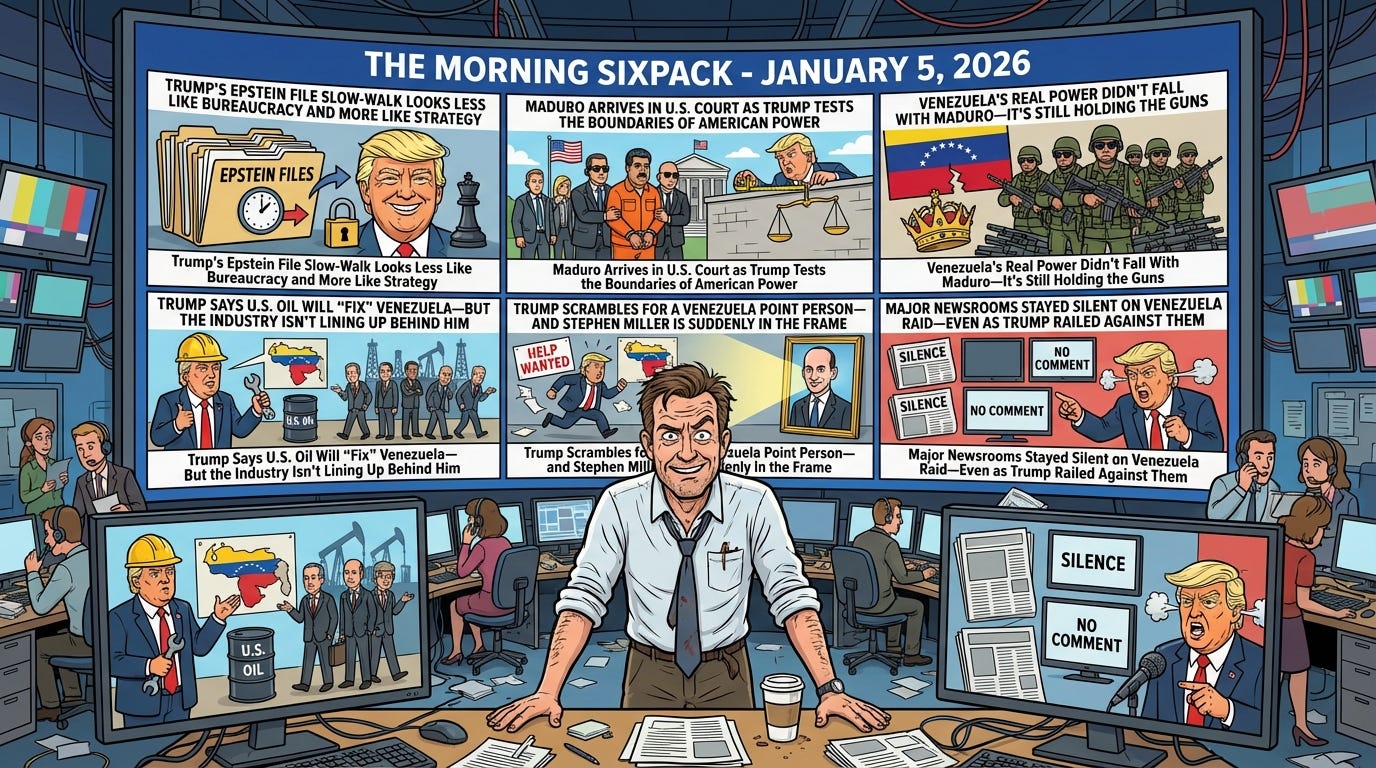
Trump’s Epstein File Slow-Walk Looks Less Like Bureaucracy and More Like Strategy
Trump’s year-long evasions on the Epstein Files now look less like incompetence and more like a calculated political firewall.
As one of her first acts as Attorney General, Pam Bondi sent a no-nonsense demand to FBI chief Kash Patel last February: deliver the “full and complete Epstein files” to her office the very next day. She wanted everything—“all records, documents, audio and video recordings, and materials related to Jeffrey Epstein and his clients, regardless of how such information was obtained.” No carve-outs, no redactions, no excuses. Yet here we are, a year later, and that directive may as well have been dropped down a well.
Congress stepped in, subpoenaed the files, and even passed a law requiring their release within 30 days. That deadline—Dec. 19—came and went as the DOJ insisted it needed more time to review a mountain of documents. But the mountain hasn’t moved. More than 5.2 million records remain tucked away inside an agency that has been promising transparency while delivering delay. A review process of this scale didn’t magically become overwhelming in December; it should have been underway last spring if Bondi’s order had been taken seriously.
The administration is capable of moving heaven and earth when Trump wants an outcome. We’ve seen the all-of-government muscle flexed to dismantle agencies, target migrants, and cast suspicion on Americans for little more than their appearance or language. If Trump wanted these files reviewed and released, he could redeploy lawyers across the government, assign support staff, even lean on outside firms. Instead, we’re watching a slow-walk so conspicuous it borders on theatrical.
Rep. Marjorie Taylor Greene recently claimed that when she threatened to release names from the files, Trump shouted, “My friends will get hurt.” Cute theory, but it requires believing Trump has friends. He doesn’t. He has people he uses until he doesn’t need them. If tossing someone else under the bus could save him, he’d be revving the engine. The more plausible explanation is much simpler: he thinks the files are worse for him than the fallout from hiding them.
So we’re left with this: a 79-year-old president with cratering approval numbers betting that concealment is safer than disclosure. And if Trump truly wanted a cover-up to work, he would do exactly what he’s doing now.
Source: democracydocket.com
Editor: Incredible that the same crowd demanding “transparency” from everyone else suddenly moves at glacial speed when the spotlight swings their way. If this is the best cover-up they can manage, imagine what the truth looks like.
Maduro Arrives in U.S. Court as Trump Tests the Boundaries of American Power
Nicolás Maduro’s forced arrival in a Manhattan courtroom marks a moment as unprecedented as it is revealing about the Trump administration’s taste for power projection.
Deposed Venezuelan President Nicolás Maduro and his wife were hauled from a Brooklyn jail at dawn Monday, shuttled onto a helicopter, and delivered under heavy guard to a federal courthouse in Manhattan. It was quick, quiet, and surreal—especially given that the courthouse sits just blocks from where Donald Trump himself was convicted in 2024. The proceeding was brief, merely the opening act of what promises to be a long legal fight over whether Maduro can be tried in the United States at all.
Venezuelan Invasion: An Explainer

Over the weekend, the United States carried out a sudden military operation in Venezuela, removing President Nicolás Maduro from power and transporting him and his wife to the U.S. to face federal criminal charges. The action was ordered by Donald Trump
Maduro’s legal team is gearing up to argue that he’s immune as a sovereign head of state. The problem? The U.S. doesn’t recognize him as Venezuela’s legitimate leader after his disputed 2024 “reelection.” That puts him in the same doomed legal lane as Manuel Noriega, who tried—and failed—to use head-of-state immunity after his own capture. Meanwhile, Venezuela’s interim president, Delcy Rodríguez, is demanding Maduro’s return even as she suddenly adopts a softer tone toward Washington, suggesting she’d love to avoid a geopolitical brawl she’s unlikely to win.
The backdrop to all of this is Trump’s swaggering insistence that the U.S. can “run” Venezuela while tossing out threats to Colombia’s Gustavo Petro and demanding “total access” from Rodríguez. Add in an indictment accusing Maduro of working with drug cartels, ordering murders, kidnappings, and taking bribes, and the stakes become clear: if convicted, he’s staring at life in prison. Yet the intelligence community’s own assessment found no evidence tying Venezuela’s government to the Tren de Aragua gang, raising uncomfortable questions about how airtight Trump’s narrative really is.
Maduro, Flores, and several top Venezuelan officials face charges ranging from cocaine trafficking to politically motivated violence, all wrapped in a 25-page indictment detailing bribes, killings, and cartel coordination. And let’s not overlook the logistical hitch: Maduro and his wife are under U.S. sanctions, meaning they legally can’t even pay a lawyer without Treasury approval. It’s hard to claim sovereign dignity when you need a special federal permission slip just to hire counsel.
For now, Maduro limps into court—literally—with the U.S. asserting jurisdiction over a foreign leader while Trump toys with post-Monroe Doctrine adventurism. If the administration wanted to send a message about who gets to call the shots in the hemisphere, consider it delivered.
Source: AP News
Editor: Funny how “defending democracy” always seems to involve a helicopter, a foreign courthouse, and a conveniently timed indictment. The Monroe Doctrine is starting to look less like a doctrine and more like an SOP.
Venezuela’s Real Power Didn’t Fall with Maduro—It’s Still Holding the Guns
Maduro may be gone, but the men who kept him in power still control the only institutions that matter: the police, the military, and the guns.
When Delcy Rodríguez stepped up to denounce the U.S. capture of Nicolás Maduro, she brought along the two men who actually determine whether Venezuela stands, crumbles, or simply switches dictators midstream: Interior Minister Diosdado Cabello and Defense Minister Vladimir Padrino. These two have spent years enforcing the regime with lethal efficiency, and despite Trump’s claim that Rodríguez will do Washington’s bidding, Cabello and Padrino are the ones with the muscle to decide Venezuela’s fate.
Analysts aren’t subtle about it. “Those are the two guys who control Venezuela right now,” said former U.S. diplomat Brian Naranjo. “These are the guys who command people with guns.” That’s the blunt truth behind Trump’s bet that the remnants of the regime will fall neatly in line now that Maduro is facing a U.S. courtroom. The country’s only functional national institution is its military, and history shows it has been the midwife of both the death and rebirth of Venezuelan democracy. They hold the real vote that counts.
For now, Cabello and Padrino are projecting unity after the dramatic strike that eliminated Maduro’s security detail and enabled his capture. But they aren’t sleeping easily. As former NSC official Juan Cruz put it, “They’re humiliated by the paper tiger that is the Venezuelan military…They are still in power. The cupola is intact. But they don’t sleep at night.” And why would they? They’ve spent decades accumulating power—illegal and otherwise—and they know better than anyone how quickly it can evaporate.
The two men aren’t just bureaucrats; they are indicted criminal actors in the eyes of the U.S., allegedly running the Cartel de los Soles like a shadow-state enterprise. Cabello, once Chávez’s loyal foot soldier and perennial enforcer, is infamous for his spiked-club rants on state TV and his role in crushing dissent through paramilitary gangs. Padrino, with Russian and Cuban backing, transformed the military into a cash-flow machine of smuggling, illegal mining, and drug trafficking—all to keep the regime afloat as the economy collapsed. These are not men who walk away quietly.
And that’s the core issue: nobody in Venezuela is celebrating Maduro’s ouster because the architecture of repression is still intact. Armed groups roam, military command is unbroken, and Trump’s threat of a “second, larger attack” hangs over every decision the regime’s survivors make. Cabello and Padrino may not like Washington’s terms, but they also understand what happens to people who miscalculate when the U.S. has already shown it can reach into Caracas and grab a sitting president from his own military base.
Source: Wall Street Journal (free)
Editor: Venezuela hasn’t entered a new era so much as it’s swapped the head on the same hydra. When the guys with the rifles decide the plot twist, democracy is just a prop on the stage.
Trump Says U.S. Oil Will “Fix” Venezuela—But the Industry Isn’t Lining Up Behind Him
Trump’s vow to march U.S. oil companies into Venezuela and “run the country” collides head-on with reality: oil majors don’t trust the place, the market doesn’t need the crude, and political chaos is the ultimate deal breaker.
Hours after U.S. forces captured Nicolás Maduro, Trump stood at a podium and made it plain: this intervention is about oil—at least in part. He promised to unleash American oil giants to rebuild Venezuela’s “badly broken” energy sector and “start making money for the country.” But here’s the problem: the majors have been burned before, global oil markets are oversupplied, and Venezuela’s crude is some of the dirtiest on the planet. You don’t fix that with a presidential decree.
Venezuela once pumped more than 3 million barrels a day and helped build OPEC; now it sputters at about a million barrels, much of it heading to China. Its heavy crude requires specialized refining and leaves an enormous carbon footprint. U.S. companies like Chevron have operated there for a century, but Chávez’s nationalizations and forced contract shake-downs in the 2000s drove ExxonMobil and ConocoPhillips straight into international arbitration—and then straight out of the country. Venezuela still owes them billions. Chevron stayed, grudgingly, and now produces about a quarter of the country’s remaining output.
The big question: will U.S. companies return now that Maduro is in a Brooklyn jail cell? Experts aren’t betting on it. ConocoPhillips says it’s simply “monitoring developments.” Exxon didn’t bother to respond. Even in a perfect geopolitical environment—which this is decidedly not—this would be a tough sell. There’s a global oil glut, demand projections are shaky, and companies with climate targets can’t justify expanding production in one of the world’s most carbon-intensive basins. Meanwhile, Guyana—right next door—is booming with lighter, cleaner crude, low taxes, no state oil giant, and far fewer headaches. Guess where Exxon put its chips? Not in Caracas.
And then there’s the most obvious obstacle: stability. Oil companies don’t gamble billions in countries where the chain of command is unclear and the streets are patrolled by armed factions. As one analyst put it: no investor is diving into “a place where there’s no legal contract and viable permission to operate or if there’s concerns about political stability and violence.” If Iraq took nearly two decades to cobble together a semi-functional oil rebound after a U.S. invasion, Venezuela—after 20 years of corruption, mismanagement, and economic collapse—won’t be rebuilt with a wave of Trump’s hand.
Trump may think he can run Venezuela like a foreclosure project with a few oil executives, but oil doesn’t flow without predictability. And right now, Venezuela has none.
Source: NPR
Editor: The idea that Exxon and Conoco are champing at the bit to re-enter the Venezuelan labyrinth is adorable—like thinking a loan shark wants to reopen a store in the neighborhood where he got mugged. Oil companies love profit, not chaos.
Trump Scrambles for a Venezuela Point Person—and Stephen Miller Is Suddenly in the Frame
The Trump administration toppled Maduro without a plan for what comes next, and now Stephen Miller—yes, that Stephen Miller—may be handed the keys to post-invasion Venezuela.
In the chaotic hours following Nicolás Maduro’s capture, one thing has become crystal clear: the administration had no coherent blueprint for governing Venezuela. Secretary of State Marco Rubio has been the front man for the invasion, but juggling State and national security adviser duties leaves him little bandwidth to actually manage the daily grind of rebuilding—or, more accurately, reengineering—a foreign country. Into that vacuum steps the one figure Trump always trusts when things get messy: Stephen Miller.
According to the Washington Post, internal confusion has spread through a White House that remains understaffed at the National Security Council and oversaturated with overlapping power centers. Officials are now openly discussing elevating Miller to oversee post-Maduro operations. And why not? He’s already shaped Trump’s hardline immigration and border policies and reportedly helped mastermind the effort to remove Maduro in the first place. Nothing says “nation-building” quite like the guy who brought you family separations.
Rubio, meanwhile, may care deeply about the Venezuela project, but as one official put it, his “expansive portfolio” means he can’t steer the ship day-to-day. That leaves Trump fishing within his tiny, insular inner circle for someone loyal, ruthless, and willing to own the mess. Miller conveniently appeared at Trump’s side after the invasion, a not-so-subtle signal that he’s already in the room where these decisions are happening.
If Miller does take the reins, Venezuela won’t just be navigating the aftermath of regime change—it’ll be subject to the ideological instincts of a man whose political brand was built on restriction, punishment, and maximal executive power. In other words, brace for a very particular flavor of “reconstruction.”
Source: Raw Story
Editor: Only this administration could invade a country without a plan and then decide the cleanup crew should be the architect of America’s harshest domestic policies. Forget nation-building—this is nation-winging.
Major Newsrooms Stayed Silent on Venezuela Raid—Even as Trump Railed Against Them
In a twist worthy of a Cold War spy novel, the same news outlets Trump loves to demonize quietly helped keep his Venezuela raid secret.
According to Semafor, both The New York Times and The Washington Post learned of the U.S. special forces operation to capture Nicolás Maduro before it kicked off Friday night—but held back publication after the administration warned that reporting could expose American troops. For all the talk of “enemy of the people,” when the stakes were life-or-death, the old national security handshake between the press and the presidency reappeared.
This wasn’t the first time legacy newsrooms tapped the brakes for national security reasons. From the Bay of Pigs to warrantless wiretapping to prisoner swaps, the Times and Post have long weighed operational secrecy against public interest. But in Trump’s second term—a term defined by hostility, media expulsions from the Pentagon, and leak-driven firestorms—the cooperation stands out. Even as Trump praised the raid as a triumph of “stealth” and “precision,” officials quietly omitted that part of that secrecy came from reporters choosing restraint.
The arrangement underscores how bizarre the relationship has become: a White House that pushes journalists out of press spaces while still relying on those same outlets to keep military plans under wraps. It also reveals the paradox of Trump-era national security reporting—constant friction, constant need. As administration officials decline comment, the pattern remains unmistakable: the press may be vilified rhetorically, but operationally, it’s still part of the apparatus.
Notably, Trump called the Times at 4:30 a.m. to celebrate the capture—because even the president who claims to despise “legacy media” still wants their front page glow. And the Washington Post’s own editorial board offered full-throated praise, calling the Maduro raid a “major victory for American interests.” Which tells you everything: in Washington, grudges melt the moment a president flexes power abroad.
In the end, secrecy held, the raid proceeded without American casualties, and the news outlets once again played their quiet, uncomfortable role in the security state’s choreography—even under a president who accuses them of treason on the regular.
Source: Semafor
Editor: Incredible—Trump spends years torching the press, then counts on their discipline to pull off his biggest covert operation. Washington hypocrisy isn’t a bug anymore; it’s the whole operating system.