


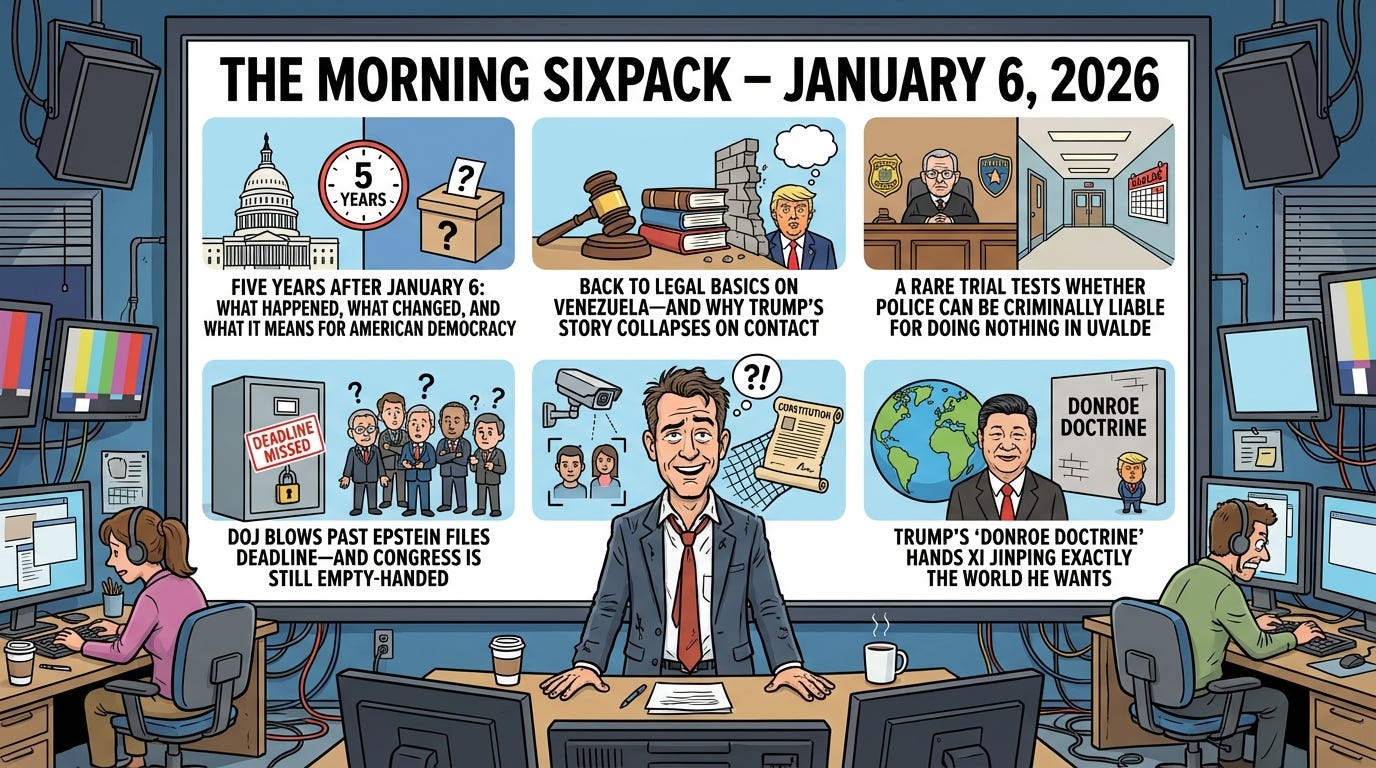
Five Years After January 6: What Happened, What Changed, and What It Means for American Democracy
Five years ago today, the United States experienced one of the most consequential domestic political crises in its modern history. On January 6, 2021, a violent mob breached the U.S. Capitol in an effort to halt Congress from certifying the results of the 2020 presidential election—an election that then-President Donald Trump had lost to Joe Biden.
The attack left the nation shaken. Five years later, with Trump back in the White House and most January 6 defendants pardoned, the question is no longer just what happened—but what did the country learn, and are we better off now?
What Happened on January 6, 2021
In the weeks following the 2020 election, Trump repeatedly and falsely claimed that widespread fraud had cost him victory. Courts rejected those claims dozens of times, and state officials from both parties certified the results.
On the morning of January 6, as Congress met to certify the Electoral College vote, Trump addressed thousands of supporters near the White House. He urged them to “fight like hell” and march to the Capitol to “take our country back.”
Soon after, a crowd overwhelmed police barricades and forced its way into the Capitol building. Rioters smashed windows, assaulted officers, and temporarily occupied the House and Senate chambers. Lawmakers were evacuated or sheltered in place as the certification was delayed for several hours.
The attack resulted in multiple deaths in its immediate aftermath and injuries to more than 140 law enforcement officers. That evening, Congress reconvened and formally certified Biden’s victory.
The Legal and Political Reckoning
The federal response was swift and historic in scale. Over the next several years, more than 1,500 people were charged with crimes related to January 6, ranging from unlawful entry to assault on federal officers and seditious conspiracy. Hundreds were convicted and sentenced to prison terms.
A bipartisan House Select Committee concluded that the attack was not spontaneous, but the culmination of a multi-part effort to overturn a lawful election. The committee found that Trump played a central role by promoting false claims, pressuring officials, and summoning supporters to Washington.
Trump was impeached by the House for incitement of insurrection but acquitted by the Senate. Later, a special counsel charged him with crimes related to election interference, though those cases never reached trial before his return to office.
The Pardons and Their Impact
On January 20, 2025, hours after being sworn in for a second term, President Trump issued sweeping pardons and commutations for nearly all individuals charged or convicted in connection with January 6—including people convicted of violent offenses and seditious conspiracy.
The move effectively ended the largest criminal investigation in Department of Justice history. Supporters described the prosecutions as politically motivated and the pardons as an act of reconciliation. Critics argued the decision erased accountability for an attack on democratic governance and undermined the rule of law.
Some pardoned individuals quickly re-entered political life, attending rallies and events portraying themselves as political prisoners rather than convicted criminals.
Where the Country Stands Now
Five years on, January 6 remains a defining fault line in American politics.
Efforts to formally memorialize the attack—such as installing a plaque honoring the officers who defended the Capitol—remain stalled amid partisan disagreement. Public opinion remains deeply divided over whether January 6 was an insurrection, a riot, or something in between.
Meanwhile, officials who oversaw the original prosecutions have largely exited government, and federal policy now reflects a dramatically different interpretation of the events than that presented in courtrooms just a few years ago.
Are We Better Off? Is Democracy Stronger?
By one measure, American democracy endured. Elections continued. Power ultimately transferred according to constitutional procedures. The system bent—but did not break.
By another measure, the country is more vulnerable. The absence of lasting accountability for political leaders, the use of presidential pardons to erase convictions tied to an attack on Congress, and the lack of consensus on basic facts have raised concerns among legal scholars and democracy advocates.
Perhaps the most enduring legacy of January 6 is not the violence itself, but the unresolved argument over what it meant—and whether attempting to overturn an election by force carries consequences in the long run. So far, it doesn’t.
The Bottom Line
January 6, 2021, was a moment when words, power, and belief converged into violence aimed at stopping a democratic process. Five years later, the events are no longer just history—they are precedent.
Whether the United States is stronger or weaker depends largely on how future leaders, voters, and institutions respond when the next test inevitably comes.
History will record what happened that day. What remains uncertain is what the country chooses to remember—and what it is willing to tolerate—going forward.
Back to Legal Basics on Venezuela—And Why Trump’s Story Collapses on Contact
The first rule of international law is you don’t get to bomb a country because you feel like it, and Trump bulldozed right through it.
It’s been an unhinged kickoff to 2026, and critics are absolutely right to call Saturday’s assault on Venezuela both illegal and unconstitutional. Nations aren’t supposed to behave like drunk bar patrons throwing chairs, and in our system, only Congress—not a president hopped up on executive grandeur—gets to declare war. Yet here we are, watching the White House tie itself in legal knots to justify the unjustifiable.
The administration’s spin has been as predictable as it is flimsy: this was “self-defense,” the kidnapping of Nicolás Maduro was somehow an “extradition,” and Congress couldn’t be told because it “leaks.” Please. None of those claims survive even a light breeze. When you strip away the noise and return to first principles, the picture is painfully clear: this was war, it was illegal, and it shredded the Constitution Trump swore to uphold.
Trump wants the theatrics of tough-guy militarism while pretending the laws of war don’t apply. He bragged that the assault was something the world hadn’t seen “since World War II,” yet his allies insist it was merely a “police action” to nab one bad guy. But facts—not vibes—determine whether an international armed conflict exists, and the facts are overwhelming: cyberattacks on Caracas’ grid, strikes on air defenses, killings of security personnel, dozens of civilian casualties, and now threats of naval blockades. Call it what it is: war.
And not just war—illegal war. The U.N. Charter’s Article 2(4) couldn’t be clearer about prohibiting force against another nation’s territorial integrity. There are only two exceptions: U.N. authorization or self-defense from an armed attack. Trump has neither. Drug trafficking doesn’t qualify as an “armed attack”—as the lawyers at Just Security put it, “the relationship between drug trafficking and the deaths that eventually result…is far too attenuated.” Expanding “self-defense” to include this would give the U.S. license to invade any country whose contraband crosses our borders. That’s not law; that’s imperial cosplay.
Then there’s the kidnapping. Maduro may be a despot, but that doesn’t grant the U.S. the legal right to snatch a foreign head of state from his own country. We’ve been here before: Israel’s abduction of Nazi fugitive Adolf Eichmann prompted the U.N. Security Council—backed by the U.S.—to affirm that violating another nation’s sovereignty is incompatible with the international order. Even the Reagan-era State Department conceded that such unconsented arrests “have no legal justification under international law aside from self-defense.” Translation: Trump’s claim collapses under its own weight.
Finally, the constitutional rot. Only Congress can authorize war, and even under the War Powers Act, Trump had to consult them. He didn’t. Instead, he lied to lawmakers about regime change plans and—this is not parody—consulted oil executives. Rubio’s excuse that Congress can’t be told because “it endangers the mission” is laughable; Trump’s line about congressional “leaks” isn’t even original. What it is, however, is a tacit admission that this administration views Congress as a nuisance, not a coequal branch.
Tomorrow’s political quagmire is already here. Trump’s illegal war with Venezuela violates international law, U.S. law, and basic common sense. And it’s setting him up for yet another messy, unpopular fiasco.
Source:

Editor: Bold strategy invading a country for “self-defense” because of drugs while simultaneously bragging about World War II–level force. When your legal argument can only be made with finger guns and a shrug, maybe rethink the whole launching-a-war thing.
A Rare Trial Tests Whether Police Can Be Criminally Liable for Doing Nothing in Uvalde
Nearly four years after Uvalde’s heartbreak, the question finally lands in a courtroom: can an officer be criminally charged for failing to act while children were being slaughtered?
Jury selection wrapped Monday in the trial of former Uvalde school police officer Adrian Gonzales, who faces 29 felony counts for allegedly placing two dozen children in “imminent danger” by failing to confront the Robb Elementary gunman. Judge Sid Harle seated 12 jurors and four alternates after an all-day process in Corpus Christi—200 miles from Uvalde and a world away from the community’s still-raw grief. Opening statements begin Tuesday, marking a trial that’s as legally uncommon as it is emotionally loaded.
The juror questionnaire made clear how fraught the task ahead is: opinions about law enforcement’s catastrophic 77-minute delay, impressions of Gonzales himself, even whether potential jurors donated money to the victims. As Harle said, “I am sure that there is literally no one in this courtroom who has not heard about this case”—and he’s right. When nearly 400 officers respond but no one stops the shooter, everybody hears about it.
Prosecutors argue Gonzales knew the shooter’s location, had the training, and still didn’t intervene. His charges cover every child who died in classroom 112 and the survivors who lived through the horror. It’s an incredibly rare use of Texas’ child endangerment statute—typically reserved for negligent parents, not police—because it requires proving a legal duty to act, not merely a moral failure. As one law professor put it, “The critical issue here is whether the individual has a duty to act.” And that’s the razor’s edge this entire trial balances on.
Defense lawyers insist Gonzales is being scapegoated for a catastrophe far bigger than any one officer. “Those precious souls were stolen by a monster that day, but that monster was not Adrian Gonzales,” his attorney said. Expect their case to lean heavily on drone footage and the chaos of the scene—because if the jury believes Gonzales was a responder without command responsibility, prosecutors may have a steep climb.
Still, the stakes are historic. A conviction would mark the first time an officer has been held criminally accountable for an on-scene response during a mass shooting. Uvalde families have waited nearly four years for someone—anyone—to be held responsible. Whether the law can finally deliver what institutions have so thoroughly failed to provide is now in the hands of 12 Texans.
Source: ABC News
Editor: If accountability requires proving a “legal duty” to save trapped children, maybe the system isn’t broken—maybe it was built with escape hatches for the people wearing badges. The families don’t get those.
DOJ Blows Past Epstein Files Deadline—And Congress Is Still Empty-Handed
The Justice Department just ignored a legally mandated deadline on the Epstein files, and no one in Congress has received the required explanation for the redactions.
A source familiar with the document release confirms what everyone paying attention suspected: the DOJ has not provided Congress with the justification for its redactions, as explicitly required by the Epstein Files Transparency Act. That explanation was due January 3. It is now well past January 3. This isn’t ambiguity or bureaucratic sluggishness—this is a straight-up failure to comply with a law designed to prevent exactly this kind of quiet opacity.
The Act wasn’t crafted for sport; it was passed to ensure that one of the most consequential criminal investigations of our era cannot be buried under layers of selective secrecy. Congress is entitled to know why material was withheld. The public is entitled to an honest accounting. And the DOJ is not entitled to shrug off statutory requirements because the calendar is inconvenient or transparency is uncomfortable.
This omission also lands in the middle of a much wider storm of concern about executive overreach, where critics say the President is testing constitutional boundaries on multiple fronts. But even in the messiest political climate, the fundamentals remain unchanged: the law doesn’t pause itself just because the executive branch finds compliance awkward.
The whole point of the Epstein Files Transparency Act was to prevent agencies from slow-walking disclosures, redacting without explanation, or engaging in the kind of institutional evasiveness that keeps the public in the dark. Yet here we are—another missed deadline, another silence where a legal obligation should be, and another reminder that oversight only works when the overseen feel compelled to cooperate.
Pressure won’t subside. The deadline has passed. The explanation is overdue. Congress and the public are still waiting—and the statute isn’t going anywhere.
Source: Meidas News
Editor: Funny how the DOJ becomes a model of efficiency when it wants to redact something, but suddenly discovers “process delays” when it has to explain those redactions. Almost like transparency was never the point.
ICE’s New Facial-Recognition Dragnet Is Reshaping Immigration Enforcement—And Civil Liberties Are the Collateral
ICE agents can now point a phone at your face, snap a photo, and instantly pull up your identity—and possibly your immigration status—without your consent.
That’s the new normal under President Trump’s second-term mass-deportation machine, powered by a tool called Mobile Fortify. What once required multiple systems, time, and verification now takes seconds. The app has become standard issue in the field, and with Congress handing ICE an unprecedented $75 billion this summer, the agency has more money than ever to expand tools like it—iris scanners, AI-assisted location tech, and whatever else the government thinks fits the vibe of a sci-fi police state.
ICE insists the tech is lawful, efficient, and more accurate than previous methods. Sure, it might reduce wrongful detentions. But it also gives federal officers the ability to run warrantless biometric scans on people walking down the street or sitting in their cars—exactly the dystopian scenario civil-rights advocates have been warning about. As the ACLU put it, “It can be used to point at people in the street, people in cars, and scan their facial prints without their consent.” And that’s not hypothetical—they’re already doing it.
The government claims Mobile Fortify doesn’t tap public data or scrape social media, but officials familiar with the tool say otherwise. Add to that a helpful detail: DHS never filed a required privacy impact assessment for the app. Neat trick. Normally, such an assessment is mandatory before deploying any tech that hoovers up biometric and personal data. But ICE didn’t exactly let procedure slow down its deportation agenda.
What makes this even more legally fraught is the tool’s origin story. Mobile Fortify was first built under Biden for Border Patrol, whose zone of operation—within 100 miles of the border—comes with weaker constitutional protections. DHS lawyers initially barred ICE from using the app precisely because it carried huge privacy risks and threatened to undermine the government’s other facial-recognition programs. Then Trump took office again, and suddenly every red flag became a green light.
ICE has now used Mobile Fortify more than 100,000 times, and the agency wants to hand a lite version to local police departments. That should worry anyone who thinks civil liberties shouldn’t be an afterthought in immigration enforcement. When high-speed biometric scanning becomes just another thing cops do on the sidewalk, you’re not streamlining deportations—you’re normalizing surveillance.
Source: WSJ (free)
Editor: Apparently “small government” now means giving ICE a smartphone app that can identify you faster than your own mother. Always amazing how efficient the state becomes when it’s aiming its tools downward, never upward.
Trump’s ‘Donroe Doctrine’ Hands Xi Jinping Exactly the World He Wants
By storming into Caracas and seizing Nicolás Maduro, the U.S. didn’t just upend Latin America—it reinforced Beijing’s belief that raw power, not shared rules, is what really governs the globe.
Hours before American commandos grabbed Maduro, China’s special envoy was in the presidential palace, smiling for cameras and signaling Beijing’s continued backing of one of its closest partners in the Western Hemisphere. The speed and force of the U.S. strike delivered a blunt message: China’s influence in the region ends the moment Washington decides it does. For all of Beijing’s years of investments, loans, and military cooperation, none of it protected its man in Caracas when the Donroe Doctrine came calling.
Yet the deeper irony is that Trump’s worldview—carving up the globe into spheres of influence where great powers do whatever they please—ultimately reinforces Xi Jinping’s own ambitions in Asia. If the U.S. gets to dominate its backyard through unilateral force, then Washington forfeits the moral standing to lecture Beijing about its behavior in the South China Sea or its military pressure on Taiwan. As one scholar put it, every time a great power ignores international norms, China gains another footnote to defend its own aggression.
Xi, of course, is already working the contrast. While U.S. airstrikes flattened buildings near Caracas, Xi hosted South Korean President Lee Jae Myung in Beijing, pitching China as the region’s steady, cooperative partner. Never mind that China has spent the past week firing rockets near Taiwan and bullying its neighbors—the optics are convenient, and the “harmony without uniformity” rhetoric plays well for audiences tired of American dominance.
Still, China is stung. The raid embarrassed Beijing, not least because it occurred the very day its envoy visited Maduro. It exposed the limits of China’s intelligence footprint in the Western Hemisphere and put billions in outstanding loans at risk. Losing leverage in Venezuela—its biggest Latin American investment and ideological partner—is no small setback. But Beijing is unlikely to walk away; as one analyst quipped, Venezuela may be a headache, “but it’s a headache worth having.”
Beijing is now condemning the U.S. action as “unilateral bullying,” a line it will surely wield the next time Washington protests Chinese muscle-flexing in Asia. And that’s the quiet victory for Xi: Trump’s strike doesn’t deter China; it validates China’s worldview. Washington’s abandonment of rules-based order gives Beijing a freer hand to argue that power decides outcomes, not law—and that big countries get to act like big countries.
Source: NYT
Editor: Hard to miss the symmetry here—Trump gets his hemisphere, Xi gets his. Turns out “might makes right” isn’t a doctrine so much as a global permission slip for every authoritarian with a map and a grievance. And don’t think Putin isn’t paying attention. Ukraine just lost.