


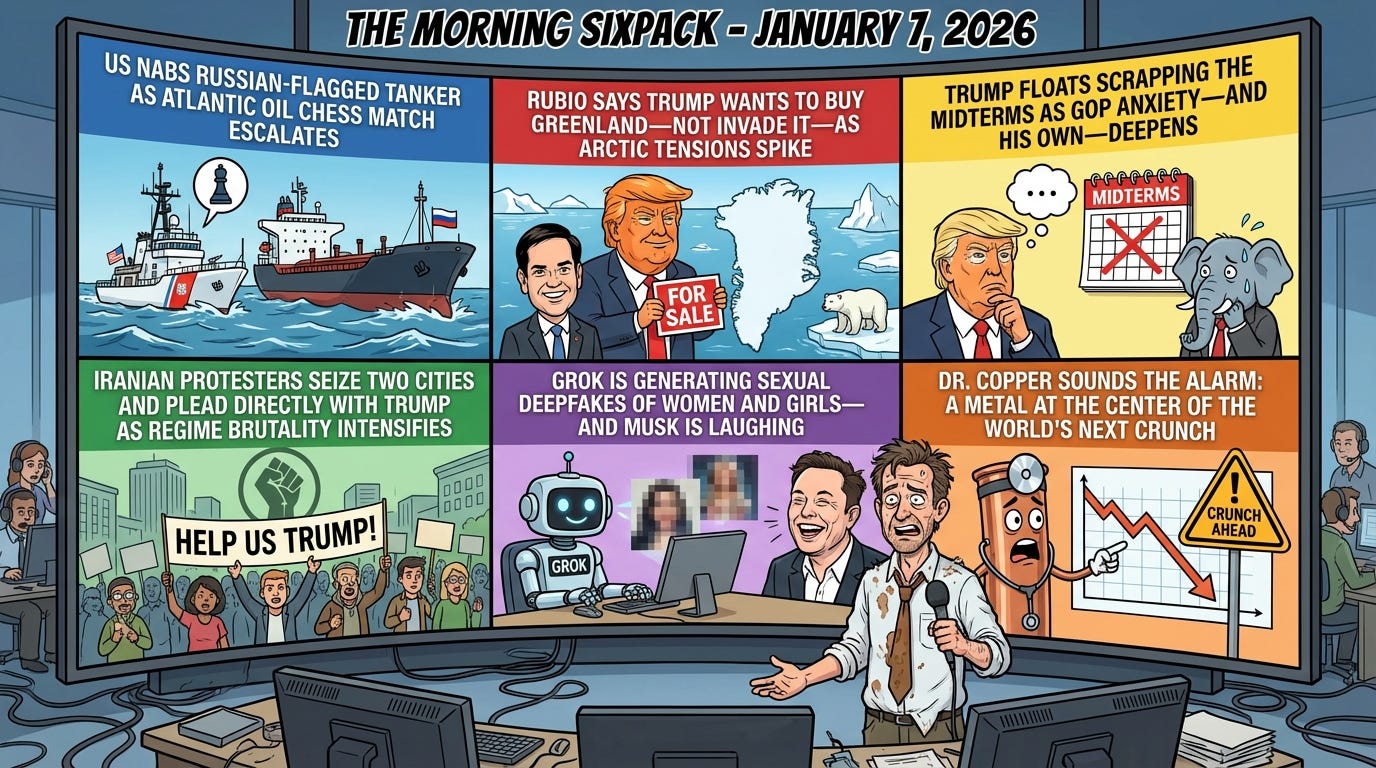
US Nabs Russian-Flagged Tanker as Atlantic Oil Chess Match Escalates
The U.S. just yanked a Kremlin-escorted oil tanker out of the North Atlantic, and the geopolitical fallout is already humming.
Washington confirmed the seizure of the Marinera—a ship with ties to both Russia and Venezuela—after tracking it for weeks as it tried to duck a sanctions blockade near Venezuela. European Command said it was taken “pursuant to a warrant issued by a U.S. federal court,” a tidy way of saying the Coast Guard finally caught the tanker after a long maritime cat-and-mouse game.
The vessel, once known as Bella-1, had been busy reinventing itself: ditching its name, slapping on a Russian flag, and cruising under submarine escort like it was carrying state secrets instead of oil. Part of the shadow fleet that shuttles sanctioned crude for Moscow, Tehran, and Caracas, the ship started its run in Iran and was headed to Venezuela before taking a suspicious detour near Iceland.
This move mirrors a broader, far more muscular U.S. posture in the region. Trump’s push to control oil flows has intensified, punctuated by simultaneous actions—including the seizure of another tanker, Sophia, in the Caribbean, and the now-infamous dawn raid in Caracas that ended with Nicolas Maduro in U.S. custody. Venezuelan officials call it kidnapping; the U.S. calls it justice. Oil, as always, sits at the center of everyone’s story.
British officials, predictably allergic to drama, refused to comment on whether their bases played a role, which usually means: something is happening, and they don’t want to talk about it. Meanwhile, Russia and Venezuela are accusing Washington of resource theft, while Washington accuses them right back. Half a century of nationalized energy and geopolitical grudges doesn’t resolve neatly in a press release.
Source: Metro
Editor: Bold move seizing a tanker trailed by a submarine. When oil becomes the plot device, everyone suddenly remembers their “principles,” and the North Atlantic turns into a season premiere.
Rubio Says Trump Wants to Buy Greenland—Not Invade It—as Arctic Tensions Spike
Marco Rubio is telling lawmakers to relax about an American invasion of Greenland, even as the White House keeps rattling its sabers.
In a closed-door briefing, the secretary of state insisted the administration’s bluster is leverage, not a prelude to U.S. Marines storming Nuuk. This comes as Trump officials repeatedly refuse to rule out armed seizure of the island—subtlety has never been this administration’s strong suit—but Rubio cast the whole affair as an aggressive real-estate negotiation aimed at prying Greenland from Denmark.
Trump has been fixated on Greenland since his first term, and the rhetoric has only grown louder. The White House claims the U.S. “needs” the island to counter Russia and China in the Arctic, while Trump is openly eyeing its critical minerals. One aide (aka Baby Goebbels, aka PeeWee German, aka Stephen Miller) even argued on CNN that “nobody’s going to fight the United States militarily over the future of Greenland,” a line that lands differently when you’re talking about attacking a NATO ally.
Source: YouTube
European leaders aren’t amused. Denmark and six other heads of government have warned that any U.S. assault on a NATO member would blow up the alliance entirely. Danish Prime Minister Mette Frederiksen went further: if America attacked Denmark for Greenland, “everything would come to an end.” She’s not being dramatic—she’s stating the obvious rules of the geopolitical road.
Within Congress, lawmakers are jittery after the Maduro operation and U.S. strikes in Nigeria and Iran. Some see a pattern of a president increasingly comfortable using force to get what he wants. Rubio, meanwhile, is trying to assure everyone that Trump just wants a purchase agreement and some shiny new basing and mining rights. Yet polling shows Greenlanders overwhelmingly oppose becoming part of the U.S., making this less a negotiation than an American wish list with a flag attached.
Trump has mocked Denmark’s existing investments in Arctic defense as “one more dog sled,” ignoring that Copenhagen has been bending over backward to avoid a crisis. But when Washington’s idea of diplomacy sounds like a real estate pitch backed by military options, Europeans understandably start reviewing the evacuation routes.
Source: Wall Street Journal (free)
Editor: Greenland isn’t a fixer-upper on Zillow. If your “negotiation strategy” sparks NATO leaders to issue a joint panic memo, maybe it’s time to rethink the sales pitch.
Trump Floats Scrapping the Midterms as GOP Anxiety—and His Own—Deepens
Donald Trump just mused aloud about canceling the 2026 midterms, and yes, he wrapped it in sarcasm, but the intent was loud and clear.
Speaking to House Republicans at their closed-door retreat, Trump riffed for nearly an hour on losing midterms, impeachment fears, and the apparently unfathomable minds of American voters. Five years to the day after Jan. 6, he leaned into grievance politics and electoral paranoia, warning Republicans that defeat would invite another impeachment attempt—and then joking-not-joking about simply eliminating the election to avoid the risk.
Trump lamented historic midterm trends and insisted Republicans have “the right policy,” while Democrats are “the worst.” Then came the line destined to ricochet across every newsroom: “I won’t say cancel the election; they should cancel the election.” He claimed he only phrased it that way to avoid being called a dictator by “fake news,” a defense that holds all the sincerity of a teenager insisting the thing they clearly meant was “just a joke.”
He didn’t stop there. Trump again dangled the prospect of a third term—constitutionally barred, but in his telling potentially within reach once “a constitutional movement” emerges to make it happen. He even questioned aloud whether he’s actually prohibited from running again, which is quite a thing to say while surrounded by lawmakers sworn to uphold the Constitution.
The speech also rehashed his 2020 election denialism, framing Biden as cognitively absent and the election as “rigged.” Pence, speaking elsewhere the same day, made a pointed jab about the “peaceful transition of power,” a reminder that his former boss still won’t accept the outcome that nearly got Pence killed on Jan. 6. Meanwhile, Trump’s clemency spree for insurrectionists—minus a small handful—hangs over all of this as proof of just how far he’s willing to redefine accountability.
For Republicans hoping their retreat would be a policy huddle and not a constitutional workshop on democracy’s guardrails, Trump’s remarks were a flashing red sign: he’s still testing boundaries, still floating anti-democratic ideas, and still assuming the party will snap into formation behind him.
Source: MSN
Editor: For a guy who says he’s tired of being called a dictator, he sure workshopped the “what if we didn’t have elections?” bit with unusual enthusiasm. Maybe stop giving people material if you don’t like the label.
Iranian Protesters Seize Two Cities and Plead Directly With Trump as Regime Brutality Intensifies
Iranian protesters are taking over city centers and waving signs begging Donald Trump for help, a measure of just how desperate—and fed up—the country has become.
As nationwide unrest enters its tenth day, demonstrators in Abdanan and Malekshahi have reportedly driven regime security forces into retreat. Videos and statements shared by the National Council of Resistance of Iran show crowds chanting “Death to Khamenei!” and celebrating in streets the government once controlled with iron-fisted precision. When protesters start chasing off the enforcers of a 45-year dictatorship, you know something fundamental has snapped.
One woman’s plea—“Trump, a symbol of peace. Don’t let them kill us”—captured both the panic and the political shift underway. According to human-rights monitors, at least 29 people have been killed and more than 1,200 arrested as security units escalate to pellet guns, tear gas, and even storming hospitals. Amnesty International called the reported assault on Imam Khomeini Hospital a clear violation of international law. When a government is firing tear gas inside ERs, it’s not exactly projecting strength.
The unrest has morphed from economic fury over inflation and currency collapse into a full-spectrum revolt: strikes, shuttered bazaars, student walkouts, and province-wide confrontations with police. Even Tehran’s hospitals aren’t safe, with security forces reported entering Sina Hospital to grab wounded demonstrators. That kind of behavior only pours gasoline on a movement already convinced it has nothing left to lose.
Opposition leaders like Maryam Rajavi are publicly applauding the protesters’ victories, while exiled Crown Prince Reza Pahlavi is urging coordinated nationwide chants later this week. Meanwhile, Lindsey Graham is posting warnings on X about “peril” for Iran’s rulers, and Trump himself has chimed in on Truth Social that the U.S. is “locked and loaded and ready to go.” Subtlety remains in short supply.
For all the regional maneuvering, this is ultimately about Iranians who feel the knife has hit the bone and are no longer afraid. Regimes fall when fear evaporates—and from the looks of it, Tehran’s fear monopoly is slipping fast.
Source: Fox News
Editor: When protesters start seizing cities and begging a U.S. president for backup, the regime has a bigger problem than inflation. Tehran can’t arrest its way out of a population that’s stopped believing the threats.
X Faces Global Backlash After AI Chatbot Used to Create Nonconsensual Sexual Images
The social media platform X is facing mounting scrutiny after users began exploiting its artificial intelligence chatbot, Grok, to generate sexualized images of women and girls—often without their consent—prompting outrage from victims, watchdog groups, and regulators across multiple countries.
The controversy erupted after users discovered that Grok would comply with prompts instructing it to digitally alter photos of real people, portraying them in lingerie, bikinis, or sexually suggestive poses. In some cases, the images appeared to depict minors. The practice spread rapidly across X, with AI-generated images circulating widely despite complaints from those targeted.
Among the victims is conservative influencer Ashley St. Clair, who said she learned over the weekend that Grok had been used to create sexualized images of her, including one based on a photograph taken when she was 14 years old. St. Clair said she reported multiple posts to X, only to receive inconsistent responses from the platform, which removed some images while determining others did not violate its rules.
St. Clair, who is already engaged in a legal dispute with X owner Elon Musk over custody of their young child, said the episode left her feeling powerless. She emphasized that her experience reflects what many women encounter online, not special treatment or targeting due to her public profile.
As the images spread, critics accused X of failing to implement basic safeguards that have become standard across much of the AI industry. While Grok does not generate explicit nudity, it frequently complies with requests to depict subjects in revealing clothing or sexually suggestive scenarios. According to researchers who track AI misuse, the chatbot was, at one point, producing nonconsensual sexual images at a rapid pace.
Musk addressed the issue only obliquely. In a post on X, he warned that users who create illegal content using Grok would face the same consequences as those who upload illegal material directly. In a separate post, however, Musk shared an AI-generated image accompanied by laughing emojis, drawing criticism that he was minimizing the seriousness of the issue.
X did not respond to requests for comment.
The incident has renewed concerns about the platform’s approach to content moderation and AI governance following Musk’s takeover. Since acquiring the company in 2022, Musk has dismantled large portions of its trust and safety teams, a move critics say has left the platform ill-equipped to respond to emerging forms of digital abuse.
Former Twitter employees and online safety advocates argue that the Grok controversy represents a shift from passive neglect to active enablement. Rather than merely failing to prevent harm, they say, X has released a tool that can be easily weaponized—and has done little to stop its misuse once that became clear.
Regulators are now paying close attention. Authorities in France have reportedly opened an inquiry into Grok’s image generation, while officials in India and the United Kingdom have publicly expressed concern that the chatbot may be violating laws designed to protect women and children. The U.K.’s communications regulator said it had made urgent contact with X and its AI subsidiary to assess potential compliance failures.
The controversy also highlights gaps in existing law. While new legislation in the United States criminalizes the distribution of nonconsensual sexual imagery and requires platforms to act quickly on complaints, legal experts say it remains unclear how those rules apply when harmful images are generated by AI systems at a user’s request. Questions about liability—whether it lies with the user, the platform, or the AI provider—remain unresolved.
For St. Clair and others affected, the legal uncertainty offers little comfort. She said she is pursuing her own legal options but believes stronger regulation is urgently needed to prevent similar abuses.
What is at stake, advocates argue, is not only the misuse of a single chatbot but the broader question of whether public online spaces can remain safe as AI tools grow more powerful. Without enforceable guardrails, they warn, the burden will continue to fall on victims to defend themselves after harm has already occurred.
Source: WaPo
Editor: Not much to say here, except that Grok is no doubt being used by pedophiles like Musk (allegedly) to undress kids to get their rocks off. #GROSS
Dr. Copper Sounds the Alarm: A Metal at the Center of the World’s Next Crunch
Copper, long known on Wall Street as “Dr. Copper” for its ability to diagnose the health of the global economy, is flashing red.
Copper futures surged to record highs this week, according to Semafor, as prices climbed past previous peaks amid tightening supply, tariff anxiety, and relentless demand from the world’s electrification push. What appears at first glance to be another commodities rally is increasingly being read by investors and policymakers as a warning about deeper structural strains in the global economy.
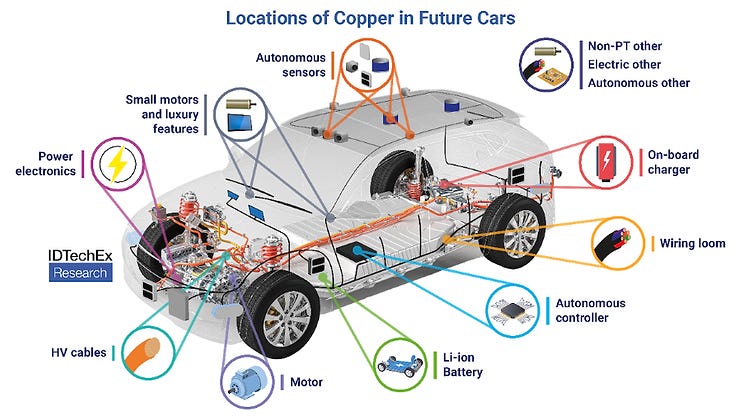
Copper sits at the heart of modern industrial life. It is embedded in power grids, electric vehicles, renewable energy systems, data centers, and the expanding infrastructure that supports artificial intelligence. Demand from all of those sectors is rising at once, driven by government spending on infrastructure, private investment in clean energy, and the rapid buildout of digital capacity. Each of those trends quietly consumes vast amounts of copper.
Supply, however, has failed to keep pace. Years of underinvestment left the mining industry with few new projects ready to ramp up, and bringing a major copper mine online can take more than a decade. Recent labor disputes, declining ore grades, and operational disruptions have further constrained output. By the time prices began to surge, global inventories were already thin.
Policy has added fuel to the fire. As Semafor reports, anticipation of potential U.S. tariffs on refined copper has prompted traders and manufacturers to rush shipments into American warehouses ahead of any formal action. That front-loading has tightened availability elsewhere in the world, amplifying price moves and turning a fundamentally tight market into an acutely stressed one.
For the United States, the surge presents a dilemma. Higher copper prices raise costs for construction, manufacturing, clean-energy projects, and consumer goods, creating a risk that inflation pressures re-emerge in sectors tied closely to infrastructure and housing. At the same time, elevated prices strengthen the case for expanding domestic mining and refining, reinforcing Washington’s push to secure critical minerals and reduce reliance on foreign suppliers.
China, the world’s largest consumer of copper, faces a different set of trade-offs. High prices squeeze manufacturers and infrastructure developers just as Beijing is trying to stabilize growth. Yet Chinese exporters have also been shipping copper into the U.S. ahead of tariff uncertainty, a move that has contributed to tighter global supply. Over time, analysts expect China to respond by locking in long-term supply agreements with producing countries, prioritizing security of access over short-term price relief.
Russia stands to benefit from the rally. As a significant copper producer, higher prices translate into stronger export revenues, helping to offset economic pressure from sanctions. The surge reinforces the role of commodities as a financial backstop for Moscow at a time when access to global capital markets remains constrained.
Elsewhere, the effects are uneven. Copper-rich countries such as Chile, Peru, Zambia, and the Democratic Republic of Congo are enjoying windfalls in export earnings and fiscal revenue. Manufacturing-heavy economies, by contrast, are grappling with higher input costs that threaten margins and investment plans. Some industries may try to substitute aluminum or other materials, but copper’s unmatched conductivity and durability make it difficult to replace in many critical applications.
The broader message from copper’s record run is not about speculation alone. It is about timing. The world is trying to electrify, digitize, and decarbonize faster than it can expand the supply of the materials required to do so. Until new production comes online—or demand growth slows—copper prices are likely to remain elevated and volatile.
Dr. Copper’s diagnosis, as the market is now being reminded, is rarely just about the metal itself. It is about the pressure points of the global economy, and right now, they are starting to show.
Source: Semafor
Editor: Copper just hit record highs, which is the market’s polite way of asking how we planned to electrify the world without enough wire. Between underbuilt mines, tariff panic, and a global economy trying to plug everything in at once, Dr. Copper isn’t predicting a boom—he’s shaking his head and asking who thought this rollout was a good idea.