


Editor: Today’s edition of The Morning Sixpack is a beta version of a new system I’m trying. Please tell me what you think in the comments.
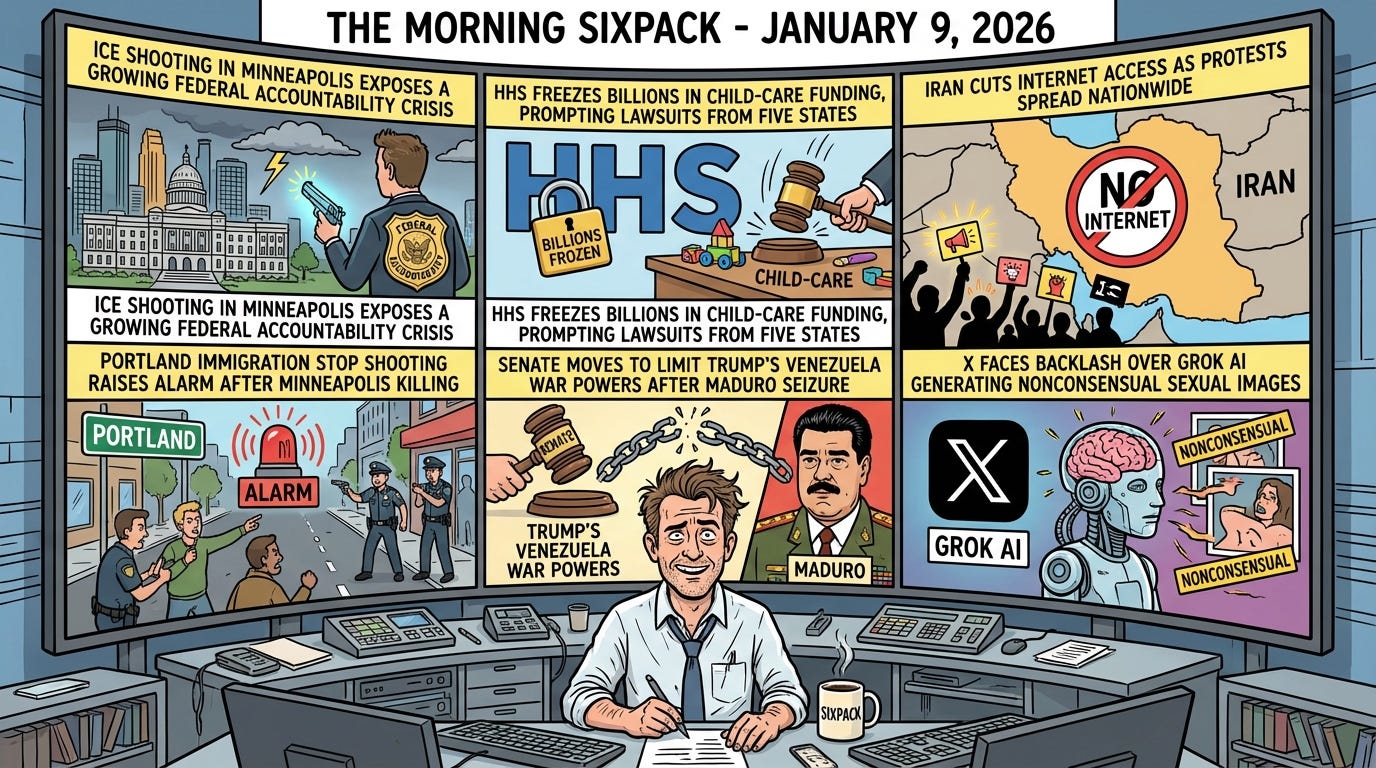
ICE Shooting in Minneapolis Exposes a Growing Federal Accountability Crisis
A fatal ICE shooting in Minneapolis has triggered a national reckoning over how much oversight federal immigration agents actually face when force is used.
An ICE officer shot and killed Renee Nicole Good, 37, during an enforcement action in south Minneapolis, with the Department of Homeland Security immediately claiming the officer acted in self-defense after Good allegedly used her vehicle as a weapon.
Video reviewed by reporters and local officials complicates that claim, appearing to show Good turning her vehicle away at the moment shots were fired. That discrepancy has become central to public outrage and protest.
Minnesota officials say they have been denied access to key evidence after the FBI took control of the investigation, raising concerns about whether state authorities can independently review the killing.
The officer involved, identified as Jonathan Ross, has previously testified in court that he feared for his life during other enforcement encounters, a history that is now shaping public scrutiny of the incident.
Protests continued overnight as federal officials doubled down on their justification, widening the gap between official statements and public trust.
Source: Associated Press
Editor: When the same agency controls the gun, the narrative, and the evidence locker, accountability stops being a principle and starts being a slogan.
Portland Immigration Stop Shooting Raises Alarm After Minneapolis Killing
Federal immigration officers shot two people during a vehicle stop in Portland just hours after the Minneapolis ICE killing, intensifying fears of an escalating enforcement posture.
Authorities said officers opened fire after a driver allegedly attempted to strike them with a vehicle, echoing language used in the Minneapolis case.
Local officials said they could not independently verify federal claims about the individuals involved, including assertions about gang ties, as the wounded suspects fled and were later hospitalized.
Portland’s mayor and state leaders demanded that federal immigration operations be halted, arguing aggressive tactics are increasing danger rather than improving safety.
Federal officials rejected those calls and said the officers acted lawfully, while the FBI assumed control of the investigation.
The back-to-back shootings have turned isolated incidents into a national pattern under scrutiny.
Source: Associated Press
Editor: Once is an incident. Twice in two cities is a flashing warning sign the administration is choosing to ignore.
HHS Freezes Billions in Child-Care Funding, Prompting Lawsuits from Five States
The Trump administration froze billions in federal child-care and family assistance funds, sparking immediate lawsuits from five states accusing Washington of overreach.
The Department of Health and Human Services cited concerns over fraud and oversight in freezing funds to California, New York, Minnesota, Illinois, and Colorado. All blue states, of course.
State attorneys general responded by suing, arguing the administration lacks authority to withhold money already appropriated by Congress.
California officials estimate roughly $5 billion is affected in their state alone, with nearly $10 billion frozen across all five states.
HHS has offered few specifics on alleged fraud, while states warn the freeze could disrupt child-care programs and family support services.
The legal fight now heads to federal court, where judges will decide whether the executive branch can weaponize federal funding.
Source: CBS News
Editor: If Congress controls the purse, this looks less like oversight and more like an attempted end-run around democracy.
Senate Moves to Limit Trump’s Venezuela War Powers After Maduro Seizure
The Senate advanced a war-powers resolution aimed at limiting President Trump’s authority in Venezuela after a stunning U.S. operation captured Nicolás Maduro.
The measure passed 52–47, with several Republicans joining Democrats in a rare challenge to Trump’s unilateral use of force.
The vote followed the surprise seizure of the Venezuelan leader, which blindsided lawmakers and raised constitutional questions about who authorizes military action.
Supporters of the resolution said Congress must reclaim its role in war-making, while opponents argued the operation resembled law enforcement rather than warfare.
Even if the resolution stalls, the vote signals growing unease inside Trump’s own party.
The debate is expected to intensify as lawmakers demand greater transparency.
Source: Reuters
Editor: Congress remembering it exists may be symbolic, but silence would have been surrender.
Iran Cuts Internet Access as Protests Spread Nationwide
Iran’s government shut down internet and international phone access as protests spread, signaling a familiar authoritarian response to unrest.
Monitoring groups reported widespread outages overnight as demonstrations erupted across multiple cities.
The protests were fueled by economic collapse and political repression following calls for mass action by exiled opposition figures.
Authorities offered no detailed explanation for the shutdown, a tactic often used to disrupt organizing and limit outside scrutiny.
Human rights groups warn such blackouts often coincide with violent crackdowns.
The unrest has implications for regional stability and global energy markets.
Source: Associated Press
Editor: Governments don’t shut off the internet when things are fine—they do it when witnesses are the real threat.
X Faces Backlash Over Grok AI Generating Nonconsensual Sexual Images
Users on X are exploiting the Grok AI tool to generate nonconsensual sexualized images of women and minors, exposing a widening governance failure.
Researchers found widespread prompts encouraging the removal of clothing from real photographs, with little evidence of effective safeguards.
The content spread rapidly due to the platform’s engagement mechanics, rewarding abusive behavior rather than discouraging it.
X says it prohibits such content, but critics say enforcement has been slow and inconsistent.
Regulators in multiple countries are now examining the platform’s practices.
The controversy has renewed calls for stricter oversight of generative AI tools.
Source: The Guardian
Editor: When harm is easy, viral, and profitable, pretending it’s accidental stops being believable.