

Trump Tariff Tension Triggers Wall Street Slide as Recession Fears Mount
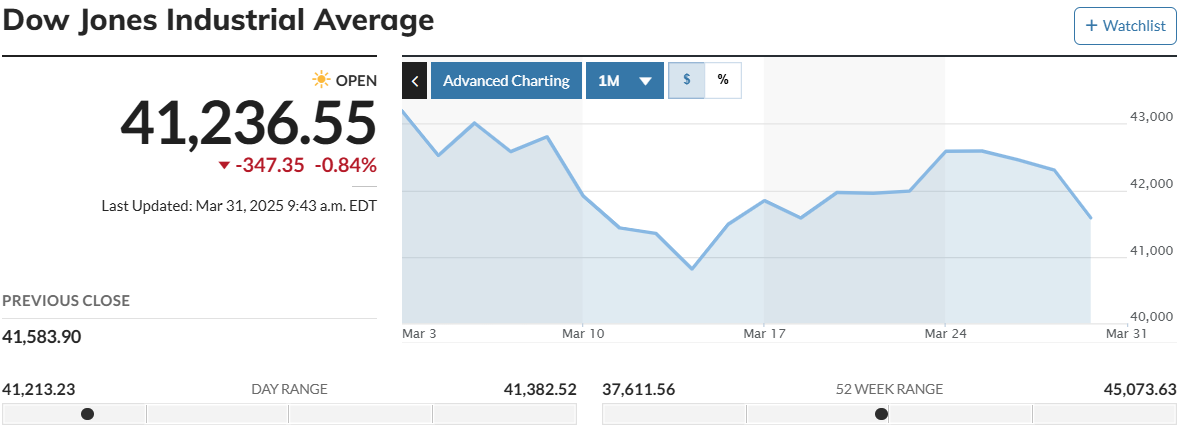
U.S. stock futures took a sharp dive Monday morning as traders reacted to escalating concerns over a looming tariff announcement from the Trump administration.
The potential for sweeping trade restrictions has investors bracing for ripple effects across the global economy—sparking fears of a recession. All three major indexes opened in the red: the Dow dropped 290.65 points (0.68%) to 41,293.25, the S&P 500 slid 56.93 points (1.01%) to 5,524.77, and the Nasdaq tumbled 277.34 points (1.58%) to 17,039.68.
The selloff reflects a classic flight from risk as markets begin to price in the potential economic blowback of aggressive protectionist policies.
Traders and analysts alike are watching for the official tariff details, which are expected to impact key industries and international trade relationships. The market's jittery reaction suggests investors aren't confident that the global economy can absorb another shockwave—especially with inflation, interest rates, and geopolitical tensions already in play.
As one insider put it, “Now is the time to start thinking about the ripple effects of tariffs on consumer demand and business investment.”
While some may see tariffs as a negotiating tactic, the market is clearly signaling something else: Uncertainty is poison for growth. Investors are repositioning quickly—and nervously.
Source: Reuters
Who would have thought insane talk about massive taxes on trade would bring about stock market woes?
USDA Cuts Leave Wisconsin Farmers Reeling, Threaten Local Food Supply
A sudden move by the USDA to pull funding from two major food programs has upended local agriculture in Wisconsin and sent shockwaves across the nation.
The Biden-era Local Food Purchase Assistance (LFPA) and Local Food for Schools (LFS) programs—responsible for funneling over $1 billion into local food systems—have been abruptly terminated for 2025.
Despite prior commitments, the USDA is walking away, citing a shift toward “long-term, fiscally responsible initiatives.”
For the farmers who relied on these funds to feed food pantries, schools, and communities, the impact is both personal and financial.
“The folks that formed the Food Hub and are participating in these programs are very tough, but at the same time, this is just a huge blow,” said Tara Roberts-Turner, head of the Wisconsin Food Hub Cooperative.
Wisconsin alone had 300 farmers enrolled, supporting 254 food pantries and over 400 small farms. Many had already made significant investments—some taking out loans and buying equipment based on the USDA’s original promises.
Tracy Vinz, a farmer who supplied fresh produce to schools and pantries, said the decision gutted a quarter of her sales. “Thank you,” one elderly woman told her, clutching a bag of fresh butternut squash. “This makes me feel human.”
With spring planting underway and budgets already tight, farmers now scramble to find new markets—restaurants, caterers, anyone who will buy. But as Vinz put it: “We’re short on staff, and it’s hard to take time away to find new customers. But we have to — to save our farm.”
Beyond the economic fallout, the funding cuts put rural food infrastructure at risk. The LFPA allowed food hubs to invest in transport networks and refrigerated trucks—tools that made local food viable in hard-to-reach communities. That momentum is now stalled.
USDA’s reversal has drawn sharp criticism from Wisconsin lawmakers. Governor Tony Evers and Senator Tammy Baldwin are demanding the funds be reinstated, with Baldwin warning,
“At a time of uncertainty in farm country, farmers need every opportunity to expand market access.”
Roberts-Turner didn’t mince words: “What we’re doing is actually lowering the cost of food. We’re lowering the cost of transport. We’re feeding our communities.” Cutting off these programs, she said, is simply a “bad business move.”
Source: CNN
Trump Threatens Oil Tariffs in Fiery Rebuke of Putin Over Ukraine Ceasefire Stalemate

In a sharp pivot from his previously conciliatory stance, President Donald Trump told NBC News he's "very angry" and “pissed off” at Russian President Vladimir Putin over stalled ceasefire talks in Ukraine.
After six weeks of negotiations, Trump is now threatening economic retaliation—promising a 25% tariff on Russian oil imports and up to 50% in secondary tariffs on nations still buying Russian oil, like China and India, if Moscow doesn’t agree to a ceasefire soon.
“If Russia and I are unable to make a deal on stopping the bloodshed in Ukraine... I am going to put secondary tariffs on all oil coming out of Russia,” Trump warned.
The statement marks a dramatic tonal shift. For weeks, Trump had pressured Ukrainian President Volodymyr Zelensky for concessions while largely accommodating Putin. European leaders had grown uneasy, fearing Trump’s posture was tilting toward appeasement. But his latest comments put new pressure squarely on Moscow.
Trump told NBC, “You could say that I was very angry, pissed off, when Putin said yesterday that—when Putin started getting into Zelensky’s credibility—because that’s not going in the right location, you understand?”
Despite the tough talk, Trump maintained that he still holds “a very good relationship” with Putin, even noting that “the anger dissipates quickly... if he does the right thing.”
Still, the threat of sweeping oil tariffs—especially targeting Putin’s key allies—signals a new phase in U.S. diplomatic posturing. Trump said he plans to speak with Putin later this week, but made it clear that if a ceasefire isn’t reached soon, the gloves are coming off.
Source: BBC
Trump Shrugs Off Rising Car Costs: "I Couldn't Care Less" About Auto Tariff Price Hikes
President Donald Trump dismissed concerns that his sweeping auto tariffs will lead to higher car prices for American consumers, saying flatly, “I couldn’t care less.”
In an interview with NBC, Trump argued that higher prices on foreign vehicles would simply drive Americans to buy domestic. But experts warn that this simplistic framing ignores the complexity of global auto manufacturing—where even U.S. brands like Ford and GM rely heavily on imports and cross-border supply chains. A nonpartisan Yale Budget Lab study estimates that the tariffs could spike the cost of a new car by an average of $6,400.
Despite White House efforts to spin the policy as targeting foreign-made cars, industry data tells a different story: Nearly half of vehicles sold in the U.S. are imported, and about 60% of auto parts in U.S.-assembled cars come from abroad. That means even "Made in America" vehicles could see significant price increases. Trump’s remarks have drawn criticism not only from economists but also from labor leaders who support reshoring jobs—but with caveats.
“If jobs are being brought back to the United States, they need to be good-paying union jobs that set standards,” said United Auto Workers President Shawn Fain on CBS’s Face the Nation.
While Trump touts tariffs as a hammer to bring manufacturing back home, critics argue that his blunt-force approach risks hammering American consumers and automakers alike. And with inflation already top-of-mind for many voters, his indifference toward price hikes could become a political liability.
“They’re going to buy American cars,” Trump insisted—but if those cars are also more expensive, it’s unclear how many Americans will be able to afford them.
Source: MDGN
Trump Flirts With Third Term: “I’m Not Joking,” Despite Constitutional Ban
In a bold and legally dubious claim, President Donald Trump told NBC News he’s “not joking” about serving a third term—despite the U.S. Constitution’s clear two-term limit. “A lot of people want me to do it,” Trump said.
When pressed for how he’d accomplish it, he floated a potential workaround: Vice President JD Vance could be elected in a future cycle and then hand over power. While Trump insisted he’s “focused on the current,” his openness to defying the 22nd Amendment has already sparked outrage and constitutional alarm bells.
Amending the Constitution would require a two-thirds majority in Congress or a convention called by 34 states—neither of which seems remotely likely.
Or Trump could merely state that elections are not going to take place because of something something something and he won’t ever have to run again.
Trump’s hints at clinging to power beyond 2029 come as some allies are already laying the groundwork. Former adviser Steve Bannon has endorsed a 2028 run, and Rep. Andy Ogles (R-TN) recently proposed scrapping the 22nd Amendment altogether.
Still, Trump notably avoided mentioning the Constitution in the NBC interview, choosing instead to lean on his popularity. “We have a long way to go,” he said. “It’s very early in the administration.” Given the country's polarized political climate, even floating such an idea is guaranteed to inflame both legal scholars and opponents alike.
Source: NPR
Trump Warns Iran: Make a Nuclear Deal or Face Bombs and Tariffs
President Donald Trump escalated tensions with Iran on Sunday, threatening military strikes and sweeping tariffs if Tehran refuses to strike a nuclear deal with his administration.
“If they don’t make a deal, there will be bombing,” Trump told NBC’s Kristen Welker in a phone interview.
He also floated the possibility of “secondary tariffs,” a strategy he claims successfully pressured Iran during his first term. The warning comes as diplomatic channels remain frayed and Iran's leadership pushes back against direct talks.
Iranian President Masoud Pezeshkian confirmed that his country has rejected direct negotiations but left the door open for indirect discussions.
“Although the possibility of direct negotiations between the two sides has been rejected… the path for indirect negotiations remains open,” he said Sunday.
Trump’s saber-rattling follows a letter he reportedly sent to Tehran—one that apparently did little to thaw relations. With global stakeholders like China, Russia, and the EU watching closely, the threat of renewed conflict looms large.
Trump’s return to power has reignited Middle East volatility. Earlier this month, he also warned Iran that further Houthi-backed strikes from Yemen would be seen as direct attacks by Iran and met with “great force.” During his first term, Trump tore up the 2015 Iran nuclear deal and accused Iran of deceit. Now, with no formal framework in place, his administration appears poised to take a harder line—one that could push the region to the brink.
Source: Politico