


The Memo that Broke America’s Budget
One four-page memo from 1980 accidentally rewired the entire U.S. government — and we’ve been paying for it ever since.
For real: Attorney General Benjamin Civiletti meant to “clarify” procedures when Congress missed a spending bill. Instead, he built the modern shutdown machine — a political Rube Goldberg contraption that’s cost taxpayers hundreds of millions, clipped billions from the economy and left our democratic institutions looking like a neglected rental property.
Civiletti, like Carter, wasn’t a villain. He was the classic hardworking public servant — thoughtful, methodical, dutiful. But in this case, he whiffed. Hard. His memo argued that when funding lapses, federal agencies can’t keep operating under the previous budget. That interpretation didn’t match decades of precedent and cracked open a door that should’ve stayed shut.
When Congress failed to pass budgets back then, agencies just… kept functioning. Workers showed up, paychecks went out, national parks didn’t barricade themselves. The train rolled on. Civiletti’s strict reading flipped that: suddenly, government operations halted unless Congress explicitly said “go.” He later softened the stance with a “well, essential workers can stay on, but unpaid” caveat — and that’s the version that metastasized.
That carve-out unleashed chaos. If “essential workers” can stay on, but everyone else gets sidelined, you don’t get an immediate crisis — you get a slow-motion one. Trash piles up. Small businesses can’t get routine approvals. Federal workers hemorrhage income. And the political class realized this zombie-mode government was a handy pressure tactic. Newt Gingrich tested it in the ‘90s. Everyone since has taken their turn.
A 2024 Senate report found that three shutdowns added $338 million in extra costs. And the CBO pegged permanent economic harm from the 2018–19 shutdown alone at $3 billion. That doesn’t even count the immeasurable hit to public trust or the erosion of the separation of powers when the president gets to decide what’s “essential.”
Shutdowns aren’t some international norm — they’re an American invention, right up there with the filibuster and paying $9 for airport coffee. Most democracies simply keep the government running under last year’s numbers. Some even dissolve parliament and hold new elections if they can’t pass a budget. We, on the other hand, reenact Groundhog Day every few years and then act shocked when confidence in our government tanks.
And here we are again — the longest shutdown finally over, billions burned, morale wrecked, and absolutely nothing gained. Shutdowns rarely even deliver policy wins. They boomerang back onto whoever tried to use them as leverage.
This whole mess traces back to a well-intentioned but disastrous memo that turned a procedural hiccup into a recurring national self-own. It’s time to retire shutdowns permanently, restore baseline funding, and stop holding the country hostage every time Congress wants to throw a tantrum.
Source: mydailygrind.news
Editor: Bold move letting a decades-old memo dictate national humiliation on a loop. Maybe next time we can avoid letting clerical footnotes determine the fate of a $28 trillion economy.
MORE: The Secret Meeting that Ended the Shutdown
Trump Signs Bill to Reopen Government After 43 Days of Chaos
The longest shutdown in U.S. history collapsed under its own weight Wednesday night as President Donald Trump finally signed the bill to reopen the government.
After seven Senate Democrats and one independent crossed the aisle to cut a deal with Republicans, the 43-day standoff — costly, messy and wildly unnecessary — is over. But the fallout isn’t done with us yet.
The bill kicks the government back into gear “immediately,” funding most operations through Jan. 30 and extending money for Agriculture, Veterans Affairs, military construction and the legislative branch through September. Translation: we’re reopening, but we’re not exactly out of the woods. Roughly 650,000 federal workers were furloughed during the shutdown, with another 600,000 working without pay, and agencies spent Wednesday evening telling staff to report Thursday if Trump signed the bill.
And about that pay: the Trump administration had dangled the threat of withholding back pay, despite a 2019 law guaranteeing it. The new deal slams the door on that move. Paychecks start going out Saturday, according to a senior administration official. The Office of Management and Budget, naturally, didn’t feel the need to clarify a thing.
Then there’s the aviation mess. Last week, the administration started phasing in flight reductions at major airports because air traffic controllers were working without pay — a plan that sent delays and cancellations spiraling. On Wednesday, Transportation Secretary Sean P. Duffy and FAA Administrator Bryan Bedford said they were freezing reductions at 6 percent while the FAA gauges whether the system can safely ramp up. Airlines are scrambling to rebuild schedules and get planes, pilots and crews where they belong, all while bracing for 31 million holiday travelers barreling toward Thanksgiving.
SNAP recipients finally get breathing room, too. Courts have been battling the administration for weeks over full payments to 42 million low-income Americans. With the government reopened, full benefits should resume — and Congress funded the program through September 2026 to prevent more chaos. Meanwhile, Washington’s museums, galleries and gardens — shuttered for much of the shutdown — are reopening in waves, with the Smithsonian and National Gallery aiming for full availability by Monday. Even ZooLights will shine on schedule.
Trump and budget director Russell Vought repeatedly threatened mass layoffs throughout the shutdown, sending notices to roughly 4,000 workers across key departments. The Senate’s stopgap bill reverses those reductions in force and bans any new ones until Jan. 30. Agencies must reinstate every affected employee within five days of enactment — a hard pivot from the administration’s earlier saber-rattling.
Source: Washington Post
Editor: Wild concept here: maybe the world’s biggest economy shouldn’t be run like a high-stakes game of chicken. Just a thought.
Democrats Release Epstein Emails Claiming Trump “Knew About the Girls”
House Democrats dropped a stack of Epstein-related emails Wednesday that directly raise the question Republicans least want in the headlines: what Donald Trump actually knew—and when—about Jeffrey Epstein’s abuse of underage girls.
The newly revealed 2019 messages show Epstein telling author Michael Wolff that Trump “knew about the girls,” though what that phrase specifically meant remains unclear. Another email released the same day — this time by a GOP-led committee — quoted Epstein insisting Trump “came to my house many times” but “never got a massage.” That’s quite the disclaimer for a man writing from the middle of a sex-trafficking scandal.
The timing wasn’t accidental. The release coincided with the swearing-in of Democrat Adelita Grijalva, which tipped the balance and opened the door for a House vote forcing the release of all unclassified Epstein records — something Speaker Mike Johnson and Trump have fiercely resisted. Grijalva didn’t mince words: “It’s past time for Congress to restore its role as a check and balance on this administration.”
Trump, who has repeatedly denied knowing anything about Epstein’s trafficking operation, lashed out immediately. On Truth Social he blasted Democrats for trying to “bring up the Jeffrey Epstein Hoax again” to distract from the 43-day government shutdown. But the political damage isn’t just coming from Democrats — an October Reuters/Ipsos poll found only 4 in 10 Republicans approved of Trump’s handling of the Epstein files, far below their usual sky-high approval.
By day’s end, Republicans themselves had released a trove of 20,000 pages of Epstein-related documents, many of which referenced Trump. Some are vague, some are crude, and some look designed to muddy the water. One eyebrow-raiser: Epstein telling a 20-year-old girlfriend he “gave [her] to Donald” in 1993, along with mentions of “Donald and girls in bikinis in my kitchen.” It’s impossible to tell whether he was joking, bragging, or confessing — but none of it reads like a man worried about lying on email.
Meanwhile, the White House is scrambling. Press secretary Karoline Leavitt accused Democrats of hiding the victim’s name because it was Virginia Giuffre — who died by suicide in April and, in her memoir, described Trump as friendly but did not accuse him of wrongdoing. And as reports from Axios and others revealed, Trump officials have been quietly lobbying GOP Reps. Lauren Boebert and Nancy Mace to withdraw their names from the petition forcing a vote to release every Epstein file. Neither woman is budging.
Source: Reuters
Editor: Honestly, if your defense hinges on arguing over whether Epstein was “joking” when he name-dropped you in emails about girls in bikinis, you’re already losing the plot.
Russia Vows to Back Venezuela as Trump Sends Warships Toward the Caribbean
Russia openly signaled it is prepared to intervene on Venezuela’s behalf just as Donald Trump escalates the U.S. military presence near the South American nation.
Lavrov’s message wasn’t subtle. The Russian foreign minister said Moscow stands “ready to fully act within the framework of the obligations” outlined in a new strategic partnership signed with Venezuela in May. That agreement hasn’t fully taken effect yet, but Lavrov says it’s “getting close” — and the evidence is piling up. Within months of the signing, Venezuela opened a Kalashnikov ammunition plant and welcomed a sanctioned Russian cargo aircraft long tied to defense deliveries.
The Kremlin’s tone is clear: security and military-technical cooperation is moving into its “final stage of ratification,” and Moscow is not shy about leaning in. Russian lawmaker Alexei Zhuravlev even boasted that Russia could supply Venezuela with “virtually the entire range of weapons, from small arms to aircraft,” adding that “The Americans could be in for some surprises.” That’s… not exactly a peace-and-hugs message.
Meanwhile, the U.S. is sending unmistakable signals of its own. The USS Gerald R. Ford — the largest aircraft carrier on Earth — arrived near Venezuelan waters on Tuesday with three additional warships in formation. Thousands more U.S. personnel are expected to join the operation, which the White House frames as an intensified counter-narcotics mission. Since early September, U.S. patrols targeting suspected drug-smuggling vessels have already resulted in at least 75 deaths.
Caracas isn’t shrugging this off. Venezuela’s defense minister Vladimir Padrino López has deployed 200,000 troops nationwide in response to what he calls the U.S. “threat.” Colombia is distancing itself as well — President Gustavo Petro has ordered security and intelligence agencies to halt information sharing with the U.S., a move that only deepens the regional split.
All of this plays out as Kremlin intrigue simmers in the background — including reports that Putin was embarrassed after “clone” safe houses were inadvertently exposed. Not exactly a confidence-builder when your global gambits are under scrutiny.
Source: The Express
Editor: Wild idea: maybe escalating two nuclear-armed powers around a nation with collapsing infrastructure isn’t the masterclass in strategy some folks think it is.
Trump’s Approval Tanks to New Lows as Shutdown Drags On
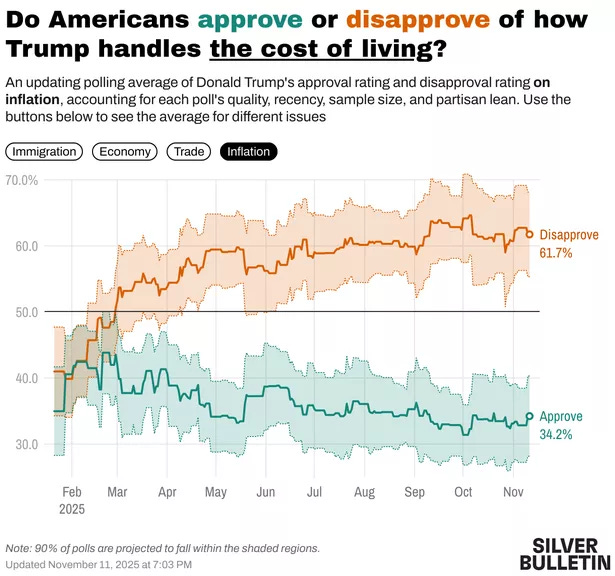
Donald Trump’s approval rating has cratered to one of the worst points of either of his terms — even lower than Joe Biden’s lowest mark — as the government shutdown continues to grind the country down.
A new YouGov/Economist poll puts Trump at a brutal 33% net unfavourable rating, worse than Biden’s -31% at the end of his presidency. That number measures the gap between Americans who approve versus disapprove of Trump’s handling of prices and inflation — and right now, the gap is wide enough to drive a B-2 bomber through. CNN’s broader approval average isn’t kinder: 40% approve of Trump’s job performance, while 59% disapprove.
What’s brutal for Trump is the trajectory. His approval has been sliding steadily since returning to office in January. His post-inauguration high hit 49% — a number that feels like ancient history now — and historically, no president has fallen this far this fast. For comparison, Biden was sitting at 42% approval at this same point, and even Trump’s first-term low-water mark didn’t dip this early. The one issue where Trump isn’t completely underwater is immigration, where 45% approve and 50% disapprove.
On the economy, trade, and inflation — the issues Trump claims as his strongest — the numbers are brutal. Only 39% approve of his handling of the economy, 38% approve of his trade approach, and just 34% back him on immigration more broadly. This isn’t subtle. Voters are telegraphing that the shutdown and economic instability are wearing thin, and the off-year elections last week made that crystal clear: Democrats swept major races in New Jersey, Virginia, New York City, and California’s Proposition 50.
Those results, paired with the new polling, spell real trouble for Republicans ahead of next year’s midterms. The GOP is now clinging to narrow congressional majorities that could evaporate if these numbers hold. Trump is frantically pushing states to redraw congressional maps to protect the House, but if Democrats flip control, his entire second-term agenda — from immigration crackdowns to trade wars — will be tossed into political purgatory along with a fresh round of investigations.
Source: The Mirror
Editor: If your approval rating drops faster than airline schedules during a shutdown, maybe take the hint that voters aren’t buying what you’re selling.
USDA Quietly Targeted “Diversity” and “Climate” Grants for Termination Under Trump
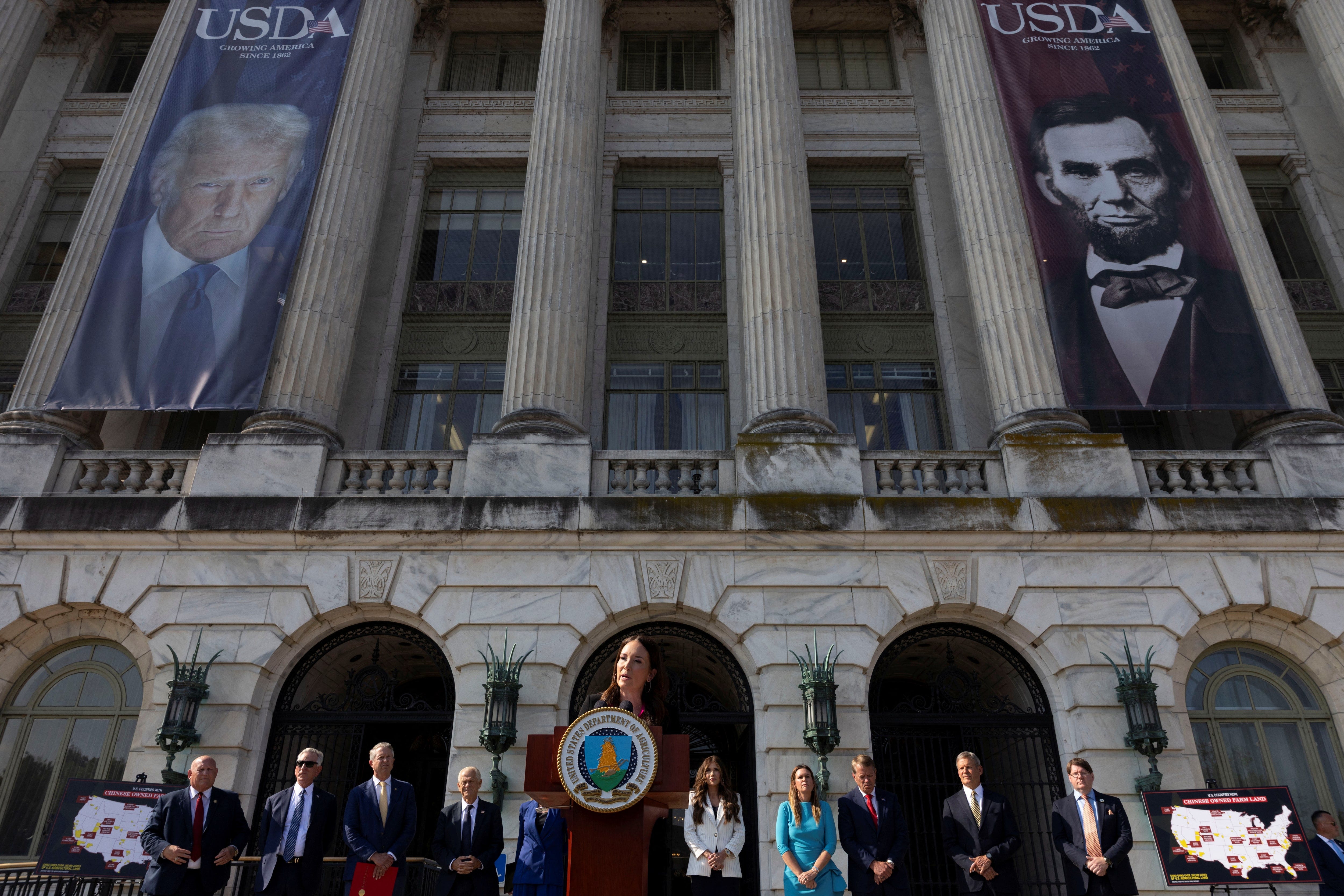
The U.S. Department of Agriculture created a keyword hit list to hunt down and cancel grants connected to diversity, equity or climate work — killing roughly $3 billion in funding in the opening months of Trump’s second term.
Internal documents obtained through litigation show that USDA officials were ordered to search for more than two dozen specific words and phrases — everything from “diversity” and “equity” to “climate modeling” and “biodiversity” — as part of a government-wide push to dismantle DEI and climate initiatives. This wasn’t subtle. It was an intentional sweep designed to identify grants for termination, and it affected everything from farm conservation programs to nutrition assistance.
Agriculture Secretary Brooke Rollins defended the purge in March memos, claiming the review was necessary to “establish a return to American principles and realign the Department’s focus.” But the scale tells the real story: about 600 grants, worth more than $3 billion, were canceled. Many of those grants supported farmers using climate-friendly practices, helped schools buy local food and improved nutrition for low-income Americans. As FarmSTAND attorney Holly Bainbridge put it, “(The termination process) has impacted organizations across the country and their ability to create a fairer food system.”
The keyword dragnet came in waves. A Feb. 6 memo directed officials to flag grants using terms like “underrepresented producers,” “underserved communities,” “socially disadvantaged producers” or “environmental justice.” On Feb. 24, USDA leaders expanded the search to climate-related topics: “climate and emission analysis,” “renewable energy modernization,” “climate adaption and resilience planning,” and more. Whether every flagged grant was ultimately canceled remains unclear — but the agency isn’t commenting, citing ongoing litigation.
The move aligns perfectly with Trump’s public campaign to eradicate DEI and climate programs from federal agencies. He’s called DEI “racist” and “illegal,” urged universities to eliminate diversity programs and dismissed climate change as a “con job.” The USDA appears to have treated those talking points as marching orders, reshaping decades of policy support for farmers of color, women and communities hit hardest by environmental risks.
The fallout is national: small farmers lose technical support, schools lose local food programs and climate-resilient agriculture loses momentum at a time when extreme weather keeps leveling American crops. But this wasn’t accidental — it was engineered.
Source: Reuters
Editor: Only in Washington do you get a government that cancels grants for “climate resilience” during a year of record crop failures and then calls it a return to “American principles.”
BONUSES
USDA Moves to Fire SNAP Official After She Warned Millions Could Lose Food Aid
The Agriculture Department is preparing to fire a furloughed employee for publicly warning that the shutdown could jeopardize food assistance for 42 million Americans.
Ellen Mei, a program specialist at the Food and Nutrition Service — and president of her local NTEU chapter — appeared on MSNBC on Oct. 2 to explain how the shutdown was fueling anxiety inside USDA and potentially threatening SNAP benefits if the impasse dragged into November. Her comments weren’t explosive, weren’t secret and weren’t even new; they matched what advocates, analysts and even USDA’s own memos were saying at the time.
The very next day, USDA informed her that a termination process had begun. Documents reviewed by the Washington Post show the agency told Mei she would be fired 30 days after the shutdown ends for discussing USDA programs “without prior approval.” That accusation rings especially hollow given that she spoke in her personal and union capacity — a point MSNBC host Chris Jansing clarified on-air — and given that Mei has spoken to media outlets for years without issue.
Mei says the real difference this time is visibility: it was her first national TV appearance. And it’s hard to miss the broader pattern. USDA scrubbed its own memo acknowledging SNAP funding risks. Federal unions warn that the administration is using firings to chill speech across agencies. Over the summer, EPA employees were placed on leave or fired after protesting policy changes. In September, HUD dismissed two civil rights lawyers for publicly criticizing the administration’s fair housing rollbacks.
Legal experts say USDA is on thin ice. “I think [Mei] has a very clean argument this is a protected disclosure,” said federal employment attorney Debra D’Agostino, citing Supreme Court precedents like Pickering and MacLean and noting that SNAP funding is unambiguously tied to public health and safety. As she put it: “Given that we’re talking about food for Americans, that is a pretty clean argument about a specific danger to public health.”
Mei has 20 days after the government reopens to contest her firing. She plans to stand with fellow federal employees at a Boston news conference on Friday to push back — not just for her job, but for the principle that public servants shouldn’t be punished for telling the public the truth about their own government.
Source: Washington Post
Editor: Imagine firing the person who warns that millions might lose access to food — while insisting the real problem is that she talked about it out loud. That’s not governance; that’s insecurity with a badge.
Verizon to Axe 15,000 Jobs as New CEO Launches Aggressive Cost-Cutting Overhaul
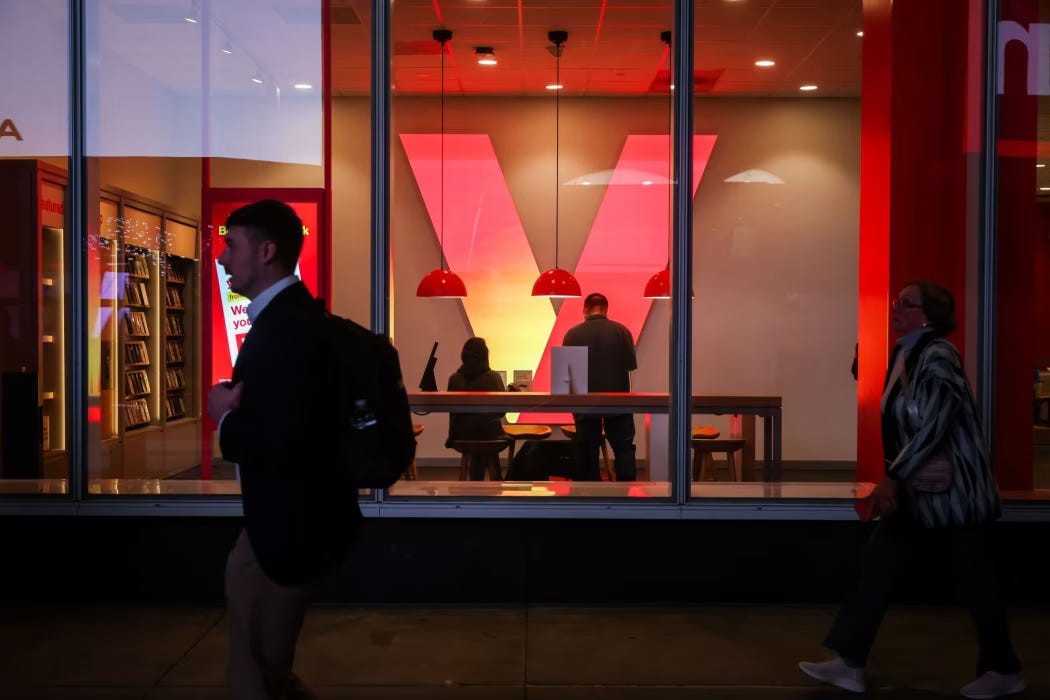
Verizon is preparing to eliminate roughly 15,000 jobs — the largest cut in its history — as it scrambles to stop bleeding customers and rein in costs.
The layoffs, expected to hit within a week, mark a massive reset for the largest U.S. telecom provider. Most of the cuts will come through direct layoffs, while about 200 corporate stores will be shifted into franchise operations, moving those workers off Verizon’s books entirely. With 100,000 employees as of February, this represents a seismic workforce reduction — one that signals the depth of Verizon’s problems in both wireless and home internet markets.
For three straight quarters, Verizon has been losing the one metric no telecom CEO ever wants to lose: postpaid phone subscribers. Last quarter alone, Verizon lost 7,000 postpaid connections despite Wall Street expecting a gain of 19,000. AT&T and T-Mobile have been eating Verizon’s lunch, forcing the company into price-lock guarantees and other last-ditch promotions just to slow customer defections.
Enter new CEO Daniel Schulman — former PayPal and Virgin Mobile USA chief — who took over last month and immediately promised a no-nonsense turnaround. “Verizon is at a critical inflection point,” Schulman warned during the company’s Q3 call, pledging to slash costs across the entire operation and dump legacy businesses that no longer produce profit. “We have a tremendous amount of opportunity to be more efficient, to be scrappier,” he said. “Cost reductions will be a way of life for us here.”
Wall Street analysts at Morgan Stanley agree the path won’t be easy in a mature telecom market, but suggest it’s “possible—if not probable” that Verizon can climb back to stronger performance over time. Still, Verizon now joins a long list of corporate giants — from Amazon to UPS to Target — that are turning to layoffs and tech-driven restructuring as competition tightens and economic pressure mounts.
The timing is especially notable given Schulman’s recent prediction that AI will reach human-level intelligence in two to four years. Verizon may need every bit of that future “efficiency” if it wants to hold onto customers — or investors — in the meantime.
Source: Wall Street Journal
Editor: Verizon bragged for years about having the “most reliable network.” Turns out the thing they should’ve been worried about failing was their own business model.