


Trump’s About-Face on the Epstein Files Blows Up His Own Party
Trump’s abrupt U-turn on the Epstein files is less about transparency and more about political self-preservation.
Trump abruptly reversed course Sunday night, declaring that House Republicans should release the Jeffrey Epstein files after months spent trying to bury the whole issue. This is the sharpest pivot he’s made in months—and it says a lot about where the pressure is coming from.
For weeks, House Republicans were barreling toward a vote to force the Justice Department to cough up the Epstein documents, with every Democrat and four Republicans signing the discharge petition. More were ready to join. Trump saw the math, hated the math, and finally gave in to the math. His post—“House Republicans should vote to release the Epstein files, because we have nothing to hide”—wasn’t conviction; it was capitulation.
The shift came after intense behind-the-scenes scrambling. Trump and his team begged Nancy Mace and Lauren Boebert to yank their signatures before the petition hit critical mass. Both ignored him. Meanwhile, Democrats released new emails that revived the spotlight on Trump’s own ties to Epstein, which—let’s be honest—didn’t help his case for stonewalling.
And then came the blowback. The fight over the files helped fuel Trump’s dramatic split with Marjorie Taylor Greene (see story below), who signed the petition. Trump publicly torched her, calling her “Far Left,” a “ranting Lunatic,” and claimed “wonderful, Conservative people” in Georgia were looking to primary her. Greene immediately claimed the attacks “put my life in danger.” The MAGA divorce papers practically filed themselves.
Rep. Thomas Massie, who led the petition, thinks up to 100 House Republicans may ultimately vote to release the files. The bill is expected to sail through the House but still needs 60 votes in the Senate—and at least 13 Republican senators—to land on Trump’s desk. Trump is now pretending to be above it all, saying Republicans should “move on” to affordability and economic issues, warning that some members are being “used,” and insisting the Epstein story is “a curse on the Democrats, not us.”
Source: The Hill
Editor: Trump pivoting this hard after months of resistance has the same energy as a kid insisting he didn’t eat the cookies while standing in a pile of crumbs. The files are coming out because the House boxed him in—not because he suddenly fell in love with transparency.
What this REALLY means: I’m no conspiracy theorist… but this may mean that the FBI has finally finished scrubbing the thousands of files and Trump’s name is no longer in them.
ICE Detention Is Scooping Up the Very People Who Followed the Rules
The U.S. immigration system is detaining record numbers of people—even though most of them haven’t committed a crime.
Trump campaigned on unleashing ICE at a scale “never seen before,” and he’s certainly delivered on volume. But here’s the part conveniently left out of the applause lines: 71 percent of the people locked up in ICE detention by late September had zero criminal convictions. That’s not a crackdown on criminals. That’s a dragnet catching anyone who happened to be standing nearby.
The Migration Policy Institute lays it out plainly—ICE is now detaining law-abiding immigrants who followed every rule laid out for visas, green cards, and asylum. These aren’t fugitives; they’re people who did everything by the book. And they’re being hauled into detention centers anyway.
In the Opinion Video featured in the piece, three immigrants who came to America legally describe being swept into detention despite full compliance with the system. They trusted the process. They played by the rules. But in this version of enforcement, it didn’t matter.
This is the system working exactly as designed under the new approach. Trump promised unprecedented action, and ICE is carrying it out—just not in the way most voters were led to imagine. When the majority of detainees have never committed a crime, you don’t have a law-and-order strategy. You have a numbers game.
The big question now isn’t whether ICE can continue expanding its detention footprint. It’s whether anyone is willing to admit this isn’t targeted enforcement at all. It’s bureaucracy with a badge.
Source: The New York Times
Editor: If this is what “tough on crime” looks like, I’d hate to see what happens when the government starts aiming at people who actually broke the law.
Trump’s “Sink the Boats” Drug Policy Raises Alarms Inside His Own Government
The Trump administration has quietly shifted from intercepting suspected drug vessels to blowing them up outright—and insiders say the strategy is killing people, destroying intelligence, and doing nothing to stop the flow of drugs.
At a Justice Department conference back in February, then–acting Deputy Attorney General Emil Bove told senior drug prosecutors that the U.S. should “just sink the boats.” At the time, it sounded like the kind of off-the-cuff bravado that gets ignored once the adults in the room start talking. Six months later, the U.S. was literally blowing up suspected drug boats in the Caribbean and Eastern Pacific—20 strikes, more than 75 dead, and not a shred of publicly released evidence that any of the targets were carrying narcotics.
This shift didn’t come out of nowhere. According to attendees at the conference, Bove dismissed traditional maritime interdictions and signaled that prosecutions were no longer a priority. One recalled, “I looked around at others in that room when he said that, and jaws literally dropped.” Another added, “Now that you look back on it, I think you can infer he probably meant just sink the boats with the people on them.” All of this unfolded as Bove was on track to be confirmed to a lifetime seat on the U.S. Court of Appeals for the Third Circuit—which he received in August.
Meanwhile, NPR spoke with nine current and former officials who described the new strategy as a radical break from decades of U.S. practice. Instead of boarding vessels, seizing drugs, and interrogating crews, the administration is wiping out boats and killing potential intelligence sources. A former DOJ official put it bluntly: “The most devastating thing is killing people on the high seas without any due process or evidence of violence. Just preemptive strikes.” Another added the obvious operational flaw: “Forgetting the philosophy of whether killing people is right or wrong, when you kill them you can’t talk to them.”
Internally, serious questions are swirling about legality and motive. The administration claims it’s acting in “self-defense” and has told Congress that the U.S. is engaged in a “non-international armed conflict” with cartels—an elastic justification that avoids seeking expanded war powers. But the deployment of the USS Gerald Ford carrier strike group to the Caribbean has fueled speculation that the real target may be Venezuelan leader Nicolás Maduro, not drug runners in plywood boats.
Veteran investigators warn that without interdictions, the U.S. is flying blind. Human intelligence dries up, electronic surveillance loses its anchor points, and the intelligence cycle collapses. As one former official said, “You need something to tell you where to look. If you’re killing all these people, you just dried up the human intelligence.” Even worse, shutting down OCDETF this fall erased one of the most effective cross-agency systems for dismantling cartels. The result: fewer arrests, fewer leads, and the same amount of drugs entering the country.
Source: NPR
Editor: If your drug-interdiction strategy destroys all the evidence, kills all the witnesses, and still doesn’t stop the drugs, maybe the problem isn’t the boats—it’s the policy.
Trump Dismisses Greene’s Safety Fears as Their Epstein Feud Goes Nuclear
Trump blew off Marjorie Taylor Greene’s warnings about threats to her life, mocking her as a “traitor” while doubling down on their escalating fight over the Epstein files.
Speaking to reporters on the tarmac in Palm Beach, Trump brushed aside Greene’s claim that his rhetoric could get her hurt, sneering, “I don’t think her life is in danger… frankly, I don’t think anybody cares about her.” That’s where things stand now between the self-proclaimed leader of the MAGA movement and one of his most loyal foot soldiers. The rift is no longer subtle. It’s open combat.
Trump then sprinted to Truth Social to add fresh insults, calling her “Wacky Marjorie ‘Traitor’ Brown,” complete with an extended riff about how “Green turns to Brown where there is ROT involved!” His message was unmistakable: Greene wasn’t just disloyal, she was decomposing. “The fact is, nobody cares about this Traitor to our Country!” he wrote. Subtlety, as always, is dead.
Greene, meanwhile, said the consequences are already hitting home. She reported “hoax pizza deliveries” to her house and a pipe bomb threat to her family’s construction business. She accused Trump of sending a “dog whistle to dangerous radicals,” writing, “This puts blood in the water and creates a feeding frenzy.” She insisted she’s no traitor: “When the President of the United States irresponsibly calls a Member of Congress of his own party, traitor, he is signaling what must be done to a traitor.”
This fight didn’t come out of thin air. Greene has been hammering Trump over his reluctance to support the full release of the Jeffrey Epstein files. The House is voting this week on a measure forcing the DOJ to cough up everything it has, and Rep. Thomas Massie expects dozens of Republicans to vote for it. That pressure only increased after Democrats released new emails, including one from Epstein claiming Trump “knew about the girls.” And wouldn’t you know it—just minutes before attacking Greene online, Trump abruptly reversed course and told House Republicans they should release the Epstein files after all.
Rep. Massie warned that new DOJ investigations into Epstein’s alleged links to Democrats could still be used to keep some files locked down even after Congress votes. So this fight isn’t over. And neither, apparently, is the Trump–Greene meltdown.
Source: The Hill
Editor: Watching Trump torch one of his most loyal acolytes is like watching a fire consume its own gasoline—messy, loud, and completely predictable when you store the cans too close to the flame.
Kash Patel Under Fire After FBI SWAT Team Assigned to Protect His Girlfriend
FBI Director Kash Patel is facing serious accusations of abusing his position after elite federal agents were diverted from critical missions to serve as a personal security detail for his girlfriend.
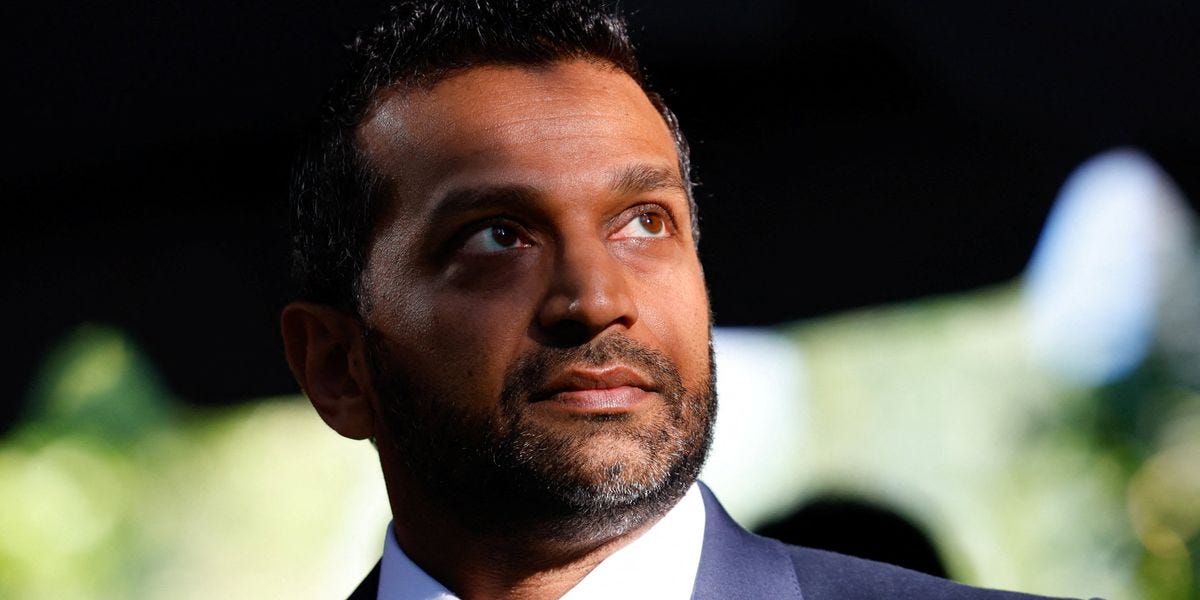
According to reporting from MS NOW, Patel’s girlfriend, country singer Alexis Wilkins, is being guarded by FBI SWAT agents normally tasked with responding to crises—mass shootings, terror threats, and high-risk raids—not chauffeuring around the boss’s partner. Multiple former officials say they’ve never seen anything like it. One put it bluntly: “There is no legitimate justification for this.”
Veteran FBI figures warn that assigning SWAT personnel to protect a private citizen—who isn’t Patel’s spouse and doesn’t live with him—is not just unusual but a misuse of resources that could delay teams from responding to real emergencies. The arrangement comes on the heels of Patel catching heat for using a $60 million FBI jet last month to watch Wilkins perform at a wrestling event—after previously blasting his predecessors for doing the same kind of thing.
Patel didn’t address the security-detail allegations directly, but he posted a fiery defense of Wilkins online, calling attacks on her “a total disgrace” and praising her as “a rock-solid conservative and a country music sensation.” He added: “Attacking her isn’t just wrong—it’s cowardly and jeopardizes our safety.” But critics noted that no one had actually attacked Wilkins—just Patel’s use of government resources to benefit her.
Sources familiar with bureau protocols say no one can recall any instance where the girlfriend of an FBI director received a taxpayer-funded federal security team, much less one drawn from a SWAT unit. Meanwhile, Patel’s opponents argue this isn’t about love—it’s about power, perks, and an FBI chief acting like the bureau is his personal concierge service.
Source: Raw Story
Editor: At this point, the only thing missing is Patel assigning the Hostage Rescue Team to walk Wilkins’ dog. When you start treating a federal agency like a backstage pass, you’re not leading it—you’re looting it.
Trump Welcomes MBS Back to the White House as Both Sides Try to Rewrite History
Crown Prince Mohammed bin Salman is returning to Washington for the first time since the murder of Jamal Khashoggi, and both he and Trump are acting like the past can be erased with a handshake and a few billion dollars.
The meeting, set for Tuesday at the White House, is being billed as a chance to “deepen cooperation” on oil, security, commerce, technology, and even nuclear energy. But make no mistake—this is about resetting a relationship that was derailed when U.S. intelligence concluded MBS approved the capture or killing of Khashoggi. Seven years later, Trump is eager to cash in on a $600 billion Saudi investment pledge and just as eager to avoid any mention of human rights. Again.
For MBS, the agenda is simple: secure strong U.S. security guarantees in a region on fire, get access to artificial intelligence technology, and finally make progress on a civilian nuclear program. As one Saudi analyst put it, “There is a page that has been turned” on the Khashoggi killing. The White House seems happy to flip that page with him.
But the push-and-pull here is brutal. The Saudis want a full defense pact—ratified by Congress. Washington wants Saudi normalization with Israel. Riyadh then ties that to Palestinian statehood. Netanyahu, on cue, reaffirms his absolute opposition. So here we are: Trump considering an executive order that mirrors the one he just signed with Qatar, which analysts say would offer consultations, not commitments. As one Western diplomat put it, “Both sides will likely get less than they want. That’s diplomacy.”
Beyond defense deals, MBS is chasing nuclear energy, AI infrastructure, and a stronger foothold in the regional tech race. He wants advanced U.S. computer chips to compete with the UAE and win his Vision 2030 showdown with Iran. But Washington won’t greenlight a nuclear partnership unless Saudi Arabia agrees to restrictions on uranium enrichment and reprocessing—two pathways to a bomb. Negotiators expect at least a statement of progress, if not a formal deal.
Underneath all the talking points, the real story is about two leaders who see opportunity in forgetting the past—one who wants geopolitical leverage and one who wants Saudi money, Saudi oil, and a win he can wave around during the next news cycle.
Source: Reuters
Editor: Watching Trump and MBS “turn the page” on Khashoggi is like watching arsonists praise the fire department they defunded—it’s a performance, and they’re hoping you’re too tired to notice the smoke.
Thanks for writing this, it clarifies a lot. It's fascinating how his internal political algorithm seemed to finally process the unavoidable data point of the discharge petition, but I'm curious if the Mace/Boebert defiance or the new emails were the actual critcal variable that tipped the scale, making his "nothing to hide" claim so hilariously transparent.