


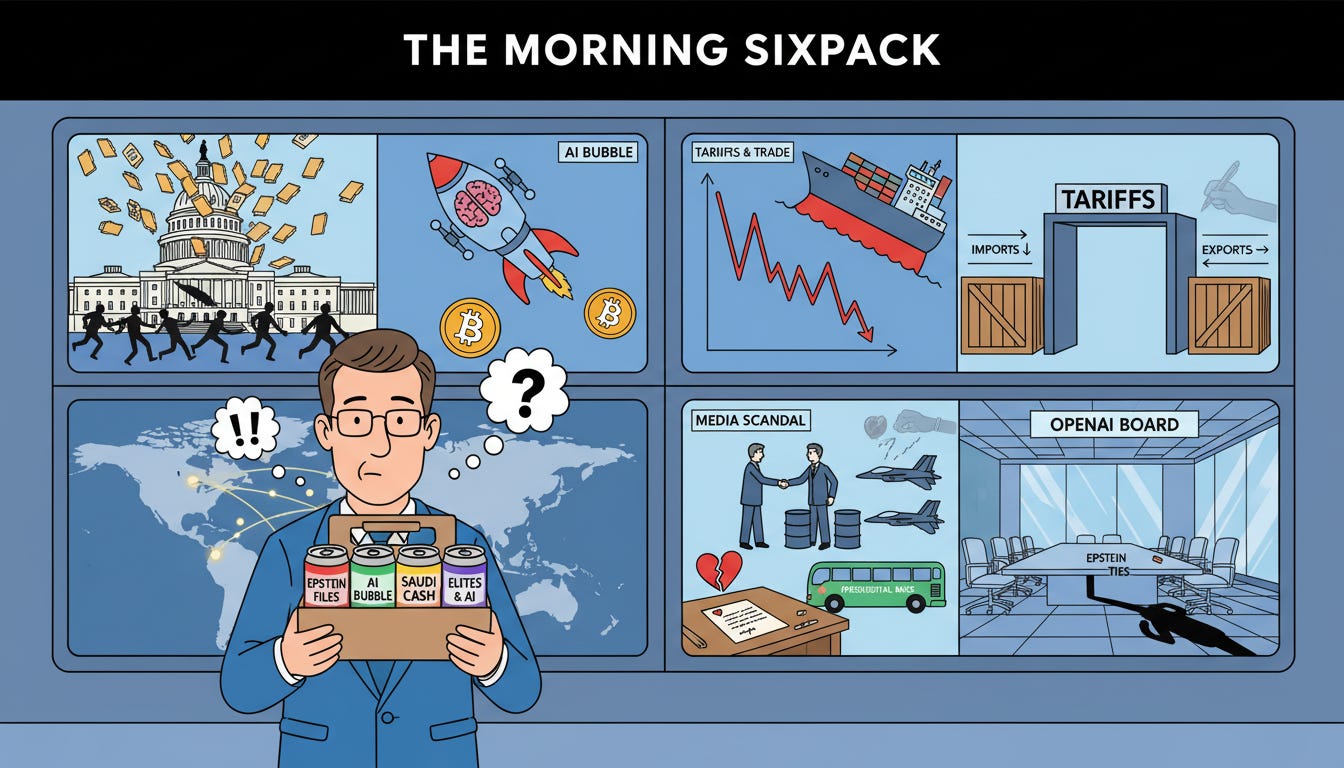
Senate Fast-Tracks Epstein Files Bill To Trump After Overwhelming House Vote
After months of dodging an on-the-record vote, the Senate agreed by unanimous consent to force out all unclassified Jeffrey Epstein files, caving to a 427–1 House landslide and a tidal wave of public pressure that even Donald Trump stopped fighting.
In an unusually aggressive procedural move, Senate leaders agreed to “deem” the Epstein Files Transparency Act passed the moment the House paperwork arrives—no floor vote, no speeches, just a fast track to Trump’s desk. Chuck Schumer orchestrated the maneuver after Republicans quietly checked their ranks for objections and found none, a sudden about-face after insisting for months that DOJ had already been transparent enough and that Congress shouldn’t dictate disclosures.
The shift underscores how politically toxic Epstein’s shadow has become. Sen. Lisa Murkowski put it bluntly: “We need to enforce transparency and integrity at the highest levels of government. It’s past time that all involved in Epstein’s illegal operation be brought to justice, so the survivors of these awful crimes can have closure.” GOP aides had floated waiting until December and adding protections for “innocent third parties,” but once the House went 427–1—with Rep. Clay Higgins as the lone no vote—that cautious talk became untenable. As John Thune dryly put it, once you have a 427–1 vote and a president pledging to sign, “I’m not sure that amending it is in the cards.”
On the House side, Speaker Mike Johnson tried to have it both ways—voting yes while warning the bill could “do permanent damage to the political system” and urging the Senate to rework it. That collided head-on with a bipartisan discharge petition led by Rep. Thomas Massie and Democrat Ro Khanna, which forced the bill to the floor once it hit 218 signatures. Four Republicans—Massie, Marjorie Taylor Greene, Nancy Mace, and Lauren Boebert—joined Democrats to break leadership’s blockade, with Massie telling the Senate, “Do not muck it up,” and warning that if they add any language that “prevents any disclosure, you are not for the people and you are not part of this effort.”
Hovering over all of this is Trump’s own whiplash. After months of deriding the transparency push as a “hoax” pushed by “Radical Left Lunatics” and reportedly leaning on Republicans to stall, he abruptly flipped on Truth Social, urging the GOP to vote for release because “we have nothing to hide.” That turn cleared the way for reluctant Republicans who’d already voted down a similar Schumer amendment in September—supported then by only Josh Hawley and Rand Paul—to now bless the same basic idea without ever taking a clean, on-the-record Senate vote.
Source: The Hill
Editor: Amazing how fast Congress discovers its love of “transparency” once a 427–1 vote, a bipartisan discharge petition, Epstein’s victims standing on the Capitol steps, and a Trump flip-flop all converge on the same week. Republicans wanted to slow-walk this, Democrats wanted the political cudgel, and only when it became clear that stonewalling would look worse than whatever’s in those files did everyone suddenly agree it was “time to move on.” We’ll see how committed they are to sunlight when the names actually hit the page.
Prediction: We will NEVER see the full Epstein Files. Trump is going to drag this out through 2028. And then the Democrats, if the party still stands, will do nothing. Just like before.
Trump’s Tariffs Shrink Trade Deficit—But Only Because Americans Bought Less
Trump’s tariffs didn’t supercharge American exports; they just made imports drop hard enough to make the trade deficit look better on paper.
In August, U.S. imports fell 5.1 percent to $340.4 billion after Trump’s sweeping tariffs on exports from roughly 90 countries kicked in on Aug. 7, according to newly released Commerce Department data. Exports, meanwhile, barely budged—up a microscopic 0.1 percent to $280.8 billion—underscoring that this “new trading system” isn’t about selling more abroad as much as it’s about taxing what Americans bring in.
Because imports fell so sharply, the overall U.S. trade deficit in goods and services dropped nearly 24 percent from July, landing at $59.6 billion. That headline number will be waved around as proof the tariffs are “working,” but cutting your deficit by choking off what people buy is a long way from rebuilding a manufacturing powerhouse.
The data release itself was delayed more than a month by the government shutdown, which means we’re only now getting a clear look at what happens when you flip the table on decades of trade policy in a matter of weeks. What we see isn’t a renaissance—it’s a shock: a sudden, tariff-driven adjustment that businesses and consumers have to eat in the form of higher prices, scrambled supply chains, or both.
Bottom line, this is the first snapshot of Trump’s reengineered trade regime in action, and it looks a lot more like a politically convenient talking point than a sustainable, growth-driving strategy. A smaller deficit achieved by making everything cost more and move slower is the economic version of going on a “diet” by locking the fridge—technically effective, practically miserable.
Source: NYT
Editor: This is classic deficit theater—crank up tariffs, watch imports fall, then declare victory while businesses scramble and consumers quietly pay the tab. If this is the grand new trading system, it looks a lot like a tax hike with better different branding.
Stock Slide: AI Bubble Fears, Bitcoin Rout & Weak Jobs Signals Drag Wall Street Into 4-Day Slide
Wall Street finally flinched as AI-bubble anxiety, a softening economy and a Bitcoin breakdown sent stocks and crypto into a broad risk-off retreat.
US indexes logged a fourth straight losing session Tuesday, with the Dow dropping about 1.1% (nearly 500 points), the Nasdaq off roughly 1.2% and the S&P 500 down about 0.8% after an early selloff. The pullback comes ahead of two big stress tests: Nvidia’s earnings on Wednesday and a long-delayed September jobs report on Thursday that will shape whether the Fed actually cuts rates or just keeps stringing markets along.
Bitcoin briefly broke below $90,000 for the first time in seven months, erasing all of its gains for the year and adding fuel to the global risk-off mood as Asia’s markets sold off hard. The speculative end of the market is clearly wobbling at the same time the AI trade is looking crowded: a Bank of America fund manager survey now ranks an AI bubble as the single biggest “tail risk,” and Big Tech followed that script Tuesday with Amazon, Microsoft, Nvidia, Tesla and Meta all sliding more than 2% while Cloudflare sank after an outage that knocked major sites offline.
Under the hood, the real economy isn’t exactly screaming confidence either. Bank of America data shows a “K-shaped” business recovery where big firms are still hiring but profitability for the smallest businesses just turned negative as costs bite harder. Homebuilder sentiment is stuck deep in pessimistic territory, with 41% cutting prices and 65% dangling incentives to move skittish buyers, while Home Depot trimmed its earnings outlook and admitted, “We believe that consumer uncertainty and continued pressure in housing are disproportionately impacting home improvement demand.” Meanwhile, gig work is quietly plugging holes as traditional payroll jobs cool and companies like Klarna brace for more loan losses even as they grow.
At the same time, investors are being told to both fear and embrace the AI boom. Mohamed El-Erian calls this “a rational bubble,” saying “the payoff [of AI] is so large that it is rational to have multiple investments and to overinvest,” even as survey data shows most fund managers now think companies are overspending on capex for the first time in 20 years. Redburn’s Alex Haissl just downgraded Amazon and Microsoft, warning, “It is time to take a more cautious stance on the hyperscalers…even though there is no clear path back to those economics,” arguing gen-AI is more expensive and less profitable than the first cloud wave. Add in Meta’s courtroom win over the FTC that leaves Instagram and WhatsApp firmly in its empire, plus Goldman’s call for a coming oil down-then-up cycle and a looming natural gas glut, and you’ve got a market that feels like it’s standing on a lot of shaky assumptions at once.
All of this is happening against an “uncertain” backdrop that even the ultra-wealthy can’t shrug off—Bentley’s CEO says high-end buyers remain cautious, noting, “It’s still uncertainty in the markets, specifically in the US. But if the US is uncertain, Europe is definitely uncertain. China is still slow.” Between AI exuberance, overlevered crypto, shaky consumers, power-law winners like Baidu still grinding out growth and infrastructure names like Cloudflare proving how fragile the internet backbone can be, Tuesday’s tape wasn’t just a bad day—it looked like a market quietly asking whether the narrative has run ahead of the math.
Source: Yahoo! Finance
Editor: This is what happens when you try to run a 2021 meme-economy on 2025 fundamentals—AI capex going vertical, Bitcoin leveraged to the moon, small businesses getting squeezed and everyone praying Nvidia’s earnings slide deck justifies the entire trade. If the best bullish case is “rational bubble,” that’s not exactly the safety word you want when the music stops.
How A Forgotten Hotel Notepad Blew Up A Decade: Olivia Nuzzi
I found out my partner was sleeping with a presidential candidate because she couldn’t even be bothered to hide her love letters on hotel stationery.
Olivia Nuzzi had just come back from what she said was a reporting trip, dumped her half-open Herschel backpack by the bed, and left a trail of Kimpton Hotel stationery across the floor like breadcrumbs to the end of our life together. That townhouse in Georgetown, with its moody little courtyard and the invasive bamboo I kept hacking back, had become our shared metaphor—me in the dirt, trying to keep the chaos underground, while she kept planting new roots of trouble just out of sight.
For years, I’d convinced myself this was just what came with loving Olivia: the trauma, the theatrics, the escape plots. I’d helped her disentangle from that bizarre, sugar-daddy-adjacent relationship with Keith Olbermann, watched as he financed her college, wardrobe, apartment, and then allegedly turned into the stalker she swore we must never acknowledge. She’d returned the favor by going to war with my enemies—from David Remnick, whom she once chased at an awards show yelling “You’re a coward!”, to Trump-world figures who’d made our lives miserable. We told ourselves that surviving all that together meant we were fated, not just dysfunctional.
That’s the context that makes what came next so grotesque. This wasn’t just cheating; it was a betrayal engineered for maximum collateral damage—personal, professional, ethical. Olivia spent a year deceiving me, then smeared me with wild stories of blackmail and even tried, with the help of a senior Trump official, to maneuver me into prison. Now she’s peddling what appears to be a heavily fictionalized, self-serving version of events in a book with the full media rollout. I’m not pretending to be Zen about it, but I’m also wary of building this whole account on rage. “Those who cling to thinking, ‘He abused me, he struck me, he defeated me, he robbed me,’ never still their hatred,” the Buddha said. I’m trying, however imperfectly, to keep that in mind.
Which brings us back to that afternoon and those hotel pages fanned out on the floor. I bent down, gathered the scattered stationery, and started stacking it neatly on her desk—just one more act in a long career of cleaning up Olivia’s messes. That’s when I saw her handwriting and the first line that stopped me cold: “If I swallowed every drop of water from the tower above your house, I would still thirst for you.” Poetic, sure, but our Georgetown place didn’t have a water tower, which meant I was not the “you” in question.
I flipped to another sheet and saw his name, along with enough detail to confirm a physical relationship and hint at some recent falling out. He was a nationally known politician, 32 years older than Olivia, already infamous for a sex scandal—and, crucially, a presidential candidate she’d just profiled in New York magazine and was using as a source for the campaign book we were under contract to write. In other words, she hadn’t just crossed a personal line; she’d detonated a journalistic one. The date on the unfinished love letter—March 5, 2020—was only days old. I picked up the phone, called my agent, and said the quiet part out loud: “We have a big problem. Olivia is sleeping with Mark Sanford.”
Source: Telos
Editor: When your personal life, your book deal, and your beat all collide in one absurdly messy affair with Mark Sanford, you’re not in a love story—you’re in a case study about why journalism ethics lectures should come with hazard pay and a drink ticket. Don’t forget: Nuzzi also got mixed up with that man who looks like a tanned chunk of beef butt, Robert F. Kennedy, Jr.
Trump Shields MBS Over Khashoggi Killing While Saudi Arabia Dangles $1 Trillion AI Cash And F-35 Deal
President Trump all but absolved Mohammed bin Salman of the CIA-confirmed Khashoggi murder in the Oval Office—then moved straight into pitching weapons, nuclear tech, and an AI cash gusher with the crown prince as the honored guest.
Pressed on CIA findings that the Saudi heir approved Jamal Khashoggi’s killing, Trump waved it away and went after the dead journalist instead. “You’re mentioning somebody that was extremely controversial,” he said. “A lot of people didn’t like that gentleman that you’re talking about. Whether you like him or didn’t like him, things happen, but he knew nothing about it. And would you leave it at that? You don’t have to embarrass our guest by asking a question.” The CIA’s conclusion that MBS signed off on a 2018 hit that saw Khashoggi killed and dismembered in a consulate met the same old Saudi line that the crown prince knew nothing. MBS called the murder “heinous” and “unjustifiable,” insisting Saudi has “improved our system to be sure that nothing happened like that.”
From there, the conversation moved seamlessly to money and hardware. Trump brushed off questions about conflicts tied to his family’s Saudi business ties, claiming he has “nothing to do” with the company and left that success behind “to make America very successful.” Together, he and MBS hyped a giant investment package, with the White House’s earlier claim of a $600 billion Saudi “commitment to invest in the United States” now upgraded by the prince to “almost $1 trillion of investment—real investment and real opportunity,” heavily framed around technology and artificial intelligence. Whether that’s actual capital or fantasy math is anyone’s guess, but the clear message was that Riyadh wants to buy deep access to the U.S. tech stack.
On the security front, both men reaffirmed plans for the U.S. to sell F-35s to Saudi Arabia, with Trump insisting Israel “is going to be very happy” about the deal. He also floated the idea of a future civil nuclear agreement with the kingdom, saying he could “see” it happening but “it’s not urgent.” For a country with a brutal human rights record and a de facto ruler linked by U.S. intelligence to a political assassination, that’s a lot of high-end kit being put on the table.
The diplomatic dance extended to the region’s broader architecture. Saudi Arabia still isn’t part of the Abraham Accords, but MBS signaled he’s open—as long as there’s a clear road to Palestinian statehood. He called relations “a good thing” and said the kingdom wants to be “part of the core,” but only if there’s “a clear path of two-state solution.” Trump said the two leaders had a “healthy discussion” and promised to keep talking about a two-state framework, even as the meeting’s public emphasis stayed locked on money, arms and optics.
And of course, this was just the daytime programming. After the handshakes and the denials in the Oval Office, the trip rolled on to a White House dinner—another chance to cement a relationship built on oil, cash, AI dreams and high-end weapons, with Khashoggi’s name treated as an awkward inconvenience to be waved away as “things happen.”
Source: NPR
Editor: This is the full MBS rehab package—minimize a U.S.-based journalist’s murder, declare the crown prince totally in the dark, and then pivot straight into a $1 trillion AI-and-F-35 infomercial from the Oval. When “things happen” is your line on state-sanctioned butchery, the message to every autocrat on Earth is clear: bring money, buy weapons, and Washington will happily pretend the bone saw never existed.
Larry Summers Bails From OpenAI Board As Epstein Shadow Reaches Into AI
Larry Summers just quietly slipped off the OpenAI board as the Epstein fallout finally landed in the heart of the AI boom.
The former Treasury secretary and Harvard president resigned from OpenAI’s board, he and the company confirmed to Axios, after new revelations about how deep his ties to Jeffrey Epstein actually ran. It’s the latest reminder that the Epstein story isn’t ancient history—it’s a live wire still running through the highest tiers of finance, academia and now the most hyped AI lab on the planet.
For years, Summers was treated as one of the country’s pre-eminent economists, the guy you wheel out for elite panels and global summits, even as questions about his relationship with Epstein kept resurfacing. Now, with investigators and reporters still prying open the Epstein record, those ties have gone from reputational nuisance to career liability, and suddenly stepping down from a marquee board seat looks less like a choice and more like risk management.
For OpenAI, this is another governance hit at a moment when the company is selling itself as the adult in the AI room. When you’re asking the world to trust you with civilization-scale technology, having a director with deep Epstein baggage is not exactly the brand alignment you want—and the fact that it took fresh reporting to trigger an exit says plenty about who gets vetted and how.
The bigger tell here is that we’re nowhere near the end of the Epstein reckoning. If a figure as entrenched and insulated as Larry Summers is now getting bounced from the AI elite over his past, it raises an obvious question: who else sitting on powerful boards and advisory councils is still one document dump away from the same fate?
Source: Axios
Editor: Summers stepping down from OpenAI isn’t accountability so much as damage control—elite circles were perfectly fine with his Epstein proximity until it threatened the optics of their favorite AI unicorn. The real story isn’t that he resigned; it’s how many people in that orbit only discover their “concerns” once the headlines hit.
And don’t forget: Summers still has a teaching job at Harvard.