


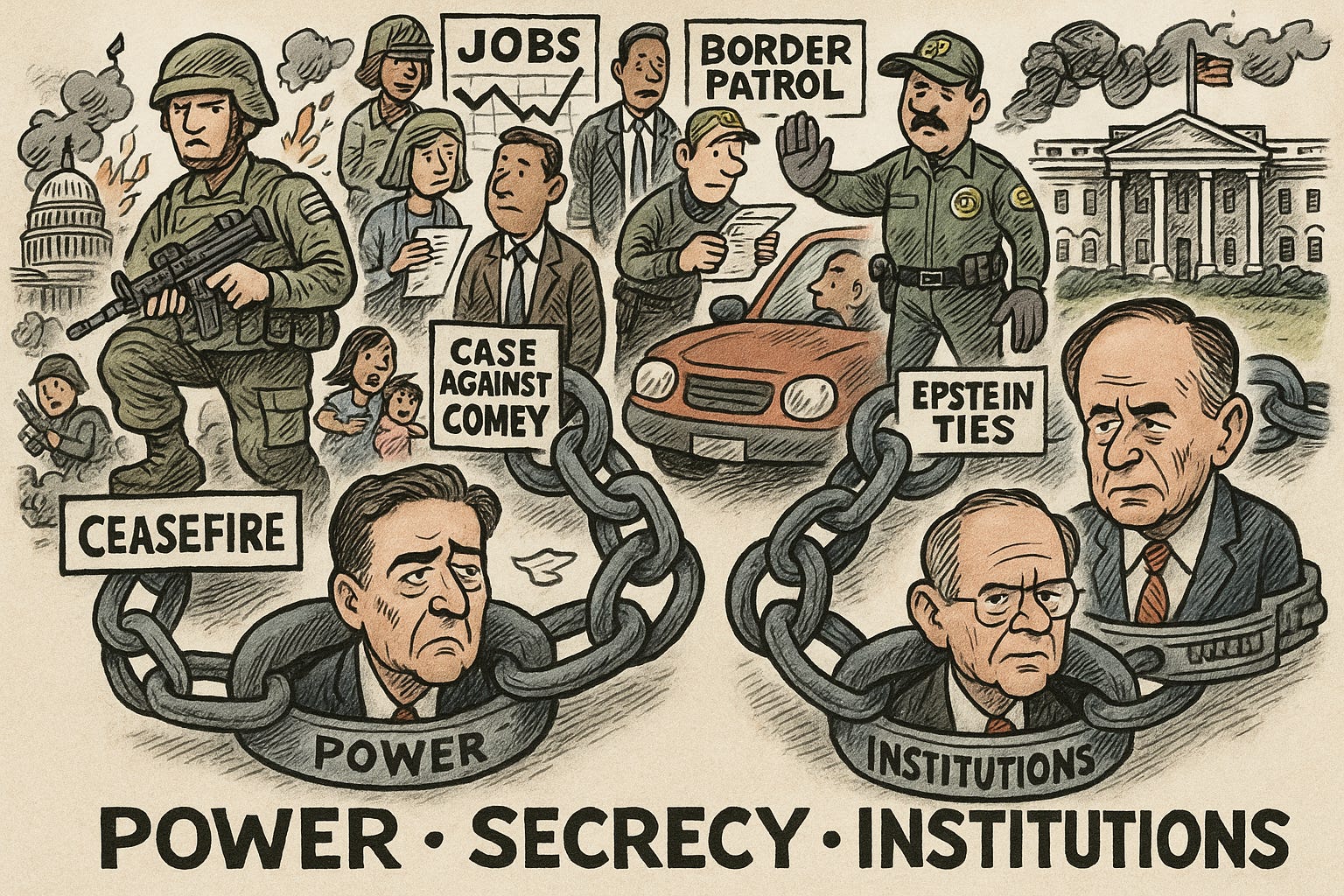
Trump Signs Bill Forcing DOJ to Release Epstein Files as Washington Braces for Fallout
Trump just detonated a political grenade by signing a bill that forces his own Justice Department to release its Jeffrey Epstein files.
In a late-night Truth Social post, the president crowed about signing the legislation—after spending months trying to slow-walk or bury the very disclosures he now claims he demanded. The bill sailed through Congress with near-unanimous support, largely because Trump abruptly reversed himself and insisted Republicans back it. Classic Washington plot twist: the arsonist demanding credit for putting out the fire.
Trump’s post hammered Epstein as a “lifelong Democrat” intertwined with “well-known Democrat figures,” even though the two men were friends until the early 2000s. And he bragged that, “Because of this request, the votes were almost unanimous in favor of passage.” The bill now orders Attorney General Pam Bondi to release unclassified Epstein and Ghislaine Maxwell records within 30 days, while carving out anything tied to active investigations, victims’ identities, or illicit materials.
But this whole saga is a political pretzel. Bondi—at Trump’s behest—has already tapped Manhattan U.S. Attorney Jay Clayton to dig into Epstein’s supposed ties to Trump’s enemies. Meanwhile, scrutiny of Trump’s own connection to Epstein keeps rising, including emails from Epstein’s estate where the disgraced financier wrote in 2018, “I know how dirty donald is,” and in 2019 claimed Trump “knew about the girls.” That’s the kind of thing that keeps comms teams up at night.
And yet, Trump dismisses the whole topic as a Democrat-driven “hoax,” lashes out at reporters who ask about his ability to release the files unilaterally, and even called for ABC’s broadcast license to be revoked. For a guy insisting he wants transparency, he’s acting like the truth is one big draft he’d prefer not to submit.
Source: CNBC
Editor: Trump signing a bill to force himself to do what he’s already empowered to do is peak political theater—like watching someone congratulate themselves for finally taking out the trash after denying for years that the smell was coming from their own kitchen.
Israel Calls It a Cease-Fire—But Gaza Is Still Being Bombed
If bombs are still falling, let’s stop pretending this is anything close to a cease-fire.
In the past day alone, Gaza authorities say Israeli strikes killed at least 33 Palestinians and injured more than 80—numbers that shatter any fantasy that the U.S.-brokered Oct. 10 truce is functioning in anything but name. Among the dead: 12 children and eight women. And rescuers warn the toll will rise because they still can’t reach people buried under rubble. A cease-fire that can’t even pause long enough for ambulances to enter a street isn’t a cease-fire; it’s a press release stapled to a war.
Israel claims Hamas fighters opened fire on IDF forces in the south, accusing Hamas of violating the agreement. Hamas fired back—verbally, at least—calling Israel’s strikes a “dangerous escalation” and urging Washington to make Jerusalem stick to the deal. Meanwhile, Gaza’s Civil Defence says entire families died in Khan Younis and Gaza City, including in an administrative building hit while people were simply trying to live their lives. None of that looks like restraint. It looks like business as usual, dressed up in diplomatic language.
One drone strike reportedly killed a man standing on a street corner. Another shell from an IDF tank hit a home. These are not the moves of a military honoring a truce; these are the moves of a military operating under the assumption that the cease-fire is a negotiable suggestion rather than a binding agreement. Call it what it is: ongoing warfare with occasional pauses for paperwork.
All of this comes just after the U.N. Security Council endorsed Trump’s 20-point peace plan—an international blueprint to rebuild Gaza without Hamas, install a transitional government, and create a new security force trained by Egypt. Trump hailed it, Hamas denounced it, and bombing resumed. That sequence tells you everything: a plan for a peaceful future doesn’t mean much when the present is still erupting.
Source: UPI
Editor: Diplomats keep calling this a cease-fire the way a restaurant calls a bowl of lettuce “entrée-sized”—technically words are being used, but nobody who ordered it feels satisfied.
September Jobs Rebound Looks Good on Paper—but the Shutdown Scrambles the Story
A jobs report released nearly seven weeks late isn’t just inconvenient—it’s a reminder of how badly a government shutdown can distort the entire picture of the U.S. economy.
September payrolls rose by 119,000, more than double what economists expected. Under normal circumstances, that would be a clean win for the labor market. But these aren’t normal circumstances. The shutdown froze federal data pipelines, leaving Wall Street, the Fed, and basically everyone else flying with half a dashboard. To make matters messier, July and August job figures were revised downward by a combined 33,000. It’s like getting your report card late and finding out two of the grades were worse than you thought.
The unemployment rate ticked up to 4.4% as nearly half a million Americans jumped back into the labor force—a sign of confidence, sure, but also one that complicates the Fed’s December decision. And because the Labor Department couldn’t collect October data during the shutdown, there’s not even going to be an October unemployment rate. Policymakers are now preparing to meet in early December with stats that might as well have an “expired” stamp on them.
Meanwhile, companies are flashing caution lights: Amazon and Target are cutting corporate jobs, consumer sentiment tanked in early November, and small-business optimism slipped as owners reported sagging sales and thinning profits. Even as third-quarter GDP estimates sit at a juicy 4.2% and Nvidia pumps out record numbers, the split in the consumer base is growing. Wealthier households are still spending; everyone else is doing math on the back of grocery receipts.
Retail bellwethers like Home Depot and Target are waving the yellow flag too. Home Depot trimmed its outlook as high rates and a dreary housing market kept homeowners from pulling the trigger on big projects. Target cut profit guidance, saying shoppers spent less and came less often—no surprise in a quarter where the federal shutdown literally paused food-assistance benefits in parts of the country.
Source: The Wall Street Journal (gift article)
Editor: Nothing says “healthy economy” quite like asking the Fed to steer with blurry gauges and missing dials—apparently the shutdown didn’t just close museums; it closed the nation’s eyesight.
Border Patrol’s Secret Roadside Dragnet Turns America’s Highways Into a Surveillance Web
If driving a perfectly legal route can get you flagged, tracked, and pulled over, then the line between border security and domestic spying has already been erased.
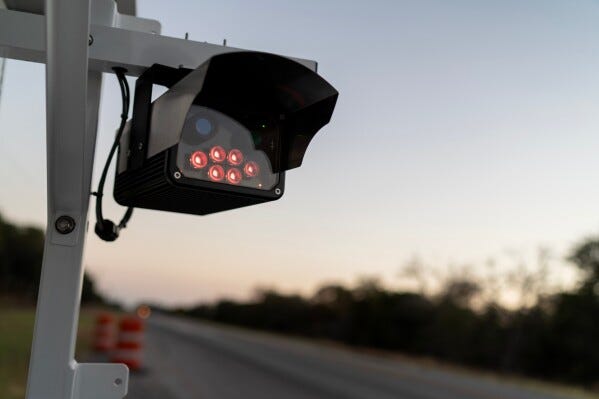
According to a sweeping AP investigation, U.S. Border Patrol has quietly built a nationwide surveillance network that monitors millions of American drivers far from any border. Cameras—often hidden in traffic barrels, cones, and roadside equipment—feed license plate data into an algorithm that flags “suspicious” travel patterns. Local police then swoop in under the guise of a routine traffic stop, leaving motorists blindsided, confused, and often terrified. The government calls it intelligence; to everyone else, it looks a whole lot like dragnet policing in a country that supposedly bans dragnet policing.
Here’s what makes this scheme truly alarming: these stops have nothing to do with warrants, suspects, or actual evidence. People are targeted because they took a “weird route,” drove a rental car, stayed in a hotel near the border, or—God forbid—made a quick round-trip to another city. Former officials admitted Border Patrol tries to keep the program hidden, even dropping charges rather than reveal its own surveillance footprint. When you’re so scared of sunlight that you’d rather let a case collapse than explain how you operate, that’s not the behavior of an agency confident in its legality.
The real-world consequences are brutal. Innocent drivers have been detained for hours, interrogated, handcuffed, and searched based on nothing more than algorithmic vibes. One trucking employee was arrested simply for carrying customer cash—police ultimately found zero contraband, yet he lost thousands in legal fees. Another man had his car torn apart because federal agents tracked his overnight business trip. As one deputy bragged, Texas traffic law contains “thousands of things you can stop a vehicle for,” which is precisely the problem. A pretext is always available when the surveillance machine has already branded you suspicious.
This isn’t isolated—it’s systemic. Group chats between Texas deputies and federal agents show real-time surveillance updates, shared addresses, social media screenshots, and even license checks for U.S. citizens. Border Patrol has tapped into DEA databases, private-sector plate readers, and local police systems funded by federal grants. All of it feeds a program built to map “patterns of life,” a phrase that should never appear in a free nation’s policing doctrine. The agency now operates deep inside major metro areas, from Phoenix to Detroit to Chicago. The border has effectively migrated inland.
And the kicker? Border Patrol calls this legal and necessary for national security. Legal scholars disagree—strongly. Courts are starting to recognize that mass, always-on surveillance tracking everyone everywhere sounds a lot like an unreasonable search, the exact thing the Fourth Amendment is supposed to block. If this is the new normal, we’ve normalized something very dangerous: a domestic intelligence agency hiding behind traffic stops.
Source: Associated Press
Editor: If this is what “border security” looks like, then every highway in America just became a checkpoint—only nobody bothered to tell the people doing the driving.
Judge Signals Comey Case Might Be Built on a Procedural Faceplant
If prosecutors can’t even prove the grand jury actually returned the indictment, then there may not be a real case against James Comey at all.
In a hearing that should have had DOJ lawyers sweating through their suits, U.S. District Judge Michael Nachmanoff pressed federal prosecutors on whether the indictment against the former FBI director was ever legitimately approved by the grand jury. What he got back were contradictions, missing pieces, and a timeline that collapses under its own weight. When your own prosecutor admits the “second indictment” was never shown to the full grand jury, that’s not a technical hiccup—that’s the legal equivalent of forgetting to attach the file before hitting send.
Comey’s attorney put it bluntly: “There is no indictment that Mr. Comey is facing.” And based on the DOJ’s own admissions, he’s not wrong. The five-year statute of limitations has now expired, meaning prosecutors can’t simply redo their homework. The messy handling has now raised red flags for three separate judges, each puzzled by gaps in transcripts, odd filing logic, and a grand jury process that appears—at best—rushed, and at worst cooked.
The timeline is damning. Halligan says she learned one count was rejected, rewrote the indictment, coordinated with her team, and returned it in open court—all in about seven minutes. One magistrate judge said flatly that such a sequence “could not have been sufficient.” Either the transcript is incomplete or the grand jury never saw the indictment that was publicly filed. Pick your poison; neither helps the government’s case.
Judge Fitzpatrick didn’t mince words, describing DOJ missteps as a “disturbing pattern” that raises “the prospect that government misconduct may have tainted the grand jury proceedings.” When judges start talking like that, you’re not just on thin ice—you’ve fallen straight through. Yet DOJ insists everything is fine, arguing critics are relying on “partial snippets.” That confidence feels misplaced given that every new question seems to reveal a new procedural pothole.
This isn’t about James Comey anymore. It’s about whether the Justice Department can competently prosecute a high-profile case without tripping over its own process. As of today, the answer looks uncomfortably close to “no.”
Source: CBS News
Editor: If the DOJ wanted to convince the world this case was political theater held together with duct tape, mission accomplished—they can’t even keep track of their own indictments, let alone defend them.
Larry Summers Quits OpenAI Board as Epstein Emails Trigger Rapid Fallout
Larry Summers didn’t just step back—he effectively pulled the emergency brake on his public life after newly released Epstein emails showed how closely he kept the disgraced financier in his orbit.
OpenAI offered the politest version of goodbye, saying it “respected” Summers’ decision and appreciated his contributions. Translation: thanks for your service, here’s the door. His resignation comes as Congress moves to force the DOJ to release its Epstein files—legislation Trump now says he’ll sign after his base reminded him transparency is only scary if you look guilty.
The House Oversight Committee’s email dump didn’t allege wrongdoing, but it did paint an unflattering picture: Summers and Epstein dining often, Epstein playing power broker, and Summers somehow thinking this was a fine idea well past the point when any sane person would’ve blocked the man’s number. Summers tried to clean it up with a pledge to “rebuild trust,” which is what powerful people say when the receipts are already public.
His departure from the Center for American Progress followed within hours, and Harvard confirmed he’s cutting back everything but teaching while the university reviews the emails. For someone who once ran the Treasury Department, chaired the National Economic Council, and led Harvard, the speed of the unraveling is remarkable—proof that proximity to Epstein remains political and reputational poison.
Summers had joined OpenAI’s board in 2023 after the company’s failed power struggle over Sam Altman. Now he exits as abruptly as he arrived, leaving OpenAI to pretend this is all normal while it quietly rethinks its vetting procedures.
Source: My Daily Grind News
Editor: Amazing how quickly “misguided decisions” become “voluntary resignations” once the emails hit daylight—some people only find accountability when it finds them first. NOTE: Summers is also no longer teaching at Harvard.