


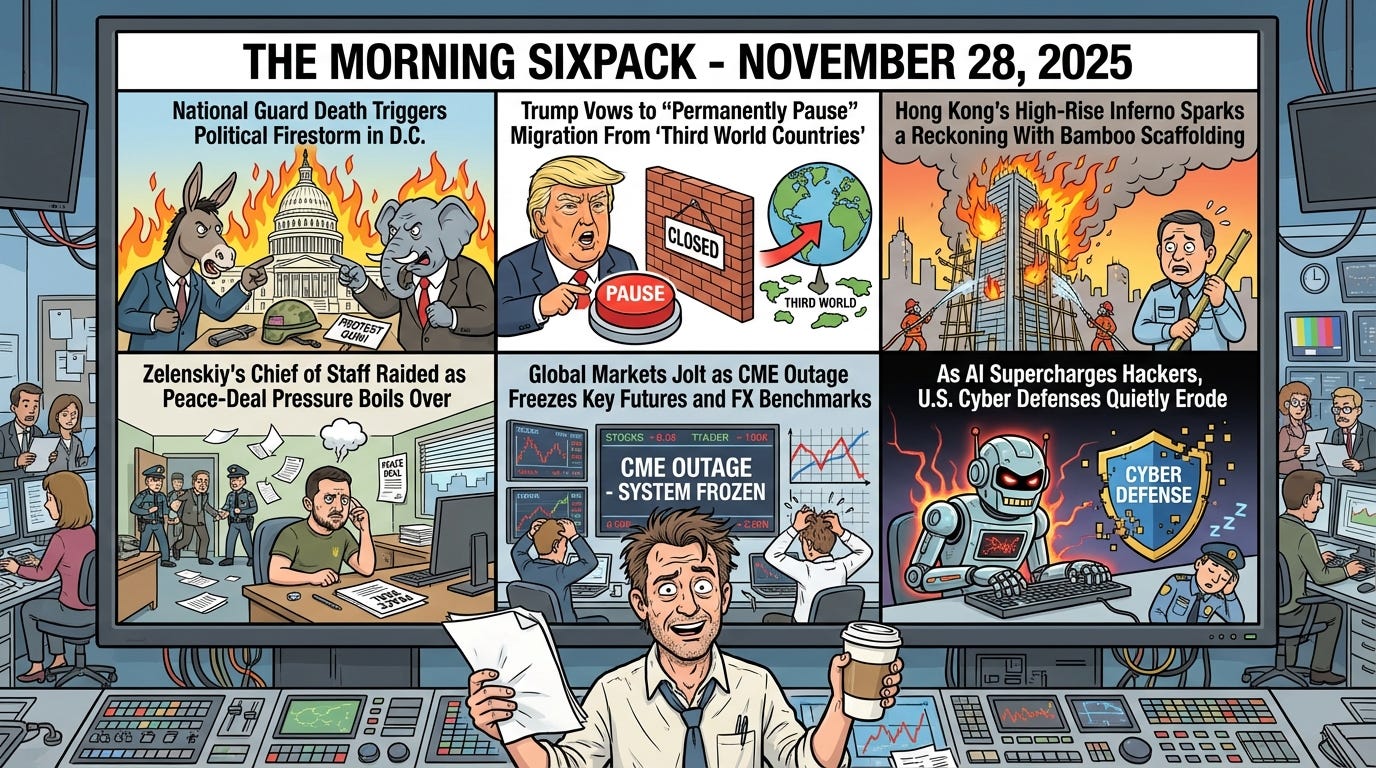
National Guard Death Triggers Political Firestorm in D.C.
A young soldier’s killing in the nation’s capital has instantly become a battleground for policy, politics, and blame.
U.S. Army Specialist Sarah Beckstrom, just 20 years old, has died after being shot near the White House—an attack that also left fellow Guardsman Andrew Wolfe fighting for his life. President Trump announced her death during a Thanksgiving call, using the moment to link the shooting to U.S. immigration policy and to declare he would “permanently pause migration from all Third World Countries to allow the U.S. system to fully recover.”
In classic Trump fashion, the president also displayed photos of the suspect—29-year-old Afghan national Rahmanullah Lakanwal—and a chaotic evacuation flight from Kabul, drawing a straight line between the Biden-era withdrawal and Wednesday’s attack. “He went cuckoo. I mean, he went nuts. And that happens too often with these people,” Trump said—a quote that tells you everything about where this debate was headed before the family had even buried their daughter.
Federal prosecutors now expect first-degree murder charges, with Attorney General Pam Bondi signaling potential terrorism counts and even the death penalty. Yet the story quickly grows more complicated: Lakanwal worked with CIA-backed units in Afghanistan and underwent what former State Department official Sam Aronson described as “among the most intensive vetting of any foreign nationals around the world.” That detail didn’t slow DHS, which raced to halt all Afghan immigration requests and review every asylum case approved under the previous administration.
Meanwhile, Wolfe remains in critical condition, and his family is pleading for prayers. Both soldiers had volunteered to serve in D.C. over Thanksgiving—sworn in less than a day before they were attacked. As officials raid homes in Washington state and San Diego for evidence, the country is left wrestling with a tragedy that has been swiftly weaponized, with little patience for nuance from those who most need it.
Source: WSJ (gift article)
Editor: Hard to miss the pattern here—every crisis becomes a policy rollout before the facts even finish arriving. Maybe let investigators speak before the campaign does.
Trump Vows to “Permanently Pause” Migration From “Third World Countries”
The president has now escalated his immigration rhetoric into a sweeping promise that raises more questions than answers.
In a late-night Truth Social post, President Trump declared he would “permanently pause migration” from all “third world countries,” saying the move would help the U.S. “fully recover” from policies he argues damaged Americans’ quality of life. He didn’t specify which nations would be hit, but he did pledge to remove anyone “not a net asset” to the country—a phrase that sounds like it was cribbed from a balance sheet, not applied to human beings.
Trump’s comments landed just a day after an Afghan national was accused of shooting two National Guard members in Washington, D.C., killing one. The president has been using the attack to amplify his argument that refugees pose a national security threat and that he’ll purge “any foreigner…who does not belong here.” The administration had already suspended Afghan immigration processing on Wednesday, citing a review of vetting procedures.
By Thursday, U.S. Citizenship and Immigration Services went further, saying it would re-examine green cards issued to immigrants from 19 countries. When pressed, the agency pointed to a White House proclamation listing nations including Afghanistan, Cuba, Haiti, Iran, Somalia, and Venezuela. No one could explain what “re-examination” actually means, but the speed of the announcement made it clear this is now a political sprint, not a policy process.
The president’s latest promise—to “end all federal benefits and subsidies to noncitizens”—piled on top of a flurry of immigration pivot points that followed revelations about the D.C. shooting suspect’s background. Officials say Rahmanullah Lakanwal worked alongside CIA units and helped guard U.S. forces at Kabul airport during the chaotic 2021 withdrawal. That nuance hasn’t slowed the messaging machine. Complexity rarely does.
And so the pattern repeats: real tragedy, real questions—and leadership that seems more interested in ideologically preloading the answers than actually finding them.
Source: MyDailyGrind.News
Editor: If policy is being drafted faster than the facts are being checked, that’s usually a hint the policy was the goal all along.
Hong Kong’s Deadly High-Rise Inferno Sparks Reckoning Over Bamboo Scaffolding
A blaze that killed at least 128 people (with 200 still missing) has forced Hong Kong to confront whether a thousand-year-old building tradition still belongs on modern skyscrapers.
Authorities say the fire erupted on the bamboo scaffolding wrapped around a 32-story tower in Tai Po before surging inside the building and then into six neighboring towers—its speed likely accelerated by strong winds and flammable renovation materials. For a city built vertically, the idea that its exterior safety net could turn into an accelerant is as devastating as it is politically unavoidable.
Bamboo scaffolding has been a staple of Asian construction for more than a millennium—lightweight, cheap, flexible, and perfect for navigating Hong Kong’s tight urban spaces. But its vulnerabilities are not news. Since 2018, bamboo-related accidents have claimed 23 lives, and even Hong Kong’s own development secretary acknowledged earlier this year that the city needed to “drive a wider adoption of metal scaffolding.” As Chief Secretary Eric Chan bluntly put it, bamboo simply falls short on fire safety.
Experts agree. “For high-risk, occupied towers, metal is the safer baseline,” said Ehsan Noroozinejad of Western Sydney University. While steel and aluminum are heavier, pricier and slower to erect, they don’t ignite—and in a city full of tall, densely packed housing blocks, that trade-off feels less theoretical by the day.
Police have already arrested three men—directors and a consultant from the construction company involved—on suspicion of manslaughter. Investigators say some external wall materials likely failed fire-resistance standards, giving the blaze a brutal head start. What wasn’t already consumed shows how much of the bamboo shell simply became fuel. As fire-safety specialist Devansh Gulati put it, “Just by chance, the wrong conditions combined.”
And with nearly a hundred families grieving in the aftermath, Hong Kong seems to have reached its inflection point. Tradition has its place—but maybe not 32 stories in the air, wrapped around homes filled with sleeping families.
Source: AP News
Editor: If it takes a catastrophe to retire a building method older than gunpowder, that tells you everything about how slowly safety culture moves when cost and convenience are the competition.
Zelenskiy’s Chief of Staff Raided as Peace-Deal Pressure Boils Over
Ukraine’s most powerful presidential aide just had his home searched, signaling a political rupture at the worst possible moment.
Ukraine’s anti-corruption agencies executed an authorized search of Chief of Staff Andriy Yermak’s apartment on Friday, thrusting the president’s closest confidant into the center of Kyiv’s most severe wartime political crisis. Yermak—Zelenskiy’s longtime friend, campaign architect and lead negotiator in talks shaped by a U.S. draft aligning with key Russian demands—confirmed the raid and said he was cooperating fully.
The search comes as agencies probe a massive $100 million kickback scandal at the state atomic energy company, a case that has already entangled former officials and a onetime Zelenskiy business partner. Although Yermak has not been named a suspect, opposition lawmakers—and even some within Zelenskiy’s own faction—have been calling for his removal. With the country under pressure from Washington to accept terms that could force territorial concessions, the timing of this escalation could not be more combustible.
Opposition parties wasted no time sharpening their knives. European Solidarity blasted Yermak’s role in negotiations and demanded Zelenskiy brief parliament on the negotiating team’s “directives and red lines.” Translation: no more back-channel diplomacy with only the president’s loyalists in the room.
All of this unfolds as Russian forces grind forward and claim they’re closing in on Pokrovsk—potentially their biggest capture in nearly two years. Putin, ever the opportunist, called the leaked 28-point U.S. peace plan “a basis for future agreements,” while insisting Kyiv pull its troops out of occupied eastern territory before Moscow stops fighting. Yermak fired back in The Atlantic: “No one should count on us giving up territory.”
But Friday’s raid may rewrite the political script. As analyst Viktor Shlinchak put it, this was “a Black Friday” for Yermak—and it may force Zelenskiy’s hand. “It looks like we may soon have a different head of the negotiating team,” he wrote. Hard to argue: the optics alone make Yermak’s continued role almost impossible.
Source: Reuters
Editor: Kyiv can’t wage a two-front war—one against Russia, the other against its own inner circle. Yet here we are, watching the political oxygen burn while Moscow keeps advancing.
Global Markets Jolt as CME Outage Freezes Key Futures and FX Benchmarks
A cooling-system failure at a Chicago data center brought the world’s largest exchange operator to a standstill—leaving traders guessing and brokers exposed.
CME Group, the backbone of global derivatives trading, was forced to halt vast swaths of its futures and currency markets on Friday after a cooling failure at a CyrusOne data center crippled critical systems. The stoppage, which began in early Asian hours and stretched well into Europe’s morning, is one of the longest market participants have seen in years—and that’s saying something in an industry that normally measures downtime in seconds.
The outage froze benchmark prices across commodities, Treasuries, equities, and major currency pairs. West Texas Intermediate crude, U.S. 10-year Treasury futures, the S&P 500, Nasdaq 100, gold, palm oil, the Nikkei—you name it, it wasn’t updating. Brokers pulled products, traders went blind, and the EBS FX platform, which handles nearly $60 billion a day, fell dark on euro/dollar and dollar/yen pricing. As CMC Markets’ Christopher Forbes put it: “It’s just a pain in the arse… I’ve never seen such a widespread exchange outage in 20 years.”
CyrusOne said its CHI1 Chicago facility suffered a cooling breakdown and that teams were scrambling to restart chillers and deploy temporary equipment. CME assured the market that its fixed-income platforms—Brokertec U.S. Actives and Brokertec EU—were still running, but everything else was effectively frozen. For a firm that touts itself as the widest-ranging benchmark marketplace on earth, the optics were brutal.
Brokers scrambled to jury-rig workarounds. Some relied on internal pricing models; others simply halted trading in affected products. None of them liked the risk. “We’re now taking a lot of unnecessary risk here to continue pricing,” Forbes said, adding that volatility will likely spike once markets reopen. Light Thanksgiving-week liquidity didn’t hurt, but it didn’t save anyone either.
CME shares slipped in premarket trading, but the larger issue is confidence. With derivatives volumes averaging 26.3 million contracts a day, the idea that a cooling glitch can seize up global hedging and speculation is…not reassuring. Yes, it’s not unprecedented—Brown at Pepperstone noted outages have happened before—but that doesn’t make it normal. Markets run on trust, precision, and uptime; watching them stall because a server room got too warm is not exactly the vibe.
Source: Reuters
Editor: A trillion-dollar market plumbing system brought down by a busted AC unit—Wall Street’s version of slipping on a banana peel, except everyone’s portfolio is standing on the stairs below.
As AI Supercharges Global Hackers, U.S. Cyber Defenses Are Quietly Eroding
The U.S. is cutting cybersecurity muscle at the exact moment attackers are getting faster, smarter, and far less human.
Interviews with current and former officials—as well as a stack of frustrated cybersecurity experts—paint a bleak picture: while adversaries are using AI to accelerate hacking, cyberespionage, and financial crime, the federal government has been shrinking its own defenses. The Cybersecurity Coalition, which includes Microsoft, Google, and Cisco, put it plainly in a letter to the White House: “New leadership is needed to protect our nation from increasing cyberthreats.”
One-third of CISA’s staff has been cut, a vacancy memo shows 40 percent of key roles empty, and major agencies—from CISA to the NSA—remain without Senate-confirmed directors. Chris Krebs, the respected former CISA chief fired in 2020, didn’t mince words: “The strategy is unclear, headcount is down, and capacity is gutted.” Meanwhile, the Trump administration insists everything is fine, pointing to classified “progress.” That’s one way to avoid accountability—just stamp it secret.
The threat landscape is shifting faster than Washington’s political machinery can track. AI tools are now helping spies and criminals discover vulnerabilities in seconds, automate whole intrusions, and even hijack AI-powered apps on victims’ devices. Anthropic revealed that Chinese state-backed hackers used its Claude model to run an advanced espionage campaign with almost no human oversight. Yet guidance for how companies should handle high-risk AI features—like AI browsers with sweeping data access—is essentially nonexistent.
Policy retreats are adding to the mess. The FCC scrapped telecom security rules imposed after Chinese hackers infiltrated major carriers. The Commerce Department's bans on risky foreign-made networking gear have stalled—some apparently held as bargaining chips in trade talks with Beijing. And federal hiring pipelines are bleeding both the most senior and the youngest cyber talent, a disastrous combination for capacity and continuity.
The result? Leading voices across government and the private sector warn U.S. posture is slipping. The Cyberspace Solarium Commission concluded for the first time that American defenses have gotten weaker. “Technology is evolving faster than federal efforts to secure it,” Sen. Angus King and director Mark Montgomery wrote. The Project on Technology and National Security struck an even sharper tone: “Time is not on the side of defense.”
And that’s the gut punch here. While AI multiplies the offensive power of hackers and hostile states, America is debating staffing cuts, leadership vacancies, and deregulation like it’s 2015. Cyber attackers aren’t waiting for Washington to get its act together—and every month lost now will be paid for later, with interest.
Source: The Washington Post (gift article)
Editor: If cyber is the new battlefield, we’re the only army showing up with fewer recruits, fewer generals, and no battle plan—while the other side just handed its soldiers jetpacks.