

Today Is Election Day—Make Sure You Vote
Voters across the country are putting Trump’s influence to the test—from New York to California—as America decides how much “MAGA” it can stomach without the man himself on the ballot.
Tuesday’s elections stretch far beyond the usual local fare, morphing into a referendum on Donald Trump’s political gravity nearly a year out from the 2026 midterms. Races in New Jersey, Virginia, New York, California, Washington, and beyond are offering an early pulse check on how voters feel about Trump’s second-term agenda—and whether Democrats have finally learned how to fight back. Even the White House is watching this one closely.
In New York City, the generational war inside the Democratic Party is on full display. Thirty-four-year-old democratic socialist Zohran Mamdani faces off against 67-year-old Andrew Cuomo—yes, that Cuomo—running as an independent. Cuomo just picked up an endorsement from Trump, because apparently we’ve hit the part of the timeline where irony is dead. Mamdani’s bold platform—rent freezes, taxing the rich, and free public transit—has energized progressives and terrified moderates, while Republicans barely register.
In New Jersey and Virginia, moderates like Mikie Sherrill and Abigail Spanberger are trying to prove that center-left pragmatism still has a pulse. Both women have emphasized economic pain and Trump fatigue as the driving forces of their campaigns. Sherrill’s neck-and-neck race against Republican Jack Ciattarelli has already shattered spending records, and Virginia’s polls suggest Spanberger’s in solid shape against Winsome Earle-Sears. Former President Obama has been making the rounds, calling Trump’s approach “lawlessness” while begging Democrats to show up. As one political analyst bluntly put it: “The state of the Democratic Party is poor. They need as much encouragement as they can get.”
Meanwhile, California’s Proposition 50 looks set to pass, giving Democrats the power to redraw congressional maps and flip Republican districts—a redistricting counterpunch to Texas’s own partisan gerrymander. Washington, Oregon, and other blue bastions are also watching turnout closely, hoping high early voting translates to national momentum.
But make no mistake—this isn’t just a Democratic stress test. It’s also a reality check for the GOP. Candidates like Ciattarelli and Earle-Sears are walking a political tightrope: distance themselves from Trump and risk losing his base, or embrace him and alienate swing voters. With Trump’s approval stuck below 45%, both strategies are risky. As one Republican strategist put it, “There’s nothing that’s going to happen in Virginia or New Jersey that will tell us much about Missouri or Maine—but it will tell us whether Trumpism still sells.”
Source: Reuters
Editor: The GOP’s 2026 test run looks a lot like 2020 in reruns—same playbook, same grievances, different states. Democrats, meanwhile, are still trying to remember which side of the football they’re supposed to kick. Snooze through these “off-year” elections if you want, but they’ll tell us exactly how much appetite this country still has for chaos as campaign strategy.
Trump Digs In as Shutdown Nears Record Length—and Millions Brace for Fallout
President Trump says he “won’t be extorted” by Democrats, even as the government shutdown barrels toward becoming the longest in U.S. history (it’s now in a tie with 2018-2019) and millions of Americans brace for food aid cuts and lost paychecks.
The standoff has entered its 34th day with no real negotiations in sight. Trump, doubling down in a 60 Minutes interview, declared he’ll only talk once Democrats agree to reopen the government. “They have lost their way,” he said, insisting, “I think they have to [capitulate]. And if they don’t vote, it’s their problem.” It’s classic Trump brinkmanship—demanding total surrender before even showing up to the table.
The shutdown’s toll is spiraling. Federal workers from air traffic controllers to TSA agents are missing more paychecks. Food assistance for 42 million Americans is hanging by a thread after courts forced the administration to partially fund SNAP with emergency reserves. “Do I put food on my kids’ table, do I put gas in the car, do I pay my rent or do I go to work and not get paid?” one official asked on air. Meanwhile, airports are reporting multi-hour delays due to staffing shortages—a grim déjà vu from Trump’s 2019 record-setting shutdown.
Behind the chaos, Trump is again pushing Senate Republicans to scrap the filibuster so he can, as he put it, “do exactly what we want.” GOP leaders like John Thune and Mike Johnson are balking, saying the rule is a safeguard against extremism. But Trump isn’t hearing it—he’s spending his time mocking Democrats online with “My Space” parodies and videos of Hakeem Jeffries in a sombrero. It’s governing as performance art while real people skip meals.
Democrats, for their part, aren’t playing heroes either. They’ve blocked 13 attempts to reopen the government without guarantees on extending Affordable Care Act subsidies—an issue that could spike insurance premiums nationwide on January 1. Trump calls the ACA “terrible” and says he’ll “fix it” once Democrats reopen the government; Democrats want to negotiate before giving up their leverage. Translation: everyone’s waiting for the other side to blink while ordinary Americans get crushed in the middle.
Transportation delays, SNAP uncertainty, and shuttered Head Start programs are now part of everyday life for millions. Virginia’s Tim Kaine says bipartisan talks are happening “to fix the health care debacle,” but few in Washington believe compromise is close. Republicans “can’t move on anything without a Trump sign-off,” said Sen. Mark Warner. That might be the real story here—the government isn’t shut down just because of partisanship. It’s shut down because one man likes holding the keys.
Source: Associated Press
Editor: This isn’t leadership—it’s political hostage-taking with a bad reality show loser TV host. Trump’s “won’t be extorted” line is rich coming from a guy holding 42 million dinner tables hostage. Republicans look terrified and the country looks exhausted. The record this shutdown has set isn’t just about time—it’s about how far America’s willing to let dysfunction masquerade as strength.
Parting shot: Somehow we’ve gone from “draining the swamp” to drowning in it.
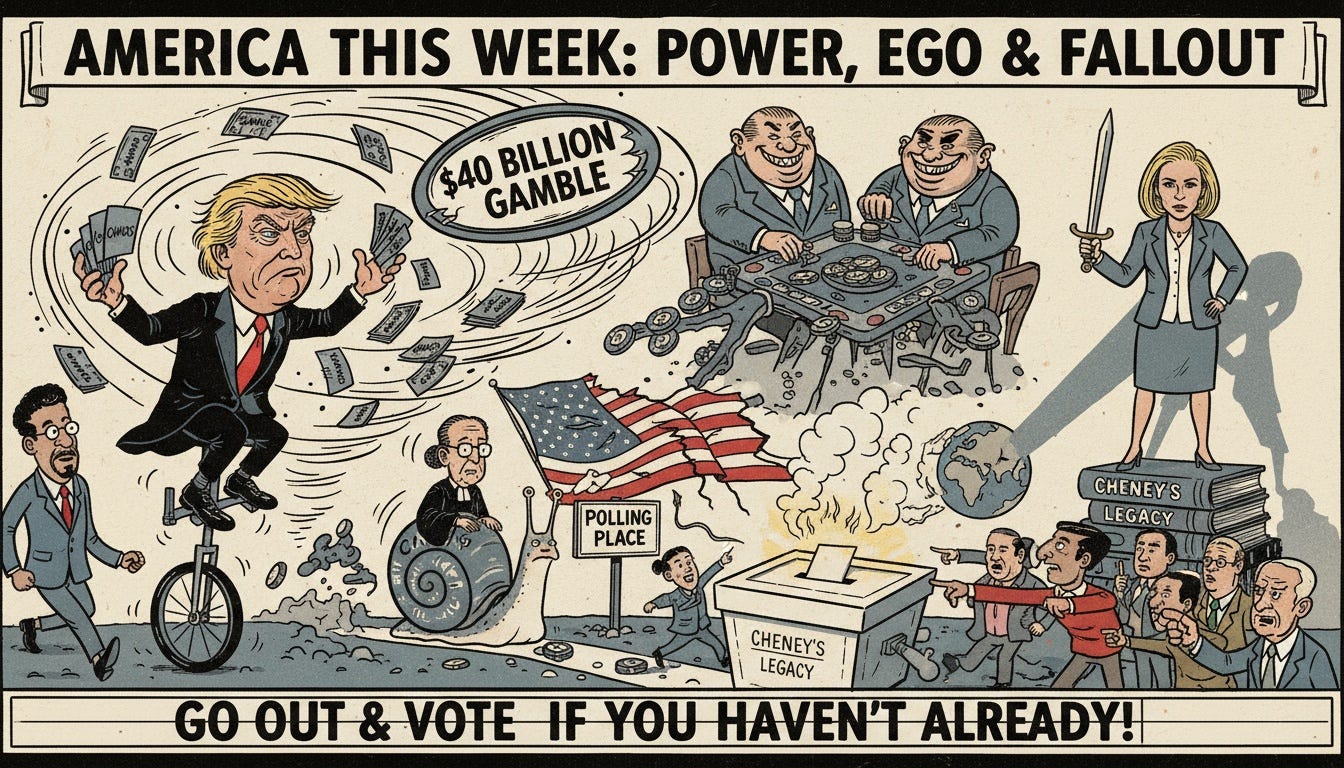
Dick Cheney Dead at 84: The Vice President Who Wielded Power Like a President
Dick Cheney, the man who turned the vice presidency into the most powerful unelected office in modern U.S. history, has died at 84.
Cheney’s family confirmed his death Monday, citing complications from pneumonia and heart disease. Their statement praised him as “a noble giant of a man,” but few figures in American politics provoked as much awe—and animosity—as Cheney. From his early missteps as a Yale dropout with multiple DUI arrests to his role as the hardline architect of the Iraq War, Cheney’s life was a study in both transformation and the dangerous seduction of power.
Born in Nebraska and raised in Wyoming, Cheney seemed destined for a quiet life until Washington came calling. He climbed the ranks fast—first as Gerald Ford’s youngest chief of staff, then as defense secretary under George H.W. Bush, overseeing Operation Desert Storm. In a rare moment of restraint, he once warned against invading Baghdad, calling it “a classic definition of a quagmire.” But by the time he returned to the White House under George W. Bush, that caution had been replaced by a sweeping doctrine of preemptive war. After 9/11, Cheney became the ultimate insider—controlling intelligence operations, pushing expansive executive power, and selling the Iraq invasion on false promises of being “greeted as liberators.”
Cheney’s vice presidency redefined the role itself. He was the operator behind the curtain, the bureaucratic surgeon who knew exactly which levers to pull and which to dismantle. He clashed with allies, ignored critics, and made “Darth Vader” jokes part of the political lexicon. “We’re not going to trade away the authority of the president,” he declared in 2002—and he meant it. The years that followed cemented his reputation as both patriot and villain, depending on which side of the drone strike you were on.
Even his personal controversies became part of the myth: the Scooter Libby scandal, his refusal to apologize over the Valerie Plame leak, and that infamous hunting accident where he literally shot a friend in the face. Cheney never flinched. On his last day in office, bundled in a wheelchair at Barack Obama’s inauguration, he looked every bit the old warlord—unbowed, unrepentant, and utterly convinced history would vindicate him.
Dick Cheney leaves behind a complex legacy: a man who believed above all else in the supremacy of the presidency, even when he wasn’t the one in it. He once told an interviewer that his mission was to “leave the office in better shape than I found it.” Whether he did that—or permanently warped it—is still up for debate.
Source: NPR
Editor: Cheney didn’t just play hardball—he replaced the field with a military base and declared himself commissioner. His brand of power politics shaped an era and poisoned it in equal measure. Love him or loathe him, Dick Cheney never blinked—and that’s exactly why America’s still living in the world he built.
Parting shot: History doesn’t forgive men like Cheney. I have to admit—I hate Dick Cheney; until Trump, he was the worst thing to have happened to American politics.
Appeals Court Rebukes Judge Aileen Cannon for “Undue Delay” in Trump-Related Case
A federal appeals court has slapped Judge Aileen Cannon with a 60-day deadline after months of inaction on motions related to Special Counsel Jack Smith’s report—calling her foot-dragging an “undue delay.”
The three-judge panel’s terse, one-page order was the legal equivalent of a raised eyebrow. Cannon, a Trump appointee already criticized for her lenient handling of the classified documents case, dismissed that case last year but still hasn’t ruled on long-pending motions to release Smith’s investigative report. The appeals court finally had enough, giving her two months to get moving—or risk yet another judicial embarrassment.
“The trial judge has not ruled or conducted any further proceedings on the pending motions,” the panel wrote, pointing out the obvious. Groups like American Oversight and the Knight First Amendment Institute have been pressing for the report’s release, arguing that the public deserves transparency about how the case collapsed after Trump’s 2024 victory. Cannon, meanwhile, seems to be testing the outer limits of the judicial concept of “taking your time.”
This latest reprimand is just another chapter in Cannon’s long and bumpy relationship with the case. She previously dismissed the prosecution entirely, claiming Jack Smith’s appointment was unconstitutional. The appeals court had reversed her once before—but Smith dropped his appeal after Trump retook the White House, citing DOJ policy against prosecuting sitting presidents. Cannon’s handling of the entire affair has been a case study in how judicial discretion can turn into judicial obstruction.
Whether Cannon complies with the new timeline or finds another creative way to stall remains to be seen. But the clock is ticking—and not even Trump’s shadow over the judiciary can stop it this time.
Source: My Daily Grind
Editor: Cannon’s courtroom runs on “Trump Standard Time”—slow, deferential, and allergic to accountability. The appeals court didn’t just light a fire under her; they practically handed her a stopwatch. But don’t bet on her moving fast—delay has always been the point. She should be removed from the bench.
Trump’s Great Gatsby Party Wasn’t “Tone Deaf.” It Was the Point.
Donald Trump threw a roaring ‘20s–style bash at Mar-a-Lago complete with sequins, feathers, and a woman bathing in a martini glass—while millions of Americans were losing food aid and paychecks. That wasn’t obliviousness. It was performance.
While 42 million Americans faced hunger and 1.4 million federal workers went without pay during the government shutdown, Trump was busy sipping champagne under chandeliers. Commentators called it “tone deaf,” but that gives him too much credit. He knew exactly how grotesque it looked. He wanted people to see it. The sheer indifference to suffering is the show—the arrogance is the message.
As writer Adam Serwer once said in The Atlantic, “The cruelty is the point.” Trump’s pleasure has always come from flaunting power while others struggle. That joy in domination has long bound his movement together—uniting the rich, the aggrieved, and the morally bankrupt in shared contempt for anyone outside their bubble. You could see it in the sneering faces of his loyalists and in the glitter of that party’s ballroom: people delighting in others’ pain while pretending it’s just politics.
The guests? America’s sycophantic elite—oligarchs, opportunists, and hangers-on who’ll endure any humiliation to stay close to the throne. Some share Trump’s gleeful cruelty. Others simply don’t care enough to notice the suffering they’re stepping over. Either way, it’s not “tone deaf.” It’s deliberate decadence—a celebration of indifference in a country on the edge.
And yet, while Trump and his crew toasted their own impunity, pundits were busy calling Democrats out of touch. Spare me. No Democrat has ever staged something so cartoonishly disconnected from reality. The Mar-a-Lago masquerade wasn’t a gaffe; it was a manifesto: “We can do whatever we want—and you can’t stop us.”
Source: Paul Krugman on Substack
Editor: Trump’s party was less Gatsby and more Nero—decadence as defiance. This wasn’t a misstep; it was a smirk broadcast from a gilded ballroom. The cruelty isn’t a bug in MAGA politics—it’s the brand.
Kimberly-Clark Bets $40 Billion on Tylenol—Even as Trump’s Autism Claim Rattles Investors
Kimberly-Clark CEO Mike Hsu is making a $40 billion gamble—buying Tylenol maker Kenvue to pivot from paper towels to pills, just as political chaos and legal threats swirl around the brand.
Hsu says he wants to transform the 152-year-old Kleenex-and-Huggies giant into a health and wellness powerhouse, telling investors, “Everything led us to health and wellness.” The massive deal—one of the largest in consumer-sector history—would merge Kimberly-Clark’s household staples with Kenvue’s medicine-cabinet icons like Tylenol, Listerine, and Neutrogena. The goal: move away from slow-growth basics and tap into higher-margin, higher-risk markets. Wall Street, though, isn’t impressed. Kimberly-Clark shares nosedived nearly 15% after the announcement, while Kenvue jumped 12%.
Hsu insists the acquisition represents “a generational value creation opportunity,” but he’s wading into a legal and political minefield. Kenvue, spun off from Johnson & Johnson in 2023, has been hammered by lawsuits and activist investors. Adding to the volatility, President Trump recently claimed Tylenol’s active ingredient causes autism—a scientifically unsupported statement that instantly reignited investor fears of fresh litigation. Tylenol alone brings in over $1 billion annually for Kenvue, and its future could determine whether this deal makes or breaks Hsu’s legacy.
Despite those risks, Hsu argues the timing couldn’t be better. With aging populations and post-pandemic health consciousness driving demand, he sees a “30-year tailwind” in wellness products. The acquisition would pair Kimberly-Clark’s baby and adult care lines—Huggies, Kotex, and Depend—with Kenvue’s baby shampoo and Nicorette gum, creating a cradle-to-grave consumer empire. But even Hsu’s own analysts warn the company may be “doubling its size too soon” in an unfamiliar space.
Kimberly-Clark is taking on Kenvue’s liabilities too, including talc-related lawsuits outside the U.S. and Canada. Still, Hsu remains upbeat, calling Kenvue “the belle of the ball.” He’s betting that blending toilet paper, toothpaste, and Tylenol can deliver growth in a bruised economy where household spending has stagnated. If he’s wrong, it won’t just be Kimberly-Clark shareholders feeling the pain—it’ll be the company’s entire brand identity.
Source: The Wall Street Journal
Editor: Mike Hsu just traded Kleenex for chaos. Betting the farm on Tylenol while Trump’s out there blaming it for autism? That’s not vision—that’s velocity without a parachute. I think the gamble will pay off—BIGLY!