


Farmers Have Real Beef With Trump: Argentina Steak Deal While U.S. Ag Suffers
It’s hard to square loudly proclaimed “America First” rhetoric with the decision to buy beef from Argentina—while American farmers are still picking up the scraps.
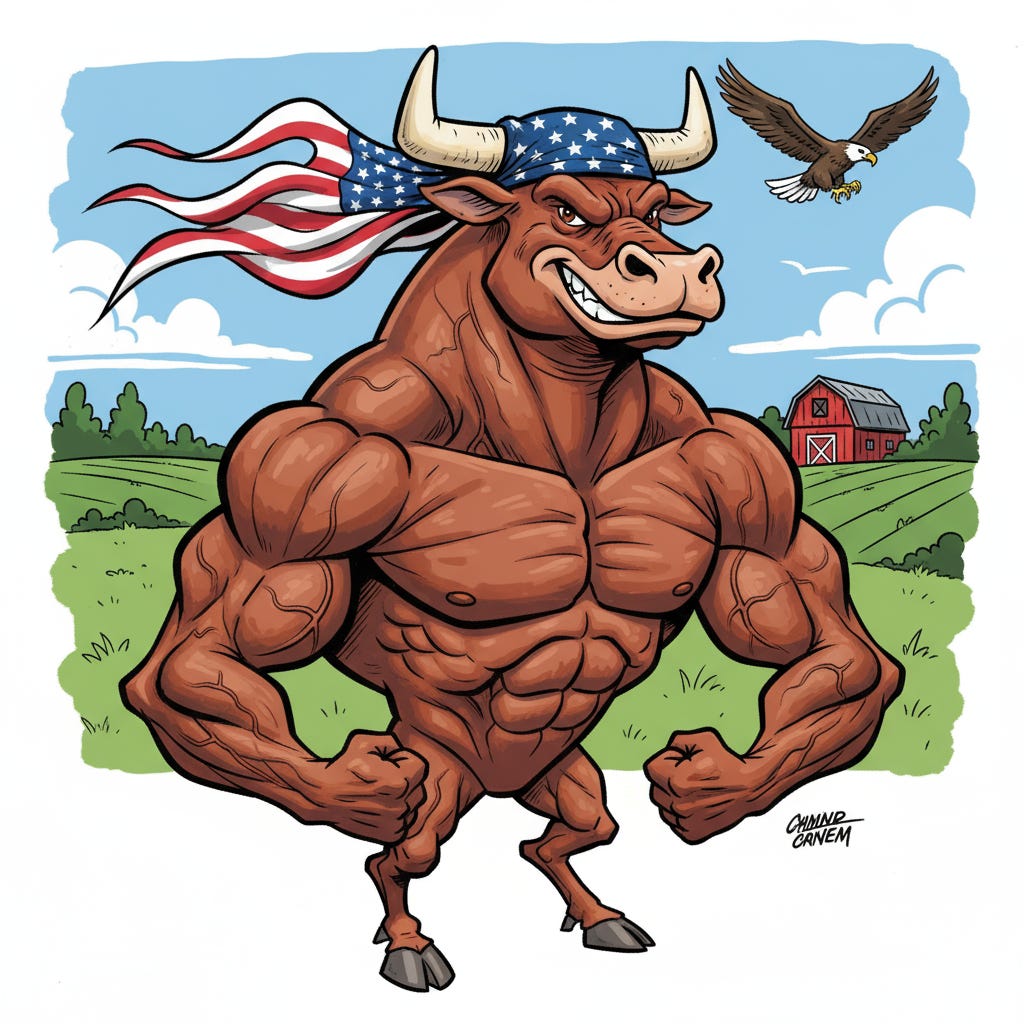
President Donald Trump’s recent announcement that the United States will import Argentine beef is being pitched as a win for consumers and trade diversification. The deal with Argentina is set against rising domestic cattle prices and supply challenges—which may indeed help domestic consumers—but it also raises tough questions for American ranchers who are already feeling sidelined. The import move comes even as U.S. ranchers face pressure from tighter margins and our government’s shifting trade priorities.
Instead of ramping up support for U.S. producers, the administration is effectively welcoming foreign beef into the market. From the Argentine side, beef producers are seizing the opportunity to fill a gap—something U.S. producers aren’t always able to do given domestic constraints. Meanwhile, U.S. ranchers are witnessing a foreign competitor walk in as though they’re not the priority. The core tension is that this beef-import decision may relieve some consumer pain, but it also indicates a trade policy that doesn’t always put U.S. agriculture front and center.
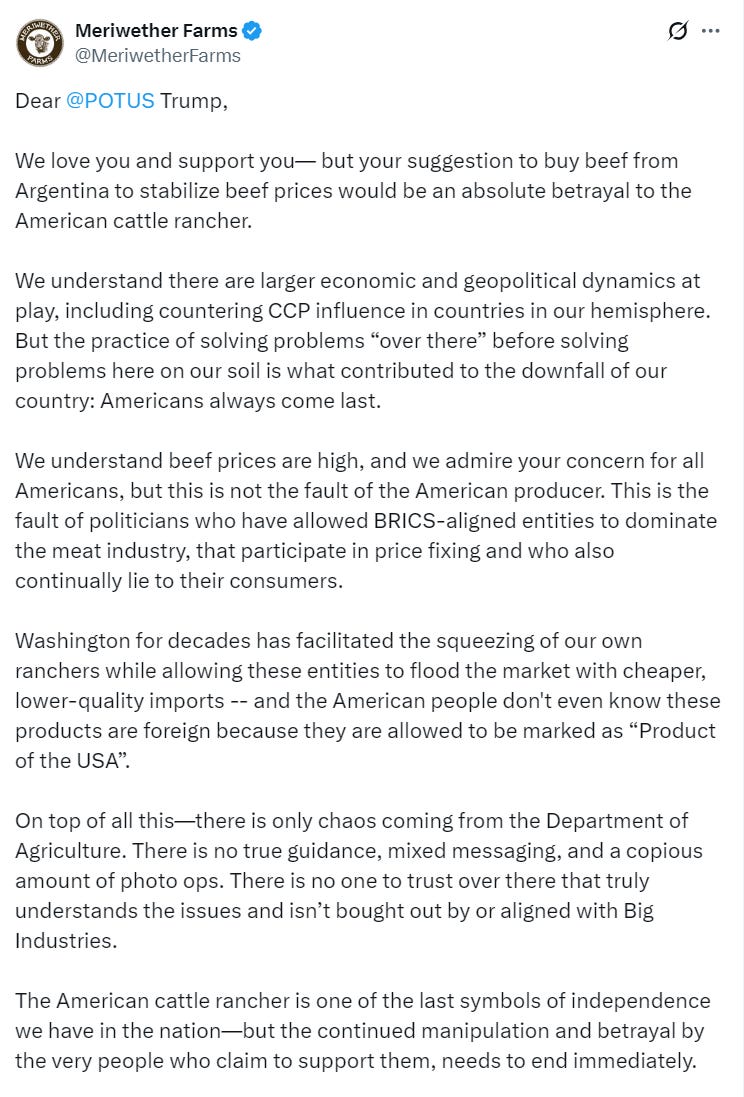
This beef rancher had something to say about it:
At the same time, American farmers—particularly those growing soybeans and other commodities tied to China—are paying a heavy price for the trade war strategy. Exports of U.S. soybeans to China recently hit zero in September, a drop that marks the first such occurrence since 2018. The disruption isn’t simply temporary: China has shifted toward other suppliers, and many U.S. growers are scrambling.
This combination of policies—importing Argentine beef while sidelining key export markets—creates the impression of a leader saying one thing (“Protect U.S. dairy, beef, grain”) but acting in ways that undermine U.S. producers. U.S. ranchers and farmers don’t get sympathetic ‘we’ve got your back’ speeches—they get global trade shifts that leave them vulnerable. And when soybean exports to China drop to zero, the math is unsparing: lost revenue, unused capacity, and extra pressure on already thin margins.
The beef-deal announcement could have been an opportune moment for a broader strategy that clearly prioritizes U.S. producers—say, coupling imports with commitments to boost domestic supply, assist ranchers with rising costs, or ensure export markets remain open. Instead, the messaging feels disjointed: open the door to foreign beef, shutter a major commodity market. It leaves many farmers with the bitter taste of being last in line despite pledges otherwise.
In short: Ranchers see the Argentine deal and wonder where their country-first trade policy is for them. Soybean growers, meanwhile, are watching their biggest customer walk away and thinking “Thanks for nothing.” One part of the administration’s trade posture keeps doors open; the other slams them shut. The result? Many U.S. producers are left hanging.
It is predicted that the US will see MASSIVE increases in bankruptcies, especially in the farm sector.
Sources: Argentina beef import deal
AP beef‐prices/cattle imports story
MSN: China buys no U.S. soybeans in September amid trade tensions
Editor: Bold moves—if only they were bold for American farmers instead of foreigners.
America on Pause: Government Shutdown Hits 22 Days as Families, Workers, and Services Buckle
The federal shutdown has entered its third week, grinding paychecks, food aid, and essential services to a halt while Republicans play chicken with the economy.
It’s Day 22 of the federal government shutdown, and the GOP-led Congress is as gridlocked as rush-hour traffic in D.C. Both parties are dug in—Republicans insisting Democrats are throwing taxpayer money at undocumented immigrants (wrong), Democrats calling that claim pure fiction. The fight started over health care subsidies for millions who depend on ACA marketplaces. Now, it’s spiraled into something far uglier: a full-blown war over the size and role of government.
Federal employees are bearing the brunt. Thousands have already been laid off, and Friday will mark their first missed paycheck. Sure, back pay is technically “guaranteed,” but the White House is already winking and hinting otherwise. Meanwhile, President Trump is using the shutdown to “shrink government,” gleefully cutting jobs and calling them “Democrat programs.” Translation: it’s a political purge disguised as fiscal discipline.
The ripple effects are spreading. Food aid programs like WIC and SNAP are running on fumes, and USDA has warned states to hold off on November benefits “until further notice.” Schools may soon lack funds to cover free lunches, forcing local districts to choose between feeding kids or going broke. Even special education programs are gutted—121 staffers overseeing $15 billion in services were slashed, leaving only a “handful” of execs to handle millions of disabled children’s needs.
Meanwhile, the military got a temporary reprieve thanks to shuffled funds (probably illegal), but families are already hitting food banks. National Parks are closing or running on volunteer fumes, air traffic controllers are stretched thinner than ever, and IRS staff are being shown the door. Yet Trump’s allies spin it as a “necessary reset,” pretending that starving citizens and furloughing workers is some kind of patriotic diet plan for America’s budget.
Source: NPR
Editor: The only thing shrinking faster than “big government” right now is the patience of millions of Americans who’d just like to eat, fly, and get paid. If this is Trump’s idea of efficiency, it’s like setting your kitchen on fire to save on the electric bill.
Trump Wants the DOJ to Cut Him a $230 Million Check—From Your Wallet
President Trump is demanding $230 million from the Department of Justice as “compensation” for investigating him—meaning taxpayers will end up footing the bill for his own legal battles.
In an unprecedented twist even for the Trump era, the man once investigated by the Justice Department now wants it to pay him back—while his own appointees decide whether he gets the money. Trump filed two administrative claims seeking damages for what he calls “violations of his rights,” tied to the Russia probe and the FBI’s 2022 Mar-a-Lago search. Both claims, insiders say, could result in taxpayer-funded settlements approved by officials who literally used to represent him in court.
Ethics experts are sounding the alarm. “What a travesty,” said Bennett L. Gershman, a law professor at Pace University. “The ethical conflict is just so basic and fundamental, you don’t need a law professor to explain it.” Trump himself even acknowledged the absurdity: “I’m sort of suing myself,” he quipped last week, while standing next to Attorney General Pam Bondi, Deputy AG Todd Blanche, and FBI Director Kash Patel—all former Trump allies now running the very agency reviewing his claims.
In a display of breathtaking conflict of interest, Deputy AG Blanche—Trump’s former criminal defense lawyer—and Civil Division Chief Stanley Woodward—who represented Trump’s co-conspirator Walt Nauta—could both sign off on any payout. The DOJ insists all decisions “follow the guidance of career ethics officials,” which sounds a lot like saying “don’t worry, the foxes are consulting with the other foxes before raiding the henhouse.”
If approved, the settlement could quietly transfer hundreds of millions in taxpayer funds to the sitting president without public disclosure. The very department meant to uphold justice may soon be writing a check to the man accused of corrupting it. Only in America could “drain the swamp” turn into “bill the swamp.”
Source: The New York Times
Editor: So now Trump wants to be paid for being investigated. Somewhere, Richard Nixon just sat up in his grave and said, “Damn, why didn’t I think of that?”
Arizona Sues House Speaker Over Blocked Swearing-In, Accuses GOP of Silencing Voters and Protecting Epstein Secrets
Arizona is taking the Republican-led House to court, accusing Speaker Mike Johnson of illegally blocking Democratic Representative-elect Adelita Grijalva from being sworn in to keep her from forcing a vote on Jeffrey Epstein records.
Grijalva, 54, won a special election last month to fill the seat vacated by her late father, Rep. Raúl Grijalva. But despite meeting every constitutional qualification, she’s been left waiting outside the chamber because Speaker Johnson refuses to reconvene the House during the ongoing government shutdown. Arizona Attorney General Kristin Mayes isn’t having it, filing a lawsuit that argues Johnson has no right to “thwart the people’s choice” and deny an entire district its representation.
“This case is about whether someone duly elected to the House—who indisputably meets the constitutional qualifications of the office—may be denied her rightful office simply because the Speaker has decided to keep the House out of ‘regular session,’” Mayes wrote. She asked the court to allow Grijalva’s oath to be administered by any authorized official if Johnson continues to stonewall.
Johnson, for his part, dismissed the lawsuit as “patently absurd,” telling reporters, “We run the House. She has no jurisdiction.” He brushed off accusations that the delay is politically motivated, claiming Arizona’s attorney general is “looking for national publicity.” But Arizona’s filing points to a more explosive motive: Grijalva has pledged to be the final signature on a discharge petition forcing a vote to release all unclassified Jeffrey Epstein records from the Trump administration—something most House Republicans are desperate to avoid.
Grijalva didn’t mince words. “Speaker Johnson cannot continue to disenfranchise an entire district and suppress their representation to shield this administration from accountability and block justice for the Epstein survivors,” she said. For now, an elected congresswoman remains locked out of the House while the Speaker plays procedural keep-away with democracy itself.
Source: Yahoo News
Editor: So the GOP that screams “election integrity” is now refusing to seat a duly elected representative—because she might demand Epstein’s dirty secrets see daylight. You can’t make this stuff up.
Trump’s “Nazi Streak” Nominee Implodes as GOP Finally Draws a Line—Sort Of
Donald Trump’s pick to lead the Office of Special Counsel withdrew his nomination after admitting he didn’t have enough Republican votes—likely because he described himself as having a “Nazi streak.”
Paul Ingrassia, a far-right lawyer and former podcast host currently serving as the White House liaison to Homeland Security, pulled the plug on his own confirmation hearing this week. Ingrassia’s downfall followed reports that he boasted about his “Nazi streak” in a group text—an admission that even Senate Republicans couldn’t stomach. “Unfortunately I do not have enough Republican votes at this time,” he conceded on social media before backing out. When your biggest problem isn’t the Democrats but your own party’s embarrassment threshold, you’ve really achieved something.
What’s unclear now is whether Ingrassia will keep his current White House role. Editor: He will.
That’s right—the administration still employs a man who openly joked about being a Nazi. Either the vetting process failed spectacularly, or worse, the Trump team knew and didn’t care. Both explanations tell you everything you need to know about the caliber of people this White House is willing to elevate.
Ingrassia’s flameout isn’t an isolated blunder. In just the last few weeks, other Trump nominees have flopped, including Brian Quintenz for the Commodity Futures Trading Commission and E.J. Antoni for the Bureau of Labor Statistics. Add them to the long list of failed picks—Matt Gaetz, Ed Martin, Kathleen Sgamma, and more—and the so-called “MAGA meritocracy” looks more like a clown car with a broken GPS.
For a man who promised to “hire the best people,” Trump keeps proving that his definition of “best” means “blindly loyal and ideologically extreme.” The fact that some Republicans are finally balking at these appointments might signal self-preservation more than principle—but at this point, even accidental integrity counts.
Source: My Daily Grind News
Editor: Trump’s talent pipeline is starting to look like a Craigslist ad titled “Fascists Wanted, Experience Optional.” The only thing more broken than his hiring process is his judgment.
Japan Elects Its First Female Prime Minister—An Ultraconservative Hawk Who Isn’t Here to Smash the Patriarchy
Japan just made history by electing Sanae Takaichi as its first female prime minister—but her hard-right politics and opposition to gender equality make her victory a paradox wrapped in patriarchy.
Takaichi, 63, takes over after the ruling Liberal Democratic Party’s bruising election losses forced out Shigeru Ishiba. A protégé of the late Shinzo Abe, she’s vowed to strengthen Japan’s military, deepen ties with the U.S., and keep a wary eye on China ahead of President Trump’s upcoming visit. “I’m determined to build a strong Japanese economy and protect Japan’s national interest with diplomacy and security,” she said after her election. In other words: expect a hawk in high heels, not a feminist in office.
Her rise is historic but hardly progressive. Takaichi admires Margaret Thatcher, opposes same-sex marriage, backs male-only succession to the imperial throne, and resists even basic gender equality reforms—like letting married couples use separate surnames. She promised more women in government but appointed only two. LGBTQ+ advocate Soshi Matsuoka called her win “epoch-making,” but warned her “extremely conservative” record could be “a serious setback” for minority rights. Progress, it seems, comes with an asterisk.
Politically, she’s walking a tightrope. Her new coalition with the right-wing Japan Innovation Party lacks a solid majority, forcing her to bargain with opposition lawmakers to get anything passed. The departure of the LDP’s longtime centrist partner, Komeito, leaves her vulnerable and could make her government short-lived. Yet Takaichi’s message was clear: “Without political stability, we cannot achieve strong economic policies, diplomacy, security or anything.”
Abroad, allies are watching closely. South Korea and China have cautiously welcomed her, though both remain wary of her nationalist streak and visits to the controversial Yasukuni Shrine. The European Union’s Ursula von der Leyen congratulated her, saying, “As Japan’s first female PM, you’re making history.” True—but history doesn’t always move forward.
Source: Associated Press
Editor: Japan just got its first female prime minister, and she’s basically Shinzo Abe in a skirt. Progress? Sure—if your idea of equality is letting women run the patriarchy instead of dismantling it.