


Jamaica Faces the Fury of Hurricane Melissa
This storm isn’t just breaking records—it’s breaking everything in its path.

Hurricane Melissa slammed into Jamaica as a catastrophic Category 5 beast, tearing roofs from homes, tossing boulders onto highways, and cutting power to most of the island. With 185 mph winds and record-level pressure, Melissa has earned a place among the most powerful Atlantic hurricanes ever recorded. Not exactly the kind of record you hang proudly on the wall.
Prime Minister Andrew Holness didn’t sugarcoat it: “There is no infrastructure in the region that can withstand a Category 5.” Translation: Everything built by humans is currently getting humbled by Mother Nature. More than 540,000 customers—77% of Jamaica — are without power, and at least 15,000 people are sheltering wherever they can find a roof still attached.
Floodwaters trapped multiple families in Black River, where crews couldn’t reach them thanks to the still-dangerous conditions. “Roofs were flying off,” said Desmond McKenzie of Jamaica’s Disaster Risk Management Council. Entire communities in St. Elizabeth Parish are reportedly “underwater,” and recovery is expected to be slow and painful.
Despite every official yelling “stay inside,” some teenagers decided this was the perfect time for hurricane tourism. Fifteen-year-old Gavin Fuller summed up his decision: “I wanted to know what it feels like to stand in the eye of something so powerful.” That’s one way to get out of algebra homework. Meanwhile, hospitals along the coast are being battered; one lost power and had to evacuate 75 patients, and crocodiles are allegedly making unwanted appearances in flooded neighborhoods. Because torrential chaos apparently wasn’t enough—now we add dinosaurs.
As Melissa tracks away from the island, it’s still clinging to Category 4 intensity and heading toward Cuba, which has already started major evacuations. Cuban President Miguel Díaz-Canel called the storm “the strongest ever to hit national territory,” and the U.N. and nonprofits are on standby, ready to rush supplies as soon as planes are allowed to land again. With seven deaths already across three islands and rescue operations waiting for daylight and calmer winds, this disaster isn’t done writing headlines yet.
Source: Associated Press
Editor: This storm is out here attacking like it’s got personal beef with the Caribbean. The only thing more relentless than Melissa right now is the cleanup bill coming next.
Putin Flaunts “Unstoppable” Doomsday Torpedo Designed to Drown the West
Vladimir Putin just bragged that Russia has tested a nuclear torpedo capable of creating a 1,600-foot radioactive tsunami—because apparently, global extinction is back on the menu.
The weapon, known as Poseidon, is the latest in Russia’s lineup of “practically indestructible” deterrents. It’s nuclear-powered, nuclear-armed, and allegedly capable of rendering entire coastlines uninhabitable. Putin called the test a “huge success,” claiming, “For the first time, we managed not only to launch it with a launch engine from a carrier submarine but also to launch the nuclear power unit on which this device passed a certain amount of time.” Translation: he’s really proud his undersea robot apocalypse machine finally started up.
Western officials aren’t laughing. Both U.S. and Russian analysts have described Poseidon as a new class of retaliatory weapon — one that could theoretically wipe out coastal economies and population centers with a wave of radioactive seawater. The torpedo is reportedly 65 feet long, moves at 115 mph, and can travel autonomously across oceans, making it nearly impossible to intercept. Even by Cold War standards, that’s one hell of a flex.
The Kremlin’s nuclear chest-thumping didn’t stop there. Just days earlier, Putin oversaw a nuclear launch drill and boasted about another test—the Burevestnik cruise missile, designed to evade missile defenses. Since first teasing Poseidon and Burevestnik in 2018, Putin has framed them as payback for the U.S. withdrawing from the Anti-Ballistic Missile Treaty and expanding NATO. Nothing says “measured response” like building a radioactive submarine drone the size of a school bus.
Skeptics point out that much about Poseidon remains conveniently “classified,” and Russia’s history of propaganda stunts leaves plenty of reason to doubt. Still, the message is clear: Putin wants the world to believe that if Russia sinks, everyone’s going down with it—literally, under a mountain of toxic seawater.
Source: Metro UK
Editor: Putin really needs a new hobby. Maybe instead of designing apocalypse torpedoes, he could try pickleball. Less radioactive, more cardio.
Israel “Turns Off” the Ceasefire to Bomb Gaza, Then Turns It Back On Like Nothing Happened
Israel’s military claimed the ceasefire in Gaza was back on Wednesday—right after dropping bombs that killed 104 Palestinians, including 46 children.
In a move that’s becoming depressingly predictable, Israel temporarily hit the pause button on peace, unleashed the deadliest airstrikes since the truce began October 10, and then announced everything was fine again. Prime Minister Benjamin Netanyahu said he ordered the strikes in response to what he called Hamas violations—namely, returning body parts of a hostage and the killing of an Israeli soldier in Rafah. So, in classic “rules for thee, not for me” fashion, Israel decided the ceasefire didn’t apply when it was angry.
Hamas denied involvement in the shooting, accusing Israel of a “blatant violation” and saying the strikes prove Israel’s intention to “undermine the ceasefire agreement.” Meanwhile, Washington nodded along. President Donald Trump, speaking from Asia, defended Israel’s right to retaliate, saying, “Israel should hit back.” That’s the kind of diplomacy you get when “proportionate response” means leveling neighborhoods.
The result was devastation. Gaza’s Health Ministry reported 104 dead and 253 wounded—most of them women and children. Hospitals filled with bodies wrapped in white shrouds. At Al-Awda Hospital, Yehya Eid wept over the body of a small child and asked, “Did they fight in the war?” In Khan Younis, another resident said her sister and nephews were “burned while they were asleep.” These aren’t militant casualties. They’re families.
The Israeli military insists the strikes were “precise,” targeting Hamas battalion and company commanders. But when the majority of the dead are children, “precision” starts to sound like propaganda. Israel claims Hamas uses civilians as human shields, while Hamas accuses Israel of using that line to justify collective punishment. The truth is, Israel keeps flipping the ceasefire switch like it’s a light—off to bomb, on to save face—and the world pretends it doesn’t notice.
Source: Associated Press
Editor: Israel’s version of a ceasefire is like a “Do Not Disturb” sign they only hang up when it’s convenient. Flip the switch, drop the bombs, and call it peace.
If this is what a truce looks like, I’d hate to see what war looks like when they’re not pretending to restrain themselves.
Senate Slaps Down Trump’s Brazil Tariffs, But It’s Mostly for Show
The Senate just voted to repeal Donald Trump’s tariffs on Brazil—a rare bipartisan rebuke that means absolutely nothing in practice.
Five Republicans joined Democrats on Tuesday to roll back Trump’s Brazil tariffs, a symbolic pushback against the former president’s heavy-handed trade policies. But since House Speaker Mike Johnson already said he won’t bring the bill up for a vote—and Trump sure as hell wouldn’t sign it—the move is pure political theater.
Washington loves to gesture toward accountability as long as it doesn’t actually have to do anything about it.
Trump’s tariffs on Brazilian goods were another brick in his “America First” economic wall—or, more accurately, an “America Pays More” wall. The duties were meant to pressure Brazil over steel exports and trade imbalances, but they ended up hitting American manufacturers with higher costs. This Senate vote, then, is less about policy and more about optics: A few Republicans trying to prove they’re not fully swallowed by the MAGA machine.
The vote also underscores how Congress continues to tiptoe around Trump’s agenda. Lawmakers didn’t stop him from launching drone strikes on alleged “drug boats” near Venezuela earlier this month—a separate measure to rein him in failed, too. So while the Senate is happy to wag its finger at his tariffs, it’s silent when the bombs start flying. Apparently, economic blunders are easier to criticize than potential war crimes.
Ultimately, this is what passes for checks and balances in 2025: performative resistance dressed up as courage. The tariffs will stay, Trump will keep calling it “winning,” and the rest of the world will keep shaking its head at America’s political cosplay.
Source: Axios
Editor: Congress flexed its spine for about five minutes, then promptly returned it to the storage locker marked “2020–Never Again.”
When both parties agree on something and it still doesn’t matter, that’s not bipartisanship—that’s kabuki.
America’s Longest Shutdown Grinds On as Federal Workers Line Up for Food
The U.S. government has been shut down for more than three weeks—and federal employees are now queuing for free meals.
This is the longest full shutdown in American history, and Washington’s political class is still locked in its favorite pastime: finger-pointing. Democrats and Republicans can’t agree on a funding deal, and after a dozen failed votes in the Senate, hundreds of thousands of workers are paying the price. About 1.4 million people are either furloughed or working without pay, and the bills aren’t waiting for Congress to figure it out.
Across the country, food banks are seeing a surge in federal workers—park rangers, TSA agents, clerks, and janitors—lining up for groceries they used to buy themselves. “We are just trying to make it day by day,” one worker in Washington, D.C., said while waiting in line for food. Others are turning to credit cards, side hustles, and family members just to scrape by. It’s a grim reminder that many government jobs, for all their supposed stability, are one missed paycheck away from crisis.
Meanwhile, essential services hang by a thread. Some departments are limping along, others are shut entirely, and the longer this drags on, the closer critical programs like food stamps come to running out of funds. The political impasse isn’t just a Washington spectacle anymore—it’s a slow bleed affecting real people who actually keep the country running.
Lawmakers remain entrenched. Each side blames the other for the lapse in funding, while President Trump’s administration has even laid off additional staff. The result is a government paralyzed by pride—and a workforce left holding the bag. The lights are still on in Congress, but clearly, nobody’s home.
Source: BBC News
Editor: Politicians get paychecks to argue; workers get empty plates for serving their country. Seems fair—if you live in an upside-down world.
Fed Poised to Cut Rates as Trump Circles Powell’s Job
The Federal Reserve is expected to cut interest rates today—but the real drama is who gets to run the place next.
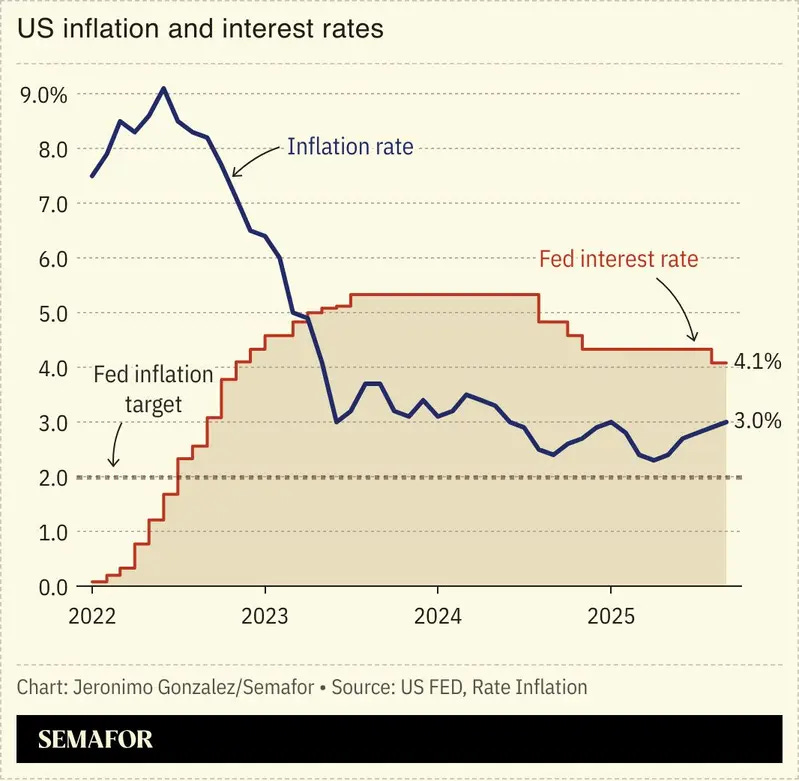
Markets are already pricing in a 99.9% chance of a modest 0.25% rate cut, but that’s not what’s got Wall Street sweating. The real story is whether this marks the beginning of the end for Jerome Powell’s tenure as Fed Chair. Trump’s team reportedly has a shortlist of replacements ready, and Powell’s political clock is ticking. When the Fed is supposed to be independent but the president’s breath is on your neck, “monetary policy” starts looking a lot like survival strategy.
Investors are also watching whether the central bank ends its “quantitative tightening” program earlier than expected. That’s the bureaucratic term for shrinking the Fed’s massive balance sheet by letting old bonds expire instead of replacing them—essentially trying to unwind the stimulus party from the financial crisis and the pandemic. If Powell pulls the plug on QT, it’ll send short-term rates tumbling and flood the system with liquidity again—a nice election-year gift for whoever’s in the White House. That would be Trump, of course.
Powell’s balancing act has never been trickier. He’s fighting inflation with one hand and fending off political pressure with the other. Cutting rates too much could reignite inflation; doing too little risks a recession Trump will happily blame on him. Either way, the Fed’s “data-driven” independence looks a lot shakier when its chair might soon be replaced by someone who thinks rate policy should come with a campaign slogan.
Bottom line: The Fed may trim borrowing costs today, but the real cut could be political. Trump wants a loyalist in the big chair—and Powell, who’s tried to stay above the noise, may find out the hard way that in 2025, there’s no such thing as apolitical economics.
Source: Semafor
Editor: If Trump replaces Powell with another yes-man, we can officially stop pretending the Fed is anything but a branch office of Mar-a-Lago.
The Fed’s new motto might as well be “In Trump We Trust—Until He Tweets Otherwise.”