



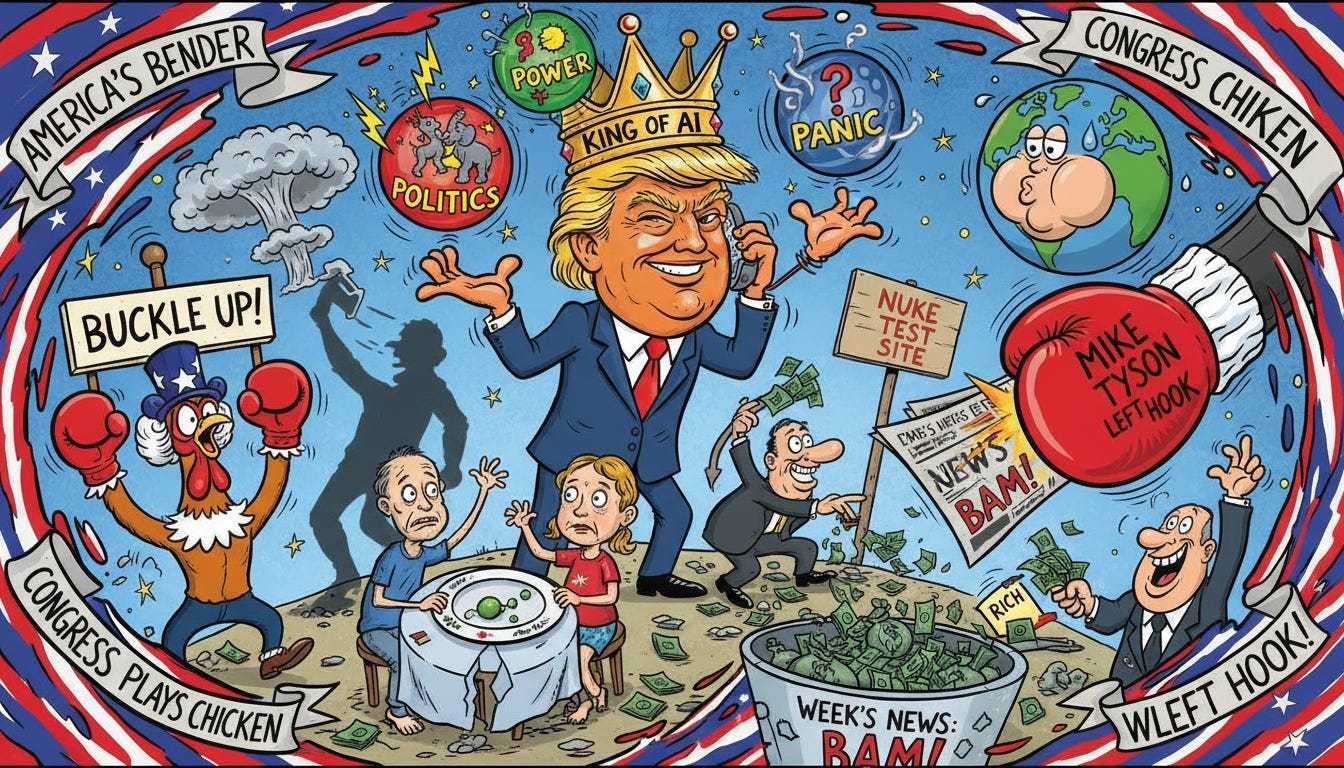
America’s on a bender—power, politics, and panic all in one dizzying week. Trump’s cutting deals, testing nukes, and crowning himself king of AI, while Congress plays chicken with people’s dinner plates. The rich get richer, the poor get hungrier, and somewhere in between, the world keeps holding its breath. Buckle up—this week’s news doesn’t ease in; it hits like a Mike Tyson left hook.
Trump and Xi Strike a Deal—Tariffs Down, Soybeans and Rare Earths Back in Play
President Trump called his latest meeting with Chinese leader Xi Jinping a “roaring success,” announcing a major tariff rollback and new trade concessions from Beijing.
After months of escalating trade tensions, Trump told reporters aboard Air Force One that the U.S. will cut tariffs on Chinese goods from 57% to 47%, easing penalties imposed earlier this year over China’s role in the global fentanyl trade. In return, China has agreed to resume buying American soybeans and allow exports of rare earth elements—a key win for U.S. tech and manufacturing sectors that depend on them.
The deal marks a rare thaw between Washington and Beijing, whose relationship has seesawed between cooperation and confrontation. Trump described the talks as “tremendously productive,” framing the tariff cut as both a diplomatic breakthrough and an economic boost. “We got what we wanted,” he said, emphasizing that American farmers and companies would see immediate benefits.
China’s agreement to reopen rare earth exports could ease supply chain constraints that have plagued industries from EVs to defense manufacturing. The move also signals Beijing’s willingness to play ball—at least temporarily—as it seeks stability amid a slowing domestic economy and rising global pressure over its alignment with Russia. For Trump, the optics couldn’t be better: an apparent win on trade, energy, and jobs all in one stroke.
Still, skeptics warn the détente may be temporary. Similar “breakthroughs” have crumbled before once the cameras stopped rolling. Tariffs can go back up as fast as they come down, and Xi’s promises on exports and purchases often arrive with hidden conditions. But for now, both leaders seem eager to declare victory—and Wall Street, predictably, is cheering.
Source: Associated Press
Editor: Trump’s calling it a “roaring success,” which is fitting—he’s been roaring for months. Let’s see if this one actually echoes past the news cycle or just fades like every other “historic” handshake.
Nvidia Hits $5 Trillion—AI’s Golden Child Becomes King of the Market
Nvidia just became the first $5 trillion company in history, proving that in the age of artificial intelligence, the real gold is made of silicon.
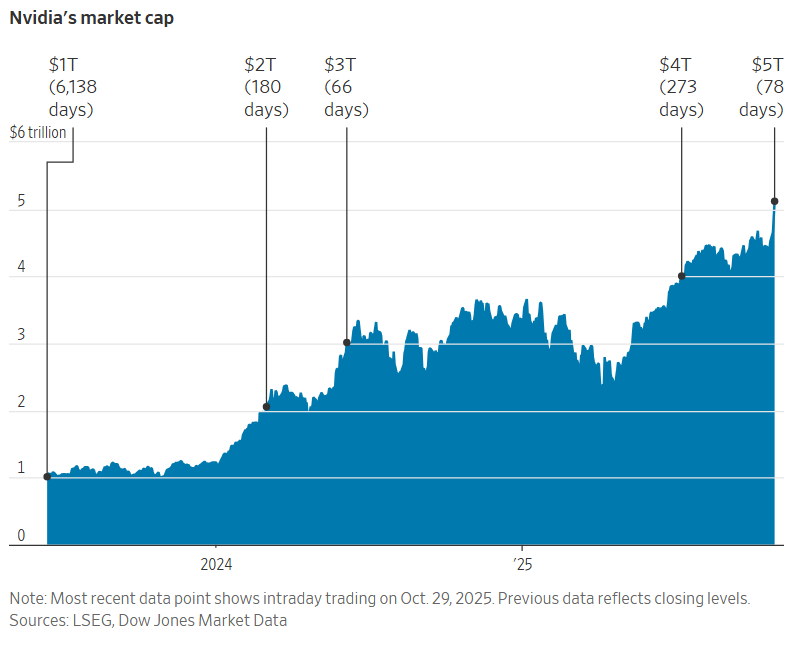
Nvidia’s stock climbed nearly 3% to $207.16, pushing its market value past $5.03 trillion and solidifying its place at the center of the AI economy. Fueled by relentless demand for its GPUs and a wave of partnerships with heavyweights like OpenAI, Oracle, and Eli Lilly, Nvidia’s growth has outpaced nearly every other company on Earth. CEO Jensen Huang’s latest Washington D.C. appearance only poured gasoline on the already raging AI fire.
“They’re the linchpin of this entire AI trade,” said Angelo Zino of CFRA Research. That’s putting it mildly—Nvidia’s market cap now eclipses AMD, Intel, Qualcomm, Broadcom, and Taiwan Semiconductor combined. It’s worth more than entire sectors of the S&P 500, including utilities and consumer staples. In other words, one chipmaker is now worth more than your electricity, groceries, and toothpaste industries combined.
The company’s meteoric rise has come faster than anyone predicted. Nvidia hit $2 trillion in March 2024, $3 trillion a mere 66 trading days later, and $4 trillion by mid-2025. Now at $5 trillion, Huang’s empire reigns over Apple and Microsoft in what some analysts are calling the “AI century.” Wedbush’s Dan Ives dubbed Huang the “godfather of AI”—which sounds less like a title and more like a coronation.
But the boom comes with a warning label. Tech analysts are whispering “bubble,” comparing today’s AI frenzy to the dot-com surge of the late ‘90s. Nvidia is betting big—pledging up to $100 billion in OpenAI infrastructure and backing multiple AI startups—but if the spending slows, its stock could take a double hit. Add U.S.-China chip tensions into the mix, and the $5 trillion crown could get heavy fast.
Still, Wall Street isn’t ready to hit the brakes. Nvidia trades at 33 times next year’s projected earnings—high, yes, but not absurd in the AI arms race. The company claims it’s already shipped 6 million Blackwell chips and expects half a trillion dollars in sales over the next five quarters. For a company once known for gaming graphics, that’s not just growth—it’s an economic transformation.
Source: The Wall Street Journal (gift article)
Editor: This isn’t a company anymore—it’s a religion. Jensen Huang doesn’t sell chips; he sells belief. And Wall Street just tithed $5 trillion to the Church of AI.
Obamacare Premiums to Jump 26%—and Could Double for Millions as Subsidies Expire
The average cost of Affordable Care Act insurance plans will surge 26% next year—but for many Americans, the real hit could be a brutal 114% jump once federal subsidies vanish.
Healthcare.gov quietly posted 2026 ACA rates just days before open enrollment begins, revealing steep increases across the board. According to the nonprofit KFF, premiums for mid-tier “silver” plans—the benchmark for most Americans—are set to rise more than a quarter. But that’s not the real gut punch. Without Congress renewing the expanded tax credits that kept costs down, the amount people actually pay will more than double for millions.
The lapse in subsidies has become yet another partisan hostage situation. Democrats are pushing to extend the enhanced tax credits as part of their opposition to the GOP’s continuing resolution to reopen the government after a month-long shutdown. Republicans argue the subsidies are fiscally reckless; Democrats counter they’re the only thing keeping middle-class families insured. Meanwhile, the average American is stuck between political trench lines—again.
CMS insists the sky isn’t falling, saying most enrollees “continue to have robust access to low-premium plans” after applying the standard tax credits. They claim most users can still find bronze-level plans under $50 a month. But those cheaper plans come with a catch: higher deductibles that can easily wipe out a savings account after one medical emergency. As KFF points out, losing enhanced subsidies often forces people to downgrade to worse coverage just to stay insured.
The Congressional Budget Office estimates 3.5 million fewer Americans will have health insurance by 2027 if Congress doesn’t act. In other words, what’s billed as “affordable care” might soon live up to the name only for those who never need it.
Source: The Hill
Editor: So, in short, premiums go up, subsidies go away, and Washington goes on vacation. At this point, the “Affordable” in ACA is doing some serious heavy lifting.
Democrats Turn the Tables on GOP’s ‘Autopen Scandal,’ Demand Scrutiny of Trump’s Jan. 6 Pardons
Republicans want to investigate Biden’s autopen-signed pardons—Democrats say, great, let’s start with Trump’s 1,500 January 6 pardons.
After House Oversight Chair James Comer claimed President Biden’s end-of-term pardons were “void” because they were signed using an autopen, Democrats were quick to point out a glaring double standard. “I hope [the report] will be an analysis by Republicans of Trump’s pardon of 1,550 people,” said Sen. Adam Schiff, who received a Biden pardon related to his January 6 committee work. “He must have a very fast hand to have signed all those,” Schiff quipped, daring Comer to investigate Trump’s mass pardons with the same enthusiasm.
Sen. Chris Coons joined the chorus, asking, “Are they gonna go examine all the pardons that Trump did of the January 6 rioters?” He noted that presidents have legally used autopens for decades, and the Justice Department explicitly approved the practice in 2005. “The President need not personally perform the physical act of affixing his signature,” the memo read. Democrats dismissed Comer’s move as a partisan stunt, pointing out that executive autopens are routine—used by both parties to handle the mountain of paperwork that passes through the Oval Office.
Republicans, meanwhile, are pretending this is the scandal of the century. Sen. Rick Scott called Biden’s autopen use “a legitimate issue,” while Sen. Ron Johnson said his committee is investigating “who was in charge” at the White House, warning that someone “unelected and unknown” could be running the show. It’s the same recycled paranoia that fueled the “deep state” narrative—and just as thin on facts.
Democrats, not impressed, called out the hypocrisy. Sen. Mazie Hirono pointed out that Trump’s pardons often rewarded loyalty and corruption, saying, “Considering that this President uses pardons to extort from people, I would hope that Republicans would be more concerned about the use of pardon powers in that way.” Sen. Alex Padilla noted the timing—Comer dropped his report while the government was still shut down—accusing Republicans of chasing conspiracy theories instead of reopening the government. Sen. Cory Booker summed it up simply: “I find that really disturbing.”
Source: Raw Story
Editor: If the GOP really wants to talk about “illegitimate signatures,” they might want to start with the guy who pardoned insurrectionists faster than he could sign autographs.
Trump Orders Immediate U.S. Nuclear Weapons Testing After 33-Year Pause
President Trump has ordered the Pentagon to restart U.S. nuclear weapons testing for the first time since 1992, declaring it’s time to “match” Russia and China.
Trump dropped the bombshell—figuratively, for now—on Truth Social while en route to meet China’s Xi Jinping in Busan, South Korea. “Because of other countries’ testing programs, I have instructed the Department of War to start testing our Nuclear Weapons on an equal basis,” he wrote. The president’s announcement came just minutes before his meeting with Xi, blindsiding allies and adversaries alike. He later told reporters the testing is “appropriate” to ensure America “keeps up” with rival powers.
The move triggered immediate global backlash. Russia called it the start of “a new era of unpredictability,” and China’s Foreign Ministry urged the U.S. to honor its decades-old moratorium on nuclear testing. No nuclear power—aside from North Korea—has detonated a test weapon in more than 25 years. Even U.S. officials appeared unsure whether Trump was referring to explosive underground testing or missile flight tests. Either way, the order effectively reopens the nuclear Pandora’s box.
Trump dismissed concerns about escalation, insisting America’s arsenal is “well locked up” while claiming he still supports eventual denuclearization. He told reporters aboard Air Force One that he’s “talking to Russia about that,” with China possibly joining later. Meanwhile, Russia’s Vladimir Putin has been parading his own new nuclear toys, including the Poseidon super torpedo and the Burevestnik cruise missile—each designed to remind the world who else has the biggest stick.
Critics called Trump’s decision reckless. Rep. Dina Titus of Nevada vowed to introduce legislation to block it, while Daryl Kimball of the Arms Control Association said, “Trump is misinformed and out of touch. The U.S. has no technical, military, or political reason to resume nuclear explosive testing.” Experts warned the move could trigger copycat tests by other nuclear powers and “blow apart the Non-Proliferation Treaty.” Translation: if Trump’s goal was to make the world less safe, mission accomplished.
Source: Reuters
Editor: The last time the U.S. tested nukes, Clinton was running for president—and now Trump’s dragging us back there, one detonation at a time. “Make America Glow Again” wasn’t on the campaign hat, but maybe it should’ve been.
Food Banks Sound the Alarm as SNAP Shutdown Looms: “We Cannot Meet the Gap”
Millions of Americans could lose food assistance this weekend—and food banks say they’re already running on fumes.
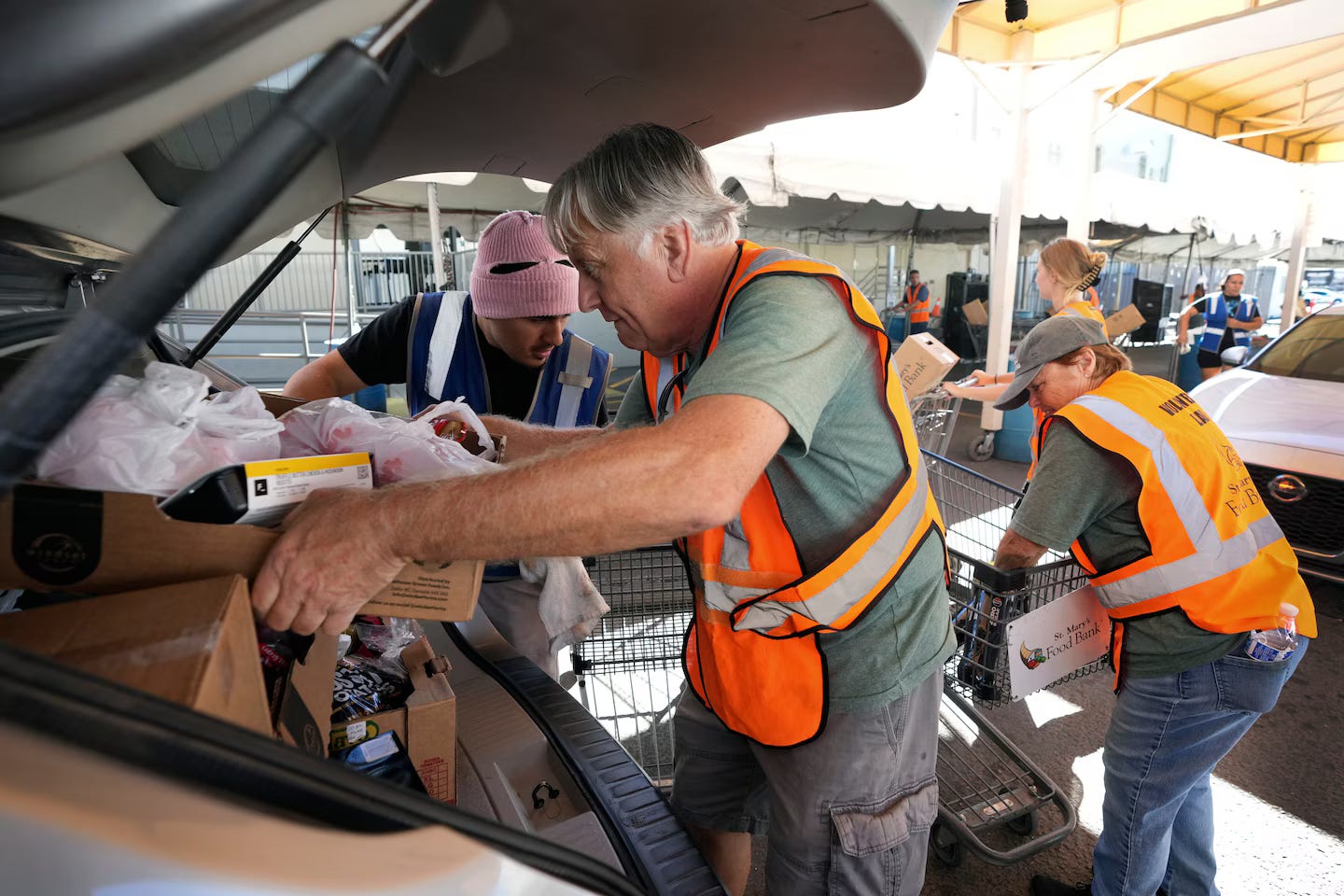
As the government shutdown drags on, funding for the Supplemental Nutrition Assistance Program (SNAP) is set to lapse Saturday, threatening to cut off benefits for millions who rely on them. Already stretched thin by earlier federal cuts and a surge in demand from furloughed workers, food banks nationwide are bracing for another wave of need. “We cannot meet the gap that will be created,” warned Brian Greene, CEO of the Houston Food Bank, which lost $25 million in federal food aid this year.
The crisis has sparked scenes of desperation across the country. At food pantries from Phoenix to Houston, people are stockpiling rice, beans, and canned goods while they still can. “I’m just trying to stock up,” said Kassandra Pearson, a mother of two in Houston. Volunteers report long lines forming before doors even open, and food bank leaders say distributions have already jumped by up to 15% since the shutdown began. In Washington, D.C., the Capital Area Food Bank opened new emergency centers to keep up.
The Trump administration’s earlier decision to end two major food bank programs—together worth about $1 billion—has made things worse. Without the Emergency Food Assistance Program or the Local Food Purchase Assistance program, many food banks are relying almost entirely on private donations. “Government shutdowns only exacerbate the problem of hunger,” said Catherine D’Amato, CEO of the Greater Boston Food Bank, which received record donations this year but still can’t keep up.
The math is brutal. One meal from a food bank equals about nine meals provided through SNAP. That means food pantries can’t come close to replacing what’s lost when benefits stop. Feeding America reports more than 50 million Americans visited food pantries in 2023—numbers that could climb sharply if SNAP goes dark. As one D.C. food bank leader put it, “People can’t negotiate rent or car payments, but they can try to stretch food. That’s where the pain shows first.”
Researchers say calls to 211, the national social services hotline, have already spiked as families scramble for help. Pearson, like many others, said she’s taking everything she can get. “Usually, I skip some things,” she said. “But this week, I took everything.” For millions of Americans, that’s not panic—it’s survival instinct.
Source: The Washington Post (gift article)
Editor: A country that can restart nuclear testing overnight but can’t keep people fed for a month has its priorities exactly backward. Hunger isn’t a partisan issue—it’s a moral failure.
If the world decides to restart testing nukes I hope they don't test like Musk does when he has all those rapid unplanned disassembly's with his rockets.