


Six Stories, One Wild Weekend
Welcome back to The Morning Sixpack, where we take the biggest stories of the day, pour them into a shaker, and serve them straight—no chaser. Today’s edition hits global conflict, domestic power plays, legal reckoning, extreme weather, and a DOJ memo that reads like it was drafted after someone lost an argument on the internet. Buckle up.
Ukraine Peace Talks: Optimism Without Receipts
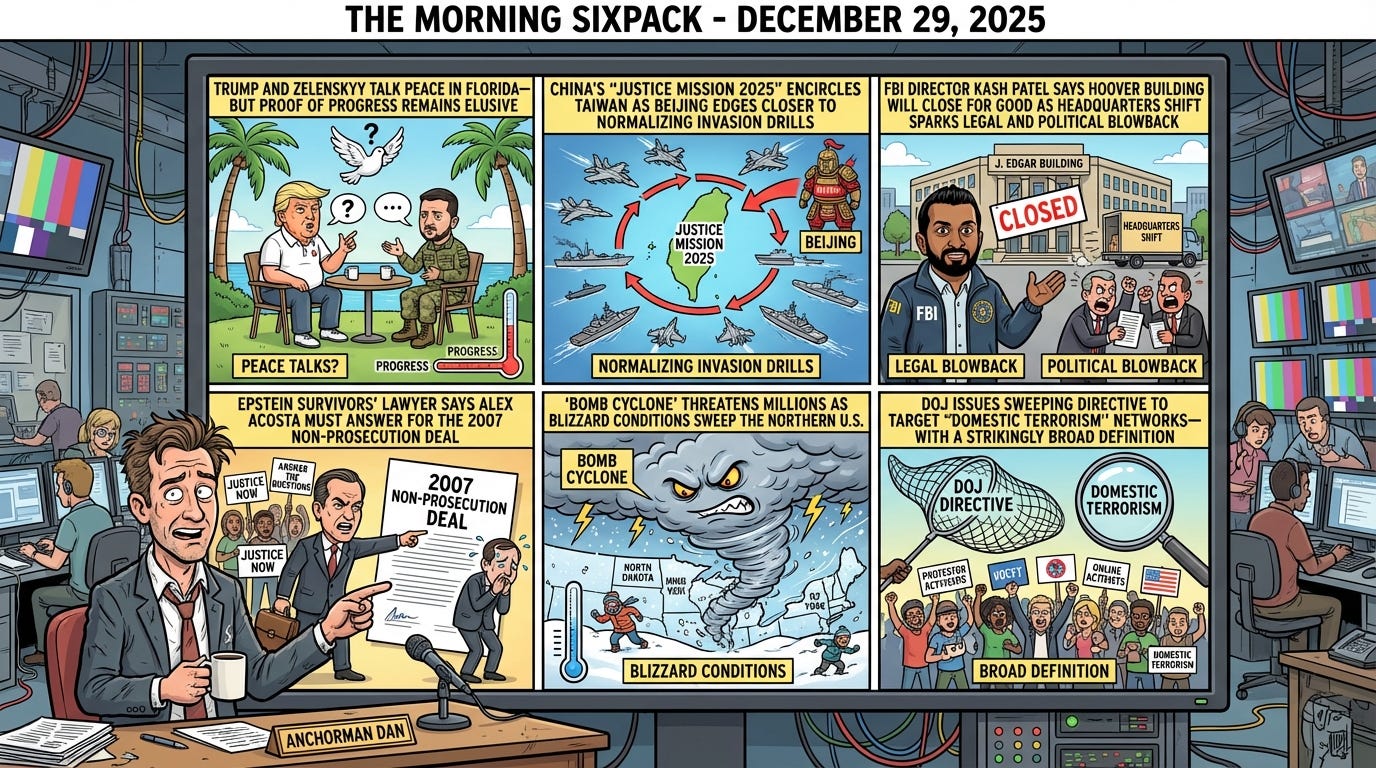
Trump and Zelenskyy insist a Ukraine peace deal is “very close,” but neither offered a shred of evidence that anything meaningful has moved. The two leaders emerged from Florida with sunny rhetoric and a 90% figure that sounds good on cable news but collapses under scrutiny. The biggest sticking points—the Donbas and that Russian-controlled nuclear plant—remain completely unresolved. Add in Russia’s ongoing missile attacks, and the idea of an imminent peace agreement looks more like stagecraft than statecraft.
China’s War Games Look a Lot Like War Plans
Beijing’s “Justice Mission 2025” drills around Taiwan weren’t subtle—they were invasion choreography. China rolled out warships, jets, artillery, and a propaganda poster set fit for a dystopian blockbuster. Taiwan, calm as ever, showed off U.S.-made HIMARS and told the world not to panic. But China’s strategy is clear: normalize the encirclement so that one day the shift from rehearsal to attack barely registers. Taiwan’s stock market shrugged; the rest of us should not.
The FBI Packs Its Bags—Hoover Building Done for Good
Kash Patel says the Hoover Building is finally dead, and the bureau is moving into the old USAID offices in the Reagan Building. Maryland’s delegation is furious—Congress had approved a Maryland headquarters, funded it, and expected the executive branch to follow the law. Now Maryland is suing over $555 million the administration redirected. It’s the federal real-estate version of a 20-year renovation that ends in, “Actually, we’re just moving into the spare room.”
Epstein Survivors Want Answers—And They’re Looking Straight at Alex Acosta
A lawyer for Epstein’s survivors says the DOJ must release the 60-count indictment prosecutors drafted in 2007—before Alex Acosta buried it. Jack Scarola argues that Epstein would’ve been convicted nearly two decades ago if federal prosecutors hadn’t abandoned their own case. He wants the indictment, the 82-page memo, and DOJ communications explaining why the deal happened at all. Congress says it wants answers, but victims have been hearing that line for years.
Bomb Cyclone: The Weather Decides It Wants a Plotline Too
A rapidly intensifying bomb cyclone is slamming the northern U.S., bringing blizzards, whiteouts, and Arctic cold to millions. Minnesota, Wisconsin, and Michigan’s Upper Peninsula are getting hammered with heavy snow and dangerous winds, while Montana freezes and Dallas drops from the 80s to the 40s like the weather accidentally hit “shuffle.” It’s one of those storms that proves Mother Nature has no respect for holiday travel or human dignity.
DOJ’s Domestic Terror Memo: A Counterterrorism Tool—or a Culture-War Weapon?
The DOJ has ordered aggressive pursuit of “domestic terrorism” networks with a definition broad enough to sweep up entire activist movements. The memo focuses almost entirely on Antifa-aligned groups and left-wing ideologies, and it directs agencies to revisit years of closed cases, identify sponsors, and build a list of domestic extremist organizations. A First Amendment disclaimer sits awkwardly beside language equating political views with violent extremism. The result: a national security framework that risks becoming a political cudgel.
Closing Thoughts
This weekend felt like a reminder that power—whether geopolitical, bureaucratic, or meteorological—rarely stays quiet for long. From Florida peace talks to Taiwan encirclement, from the FBI’s forced migration to the DOJ’s ideological radar expansion, everyone seems to be turning the dial up. Even the weather wanted a headline.


