


Welcome back to The Morning Sixpack—your rapid-fire tour through a week where Washington ricocheted from domestic reset attempts to foreign policy brinkmanship, all while culture-war politics found new terrain inside the Pentagon. Buckle up.
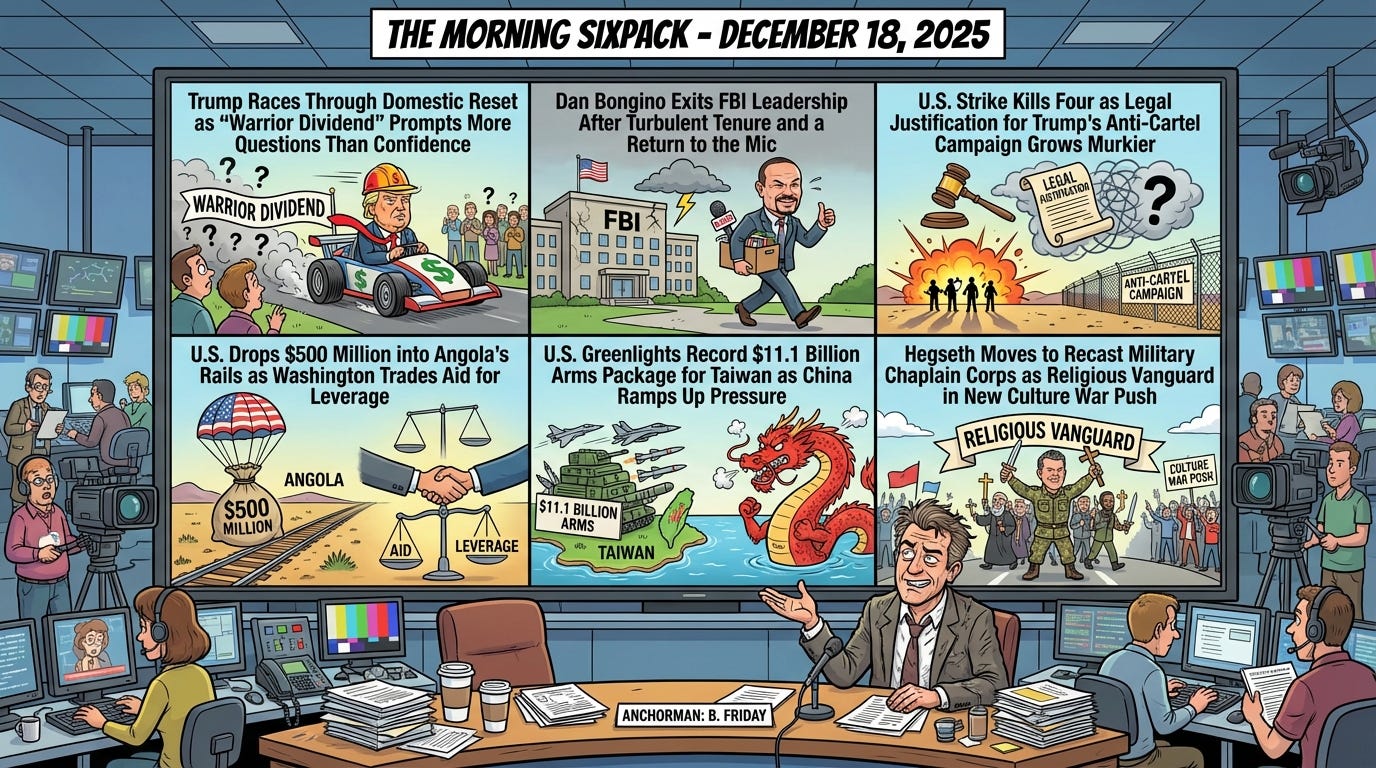
Trump Races Through Domestic Reset as “Warrior Dividend” Prompts More Questions Than Confidence
Trump delivered an 18-minute blur of a speech meant to reboot his political fortunes, but it mostly underscored how far he still is from winning back skeptical voters. He slammed Biden, declared the U.S. “dead” before he returned, and unveiled a $1,776 “Warrior Dividend” with zero clarity on funding or legality. Supporters wanted reassurance on the economy; what they got was a rhetorical sprint past stubborn inflation, weak hiring, and underwater approval ratings. Trump may call it progress—voters aren’t convinced.
Dan Bongino Exits FBI Leadership After Turbulent Tenure and a Return to the Mic
Dan Bongino is leaving the FBI after a whirlwind year that began in controversy and ends with him heading back to his comfort zone: the studio. His tenure swung from conspiracy-monger to reluctant institutionalist, even backing official findings on Epstein and pushing the long-stalled pipe bomb investigation. Praise from the administration aside, Bongino’s departure highlights the tension between governing and feeding the base that built his brand.
U.S. Strike Kills Four as Legal Justification for Trump’s Anti-Cartel Campaign Grows Murkier
Another U.S. strike, another set of questions Washington can’t answer cleanly. Four people were killed on a boat the administration claims belonged to a terrorist-designated cartel—yet offered no evidence. With at least 26 strikes since September, critics warn the campaign looks like an undeclared war carried out without congressional authorization. Add a naval blockade of Venezuela and rising regional tensions, and you’ve got a strategy defined by escalation, not clarity.
U.S. Drops $500 Million into Angola’s Rails as Washington Trades Aid for Leverage
A half-billion-dollar loan to Angola signals Washington’s new African playbook: less charity, more chessboard. The Lobito Corridor will help extract minerals from central Africa to the Atlantic—a direct counterweight to China’s long-running infrastructure diplomacy. It’s a geopolitical flex disguised as development, and while Angola gets a modernized rail line, other African nations are left scrambling to fill the void left by the U.S. pivot from “aid” to “trade.”
U.S. Greenlights Record $11.1 Billion Arms Package for Taiwan as China Ramps Up Pressure
The U.S. approved its biggest Taiwan arms sale ever—a staggering $11.1 billion meant to harden the island against Chinese aggression. HIMARS, howitzers, drones, Javelins—you name it, Taipei’s getting it. Beijing is furious, Taipei is relieved, and the Pentagon insists the deal is about deterrence and maintaining military overmatch. With Trump eyeing a 2026 visit to Xi, the timing alone adds intrigue to an already tense strategic triangle.
Hegseth Moves to Recast Military Chaplain Corps as Religious Vanguard in New Culture War Push
Defense Secretary Pete Hegseth wants chaplains to stop being “therapists” and start being spiritual warriors again. His rollout video slams decades of “secular humanism,” rejects the Army’s modern spiritual fitness guide, and champions a 1956 chaplain manual as the future template. It’s a clear signal: the Pentagon’s culture-war renovation is expanding, and inclusivity is about to collide head-on with a revived religious mission.
Thanks for listening to The Morning Sixpack—where we break down the day’s chaos so you don’t have to. Stay caffeinated, stay sharp, and stay tuned for the next round.


