



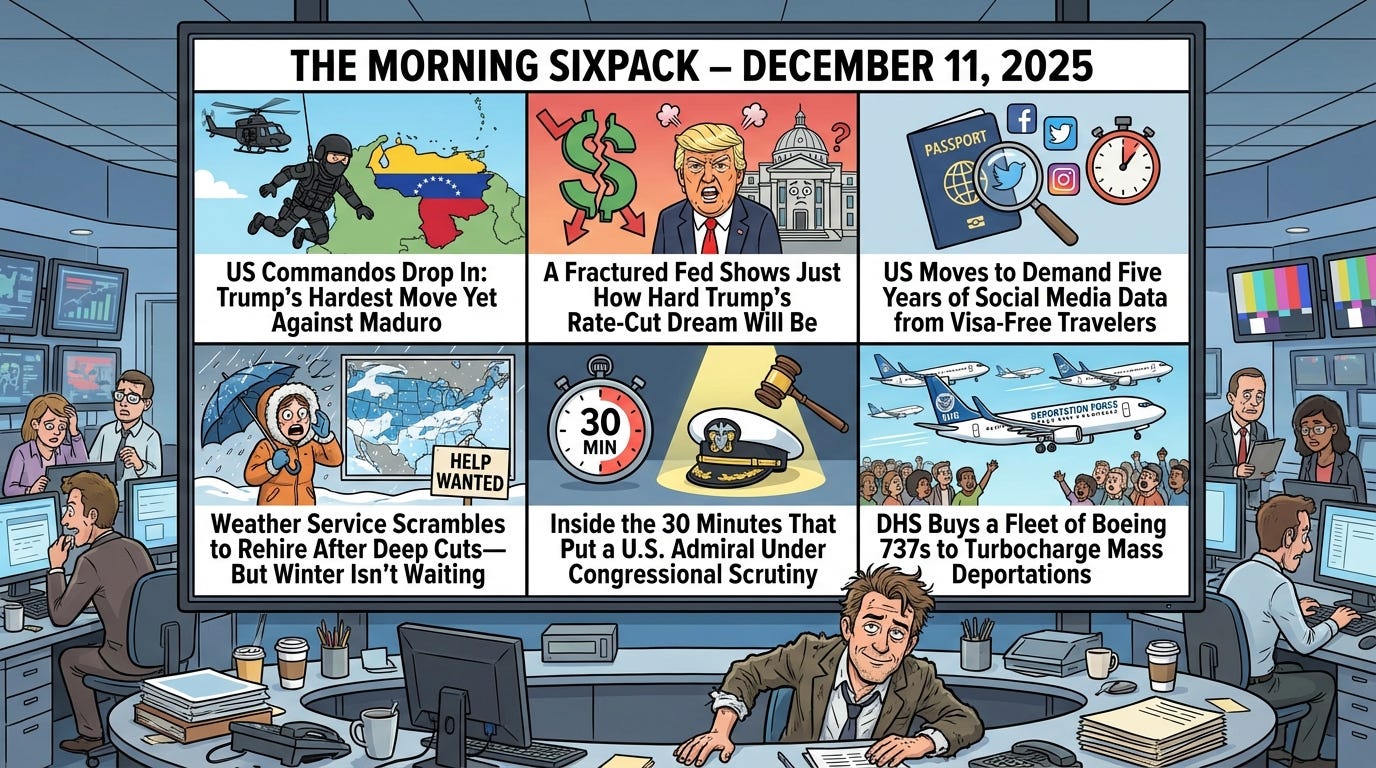
Welcome back to The Morning Sixpack, where we break down the day’s sharpest stories with the clarity, punch, and side-eye they deserve. Let’s dive in.
US Commandos Drop In: Trump’s Hardest Move Yet Against Maduro
A dramatic fast-rope assault on a Venezuelan-linked oil tanker shows how far the Trump administration is willing to go in its escalating showdown with Nicolás Maduro. The operation—complete with helicopters, elite forces, and federal-agency coordination—marks a shift from targeting small-time narco boats to hitting the heart of Venezuela’s oil trade. Trump insists it’s about narcotics; the geopolitical math says it’s about leverage. And Maduro? He’s running out of beds to sleep in.
A Fractured Fed Shows Just How Hard Trump’s Rate-Cut Dream Will Be
Jerome Powell forced through a rate cut, but nearly a third of his own policymakers didn’t want it. The divisions reveal a Fed deeply torn between recession fears and inflation paranoia—and a president desperate for cheaper money ahead of installing a new chair. Powell gave no hint of more cuts, and the loudest message from the room was simple: personnel won’t solve Trump’s rate problem; the data will.
U.S. Moves to Demand Five Years of Social Media Data from Visa-Free Travelers
The Department of Homeland Security is turning the once-simple ESTA form into a digital biopsy. Travelers from 42 visa-waiver countries may soon have to hand over years of social media accounts, emails, phone numbers, biometric data, and even photo metadata. It’s the biggest expansion of screening in years, driven by Trump-era directives and wrapped in the language of security. Privacy advocates are already reaching for their megaphones.
Weather Service Scrambles to Rehire After Deep Cuts—But Winter Isn’t Waiting
After slashing 550 staff earlier this year, the government is now racing—slowly—to fix the staffing crisis it created at the National Weather Service. With only 80 hires locked in and key offices missing half their meteorologists, America is heading into storm season with degraded forecasts, fewer balloon launches, and at least one office unable to operate 24/7. NOAA claims readiness; insiders call that optimistic at best.
Inside the 30 Minutes That Put a U.S. Admiral Under Congressional Scrutiny
Adm. Frank Bradley’s decision to order a second strike on two shipwrecked survivors has become a legal and moral firestorm. The men were waving from debris when the missile hit, and experts say they likely qualified as “shipwrecked” under international law—protected, not targetable. With Congress investigating and the administration framing drug smugglers as combatants, the line between warfare and law enforcement is dissolving fast.
DHS Buys a Fleet of Boeing 737s to Turbocharge Mass Deportations
The Trump administration is literally scaling deportations by the plane-load. DHS is buying six Boeing 737s so ICE can run its own deportation airline, a $140 million move officials say will “save money” while enabling the push for one million removals. Between this and the billion-dollar “self-deportation” contract, immigration enforcement is starting to look more like a logistics empire than a federal function.
Thanks for tuning in. If this week has a theme, it’s this: when government decides to go big, it goes big—from the skies over Venezuela to the runways ICE now calls its own. Catch you in the next Sixpack.


