


The Morning Sixpack Podcast: Power, Pressure and the Politics of Force
Here’s your guided walk-through of the day’s biggest stories—each one a case study in how authority gets used, abused, or conveniently redefined.
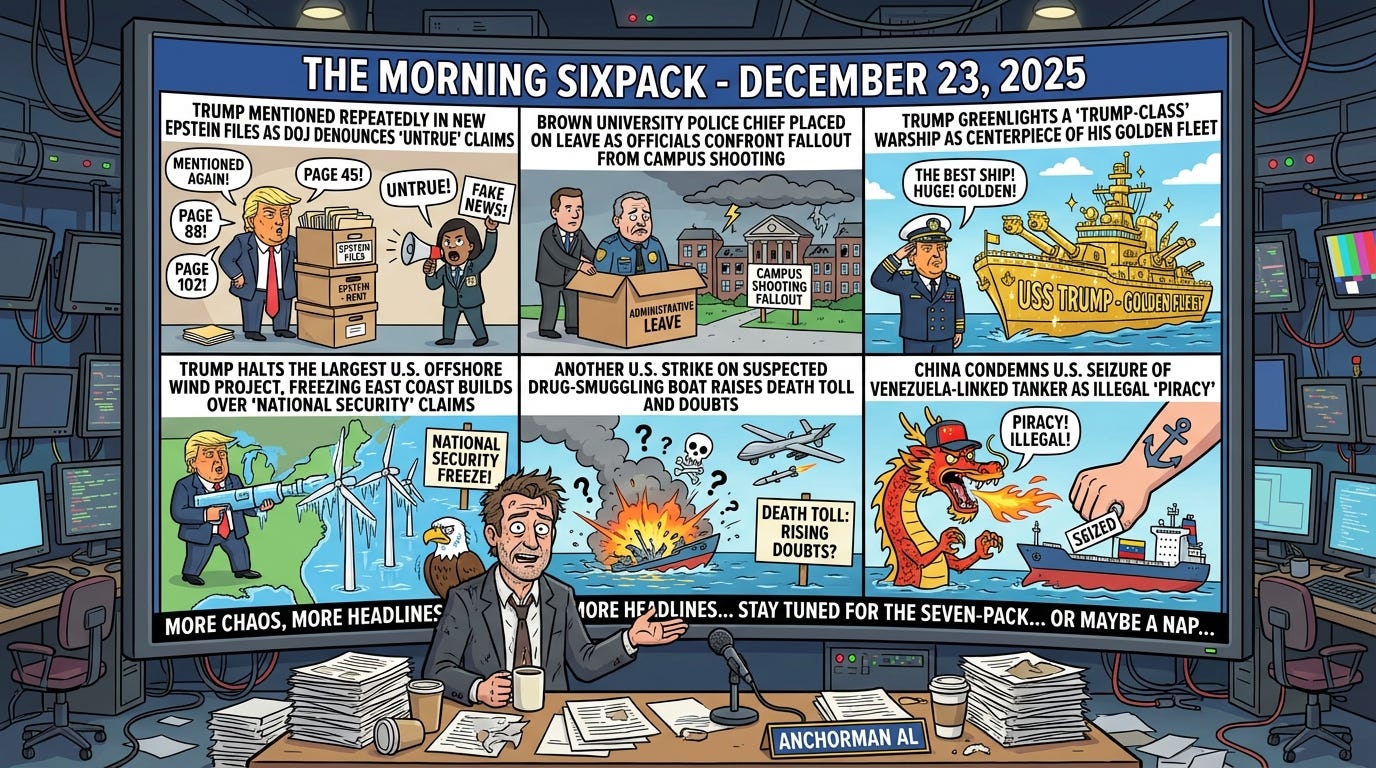
In the newly released Epstein files, Trump’s name finally shows up in bulk, despite the DOJ insisting many claims are “untrue.” The second batch of documents paints a far more entangled picture of Trump’s past proximity to Epstein, including multiple shared flights and a subpoena to Mar-a-Lago tied to the Maxwell case. While the DOJ calls some allegations unfounded, the release itself—after briefly vanishing from the government website—has only fueled suspicion about who’s protecting whom. The president, predictably annoyed, continues to insist he barely knew Epstein, even as prosecutors documented otherwise.
Brown University is reeling after a mass shooting, and the school has benched its own police chief amid a badly shaken community. With two students dead, nine wounded and a suspect tied to a second killing at MIT, Brown’s leadership is scrambling to restore trust. The Department of Education has launched a review, and students are demanding to know how a gunman fired 44 rounds inside an academic building without an immediate, effective response. As the university conducts a top-to-bottom safety audit, its assurances feel thin next to the scale of the trauma.
Trump’s “Golden Fleet” vision now includes a Trump-class battleship—because apparently the Navy needed a personal branding refresh. The USS Defiant will kick off a series of enormous, hyper-weaponized ships built to the president’s taste for spectacle. Critics, including former admirals, say the ships are strategically mismatched for countering China and carry price tags that redefine excess. Still, shipbuilders are delighted, and Trump seems eager to turn America’s fleet into floating monuments to his own design instincts.
The administration has frozen the nation’s largest offshore wind project—plus four more—under the banner of “national security.” Coastal Virginia Offshore Wind, key to powering a booming data-center corridor, is now on ice after the Pentagon claimed turbine blades interfere with radar. Dominion Energy and state leaders warn the halt threatens grid reliability, jobs and energy prices. Given Trump’s long-standing vendetta against wind power, the move looks less like defense policy and more like politics dressed in a uniform.
China and Venezuela are accusing the U.S. of maritime “piracy” after the Coast Guard seized a tanker carrying 1.8 million barrels of oil destined for Chinese buyers. Beijing says Washington violated international law; Caracas says Trump’s self-declared blockade has no legal foundation. The administration argues the tanker was part of PDVSA’s shadow fleet, using false names to dodge sanctions. The seizure underscores an increasingly confrontational U.S. posture at sea, where anti-Maduro enforcement now blends with great-power friction.
And that’s the lineup: documents exposing power, guns exposing vulnerability, ships exposing ego, wind farms exposing ideology, and tankers exposing geopolitical nerves.
The throughline? When authority flexes without transparency, the cracks show—fast.
Stay tuned. More turbulence ahead.


