


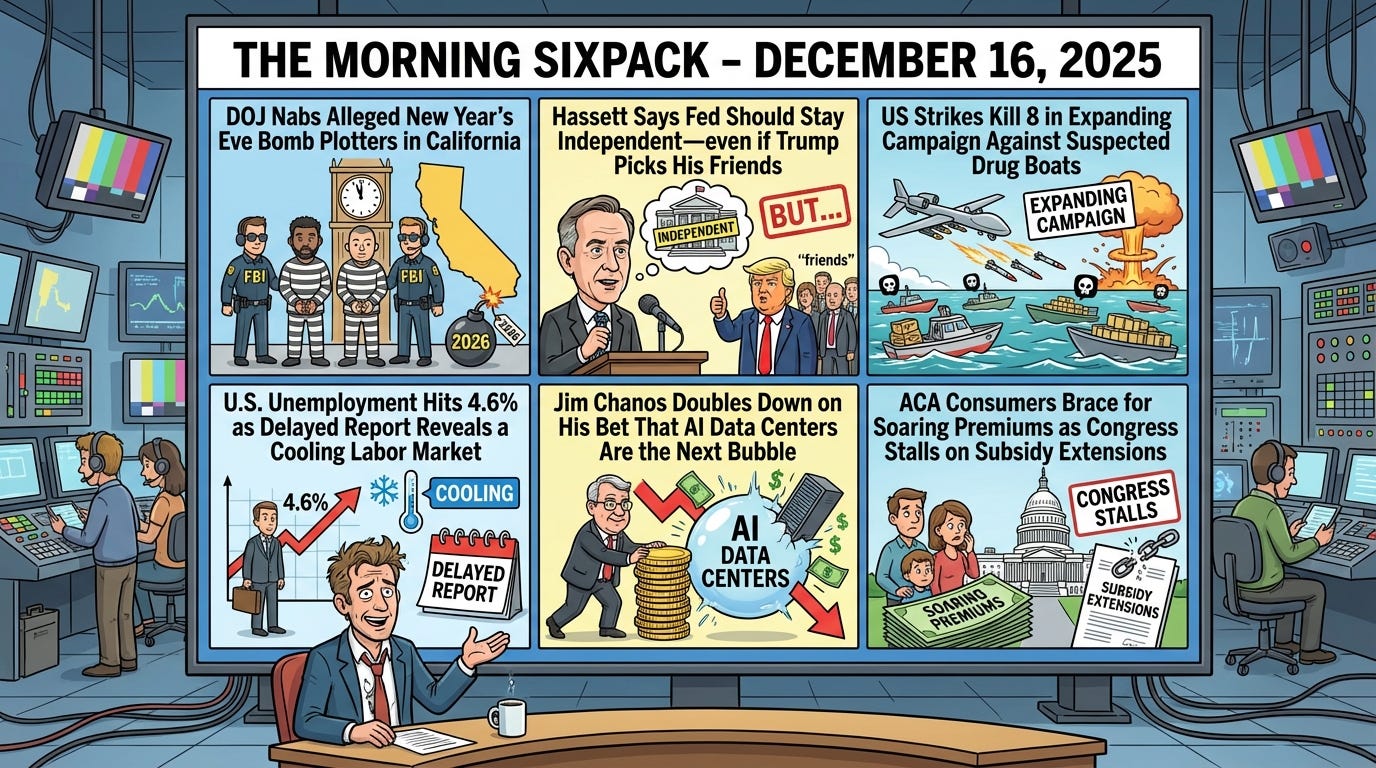
DOJ Nabs Alleged New Year’s Eve Bomb Plotters in California
Federal agents say they shut down a coordinated New Year’s Eve bombing plan before it ever left the desert.
The Justice Department announced the arrests of four members of the self-styled Turtle Island Liberation Front, a group Attorney General Pam Bondi labeled “far-left,” after investigators said the crew spent December stockpiling materials and even test-detonating devices in the Mojave. According to the criminal complaint, they were aiming for a multi-target strike at midnight on New Year’s Eve.
The FBI says the suspects had drafted a detailed plan—helpfully titled “OPERATION MIDNIGHT SUN”—spelling out simultaneous backpack IED attacks against two companies operating in California. One of the accused, Audrey Illeene Carroll, allegedly handed the document to a confidential source and later joked about her “terrorist diary,” writing, “so it’s like / my terrorist diary / lmaooooo / I have to get rid of that,” which is certainly not the flex she thinks it is.
Authorities emphasized that agents moved in before any functional device was assembled, a testament to both undercover work and the suspects’ apparent inability to keep incriminating notes out of the wrong hands. Carroll reportedly told a co-defendant that the plan avoided harming civilians and that if they saw anyone—say, a security guard—they’d warn them. Yes, because nothing reassures the public quite like the promise of a courtesy alert before an explosion.
Officials say they’ve rounded up everyone linked to the scheme, including a fifth group member arrested in Louisiana who they say wasn’t part of the operation. The broader political backdrop: the Trump administration’s ongoing campaign to spotlight threats from left-wing groups, including his much-debated move to label antifa a “major terrorist organization.”
Source: NBC News
Editor: If your revolution requires a handwritten bomb blueprint and a giggly note about a “terrorist diary,” maybe rethink the whole revolution thing—you’re not exactly giving off ‘criminal mastermind’ energy.
Hassett Says Fed Should Stay Independent—even if Trump Picks His Friends
Kevin Hassett is bending over backward to say he’s independent while auditioning for a job given by a president who hates being told no.
With President Donald Trump inching toward naming Jerome Powell’s successor, Hassett—now a finalist for the top Fed job—used a CNBC interview to praise central bank independence and the art of consensus. He wouldn’t touch questions about his own candidacy, but he made it clear that whoever gets the role needs to steer interest rates through data, not deference.
Hassett’s problem is the political gravity around him. Trump’s advisors reportedly worry he’s too chummy with the boss, raising fears he’d turn the Fed into a presidential suggestion box. Hassett pushed back, arguing that friendship shouldn’t be a disqualifier: “The idea that someone isn’t qualified for the job because they are a close friend who’s worked well with the president is something that I think the President rejects,” he said.
Meanwhile, Trump keeps sniping at Powell—even after three rate cuts totaling 75 basis points—and pushing for even deeper reductions. Hassett’s response? A carefully calibrated line about consensus and data, followed by a nod to Trump as a “seasoned observer of the economy,” which is diplomatic-speak for: I hear you, but I’m not promising anything.
Hassett and former Fed Governor Kevin Warsh are said to be the frontrunners, with a final decision expected in early January. Treasury Secretary Scott Bessent is steering the process, which at this point looks less like a selection and more like the final round of a political reality show.
Source: CNBC
Editor: If your pitch is “I’ll be independent, but also the president has great ideas,” you’re not threading a needle—you’re knitting a sweater out of contradictions.
US Strikes Kill 8 in Expanding Campaign Against Suspected Drug Boats
The Trump administration keeps widening its undeclared ocean war, and Monday’s strikes added eight more bodies to the tally.
US Southern Command said Joint Task Force Southern Spear hit three vessels in the eastern Pacific on December 15, labeling them “Designated Terrorist Organizations” and asserting they were running narcotics along established smuggling routes. That brings the death count from these boat strikes to at least 95 since September—an extraordinary number for a campaign that still lacks anything resembling transparent legal grounding.
This is MURDER.
The administration insists the US is in an “armed conflict” with drug cartels, a framing that gives officials broad leeway to treat suspected traffickers as battlefield enemies rather than criminal suspects. But that claim is already under congressional scrutiny, particularly after CNN reported that a September 2 follow-up strike in the Caribbean targeted survivors from an initial attack—a move legal experts warned could constitute a war crime.
Now Congress is demanding answers. Senate Minority Leader Chuck Schumer announced that all senators will get a briefing Tuesday with Secretary of State Marco Rubio and Defense Secretary Pete Hegseth. House lawmakers will get a classified version as well. Oversight isn’t optional when lethal force is deployed in international waters; it’s the bare minimum.
The administration, meanwhile, is sticking to its script. Officials say those killed were “unlawful combatants,” and they cite a classified DOJ finding that supposedly authorizes lethal strikes with no judicial review. All of this unfolds alongside a broader pressure campaign against Venezuela, including troop deployments, a carrier strike group, and new sanctions targeting its oil trade.
Monday’s strikes won’t end the questions—if anything, they amplify them. A government declaring war by memo while racking up casualties at sea should expect a reckoning, and Congress finally seems willing to demand one.
Source: CNN
Editor: If the White House needs a classified memo to justify murdering nearly a hundred people at sea, maybe the problem isn’t the boats—it’s the legal theory holding this whole operation together with duct tape and vibes.
U.S. Unemployment Hits 4.6% as Delayed Report Reveals a Cooling Labor Market
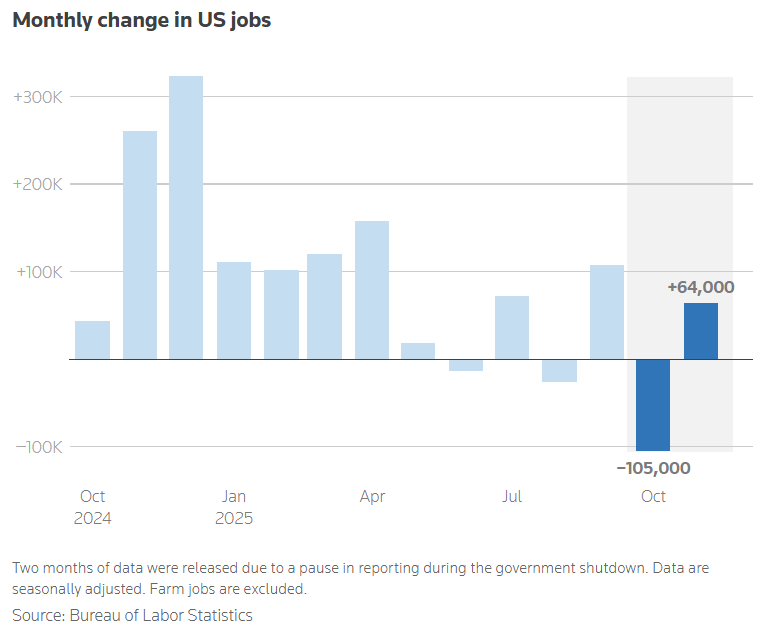
A long-delayed jobs report finally landed—and it paints a far weaker picture of the economy than the White House has been selling.
The Labor Department’s release showed unemployment jumping to 4.6% in November, the highest in more than four years, despite a modest gain of 64,000 jobs. That uptick is less encouraging once paired with the revelation that 105,000 jobs were actually lost in October—data that had been buried behind the 43-day government shutdown.
Federal job losses loomed large. Washington shed 162,000 workers in October and another 6,000 in November, piling up to a staggering 270,000 federal positions eliminated since January. That’s the delayed accounting of Trump’s government-slashing agenda finally hitting the numbers. Thanks, DOGE.
And no—AI experiments and seasonal hiring freezes aren’t doing the labor market any favors either.
Revisions to August and September were grim as well, turning previously reported gains into losses. Private-sector hiring eked out 121,000 positions across October and November, but it was almost entirely propped up by healthcare and social assistance. Manufacturing, transportation, temp work, information, and finance all bled jobs. This is a slow-burn labor market—workers aren’t getting laid off en masse, but employers are clutching their wallets like it’s a new Olympic sport.
The Fed now gets to sift through all this messy, delayed data ahead of its late-January meeting. Powell has already warned that numbers might be overestimating job creation by as much as 60,000 a month—meaning we could have been losing 20,000 jobs a month since spring. If true, the labor market isn’t cooling; it’s been quietly losing altitude while everyone was arguing about shutdown theatrics.
Source: The Wall Street Journal
Editor: Only in Washington do you fire a quarter-million federal workers and then act surprised when the unemployment rate jumps. This is what happens when fiscal policy is driven by vibes and vendettas instead of math.
Trump is a stupid, stupid unserious man.
Jim Chanos Doubles Down on His Bet That AI Data Centers Are the Next Bubble
Jim Chanos is back with another ice-bath reminder that not every shiny AI investment is actually gold—some of it is just expensive wiring with a depreciation problem.
In a new interview, the famed short seller argues that legacy data centers were already “crummy” businesses, and the GPU-filled AI mega-centers popping up everywhere aren’t any better. His view: hosting GPUs is a commodity grind with low margins, high capital costs, and a five-year obsolescence clock ticking loudly in the background. And yes, he name-dropped several players who should feel a little queasy.
Chanos warned clients back in 2022 that old-school cloud data centers were headed for trouble; now he’s even more bearish on the “neocloud” trend—bitcoin miners rebranding themselves as AI compute landlords and startups rushing to lease racks to anyone training a model. “The magic and the money is going to come from what the chips produce ultimately, not where they reside,” he said. Translation: Don’t confuse the warehouse with the value.
He pointed out that hyperscalers like Microsoft and Meta can bankroll their own data farms, but Oracle and Amazon need outside financing, even as they struggle to monetize the staggering amounts they’re pouring into GPUs and infrastructure. And that’s before considering what happens if sentiment cools or credit tightens (it’s coming, y’all)—conditions he says would kneecap the sector just like the early-2000s telecom bust.
A deeper problem: a huge share of the companies renting compute aren’t making money. Chanos says the percentage of unprofitable firms fueling this wave of AI spending is higher than during the infamous telecom bubble. When your customer base is burning cash to rent hardware that may be outdated in five years, you’ve built a business model on a trapdoor.
Chanos’ bottom line is bleak for the data-center craze: fewer of them will be needed, returns will disappoint, and today’s frenzy looks uncomfortably similar to 1999‒2000. Investors chasing the AI wave, he says, would be better off sticking to true AI developers—not the digital landlords trying to skim rent off the boom.
There was a book released in 2000 (right before the dot-com bust) called TELECOSM by George Gilder. In it, he proclaimed that all the fiber being laid would revolutionize the world. Then the bubble burst, and all that bandwidth literally sat at the bottom of the ocean, much of it unused for years. Gilder was wrong then. The AI “gurus” are wrong now. A few big players will survive, and every other startup will die.
Source: MarketWatch
Editor: At some point we have to admit that slapping “AI” on a server farm doesn’t alchemize it into a high-margin business—it just makes the electricity bill bigger and the disappointment louder.
ACA Consumers Brace for Soaring Premiums as Congress Stalls on Subsidy Extensions
Washington is somehow managing to hold open enrollment hostage, and millions of Americans are the collateral damage.
The enhanced ACA subsidies—lifelines that kept premiums manageable during and after the pandemic—are set to expire at year’s end, yet Congress is still flailing over whether to extend them. In the middle of open enrollment. With people literally trying to pick plans as lawmakers argue over the politics of health care for the millionth time.
Democrats want the subsidies extended. Republicans are fractured, torn between long-standing hostility toward the ACA and real fears of enraged voters facing premium spikes next year. A December KFF poll underscores that danger: half of ACA enrollees who vote say a $1,000 jump in their total health costs would strongly affect how they vote in the midterms. If you’re wondering why some GOP lawmakers are suddenly subsidy-curious, there’s your answer.
Meanwhile, chaos reigns on the consumer side. People like Chicago education consultant Daniela Perez are frozen in place, waiting for Congress to decide whether her premium will be $180 or $1,200 a month. State-based marketplaces say call volumes are exploding, confusion is rampant, and far too many shoppers are “downshifting” into high-deductible bronze plans because affordability is evaporating. As one state director bluntly put it, call centers are hearing “heartbreaking” stories from people who don’t see how they can afford to stay insured.
On Capitol Hill, Republicans’ House bill—framed as tackling “real drivers of health care costs”— pointedly excludes extending ACA subsidies but expands association plans, funds cost-sharing reduction payments, and tightens PBM transparency rules. None of that solves the immediate crisis for families staring down four-figure monthly bills. And the Senate’s attempt to pass an extension failed to clear the 60-vote bar, leaving both chambers stuck with dueling visions and little time left on the 2025 calendar.
If subsidies expire, premiums will snap back to pre-pandemic formulas: low-income consumers paying at least 2.1% of household income and middle-income earners facing the old subsidy cliff. For many, that means punishing increases. One California couple said their ACA plan would soar from $1,000 to $2,400 a month. “How can you have health insurance that is more than your rent?” one asked—an excellent question Congress seems in no rush to answer.
Enrollment data so far reflects the uncertainty: fewer new sign-ups, more returning customers choosing early, and a noticeable shift toward cheaper, higher-deductible plans. People aren’t dropping coverage because they don’t value it. They’re dropping out because the math doesn’t work.
Source: NPR
Editor: Congress treating health insurance like a political football would be comical if millions of families weren’t getting kicked in the face with every punt.