


A Fireworks Warehouse Near Sacramento Erupts in a Massive Explosion, Sparking a Large Fire
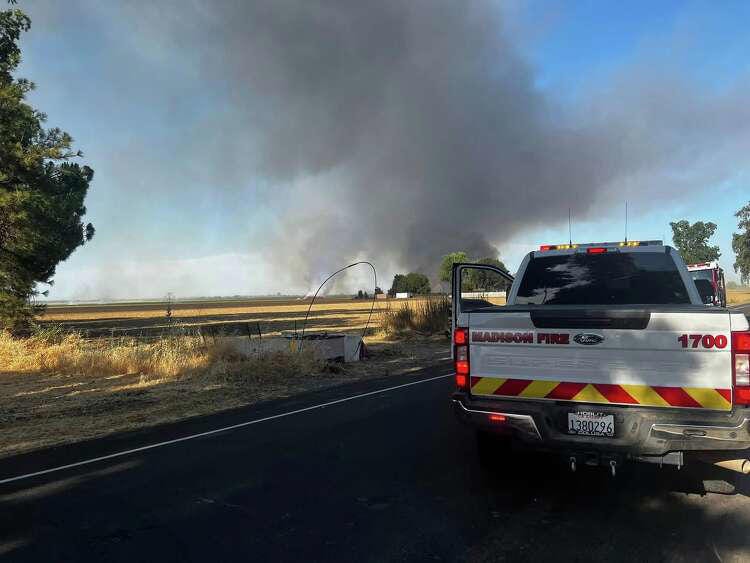
A massive explosion tore through a fireworks warehouse near Sacramento Tuesday evening, sending a towering fireball into the sky and igniting a sprawling blaze.
The explosion occurred around 5:50 p.m. near Esparto, California, about 36 miles northwest of Sacramento. Firefighters quickly responded to the scene but faced significant challenges as the fire spread across roughly 80 acres, fueled by the warehouse’s volatile contents.
Authorities established a 1-mile evacuation zone and urged residents to steer clear so emergency crews could operate safely. While the cause remains unknown, investigators from CalFire’s Office of the State Fire Marshal are on site, though no criminal probe has been launched yet.
Local fire chief Curtis Lawrence refrained from commenting on any casualties, leaving that question open as the investigation and firefighting efforts continue. Aerial footage showed flames bursting through the roof and fireworks exploding amid the smoke, underscoring the dangerous conditions.
This incident is a stark reminder of the risks involved in storing and handling fireworks, especially in California’s dry environment. For now, all eyes remain on the ongoing containment efforts and the safety of those nearby. And come on California—outlaw fireworks. They’re just stupid.
Source: Fireworks Warehouse Explosion Near Sacramento—UPI
Bryan Kohberger Set to Plead Guilty in Idaho College Killings, Avoiding Death Penalty

Bryan Kohberger, accused of brutally murdering four University of Idaho students, is expected to plead guilty today, sparing himself the death penalty but accepting four consecutive life sentences.
The former criminology student, charged with first-degree murder and burglary, will waive his right to appeal as part of the plea deal. How can this even be legal?
Prosecutors see this as a "sincere attempt to seek justice," though some family members remain deeply dissatisfied, arguing the plea deal was rushed and lacks crucial details like a full confession and the location of the murder weapon.
The plea comes just weeks before Kohberger's trial was set to begin, with jury selection slated for early August. Prosecutors plan to present a factual summary of evidence during the hearing and more details at sentencing, expected later this month.
Kohberger’s defense hit several roadblocks, with courts rejecting attempts to exclude DNA evidence and deflect blame to other suspects. Legal analyst Dan Abrams notes the defense had a “pretty bad case” against the overwhelming evidence linking Kohberger to the crimes.
While the families seek closure, the deal leaves some questions unanswered. Justice is a complicated, imperfect game, and in this case, it looks like the system prioritized certainty over full disclosure.
Source: Bryan Kohberger Pleads Guilty - ABC News
Senate Passes Massive GOP Bill Steering Trump’s Agenda to House, But Final Hurdles Remain
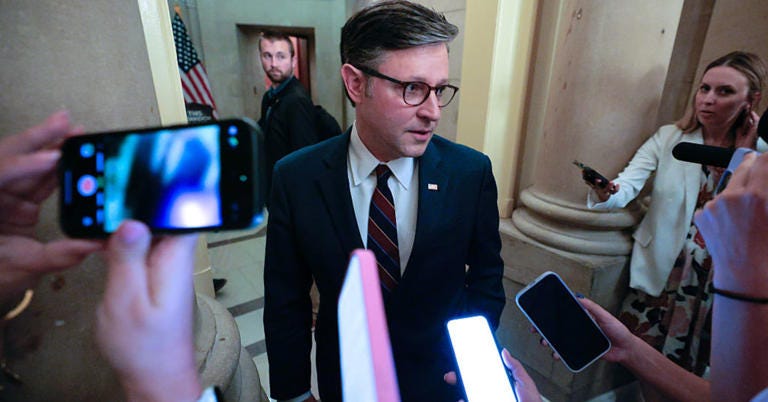
The Senate just pushed through a sweeping Republican bill packed with key parts of President Trump’s domestic agenda, leaving the House with the tricky job of sealing the deal.
By a razor-thin 51-50 vote, with Vice President JD Vance casting the tie-breaker, Senate Republicans approved legislation that extends Trump-era tax cuts, boosts border security funding, and tightens Medicaid work requirements. But with the House having passed an earlier version, negotiations are still underway to iron out differences before the bill lands on the president’s desk.
I’m no Senate Parliamentarian, but call me skeptical about how fundamentally changing Medicaid can be part of a “reconciliation” budget bill? (HINT: It can’t.)
Key Senate changes include a larger $5 trillion debt ceiling hike, expanded child tax credits, and tighter SNAP work rules (same commentary as above about Medicaid) that could reshape assistance for millions. However, these changes face pushback, especially from House Republicans uneasy about Medicaid cuts and the bigger debt limit—issues that Speaker Mike Johnson must navigate with his slim majority.
The bill also phases out clean energy tax credits sooner than planned, which critics warn will stall America’s renewable energy growth and hand an advantage to China’s solar manufacturing juggernaut. And let’s not talk about American EVs (see Tesla news immediately below).
Bottom line? This “big, beautiful bill” is a high-stakes gamble—trying to unite diverse GOP factions while advancing Trump’s priorities—but the political and policy battles ahead could still derail the plan.
Source: Senate GOP Passes Trump’s Sweeping Policy Bill - NPR
Tesla’s Global Vehicle Deliveries Plunge 13.5% in Q2 Amid Shift to Autonomous Tech
Tesla’s vehicle sales took a noticeable dive in Q2, with deliveries dropping 13.5% year-over-year as the company doubles down on its autonomous vehicle ambitions.
The final count came in at 384,122 cars, just missing analysts’ 387,000 target, continuing a steep slide that’s been going on for months. Part of the backlash is tied to Elon Musk’s controversial political moves and the impact on the brand’s appeal, even as he stepped down from federal roles in late May. By then, the damage had been done.
To keep the momentum, Tesla has rolled out refreshed versions of its Model Y, a cheaper Cybertruck variant, and updated luxury models like the Model S and Model X. Meanwhile, the launch of Tesla’s robotaxi service in Austin (finally) marks a bet on AI and robotics as future growth engines, despite the sales slump. Tesla is way behind Google’s Waymo in terms of “robotaxis.”
Musk’s vision of hundreds of thousands of Teslas driving fully autonomously by 2026 depends heavily on continued vehicle sales to bankroll the expensive AI investments. The upcoming Cybercab, a dedicated autonomous vehicle priced at $30,000, will be the real test of this strategy. Note that Musk has been saying “FSD (Fully Self-Driving)” cars were in Tesla’s immediate future since—get this—2016.
Compared to other automakers, Tesla’s sales dip is in line with a broader EV slowdown, with Ford and Hyundai seeing sharp declines while GM bucks the trend. Tesla’s stock reacted positively to the delivery news, but the company’s ability to navigate this rough patch will determine if Musk’s grand plans come to fruition.
Source: Tesla Q2 Sales Report - Wall Street Journal (gift article)
Private Sector Lost 33,000 Jobs in June, Flipping Expectations on Their Head
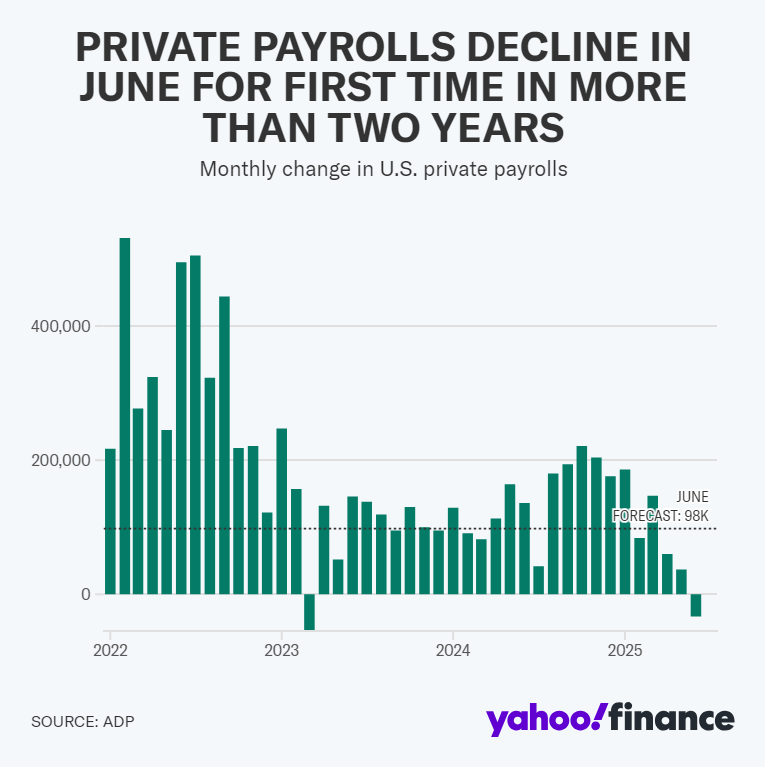
The U.S. private sector unexpectedly shed 33,000 jobs last month, a sharp reversal from the predicted 100,000 gain, signaling cracks in what many thought was a rock-solid economy.
ADP’s payroll data, often a rough preview of the government jobs report, shows the first contraction since March 2023—and it’s a big deal. While layoffs remain rare, businesses are clearly hesitant to hire or replace workers, particularly in service sectors like professional/business services and health/education, which led the losses.
The decline wasn’t uniform, though. Goods-producing industries like manufacturing and mining actually added 32,000 jobs, and large companies (500+ employees) saw payroll growth, while small businesses took the biggest hit. Regionally, the Midwest and West faced the sharpest drops, with the South standing alone in job growth.
This unsettling report comes just days before the official government jobs numbers drop, expected to show modest growth and a slight uptick in unemployment. Still, this ADP data has tripped investors before by missing the mark, so we’ll wait and see if the official numbers confirm a slowdown.
Bottom line: The job market may not be the invincible powerhouse Wall Street wants it to be. Hiring hesitation and shrinking payrolls could mean the economy is steering into choppier waters sooner than expected. And then Trump can—FINALLY!—get his rate cuts.
Source: ADP Jobs Report June 2025 - CNBC
China Is Rapidly Closing the Gap in the Global AI Race, Challenging U.S. Dominance
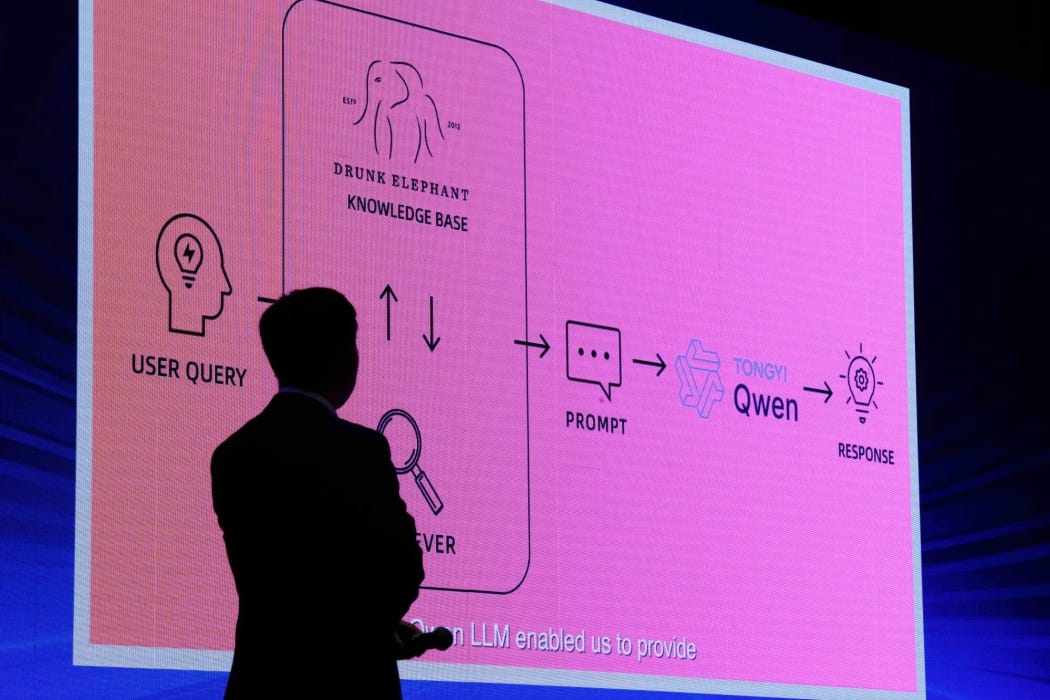
Chinese AI companies are aggressively chipping away at America’s lead, offering cheaper, widely adopted alternatives that threaten to redraw the global technology map.
Across Europe, the Middle East, Africa, and Asia, institutions from multinational banks to universities are increasingly embracing Chinese AI models like DeepSeek and Alibaba’s Qwen, even as U.S. firms like OpenAI’s ChatGPT remain industry favorites. The Chinese approach focuses less on chasing breakthroughs and more on practical applications—making their AI affordable, customizable, and open-source, which appeals especially in emerging markets.
This shift signals more than just a tech rivalry—it’s edging toward a Cold War-style split, with countries forced to pick sides.
Microsoft’s Brad Smith nailed it: “Whoever gets there first will be difficult to supplant.”
The U.S. has tried to hamper China’s progress with export controls and chip restrictions, but Beijing is building its own AI supply chain, determined to reduce dependency.
The fallout isn’t just geopolitical; U.S. companies like Nvidia face billions in lost revenue as Chinese models gain traction globally. OpenAI CEO Sam Altman frames the battle as democratic AI versus authoritarian AI—a high-stakes fight that will shape innovation, security, and information flow worldwide.
Bottom line: The AI playing field is fracturing fast. America’s edge won’t last if it can’t deliver affordable, accessible AI that the world wants to adopt—and China is moving fast to fill that void. I wouldn’t call China’s approach on AI as “authoritarian” but rather smart. First movers rarely win the race. Look it up!
Source: China Is Quickly Eroding America’s Lead in the Global AI Race - WSJ (gift article)