


Editor: In a move that reads like political fan fiction, the Trump administration has booted out a decorated admiral—Rear Adm. Kurt Rothenhaus—and handed his job to a 33-year-old consultant whose combat experience begins and ends with slide decks. The new Chief of Naval Research, Rachel Riley, built her career at McKinsey and the so-called “Department of Government Efficiency,” better known as DOGE (yes, like the meme coin that tanked your cousin’s crypto wallet).
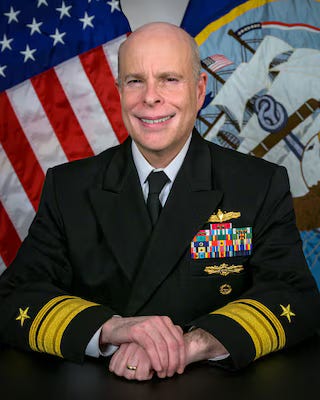
The Navy’s top research post—a job historically filled by battle-hardened flag officers with decades of technical and operational expertise—has just been handed to a 33-year-old management consultant. And no, that’s not a setup for a “Dilbert” strip. Rear Adm. Kurt Rothenhaus, a career naval officer with real deployments, commands, and tech programs under his belt, has been booted from his role as Chief of Naval Research (CNR) and replaced by Rachel Riley, a former McKinsey partner and self-proclaimed government “efficiency” guru.
From Combat Systems to PowerPoint Slides
Rothenhaus’s résumé reads like a textbook on how to lead military R&D: commands at sea, system engineering experience, and most recently, heading the Office of Naval Research—the Navy’s innovation engine responsible for billions in basic and applied research. His removal, confirmed by multiple defense and political outlets this week, was abrupt and unexplained.
Enter Rachel Riley, whose credentials come straight out of the corporate consulting playbook: Rhodes Scholar, McKinsey partner, and most recently a DOGE (Department of Government Efficiency) operative. Her claim to fame? Pushing for deep staff cuts at the Department of Health and Human Services earlier this year. The Trump administration apparently liked that vibe so much they decided to give her control over Navy science.
A Radical Shift—or an Experiment Gone Wrong?
Traditionally, the Chief of Naval Research is a rear admiral—a commissioned officer deeply embedded in the Navy’s technical ecosystem. Riley, by contrast, has no known military experience. According to Politico, she’s viewed as part of a larger Trump-era effort to install loyal “efficiency enforcers” across the federal bureaucracy. If that sounds like “McKinsey meets the Pentagon,” it’s because it is.
Critics see this as yet another example of ideological loyalty trumping expertise. The Daily Beast described it as a “purge” of experienced leaders, while Defense One noted it continues a wave of unorthodox appointments across the Defense Department. The symbolism is stark: replace a seasoned admiral with a consultant whose last battlefield was probably a spreadsheet.
Why It Matters (Hint: Billions of Dollars)
The Office of Naval Research (ONR) isn’t some obscure Pentagon backwater. It manages over $3 billion annually in science and technology funding, coordinating everything from AI and autonomous systems to advanced materials and naval warfare research. The person running it influences not just Navy innovation but also partnerships with universities, defense contractors, and allied research programs.
Replacing a technocrat with a management consultant could reshape how that money flows—and to whom. Efficiency reformers often love cutting “bureaucracy,” but in defense research, “bureaucracy” often means scientists, labs, and testing programs. If Riley brings the same slash-and-burn approach she used at HHS, ONR’s research community could be in for a bumpy ride.
The “DOGE” Factor
Let’s pause to appreciate the irony of calling this network the Department of Government Efficiency, or DOGE. The DOGE initiative has been the vehicle for staffing many mid-to-senior roles across the new Trump administration—people with consulting or think-tank backgrounds but little public-sector tenure. Riley’s rapid rise fits the pattern: young, credentialed, loyal, and ready to “streamline” whatever agency she lands in.
Efficiency isn’t inherently bad—but efficiency without context can gut the very institutions it’s meant to improve. You can’t Six Sigma your way through naval warfare readiness.
The Big Picture
This move underscores a broader realignment within the Pentagon. The new leadership appears less interested in maintaining traditional hierarchies and more focused on inserting ideologically aligned “change agents.” That might sound innovative—until you remember that military R&D is not a corporate turnaround project.
Even some defense insiders who once welcomed Trump’s push for accountability are uneasy. “You can’t manage a carrier strike group like a consulting engagement,” one retired flag officer quipped anonymously. “And you can’t outsource warfighting expertise to McKinsey.”
What Happens Next
Riley’s appointment hasn’t yet appeared in official Navy statements, and it’s unclear if she’ll hold the same rank or operate as a civilian. Rothenhaus’s next move also remains unknown. But the message has been sent: institutional experience no longer guarantees job security, even in the Pentagon’s most technically demanding roles.
If Riley’s tenure brings significant budget cuts or R&D slowdowns, expect Congress—particularly the Senate Armed Services Committee—to start asking hard questions about whether “efficiency” has gone too far.
Source: Politico – “DOGE holdover who pushed for deep cuts at HHS is headed to the Navy”
Parting Shot: Apparently, “Thank you for your service” now comes with an asterisk: “unless a consultant needs your desk.”