


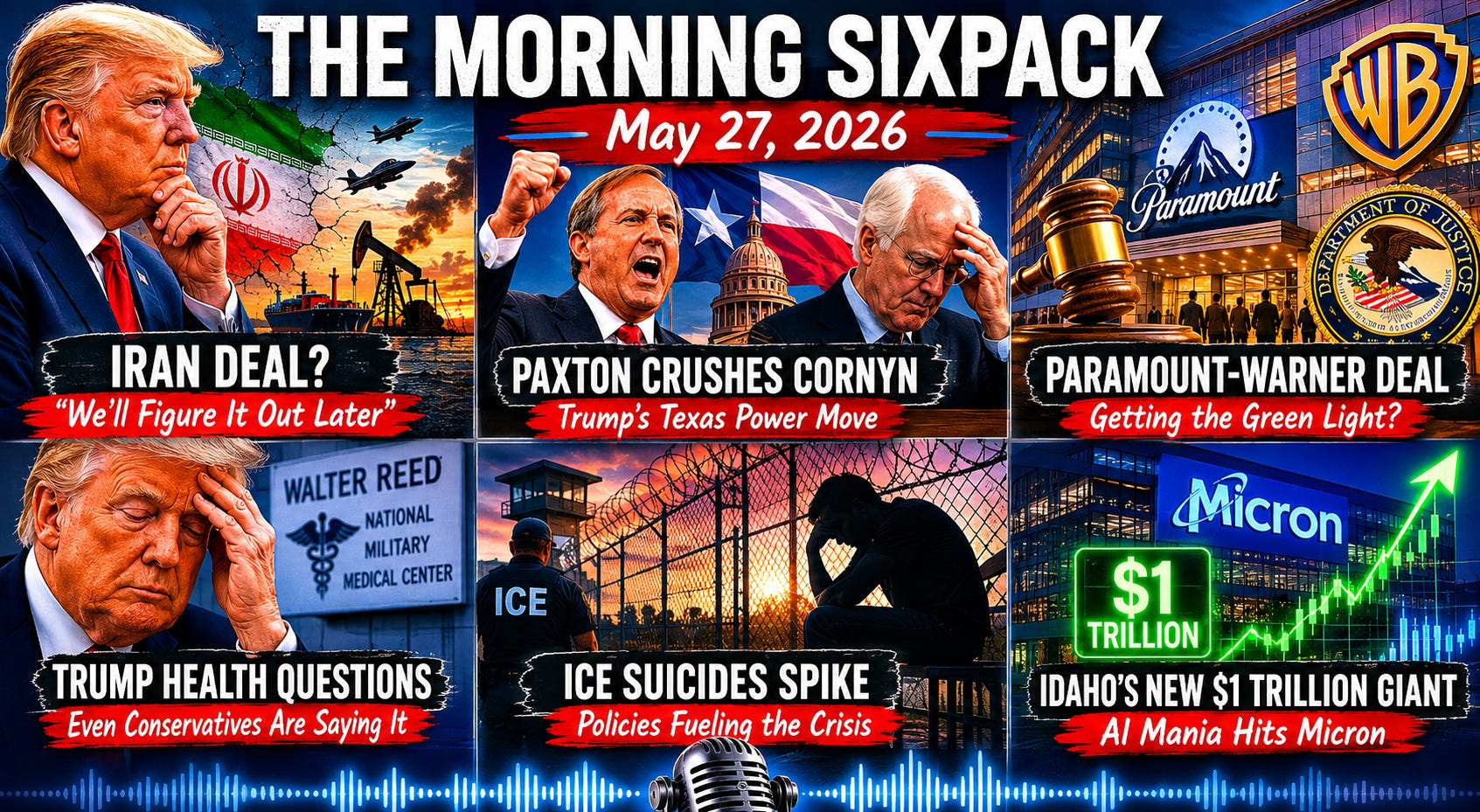
The biggest takeaway? The White House may trade sanctions relief and frozen cash for promises Iran hasn’t fully agreed to yet.
Trump’s Iran Deal Looks More Like “We’ll Figure It Out Later”
After months of missiles, oil panic, and global brinkmanship, the U.S. and Iran are inching toward a deal that appears to boil down to: stop shooting, reopen Hormuz, and pray everyone behaves. Washington and Tehran are selling this as progress, but a lot of the “details” still seem to exist in the imagination phase.
The emerging framework would gradually reopen the Strait of Hormuz, where roughly 20% of the world’s oil supply moves through daily. Iran would also reportedly give up its stockpile of highly enriched uranium—eventually, somehow, maybe through Russia. In exchange, the U.S. would ease sanctions and allow Iranian oil exports to resume. Because apparently “trust but verify” has now become “verify later.”
Trump is publicly optimistic, posting that negotiations are “proceeding nicely,” while also warning that if talks collapse it’s “back to the battlefront and shooting, but bigger and stronger than ever before.” That’s not exactly diplomatic language, but subtlety has never been the product here.
Meanwhile, major questions remain unresolved: whether Iran can still enrich uranium, what happens to its missile program, and whether Hezbollah and other Iranian proxies actually stop operating across the region. Iran is also accusing the U.S. of violating the current ceasefire after recent American strikes in southern Iran. So yes, everyone is still technically negotiating while also accusing each other of bad faith and launching missiles. Very stable process.
Source: Associated Press
Editor: Nothing inspires confidence quite like a peace agreement where the fine print includes “continued self-defense strikes.”
The bigger story here isn’t Paxton winning—it’s that a four-term senator from Texas just got politically executed for not kissing the ring hard enough.
Trump Just Took Out a Texas Republican Institution
Ken Paxton crushed Sen. John Cornyn in Texas, proving once again that in today’s GOP, loyalty to Trump matters more than seniority, fundraising, or actually being electable statewide. Cornyn spent years climbing the Republican ladder in Washington. Trump erased him with one endorsement and a week of momentum.
Paxton celebrated the victory by thanking Trump directly, calling him “the leader of our party” and praising the endorsement as “the most powerful force in politics.” Hard to argue with that after Cornyn became the first Republican senator from Texas to lose a renomination bid since the modern primary era took hold.
Now Republicans get to test whether nominating a scandal-covered attorney general accused of corruption was genius or self-inflicted pain. Democrats are openly thrilled. State Rep. James Talarico suddenly has a real shot in a state Democrats usually lose by default. GOP strategists are already warning this race could force Republicans to spend millions defending a seat that should’ve been safe.
Cornyn’s concession speech was short, awkward, and delivered mostly to reporters. Meanwhile, Paxton leaned fully into the MAGA message, framing himself as the outsider fighter despite being Texas attorney general for years. That’s modern politics in a nutshell: everyone’s anti-establishment until they actually have to govern.
Source: Associated Press
Editor: Republicans just replaced a dependable Senate veteran with a walking opposition ad and called it strategic brilliance.
The pitch from Paramount basically boils down to: “Trust us, we totally still care about movie theaters.”
Paramount’s Warner Deal May Be Getting the Government Green Light
Paramount appears to be winning over Justice Department staff in its $110 billion bid to take over Warner Bros. Discovery, despite Hollywood fears that the merger could gut theaters and funnel even more movies into streaming apps. Translation: the people making movies are worried the people making spreadsheets are about to win again.
According to Semafor, DOJ antitrust staff spent two hours grilling Paramount CEO David Ellison about whether a merged Paramount-Warner empire would release fewer movies theatrically. Executives insisted the combined company would still commit to releasing 30 films a year and argued that pandemic-era streaming trends distorted the data regulators are looking at. Hollywood skeptics remain unconvinced.
One key concern hanging over the deal is what happened after Disney bought Fox in 2019. Regulators pointed out Disney shifted more films toward streaming and cut back theatrical releases. Paramount claims that comparison is unfair because COVID turned the entertainment industry upside down. Fair point—but executives promising they love theaters while Wall Street demands streaming profits is a little like a fast-food chain promising it’s pivoting to salads.
California Attorney General Rob Bonta is still threatening to investigate the merger, and states can challenge deals even if the DOJ signs off. That means this isn’t over yet. But the mood appears to be shifting toward approval, which would create an absolutely massive entertainment giant at a time when Hollywood already feels increasingly consolidated, increasingly risk-averse, and increasingly obsessed with squeezing every last subscriber out of audiences.
Source: Semafor
Editor: Hollywood executives promising to protect theaters is adorable right up until the next quarterly earnings call arrives.
When political commentators start comparing your White House to Woodrow Wilson’s 1919 health cover-up, the messaging operation may have already lost control of the narrative.
Trump’s Health Questions Aren’t Going Away—And Even Conservatives Are Starting to Say It Out Loud
Donald Trump’s latest Walter Reed visit has reignited growing speculation about his health, with longtime Republican strategist Rick Wilson accusing the White House of running an active cover-up around the president’s physical and mental condition. The real headline here isn’t the criticism itself—it’s that people who spent years inside Republican politics are now openly talking this way in public.
Wilson’s broadside came after Trump’s reported third Walter Reed visit in just over a year. In a blistering Substack post highlighted by Raw Story, Wilson accused White House officials—including press secretary Karoline Leavitt and communications director Steven Cheung—of misleading the public about Trump’s condition while aggressively projecting strength and vitality.
One quote in particular stood out: “The cover-up is already running.” Wilson argued that the administration’s repeated insistence that Trump is in excellent health only fuels more skepticism, especially as public appearances increasingly trigger scrutiny over bruised hands, swelling, speech patterns, and repeated medical visits. Trump himself has continued insisting that his exams have gone “perfectly.”
To be clear, Wilson is a longtime anti-Trump critic and founder of The Lincoln Project, so this isn’t exactly neutral analysis. But politically, the significance is that concerns about Trump’s age and stamina are no longer limited to Democrats or cable news panels. Republicans spent years hammering Joe Biden on decline and transparency. Now some of the same questions are boomeranging back toward Trump as he approaches 80 while trying to project nonstop strength.
Source: Raw Story
Editor: Every White House says the president is in “excellent health” right up until reporters start counting the trips to the hospital. Three in thirteen months. NOT NORMAL.
Ten detainee suicides since Trump returned to office isn’t just a bad statistic—it’s a flashing warning light about conditions inside these facilities.
ICE Suicide Deaths Are Spiking—And Critics Say Trump Policies Are Fueling the Crisis
Suicides inside ICE detention facilities are rising at a record pace under Donald Trump’s immigration crackdown, with critics warning the system is collapsing under policies focused on mass detention over basic human care. The administration talks endlessly about toughness at the border. What it talks about far less is what happens after people disappear into the detention system.
Raw Story highlighted reporting from the Associated Press showing at least 10 ICE detainees have died by suicide since January 2025, already making this the deadliest fiscal year for suicides in the agency’s history. ICE historically recorded one or fewer suicides annually. That’s not a small increase. That’s a system veering off the rails.
One of the most haunting cases involved Brayan Rayo Garzon, who was isolated in a Missouri detention center while suffering COVID symptoms. According to the report, he begged guards to let him contact his mother after missing routine phone calls. In a handwritten note, he wrote: “I feel in my heart that she’s very worried about me.” He was later found unresponsive in his cell.
American Immigration Council senior fellow Aaron Reichlin-Melnick argued these deaths are preventable with proper staffing, screening, and mental health care, calling the spike “a sign of a systemic breakdown.” That phrase matters because it cuts through the usual political shouting. This isn’t just about border ideology anymore—it’s about whether the detention system itself is functioning safely at all.
Source: Raw Story
Editor: “Law and order” gets pretty hollow when the people in your custody keep dying while bureaucracy shrugs and moves on.
The AI stock bubble has gotten so aggressive that a company founded by Idaho potato money is suddenly one of the most valuable businesses on Earth.
Idaho Just Produced America’s Newest $1 Trillion Giant
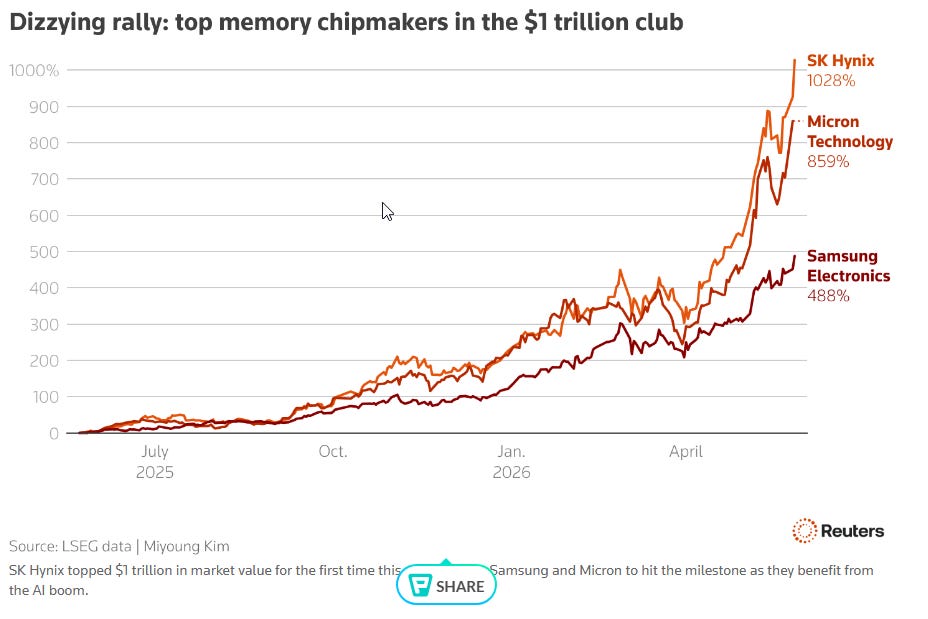
Micron—the Boise chip company once dismissed as a boring commodity business—just blasted past a $1 trillion valuation in only 48 days, making it the fastest company ever to make the jump from $500 billion to 13 figures. Wall Street’s AI mania has officially reached the point where memory chips are now treated like gold bars with circuit boards attached.
Micron shares exploded another 19% Tuesday and have surged roughly 80% in the last month alone. The company is now the 12th U.S. company worth more than $1 trillion, riding a massive investor stampede into anything connected to artificial intelligence infrastructure. The kicker? Micron isn’t even making flashy AI chatbots—it makes memory chips. The plumbing behind the AI gold rush is now worth a fortune itself.
Wall Street analysts are basically throwing gasoline on the rally. UBS hiked its Micron price target from $535 to $1,625 in one move, citing a long-term shortage of DRAM and NAND memory chips. Translation: everyone building AI systems suddenly needs mountains of memory capacity, and Micron happens to sit right in the middle of that feeding frenzy.
The broader market followed the chip surge higher. The Nasdaq gained 1.2%, the S&P 500 hit another record, and semiconductor stocks ripped across the globe from the U.S. to South Korea. Investors clearly still believe there’s no ceiling on AI demand—even as oil spikes, geopolitical chaos brews in Iran, and valuations start looking increasingly detached from gravity.
Source: The Wall Street Journal (gift)
Editor: Somewhere in America, a guy who bought Micron because he liked Idaho potatoes is now pretending he always understood semiconductor supply chains.