


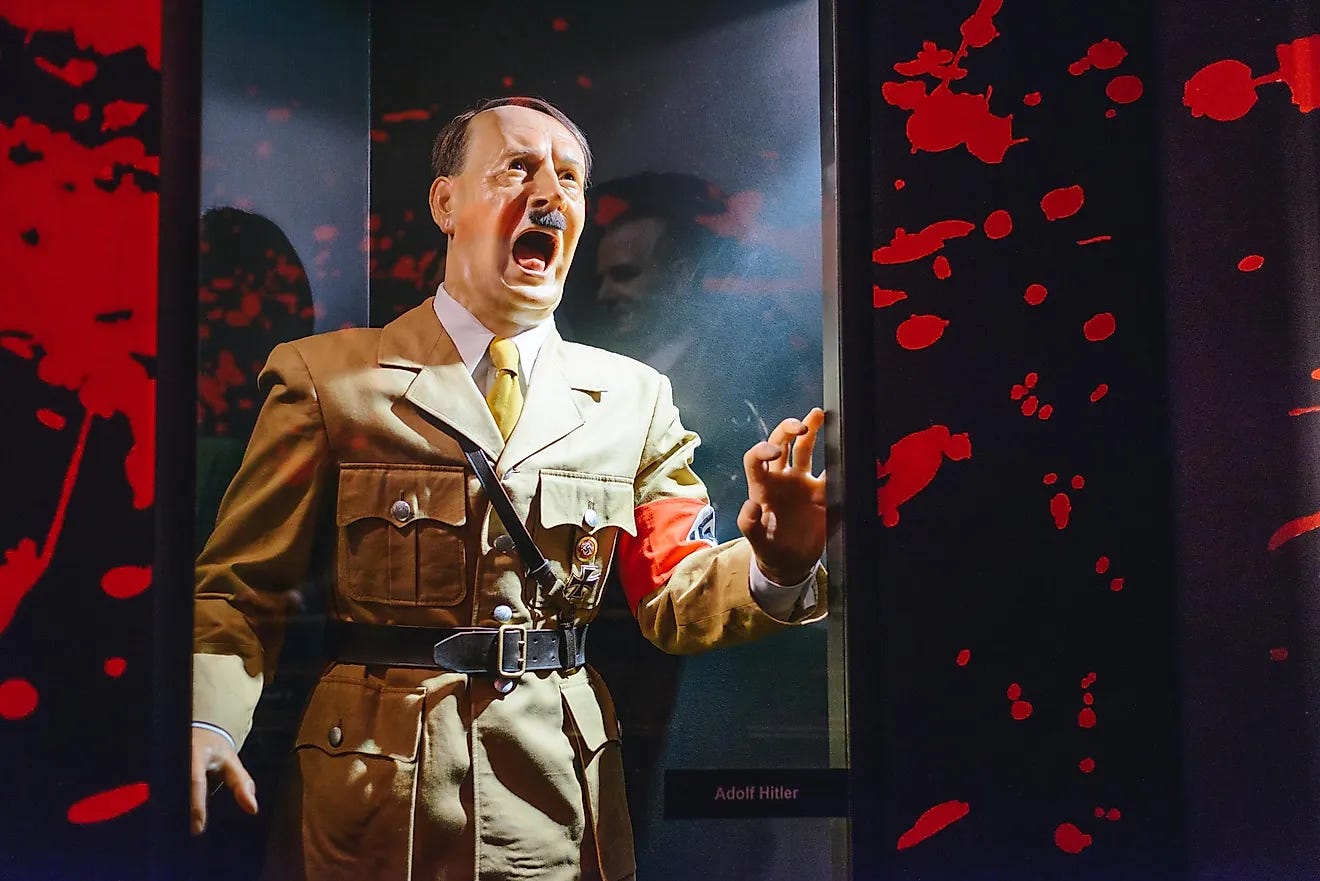
It began quietly, almost imperceptibly—laws passed in parliament, neighbors whispering in fear, a creeping sense that certain people no longer belonged.
What started as a promise to restore Germany’s pride soon revealed itself as a machinery of exclusion and hate.
First came the silencing of dissent, then the stripping of rights, and finally the destruction of entire communities. You know, genocide.
By the time the world grasped the full scope of Adolf Hitler’s vision of “racial purity,” Europe was littered with ghettos, camps, and mass graves. This is the story of how a regime turned prejudice into policy and policy into genocide.
IT CAN HAPPEN HERE.
Berlin, 1933—The Warning Signs
The story began not with mass killings, but with rhetoric and repression. Adolf Hitler, newly appointed Chancellor of Germany, seized on Germany’s humiliation after World War I and the hardships of the Great Depression. From his first days in power, the Nazi regime set out to silence its critics: communists, socialists, and trade unionists were the earliest victims, rounded up and sent to newly built concentration camps like Dachau. But Hitler’s real obsession was racial purity. Jews became the central scapegoats, blamed for both Germany’s economic troubles and its defeat in 1918.
The Legal Stranglehold, 1933–1935
The cleansing began not with bullets, but with laws. Boycotts of Jewish businesses in 1933 gave way to the Nuremberg Laws of 1935, which stripped Jews of citizenship and forbade marriage with “Aryans.” Roma, too, were branded as racial outsiders, while homosexuals faced escalating persecution under tightened anti-gay laws. Afro-Germans, few in number, were sterilized under eugenics policies that viewed them as a threat to racial “purity.”
The March Toward Violence, 1936–1939
The noose tightened as Jews were excluded from professions, schools, and public life. On a single night in November 1938, the so-called Kristallnacht, Nazi mobs torched synagogues, smashed shop windows, and dragged thousands of Jewish men to camps. Meanwhile, disabled Germans were marked as “unworthy of life.” Hitler’s doctors quietly began the T4 euthanasia program, killing children and adults with disabilities in secret hospitals.
War as Cover, 1939–1941
The invasion of Poland in 1939 marked a turning point. The Nazis created ghettos—walled-off districts in Warsaw, Łódź, and beyond—where Jews starved in squalid conditions. At the same time, Roma families were rounded up, and disabled Germans continued to be murdered. Under the chaos of war, Nazi racial policy turned from exclusion to annihilation.
The Final Solution, 1941–1945
The German invasion of the Soviet Union in 1941 unleashed mobile killing squads, the Einsatzgruppen, who shot Jews and Roma en masse in forests and ravines. But the shootings proved too “inefficient.” By 1942, the Nazi high command coordinated what it called the “Final Solution”: a continent-wide plan to exterminate the Jews. Death camps like Auschwitz, Treblinka, and Sobibor were built for this purpose. Cattle cars brought millions to their deaths in gas chambers.
The Collapse, 1945
By the time Allied forces liberated the camps, six million Jews had been murdered, alongside hundreds of thousands of Roma, tens of thousands of homosexuals, hundreds of thousands of disabled people, and countless political opponents. Hitler’s dream of racial purity ended in rubble, but not before consuming millions of lives.
Editorial Note
This is not just a history of Germany—it is a warning. The Nazis began their ethnic cleansing with laws and lies, not mass graves. They tested how far society would tolerate exclusion, persecution, and dehumanization. By the time the killing began in earnest, the world had looked away for too long.
I know there are trolls in here so I'm forced to hush my thoughts!