


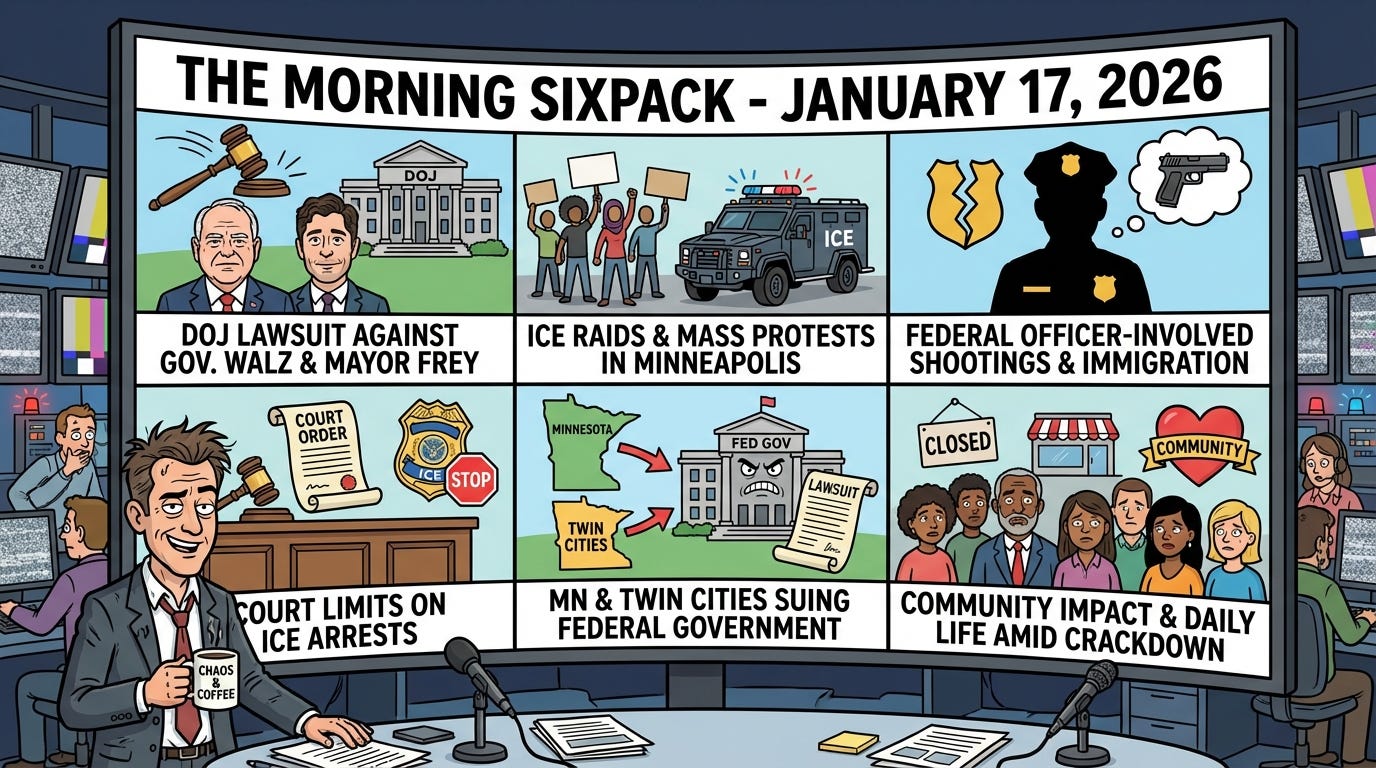
Minneapolis, ICE, and the Federal-State Collision
Story 1: DOJ Sues Minnesota’s Governor and Minneapolis Mayor
The federal government escalated its standoff with Minnesota by filing a lawsuit against Governor Tim Walz and Minneapolis Mayor Jacob Frey. The U.S. Department of Justice alleges that the two officials obstructed federal immigration enforcement by publicly opposing ICE operations and encouraging non-cooperation. The suit marks an unprecedented move against sitting state and municipal leaders for political speech tied to immigration.
According to DOJ filings, Walz and Frey crossed from policy disagreement into active resistance by criticizing ICE deployments and signaling support for protests. Federal prosecutors argue this created unsafe conditions for agents and interfered with lawful enforcement. Legal experts note that the case pushes the boundaries of obstruction law into dangerous territory.
Walz responded by accusing the federal government of criminalizing dissent and attempting to silence elected officials. Frey called the lawsuit intimidation, saying it threatens democratic norms and free speech protections. Both leaders insist they acted within their constitutional authority.
The lawsuit lands amid rising protests and violence in Minneapolis, ensuring the legal fight won’t stay confined to courtrooms. It also raises national questions about whether local leaders can openly oppose federal actions without legal retaliation. Whatever the outcome, the precedent alone could reshape federal-state relations.
This is no longer just about immigration enforcement—it’s about whether dissent itself is becoming prosecutable.
Source: CBS News
Editor: The DOJ suing elected officials for criticizing federal policy is not “law and order.” It’s lawfare, and everyone pretending otherwise is lying to themselves.
Story 2: ICE Raids Spark Citywide Protests
ICE operations across Minneapolis have triggered sustained protests that show no sign of slowing. Federal agents have conducted raids in residential neighborhoods, workplace locations, and transit corridors, prompting immediate backlash. Demonstrations that began locally have grown into coordinated citywide actions.
Protesters say the raids are indiscriminate and terrorize immigrant communities already living in fear. Federal officials counter that enforcement is targeted and lawful, aimed at individuals with removal orders. The disconnect between those narratives has fueled anger on the streets.
Crowds have repeatedly gathered near federal buildings and downtown corridors. Arrests, crowd-control tactics, and police reinforcements have followed. City officials urged restraint while criticizing the scale and aggressiveness of the operations.
Minneapolis is now bracing for continued unrest, with National Guard units placed on standby. What began as enforcement has turned into a rolling confrontation between federal authority and public resistance.
Source: Star Tribune
Editor: If your “public safety” operation requires armored vehicles and riot lines, maybe it’s not actually about safety.
Story 3: Federal Shootings Intensify Public Fury
Public outrage intensified after the fatal shooting of Renee Good during an ICE-related operation. Federal officials described the killing as justified, citing perceived threats. Witness accounts and family statements sharply dispute that version.
Days later, a second incident left another individual wounded during a confrontation with federal agents. Though non-fatal, the shooting reinforced fears that ICE operations were spiraling out of control. Protesters pointed to a pattern of escalation and impunity.
Federal agencies maintain their agents acted in self-defense under hostile conditions. Critics argue the hostility stems from the raids themselves and the aggressive posture federal officers adopted. Calls for transparency and independent investigations have grown louder.
So far, limited information has been released, deepening mistrust. For many residents, the shootings represent a breaking point rather than isolated incidents.
Source: CBS News Minnesota
Editor: When “law enforcement” keeps killing people and asking for patience, the problem isn’t patience—it’s accountability.
Story 4: Judge Restricts ICE Arrests of Protesters
A federal judge in Minneapolis imposed new limits on ICE and DHS actions against protesters. The ruling bars federal agents from arresting peaceful demonstrators absent clear evidence of criminal conduct. The court cited constitutional protections and concerns about overreach.
The judge emphasized that protest alone does not equal obstruction. Agents were warned against using mass arrests or intimidation tactics to suppress lawful demonstrations. Civil liberties groups called the ruling a necessary check.
Federal officials argued the restrictions endanger agents and hinder enforcement. The court rejected that argument, noting existing laws already address violence and interference. The ruling drew praise from local officials and activists alike.
While not ending confrontations, the decision redraws legal boundaries at a critical moment. The DOJ has not ruled out appealing.
Source: Washington Post
Editor: Judges shouldn’t have to remind the federal government that protesting isn’t a crime—but here we are.
Story 5: Minnesota and Twin Cities Sue the Federal Government
Minnesota, Minneapolis, and St. Paul filed their own lawsuit against the federal government, accusing it of unconstitutional immigration enforcement. The complaint alleges violations of due process and civil liberties tied to the ICE surge. State officials say the operations destabilized communities.
The lawsuit claims federal agencies bypassed coordination norms and disregarded local law enforcement structures. It also cites economic disruption and fear among residents. State attorneys frame the issue as federal overreach.
The DOJ dismissed the case, asserting immigration enforcement is exclusively federal authority. Federal lawyers argue states cannot block or condition enforcement actions. Legal analysts say the outcome could reshape federalism doctrine.
With lawsuits now flying both directions, the courts have become the central battlefield. The stakes extend far beyond Minnesota.
Source: Associated Press
Editor: When everyone is suing everyone else, that’s not governance—that’s institutional failure with better stationery.
Story 6: A City Living Under Constant Tension
Daily life in Minneapolis has shifted under the weight of enforcement and protest. Residents report avoiding public spaces, altering routines, and keeping children home. Immigrant communities describe living in constant fear.
Businesses near protest zones have boarded windows and shortened hours. Transit disruptions and heightened police presence are now routine. The city feels brittle, strained, and uneasy.
Community leaders warn that trust between residents and institutions is eroding rapidly. Federal officials insist enforcement must continue regardless of discomfort. That divide shows no sign of narrowing.
Minneapolis has been here before, but this time the conflict runs straight through federal power itself. And there is no clear off-ramp.
Source: The Guardian
Editor: You don’t “restore order” by making an entire city feel occupied—history’s already tried that experiment.