


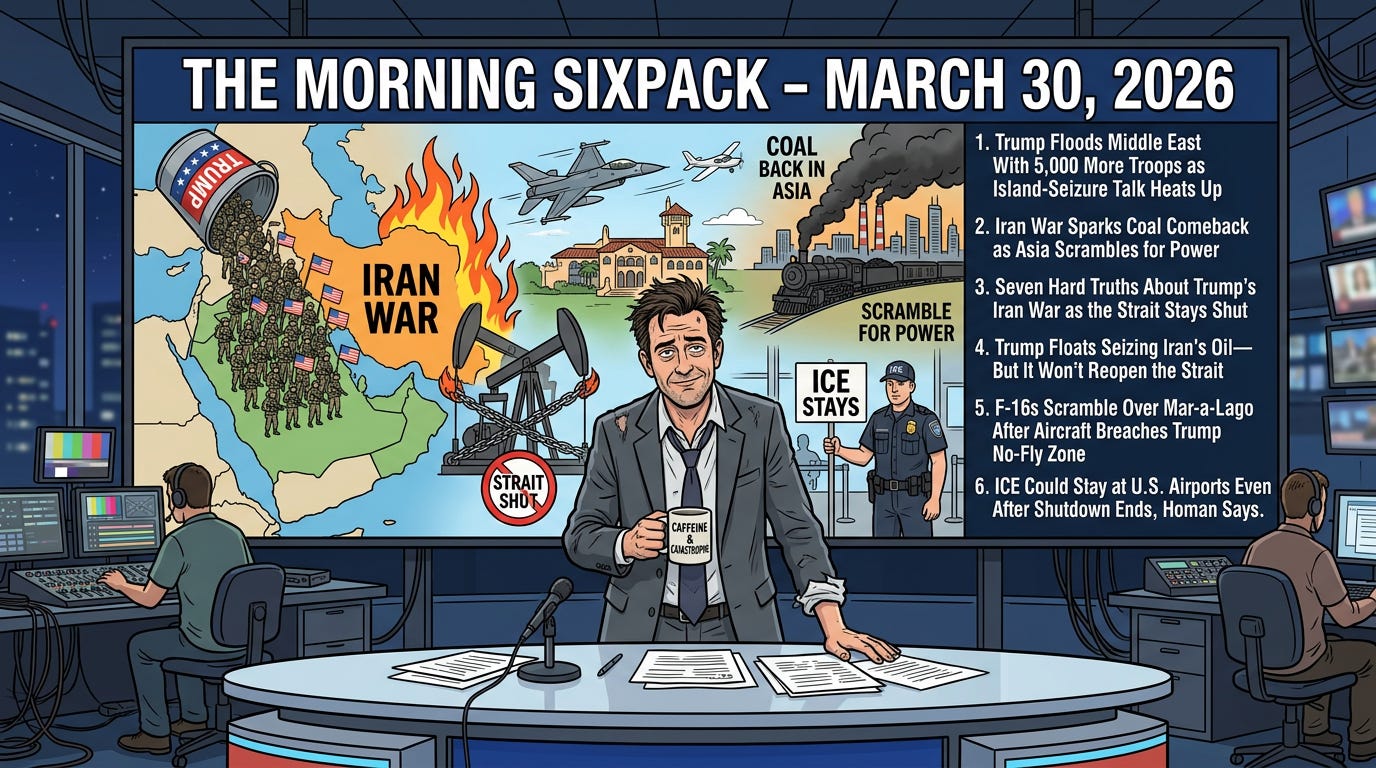
5,000 more U.S. troops just hit the Middle East as Trump weighs grabbing Iranian territory, even as the USS Gerald Ford limps out of the fight.
Trump Floods Middle East With 5,000 More Troops as Island-Seizure Talk Heats Up
The U.S. now has more than 50,000 troops in the Middle East—about 10,000 above normal levels—as President Trump considers expanding his month-old war with Iran.
The arrival of 2,500 Marines from the 31st Marine Expeditionary Unit and another 2,500 sailors pushes the American footprint across the region to its highest point in years. U.S. officials say Trump is weighing options that go beyond airstrikes—including potentially seizing an island to force open the Strait of Hormuz, the vital artery that carries roughly 20 percent of the world’s oil.
The strait has been largely closed amid Iranian retaliation against U.S. and Israeli attacks. One possible target: Kharg Island, Iran’s main oil export hub in the northern Persian Gulf, where U.S. warplanes reportedly struck more than 90 military targets earlier this month. About 2,000 soldiers from the Army’s 82nd Airborne Division have also been deployed to the region, their exact location undisclosed—but within striking distance of Iran.
For context, the U.S. typically maintains around 40,000 troops scattered across bases and ships in Saudi Arabia, Bahrain, Iraq, Syria, Jordan, Qatar, the United Arab Emirates and Kuwait. Now it’s north of 50,000. That said, one notable absence: the aircraft carrier U.S.S. Gerald Ford, which withdrew from the region after a string of mishaps—including a laundry-room fire—and is now floating somewhere between Crete and Croatia.
Military experts are already throwing cold water on any notion of a full-scale ground operation. Israel mobilized more than 300,000 troops for Gaza. The U.S.-led invasion of Iraq in 2003 began with nearly 250,000 coalition forces. Iran is nearly a third the size of the continental U.S. with 93 million people. Fifty thousand troops—many of them at sea—might be enough to seize a strategic point. Holding it? Different story.
Source: The New York Times
Editor: Seizing an island sounds decisive on cable news. Governing what happens the day after tends to be where the bill comes due. More below.
The Iran war’s shutdown of the Strait of Hormuz is padding coal profits as Asian countries scramble for energy security.
Iran War Sparks Coal Comeback as Asia Scrambles for Power
The closure of the Strait of Hormuz is driving Asian nations back to coal, handing producers a profit surge just months after “peak coal” was in sight.
Energy security just shoved climate goals to the back of the line.
As recently as December, the International Energy Agency expected global coal demand—about 8.8 billion tons in 2024—to flatten in 2025 and begin declining by 2030. China’s appetite looked like it had peaked. India’s coal-fired generation was slipping for the first time in decades. Then war between the U.S., Israel, and Iran choked off a fifth of the world’s oil and LNG flows through Hormuz.
The result: Asian economies that rely on Middle Eastern fuel are scrambling. With Iranian strikes knocking out nearly a fifth of Qatar’s LNG production and oil output projected to fall by 8 million barrels per day in 2026, utilities are making a cold calculation. Pay sky-high spot prices for gas—or fire up coal plants. In South Korea, limits on coal utilization were lifted. Thailand restarted coal units. Japan is reconsidering caps it once planned to tighten.
Anthony Knutson of Wood Mackenzie put it bluntly: “You’re not going to open a new pit. You’re not going to buy new mine fleets. This is gravy right now.” Coal prices have jumped to around $140 per ton from roughly $101 at the start of the year—nowhere near the 2022 spike above $420, but more than enough to juice margins.
Analysts say this may be a longer plateau, not a permanent reversal. China and India can lean on domestic supply; the rest of Asia will turn to exporters like Indonesia and Australia. Indonesia had planned to cut production amid oversupply fears. Now miners are ramping back up. Because when pipelines close and tankers stall, the dirtiest fuel in the mix suddenly looks reliable.
Source: Heatmap
Editor: Funny how “peak coal” lasts right up until the lights might flicker. Climate pledges are sturdy—until the AC shuts off.
I don’t normally link out to LinkedIn posts but this one is worth the read.
Seven Hard Truths About Trump’s Iran War as the Strait Stays Shut
Nearly two months into the fight, the U.S. and Iran are shaping the battlefield for leverage—not peace—and the endgame is getting murkier by the day.
If the Strait of Hormuz stays closed, no one gets to declare mission accomplished.
First, this isn’t negotiation—it’s diplomatic theater. Washington and Tehran are staking out maximalist positions and insisting the other side is desperate. That’s classic shaping behavior. Real talks may come, but history says they’ll likely require more time—and more fighting—before either side feels enough pain to compromise.
Second, watch the troops, not the talking points. Thousands of U.S. ground forces are assembling across the region under the umbrella of diplomacy. There’s chatter about seizing Kharg Island, Iran’s oil export hub, but grabbing territory doesn’t automatically reopen the Strait of Hormuz. If the waterway is the problem, operations along Iran’s coast—or elsewhere—may matter more than a symbolic land grab.
Third, the escalation ladder is still tall. Gulf Arab states could start firing directly into Iran. The Houthis could choke off the Bab el-Mandeb. Israel could expand into southern Lebanon. Shia militias in Iraq could intensify attacks. Both Washington and Tehran could widen strikes on regional energy infrastructure. And that’s before factoring in direct U.S. ground combat.
Fourth, the White House’s objectives keep shrinking. Regime change? Gone. Choosing Iran’s supreme leader? Gone. Unconditional surrender? Gone. Now the public demand is a pledge from Tehran never to develop a nuclear weapon—a promise Iranian leaders made repeatedly before the war. Changing intent is slippery. Degrading capability—drones, missiles, naval forces, nuclear infrastructure, the defense industrial base—is concrete. If there’s a realistic aim here, it’s the latter.
Fifth, “declare victory and move on” is fading as an option. U.S. Central Command will likely finish most of its target set soon. But if the Strait remains closed, oil stays elevated, and the global economy feels the squeeze, no speech from the Oval Office will override reality.
Sixth, once—or if—the Strait reopens, it won’t secure itself. An international maritime coalition escorting tankers and patrolling sea lanes is the logical next step. That requires allies. Publicly needling them while asking for ships is not a strategy; leading them is.
Finally, this may end up looking uncomfortably familiar. In 1991, the U.S. expelled Iraqi forces from Kuwait but left Saddam Hussein in power. What followed was years of sanctions, containment, and a heavy U.S. military presence. A 2026 version could feature a weakened but hostile Iranian regime, boxed in yet unbowed. Containment isn’t flashy. It’s expensive, slow, and politically draining. But it may be where this is headed.
Source: LinkedIn
Editor: Wars start with speeches about decisive outcomes. They often end with patrol schedules, sanctions regimes, and a calendar that keeps flipping. History has a long memory—even when policymakers don’t.
Trump is now openly talking about seizing Iran’s oil, even as experts warn it won’t fix the real problem: a closed Strait of Hormuz.
Trump Floats Seizing Iran’s Oil—But It Won’t Reopen the Strait
President Trump is openly weighing a U.S. military move to seize Iran’s oil infrastructure, including occupying Kharg Island, as the war grinds on with no clear exit.
Taking the oil sounds decisive—but it doesn’t solve the choke point that actually matters.
In a weekend interview, Trump said grabbing Iran’s oil was his “favorite thing,” floating the idea of taking and holding Kharg Island, the country’s main export hub. “Maybe we take Kharg Island, maybe we don’t,” he said, brushing off concerns and claiming Iranian defenses wouldn’t put up much of a fight. Critics, he added, are just “stupid people.”
Here’s the problem: even if U.S. forces planted a flag on Kharg Island, it doesn’t magically reopen the Strait of Hormuz. Tankers would still have to run a gauntlet of Iranian drones and missiles. One official called the idea “very risky,” with limited upside beyond optics—and plenty of downside if things go sideways.
Meanwhile, the economic pressure is already building. Brent crude pushed past $115 a barrel as markets react to the possibility of deeper disruption. And Trump isn’t exactly dialing things down—he’s now threatening to “obliterate” Iran’s power plants, oil wells, and desalination facilities if a deal doesn’t materialize and the Strait isn’t reopened.
All of this points to a widening gap between rhetoric and reality. Seizing assets is the kind of move that plays well politically. Reopening a strategic waterway under fire—and keeping it open—is the part that requires sustained military risk, allied coordination, and time. Lots of it.
Source: UPI
Editor: “Take the oil” makes for a clean slogan. Keeping ships moving through a war zone tends to be where slogans go to die. Taking over Kharg Island is a suicide mission. MARK MY WORDS.
F-16s Scramble Over Mar-a-Lago After Aircraft Breaches Trump No-Fly Zone
NORAD launched fighter jets and deployed flares Sunday after a private aircraft entered restricted airspace near President Trump’s Palm Beach residence.
For a few tense minutes, the skies over Mar-a-Lago looked a lot less like a resort town and a lot more like a combat drill.
Around 1:15 p.m., F-16s were scrambled after a civilian plane violated a Temporary Flight Restriction—standard airspace lockdown that follows the president wherever he goes. NORAD confirmed its aircraft dispensed flares during the intercept, which may have been visible from the ground. The Secret Service said Trump’s safety was never at risk.
The aircraft was escorted out of the restricted zone without incident. Officials noted flares are routinely used to get a pilot’s attention and burn out quickly, posing no danger to people below. NORAD says similar breaches have occurred multiple times since Trump began his second term.
The episode briefly fueled social media frenzy after a viral video showed a Delta pilot telling passengers there was a “ground stop” at Palm Beach International Airport because of a possible drone. That sparked speculation about threats near Air Force One. But a White House pool reporter confirmed the president’s plane never attempted takeoff—and Trump himself was at his West Palm Beach golf club at the time.
In the end, no drones. No attack. Just another reminder that when the president weekends in Florida, the airspace comes with teeth.
Source: Irish Star
Editor: Palm Beach wanted ocean breezes and brunch. Instead, they got afterburners and flares. Welcome to the new normal. #ThanksTrump
ICE agents sent to plug TSA staffing gaps during the DHS shutdown may stay at airports even after federal workers are paid again.
ICE Could Stay at U.S. Airports Even After Shutdown Ends, Homan Says
ICE agents deployed to airports during the Department of Homeland Security shutdown may remain on duty even after TSA employees return to work, the White House border czar said Sunday.
Temporary backup is starting to sound a lot like a permanent fixture.
During appearances on CNN and CBS, Tom Homan said Immigration and Customs Enforcement officers were sent to airports to help cover security shortages—but their presence won’t automatically end when paychecks resume. “It depends how many T.S.A. agents come back to work,” Homan said on “State of the Union.” “How many T.S.A. agents have actually quit and have no plan coming back to work?”
Homan added that he’s coordinating with the TSA administrator and ICE leadership to determine “what airport needs what.” Later, he said ICE would remain “until the airports feel like they’re 100 percent” and “normal operations” resume.
The backdrop: a shutdown of the Department of Homeland Security that left airport security staffing stretched thin. TSA officers, though deemed essential, were working without pay—raising concerns about absenteeism and long-term attrition. ICE agents were brought in as a stopgap to keep screening lines moving.
The open question now isn’t whether the shutdown strained the system. It’s whether a crisis workaround becomes standard operating procedure—blurring the lines between immigration enforcement and routine airport security.
Source: The New York Times
Editor: When “until things feel normal” becomes the benchmark, don’t be surprised if normal quietly changes. Remember, this is a warmup for the midterms.