


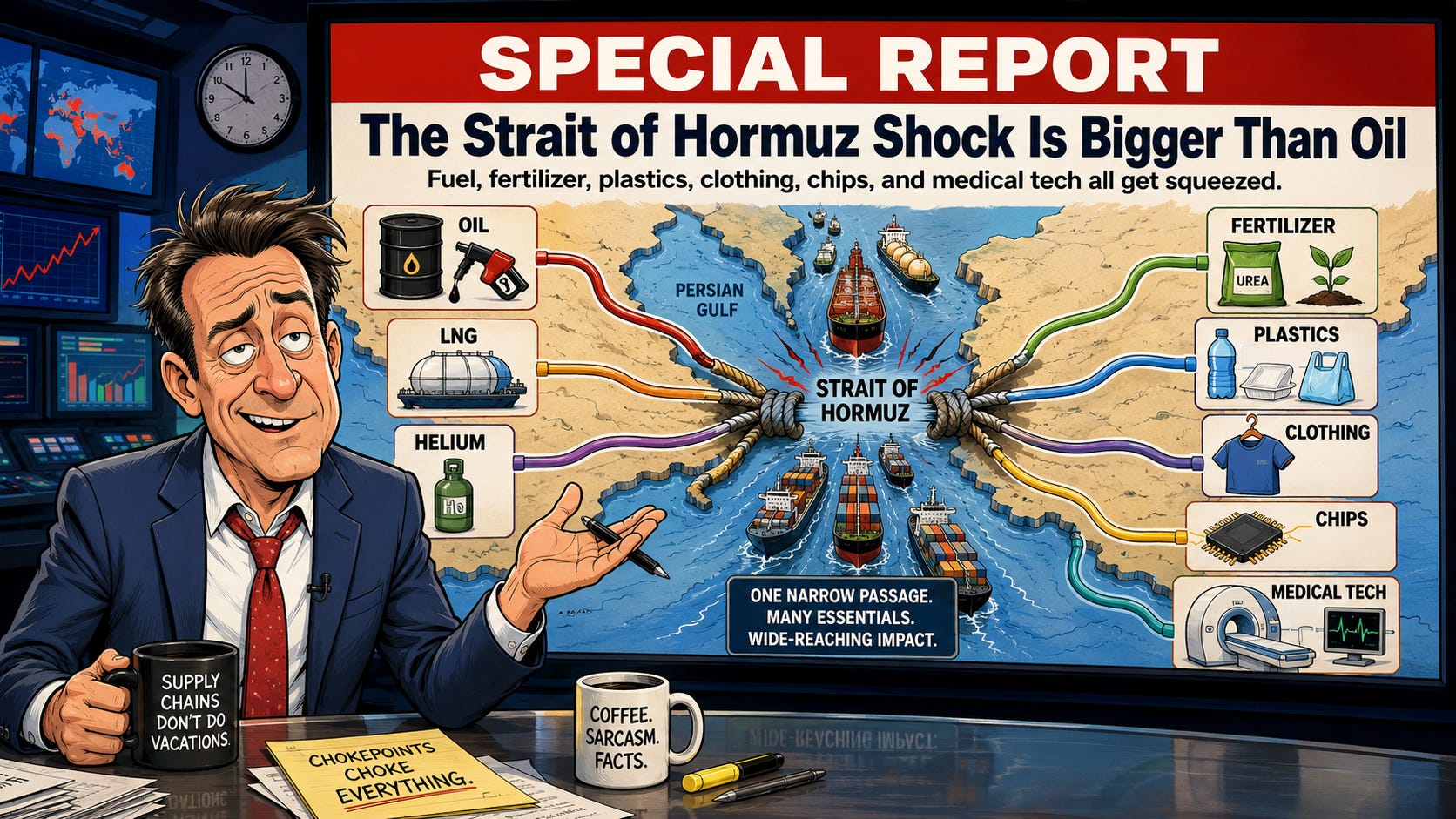
For years, the Strait of Hormuz was treated like a worst-case scenario.
What if Iran closed it? What if tankers stopped moving? What if a narrow waterway between Iran and Oman became a choke collar around the global economy?
That question is no longer theoretical.
Shipping through the strait has been largely blocked since February 28, 2026, when the United States and Israel launched an air war against Iran. Iran responded with missile and drone attacks, and the Islamic Revolutionary Guard Corps issued warnings forbidding passage through the strait, boarded and attacked merchant ships, and laid sea mines. On March 4, Iran announced that the Strait of Hormuz was “closed” and threatened to attack any ship attempting to pass.
By late March, this was no longer just a warning. On March 27, the IRGC announced that the strait was closed to vessels going “to and from” the ports of the United States, Israel, and their allies. Shipping firms had already suspended operations, tanker traffic had reportedly fallen sharply, and more than 150 ships had anchored outside the strait to avoid the risk. Soon afterward, traffic was reported to have dropped to about zero.
That is the turning point. This is not a story about a possible oil shock someday. This is a story about an active chokepoint crisis that has already dragged on for weeks.
And it is much bigger than oil.
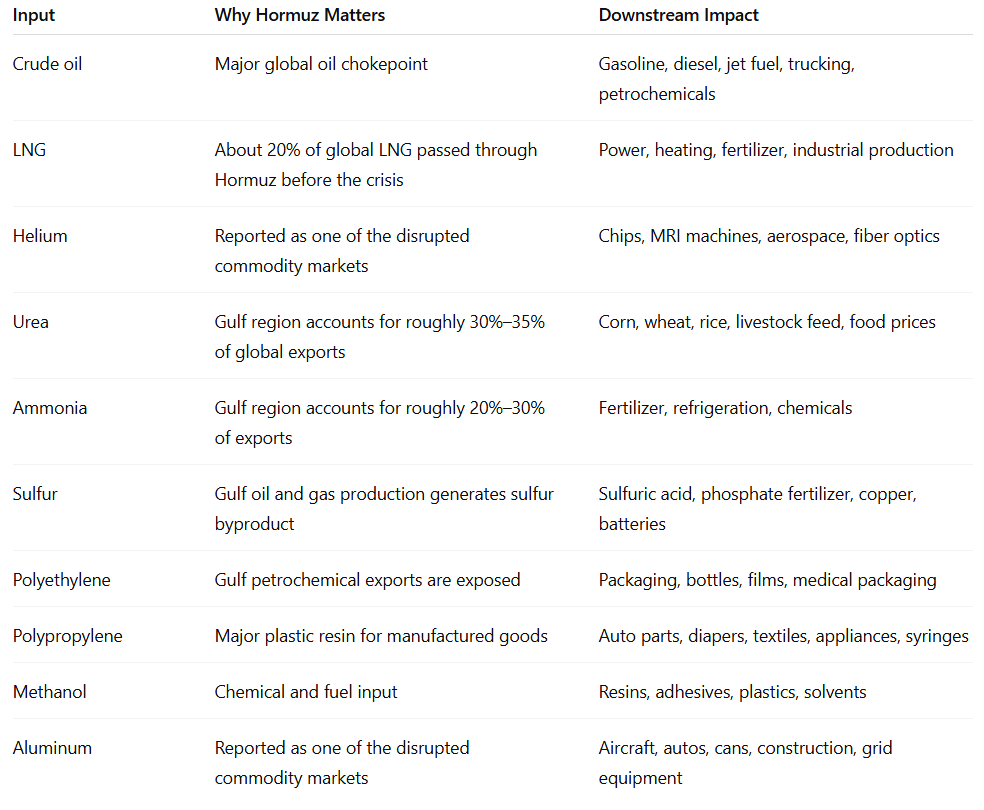
The Strait of Hormuz normally carries a massive share of the world’s energy trade. Before the crisis, about 25% of the world’s seaborne oil trade and about 20% of global liquefied natural gas passed through it. The Persian Gulf is also a major fertilizer hub, with the region accounting for roughly 30% to 35% of global urea exports, 20% to 30% of ammonia exports, and up to 30% of internationally traded fertilizers normally transiting the strait.
So when Hormuz shuts down, it does not simply raise prices at the pump.
It reaches into fertilizer, food, plastics, packaging, clothing, chips, hospitals, shipping insurance, aluminum, sulfur, and the hidden industrial materials that keep modern life running.
Hormuz does not just move oil. It moves the ingredients of the global economy.
Executive Summary
The Strait of Hormuz crisis began on February 28, 2026, when shipping through the waterway became largely blocked after the U.S. and Israel launched an air war against Iran. Iran announced on March 4 that the Strait was “closed,” then formalized restrictions on March 27 against vessels traveling to or from ports of the U.S., Israel, and their allies.
The oil shock came first. Brent crude crossed $100 per barrel on March 8 and later peaked around $126, as markets priced in prolonged supply disruption, shipping risk, and uncertainty. The closure has been described as one of the largest disruptions to world energy supply since the 1970s energy crisis.
The LNG shock is just as important. Roughly 20% of global LNG normally passes through Hormuz, and Gulf LNG is especially important to Asian and European buyers. If Qatari and UAE LNG cannot move normally, power, industrial heat, fertilizer, and petrochemical markets all tighten.
Fertilizer is in the blast radius. The Persian Gulf is a major hub for urea and ammonia exports, and up to 30% of internationally traded fertilizers normally move through the strait. That means farm input costs, crop yields, livestock feed, and food prices are all exposed. Longer-term, shortages threaten.
The real story is the cascade. Oil, LNG, helium, fertilizer, plastics, sulfur, aluminum, shipping insurance, and petrochemical feedstocks all connect to everyday goods: clothing, food packaging, medical devices, electronics, auto parts, diapers, batteries, construction materials, and chips.
1. The Timeline: From Warning to Shutdown
The Strait of Hormuz crisis escalated in stages.
February 28, 2026: The crisis begins
The crisis began when shipping through Hormuz became largely blocked after the United States and Israel launched an air war against Iran. Iran retaliated with missile and drone attacks on Israel, U.S. military bases, and U.S.-allied Gulf states. The IRGC then issued warnings forbidding passage through the strait.
Before this point, Hormuz was one of the busiest and most important energy corridors on Earth. After this point, it became a war-zone chokepoint.
March 4, 2026: Iran announces the Strait is “closed”
On March 4, Iran announced that the Strait of Hormuz was “closed” and threatened to attack any ship attempting to pass through it.
That is when the crisis shifted from market fear to operational shutdown.
Early March: Shipping traffic collapses
After the Iranian warnings and subsequent attacks, shipping firms began suspending operations in the strait. Tanker traffic reportedly dropped first by about 70%, with more than 150 ships anchoring outside the strait to avoid risk. Soon afterward, traffic reportedly dropped to about zero.
This is what makes the crisis so dangerous: The shipping system can freeze even before every vessel is physically blocked. Insurance, crew safety, charter terms, mine risk, and military warnings can shut down trade almost as effectively as a barricade.
March 27, 2026: The IRGC formalizes the blockade
On March 27, the IRGC announced that the strait was closed to any vessel going “to and from” the ports of the U.S., Israel, and their allies.
That turned the closure into something more targeted and political: Not simply “no ships,” but selective access based on alignment.
April 8, 2026: Ceasefire framework, but no clean reopening
A temporary ceasefire between Iran and the U.S. was agreed on April 8 and was supposed to involve reopening the strait. But Iran reportedly began controlling traffic and charging tolls of $2 million per ship instead.
In other words, the crisis shifted from “closed” to “controlled.”
For global trade, that distinction barely helps. If ships can only pass under threat, vetting, tolls, exceptions, and military risk, the route is not truly open in the commercial sense.
April 13, 2026: A dual blockade emerges
On April 13, the U.S. Navy began blockading Iranian ports. The situation was described as a “dual blockade,” with Iran blockading Gulf shipping and the U.S. Navy blockading Iran.
This matters because it hardened the crisis. The Strait was no longer just a single closure dispute. It became a broader maritime confrontation involving Gulf shipping, Iranian ports, U.S. naval power, and global trade. It’s a powder keg waiting for a spark.
April 17, 2026: Iran announces reopening during truce
On April 17, Iran announced that the Strait of Hormuz would be open to commercial shipping during the Israel–Lebanon truce. But restrictions were later reimposed as the U.S. blockade of Iran continued.
This is the pattern of the crisis: Announcements, partial openings, restrictions, reclosures, and uncertainty.
Markets hate uncertainty. Shipowners hate uncertainty even more.
April 21, 2026: Ships and mariners stranded
On April 21, the International Maritime Organization reportedly said that about 20,000 mariners and 2,000 ships were stranded in the Persian Gulf due to the closure.
That is not just a regional incident. That is a global logistics crisis.
May 4–6, 2026: U.S. escort operation, then pause
On May 4, President Trump launched Operation Project Freedom, a U.S. Navy mission to escort merchant ships out of the Gulf. Iran warned that this would violate the ceasefire. On May 6, Trump announced a temporary pause in the operation, citing “great progress” toward a possible agreement with Iran.
So as of now, the world is not dealing with a clean reopening.
It is dealing with a rolling chokepoint crisis.
2. Oil: The First Shock Everyone Feels
Oil is the first and most obvious casualty.
The Strait of Hormuz is one of the most important oil chokepoints in the world. Before the crisis, the strait carried around 25% of global seaborne oil trade, including crude and condensate shipments from major producers such as Saudi Arabia, the United Arab Emirates, Iraq, and Qatar. In 2024, an estimated 84% of crude oil and condensate shipments through the strait were destined for Asian markets.
When Hormuz closes or becomes too dangerous to transit, the market does not wait for every tank to run dry.
Prices move first.
Brent crude reportedly crossed $100 per barrel on March 8 for the first time in four years and later peaked around $126 per barrel. The crisis also produced a historically large monthly jump in oil prices in March 2026.
That feeds directly into:
Gasoline
Diesel
Jet fuel
Marine fuel
Farm diesel
Trucking
Air freight
Refining
Petrochemical feedstocks
For the United States, the key point is this: America may be less dependent on Gulf crude than many Asian economies, but it is not insulated from global prices.
Oil is globally priced.
If Asian refiners lose Gulf barrels, they bid for replacement crude from elsewhere. That pulls supply into new routes, tightens markets, and raises the global clearing price. Even domestic U.S. production does not fully shield American consumers from a global oil shock.
Diesel is the bigger economic pressure point.
Diesel moves trucks, farm equipment, construction machinery, mining equipment, rail freight, backup generators, and parts of the military logistics system. When diesel rises, nearly every physical good becomes more expensive to produce or move.
That is how an oil shock becomes a grocery shock, a clothing shock, and a manufacturing shock.
3. LNG: The Gas Shock Behind the Oil Shock
The second major pressure point is liquefied natural gas.
Before the crisis, about 20% of the world’s LNG passed through the Strait of Hormuz. Europe reportedly received 12% to 14% of its LNG from Qatar through the strait.
This matters because LNG is not just about heating homes.
Natural gas supports:
Power generation
Industrial heat
Fertilizer production
Petrochemicals
Refining
Hydrogen production
Glass, steel, and ceramics
Food processing
If Qatari and Gulf LNG cannot move normally, Asia gets hit first. Japan, South Korea, China, and India depend heavily on imported LNG. Europe also gets pulled into the bidding war when supplies tighten.
The U.S. has domestic natural gas, which gives it an advantage. But U.S. LNG exporters benefit from higher overseas prices, while American utilities and manufacturers worry that global demand can keep upward pressure on domestic prices over time.
The LNG shock also feeds into fertilizer.
Natural gas is the feedstock for ammonia.
Ammonia is the backbone of nitrogen fertilizer.
Nitrogen fertilizer is the backbone of modern food production.
That is why the LNG story quickly becomes a food story. And there’s another fertilizer aspect we haven’t talked about. Keep reading; we hit it in #5.
4. Helium: The Quiet Bottleneck for Chips and Hospitals
Helium is one of the most underappreciated risks in this crisis. Most people think of balloons. That is the least important use. Helium is essential for:
Semiconductor manufacturing (this one is HUGE)
MRI machines
Aerospace systems
Fiber optics
Cryogenic cooling
Quantum research
Leak detection
Advanced welding
Defense and space applications
The public crisis summary specifically identifies helium as one of the commodity markets suffering supply disruption and price increases due to the Hormuz closure.
That matters because helium is not easily replaced. It requires specialized production, purification, liquefaction, storage, and cryogenic transport. High-purity helium supply chains are fragile, concentrated, and difficult to reroute quickly.
If helium tightens, it will likely be rationed by importance.
Top priority goes to semiconductor fabs, medical imaging, aerospace, defense, and critical research. Lower-priority users face delays, allocations, or steep price increases.
This is how a maritime chokepoint becomes a chip problem. And a hospital problem.
A prolonged Hormuz crisis does not need to shut down every fab to hurt the semiconductor industry. It only needs to raise costs, disrupt specialty gas deliveries, or force allocation decisions across a supply chain that already runs on precision.
Read this for some real horror:
5. Urea, Ammonia, and the Fertilizer Shock
Fertilizer may be the most politically explosive second-order effect.
The Persian Gulf is a major global fertilizer hub. In the 2020s, the region accounted for roughly 30% to 35% of global urea exports and about 20% to 30% of ammonia exports. Overall, up to 30% of internationally traded fertilizers normally transit the Strait of Hormuz.
That puts food production directly in the blast radius.
Urea is one of the world’s most important nitrogen fertilizers. Ammonia is both a fertilizer and a building block for other nitrogen products. Sulfur and sulfuric acid are essential for phosphate fertilizer and mineral processing.
The chain reaction is simple:
Hormuz disruption
Less fertilizer trade
Higher fertilizer prices
Higher farm costs
Reduced fertilizer application
Lower potential crop yields
Higher food prices
Shortages
Potential for sustained starvation
This does not happen overnight. But it moves faster than you may imagine.
It moves through planting seasons, crop cycles, grain markets, livestock feed, meat, dairy, ethanol, and packaged foods.
The most vulnerable countries are major fertilizer importers: India, Brazil, parts of Africa, Southeast Asia, and other food-importing economies.
The U.S. is in a better position because it has domestic natural gas and nitrogen fertilizer production. But American farmers still face global prices for urea, ammonia, diesel, sulfur, phosphate inputs, freight, equipment, and credit.
For U.S. consumers, the fertilizer shock can eventually show up in:
Corn
Wheat
Rice
Soy
Livestock feed
Meat
Dairy
Eggs
Ethanol
Processed foods
This is why Hormuz is not just an energy story. It is a grocery story. It will become a major FOOD STORY. (Or lack thereof.)
6. Plastics, Packaging, Clothing, and Consumer Goods
The Gulf is not only an oil and gas region. It is also a petrochemical powerhouse.
That means a Hormuz shutdown can affect the chemical building blocks of daily life.
Key materials include:
Polyethylene
Polypropylene
Methanol
Naphtha
Ethane
Propane
Aromatics
Synthetic rubber
Solvents
Coatings
Adhesives
These materials become thousands of everyday products. Polyethylene is used in packaging film, bottles, bags, food packaging, medical packaging, and consumer containers.
Polypropylene is used in auto parts, appliances, carpets, textiles, diapers, syringes, food containers, and household goods.
Aromatics and petrochemical intermediates are used in polyester, nylon, dyes, resins, electronics materials, and coatings.
That is the clothing connection.
Modern apparel is deeply tied to petrochemicals. Polyester, nylon, acrylics, spandex, dyes, waterproof coatings, plastic buttons, hangers, packaging, and shipping materials all depend on energy and chemical supply chains.
Even cotton is indirectly exposed through fertilizer, diesel, irrigation, machinery, and freight.
So a Hormuz shutdown can raise the cost of both synthetic and natural-fiber clothing.
It can also raise the cost of:
Diapers
Food packaging
Medical supplies
Auto components
Appliances
Electronics casings
Cleaning products
Paints and coatings
Building materials
Shipping pallets and films
Consumers may not know polyethylene or polypropylene by name. But they buy them every day. And they’ll first be paying more and then won’t be able to find the products made from them (i.e., shortages).
7. Sulfur, Sulfuric Acid, Metals, and Batteries
Sulfur is another hidden pressure point.
Oil and gas production produces sulfur as a byproduct. Gulf producers are important suppliers. Sulfur is used to make sulfuric acid, one of the most important industrial chemicals in the world.
Sulfuric acid is used in:
Phosphate fertilizer (there’s that word again)
Copper processing
Nickel processing
Battery materials
Refining
Mining
Chemicals
Water treatment
If Gulf oil and gas production is reduced, sulfur recovery can fall. If shipping is disrupted, sulfur exports can be delayed or stranded. That pressures phosphate fertilizer and metals processing.
And that matters for:
Batteries
Wiring
Grid equipment
Defense hardware
Vehicles
Electronics
Construction
Renewable energy infrastructure
The chain looks like this:
Hormuz shutdown → oil and gas disruption → less sulfur recovery and export capacity → sulfuric acid pressure → fertilizer and metals stress → higher costs for food, batteries, copper, grid equipment, and industrial goods.
Aluminum is another exposed sector. The crisis summary identifies aluminum as one of the commodity markets suffering disruption and price increases due to the closure.
That matters because aluminum is used in aircraft, vehicles, cans, construction, power lines, solar equipment, electronics, and defense systems.
A disruption that starts with shipping can become a metals problem.
A metals problem becomes an infrastructure problem.
And that Ford F150 (link) you may have wanted to buy just got a lot more expensive.
8. Shipping Insurance: The Multiplier
One reason Hormuz is so dangerous is that shipping markets react before inventories run out.
Shipowners do not wait for a perfect legal definition of “closed.”
If crews are at risk, mines are present, vessels are being boarded, missiles are flying, and insurers are charging extreme premiums, commercial shipping freezes.
War-risk insurance premiums had already risen before the February attacks, from 0.125% to between 0.2% and 0.4% of vessel value per transit. By March 9, shipping insurance rates for the strait were reportedly four to six times higher than the previous week.
That is the multiplier. Even goods that technically exist become more expensive to move.
This affects:
Crude tankers
LNG carriers
Chemical tankers
Container ships
Dry bulk carriers
Fertilizer shipments
Petrochemical cargoes
Metals and minerals
Manufacturers do not need every input to disappear. They only need one critical input to arrive late.
A food company can have ingredients but no packaging.
A farm can have seed but no affordable fertilizer.
A chip fab can have power but not enough helium.
A hospital can have MRI demand but constrained helium supply.
A clothing maker can have fabric but higher dye, resin, fuel, and freight costs.
Supply chains break at the missing link.
9. Why the U.S. Is Safer—But Not Safe
The United States has real advantages. It produces large amounts of oil and gas.
It has domestic petrochemical capacity. It has a major agricultural base. It has some helium production.
It has Canada and Mexico nearby. It has Atlantic and Pacific ports outside the Gulf crisis zone.
But none of that makes the U.S. immune.
America is still exposed through:
Global oil prices
Diesel and jet fuel
LNG price spillovers
Fertilizer markets
Helium supply chains
Semiconductor gases
Plastics and packaging
Imported consumer goods
Shipping insurance
Food inflation
Defense logistics
Financial markets
The U.S. consumer may notice gasoline first. Then freight. Then groceries. Then packaged goods.
Then clothing, appliances, electronics, auto parts, medical supplies, and home-improvement materials.
The longer the disruption lasts, the more visible the damage becomes. And potentially, the harder it is to return to “normal.”
The Critical Materials Map
What Policymakers Should Do Now
The response cannot be only about oil. Strategic petroleum releases may help fuel markets in the very near-term, but they do not solve LNG, helium, fertilizer, sulfur, plastics, aluminum, or shipping insurance.
A serious response should include:
1. Prioritize critical gases
Helium should be directed first to semiconductor fabs, MRI machines, aerospace, defense, and critical research.
The tradeoff: Lower-priority users will face rationing and higher prices.
2. Secure fertilizer before planting windows
Governments and large buyers should coordinate urea, ammonia, sulfur, and phosphate procurement before panic buying makes shortages worse.
The tradeoff: Emergency tenders and subsidies can raise prices if countries bid against each other.
It quite possibly is already too late.
3. Coordinate with allies
The U.S., Europe, Japan, South Korea, India, and food-importing economies should coordinate energy, fertilizer, and critical-material supply instead of fighting over the same cargoes.
The tradeoff: Domestic politics make coordination difficult when prices rise.
The U.S. has done a lousy job at collaborating and cooperating with our allies.
4. Build inventories beyond oil
The U.S. and allies need strategic buffers for helium, fertilizer inputs, specialty gases, sulfur, selected resins, medical gases, and semiconductor materials.
The tradeoff: Stockpiling costs money and can distort markets, but not having buffers is worse during a crisis.
Again, it’s most likely too late.
5. Expand alternative supply routes
Saudi pipelines, UAE ports outside the Strait, Oman routes, Red Sea routes, and Atlantic Basin suppliers can help, but they cannot fully replace normal Hormuz flows.
The tradeoff: Alternative routes can become chokepoints themselves.
6. Re-shore and friend-shore critical inputs
Domestic or allied production of ammonia, urea, helium, specialty gases, petrochemicals, and critical minerals would reduce vulnerability.
The tradeoff: New capacity takes years, costs capital, and faces permitting and environmental hurdles.
What Businesses Should Do
Companies should not ask only whether they buy directly from the Gulf.
They should ask:
Which of our suppliers depend on energy, shipping, chemicals, fertilizer, gases, or materials that pass through Hormuz?
Businesses should review:
Fuel contracts (this is what recently killed Spirit Airlines—link)
Freight contracts
War-risk insurance clauses
Force majeure language
Fertilizer procurement
Resin and packaging supply
Specialty gas supply
Single-source inputs
Inventory levels
Supplier geography
Alternate transport routes
The companies that map second- and third-tier supplier exposure fastest will be in the best position.
The ones that wait for shortages to hit invoices will be late. TOO LATE.
What Consumers Should Expect
Not everything rises at once. Some companies have inventories. Some have long-term contracts. Some absorb costs temporarily. Others pass costs through quickly.
All consumer goods will get more expensive and shortages will creep in, first slowly, and then very quickly.
The longer Hormuz remains closed, controlled, mined, tolled, or too dangerous for normal transit, the more the shock spreads.
A short disruption is a price spike. A long disruption is a supply-chain redesign.
A long disruption with military escalation is an industrial crisis. We are here now, IMHO.
Count on an even longer shutdown.
You can thank Trump for this.
What a read<3 What a mess! and F Trump!!!