


The Morning Sixpack stays free because the news that shapes your life should not be hidden behind a paywall. Paid subscribers are not paying for access. They are helping fund the research, writing, and independent voice that goes into every issue. Become a paid subscriber and help keep smart, honest news analysis free for everyone.
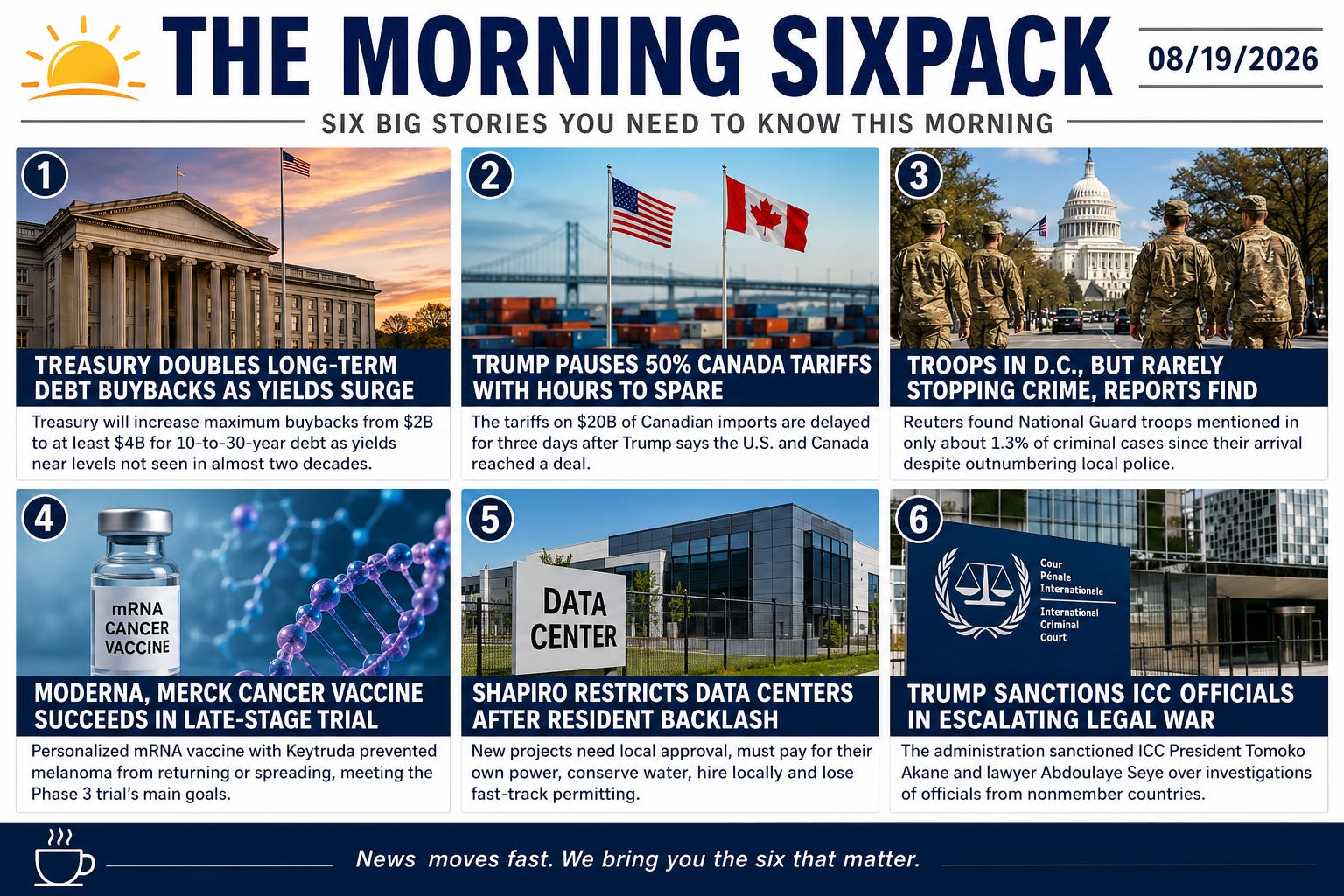
Treasury is doubling down on long-term debt buybacks to calm a stressed bond market—because apparently when yields start screaming, Washington reaches for a bigger checkbook. If this isn’t a sign, I don’t know what is…
Treasury Doubles Long-Term Debt Buybacks as Bond Yields Flash Warning Signs
The Treasury Department is more than doubling the size of its long-term government debt buybacks, targeting a battered corner of the bond market where yields have surged to levels not seen in nearly two decades. Led by Treasury Secretary Scott Bessent, the department will increase maximum buybacks from $2 billion to at least $4 billion for debt in the 10-to-20-year and 20-to-30-year ranges, where buyers have been scarce since late June.
The market got the message immediately: Treasury is willing to put serious money behind keeping the long end of the bond market from coming unglued.
Yields dropped hard after the announcement, while stock futures jumped. The benchmark 10-year Treasury yield fell 6 basis points to 4.647%, while the 30-year yield dropped 9 basis points to 5.196%. The expanded program begins Sept. 9 and runs through Nov. 4. Treasury said the increase reflects its desire to provide “greater liquidity support in longer-dated nominal sectors,” pointing to the volume of quality offers it receives during existing buyback operations.
The maneuver could entice buyers back into long-term Treasuries and punish traders betting aggressively against bonds, but it doesn’t make the underlying fiscal math disappear. Evercore ISI’s Krishna Guha said the move could “help crowd in potential buyers” and trigger short-covering, but added that it changes “almost nothing” about the need to finance huge government deficits alongside a wave of AI-related corporate borrowing. RSM chief economist Joe Brusuelas went further, arguing that Treasury’s attempt to restrain yields could complicate the Federal Reserve’s inflation fight and accusing Bessent of focusing on the upcoming election rather than price stability.
And here’s the part worth remembering when somebody inevitably sells this as Washington fixing the debt problem: It isn’t. Higher term premiums, changing Treasury buyers, massive government borrowing, and surging corporate debt issuance are still sitting there waiting after the buybacks are finished. As One Point BFG Wealth Partners CIO Peter Boockvar put it: “This is NOT a debt paydown, it is just a rearrangement of the maturity schedule of Treasuries.”
Editor: Treasury can rearrange the chairs, buy a few of them back and encourage Wall Street to stop throwing the rest overboard. What it can’t do with a $4 billion buyback is make America’s much larger borrowing problem magically vanish. By the way, $4 billion is an ass pissing in the wind.
Source: CNBC
Trump threatened Canada with 50% tariffs, marched the deadline to the edge, and then paused them for three days after claiming a deal—another helping of TACO, although this time he may have extracted concessions before leaving the table.
Trump TACO Trades Again, Pausing 50% Canada Tariffs with Hours to Spare
President Donald Trump delayed threatened 50% tariffs on $20 billion worth of Canadian imports less than two hours before they were supposed to take effect, announcing a three-day pause after the U.S. and Canada reached what he called a deal (another “MOU” LOL?). Hockey sticks and tongue depressors can stand down—for three days, anyway.
Threaten massive tariffs, rattle markets and allies, then find an off-ramp at the deadline: Yes, the TACO trade is back on the menu.
Trump announced the pause on Truth Social, writing: “I have paused the 50% Tariffs against Canada, that were scheduled to kick in tomorrow morning for a three day period, based on the fact that Canada and the U.S.A., subject to the finalization of documents, have a DEAL!”
The White House says Canada committed to removing measures Washington considers discriminatory against U.S. alcohol, dairy, and auto exports, although Canada did not immediately confirm those specific concessions. Prime Minister Mark Carney said only that “substantial progress” had been made and that important work remains.
Both sides had plenty of incentive to avoid another trade war. Nearly 72% of Canada’s goods exports went to the U.S. last year, while Canada had threatened retaliatory tariffs if Trump’s 50% levies took effect. American importers would pay the tariffs and could pass those costs along to consumers—not exactly ideal politics heading toward November’s midterms with voters already aggravated by the cost of living. Canadian Chamber of Commerce CEO Candace Laing called the delay a relief but added, “This limbo state is not anyone’s preferred outcome.”
The bigger story is Trump’s increasingly creative search for tariff authority after the Supreme Court struck down his sweeping tariffs in February. This time he invoked Section 338 of the Tariff Act of 1930, a never-before-used provision allowing tariffs as high as 50% against countries deemed to discriminate against American businesses. That gives Trump another negotiating weapon as the U.S., Canada, and Mexico renegotiate the USMCA (you know, NAFTA II).
So did Trump TACO? For now, yes: The tariff threat got delayed before anybody had to swallow it. But if Canada actually made meaningful concessions, Trump will argue the threat did exactly what it was supposed to do. We’ll know more when the “DEAL!” gets actual signed documents. And even then, will we really be sure? Trump renegs on lots of agreements.
Editor: TACO doesn’t necessarily mean the tactic failed. If you threaten a 50% tariff, get concessions, and never collect the tariff, that’s negotiation. If you threaten it, declare victory, and spend three days figuring out what everyone actually agreed to, that’s Taco Tuesday with paperwork.
Source: NPR
Trump deployed thousands of National Guard troops to Washington to fight crime, but a Reuters review found soldiers involved in just 1.3% of D.C. criminal cases—and sometimes they were the victims.
Trump Put 4,500 National Guard Troops in D.C.—Reuters Found They Rarely Stop Crime
President Donald Trump has roughly 4,500 National Guard troops deployed across Washington, D.C., but a Reuters examination of court records found the soldiers mentioned in only about 1.3% of criminal cases filed since their arrival last August. They now outnumber the city’s roughly 3,200 police officers, which is quite a military footprint for a force whose official mission largely amounts to being conspicuously present.
Washington got thousands of soldiers, a potentially billion-dollar tab, and one unavoidable question: Is this fighting crime or staging a very expensive show of force?
Reuters reviewed every publicly available charging document filed in D.C. Superior Court and found 217 criminal cases mentioning National Guard involvement. In just 62, soldiers independently stopped someone suspected of a crime, often for minor offenses such as shoplifting or fare evasion; in another 43, they helped police make arrests. Among the incidents: Soldiers chased a man accused of taking two pizza slices, detained someone accused of stealing about $7 worth of beef jerky, and, in another case, six soldiers held a woman accused of drinking a root beer without paying. The troops have limited law-enforcement authority, meaning they can detain suspects but generally need police to make the arrest.
The deployment isn’t cheap. The administration previously told Congress it cost about $1.65 million per day before the troop presence was doubled this summer, compared with a D.C. police budget of roughly $1.5 million per day. The administration plans to maintain a military presence through the end of Trump’s presidency in 2029 at an estimated cost of $1.4 billion. Reuters also found little evidence that troops were operating in the neighborhoods suffering most from serious violence: Court records contained no references to Guard law-enforcement activity in areas accounting for about 82% of Washington’s 859 murders during the previous five years. The White House says Trump’s efforts have “driven down crime, beautified the city, and improved quality of life for countless individuals.”
Washington’s murder count has fallen for a third consecutive year, but that doesn’t establish that the Guard caused the decline—homicides have also fallen in cities without comparable deployments, and D.C.’s overall reported violent crime between January and mid-August was about 4% higher than last year. A May Niskanen Center study found the deployment reduced vehicle theft but had no effect on violent crime, while Heritage Foundation senior fellow Charles Stimson argues the troops provide deterrence simply through their visibility. Former National Guard Bureau deputy chief Gen. Randy Manner offered a much less enthusiastic assessment: “You do not want armed soldiers on the streets of America.”
Editor: If 4,500 troops are stopping car thefts and discouraging some crime, that’s worth acknowledging. But when soldiers outnumber the city’s cops, cost more than the police department, and are chasing pizza thieves while barely appearing in the neighborhoods where most murders occurred, somebody should probably ask whether Washington bought a crime strategy or America’s most expensive neighborhood watch.
Source: Reuters
Moderna and Merck’s personalized mRNA cancer vaccine succeeded in a late-stage melanoma trial, potentially opening an entirely new chapter for cancer treatment—and reminding everyone that mRNA was never supposed to stop with COVID.
Moderna’s mRNA Cancer Vaccine Clears a Major Test—and Its Stock Goes Vertical
An experimental personalized mRNA cancer vaccine from Moderna and Merck succeeded in preventing high-risk melanoma from returning or spreading in a late-stage trial, marking the first successful Phase 3 study of a personalized mRNA cancer therapy. Investors didn’t need six weeks to process that news: Moderna shares more than doubled Wednesday morning, while Merck jumped more than 10%.
This isn’t a vaccine designed to prevent cancer—it’s a custom-built treatment teaching a patient’s immune system to hunt down the cancer they already had.
The treatment, called intismeran, was combined with Merck’s blockbuster immunotherapy Keytruda and tested against Keytruda alone in more than 1,000 melanoma patients whose tumors had been surgically removed. The trial met its primary goal of extending the period before cancer returned and also met a secondary goal of preventing melanoma from spreading to other organs. Merck oncology executive Jane Healy summed up the possibilities nicely: “I have a feeling that this is just the beginning of a new field.”
Here’s where it gets fascinating. Doctors take a blood sample and biopsy from the patient’s tumor, analyze its genetic profile, and identify mutations likely to trigger an immune response. Moderna then encodes those targets into mRNA and manufactures a personalized vaccine specifically for that patient, a process taking roughly six weeks. Earlier studies found that intismeran plus Keytruda reduced the risk of melanoma recurrence or death by 49% compared with Keytruda alone. Trials are also underway in bladder, kidney, and a common form of lung cancer.
There are still some very important asterisks. Moderna and Merck haven’t yet released detailed Phase 3 numbers showing exactly how much longer patients remained cancer-free or overall survival data; those results are expected at a medical conference later this year. Personalized vaccines are also complicated and expensive to manufacture, and proving that this approach works across multiple cancers will be critical. But Moderna hopes to put the treatment on the market in 2027, potentially giving the company an entrance into the $240-billion-plus cancer-drug market. CEO Stéphane Bancel didn’t bother underselling the moment: “We are now an oncology company.”
Editor: Moderna became a household name because of COVID, but this was always the bigger mRNA dream: Program medicine to recognize the biological fingerprints of an individual’s disease. One successful trial doesn’t cure cancer, and we still need the actual Phase 3 numbers. But personalized vaccines that can keep cancer from coming back? Yeah, that’s a scientific development worth watching very closely.
Source: The Wall Street Journal (free)
Pennsylvania Gov. Josh Shapiro went from pitching data centers as part of America’s AI race to cracking down on speculative projects—a reminder that the AI boom looks different when somebody wants to build the server farm next door.
Josh Shapiro Slams the Brakes on Pennsylvania’s AI Data Center Gold Rush
Pennsylvania Gov. Josh Shapiro is imposing major new restrictions on data centers, requiring local approval, eliminating fast-track permitting, and forcing developers to commit to paying their own power costs, hiring locally, and conserving water. For an industry accustomed to governments rolling out the red carpet, Pennsylvania just replaced it with a zoning meeting.
The AI boom has officially collided with the oldest force in American politics: Voters who don’t want somebody else’s economic revolution dropped in their backyard. #NIMBY? Yes.
Shapiro’s executive order marks a sharp change in tone from a governor who previously promoted Pennsylvania as a potential leader in the AI and data center boom. He says the state has been flooded with roughly 100 speculative proposals since announcing two major Amazon-backed projects last year, even though only about five projects have received permits. Data center developers will now need local approval, won’t qualify for Pennsylvania’s expedited permitting program, and won’t be allowed to use nondisclosure agreements around projects.
“We will not be bullied by these developers,” Shapiro said. “We will not be bulldozed by the lawyers working for these big tech companies.”
The politics aren’t exactly hiding behind the server racks. Shapiro faces re-election this fall and remains a potential Democratic presidential contender in 2028, while opposition to data centers is spreading across the country. Residents have raised concerns about electricity prices, enormous power demands, water consumption, environmental impacts, and the transformation of local communities. Shapiro says his change in approach came from listening to those residents, and he was especially emphatic about projects he believes are trying to steamroll local opposition: “I’m a hell no on that project,” he said of one proposal, adding, “I’m a hell no on many other projects.”
Pennsylvania isn’t alone. Democratic New York Gov. Kathy Hochul signed a data center development moratorium last month, while Republican Texas Gov. Greg Abbott paused audit data center projects this month. Meanwhile, President Trump’s administration continues promoting data center construction as a pillar of America’s AI strategy while pushing a “Ratepayer Protection Pledge” intended to make developers cover the additional electricity generation and infrastructure their projects require. The industry argues the facilities bring jobs, tax revenue, and investment. Increasingly, politicians in both parties are answering: Fine—but prove the benefits and don’t stick everybody else with the bill.
Editor: AI may live in “the cloud,” but the cloud apparently needs several acres, a small ocean of water, and enough electricity to make your utility company start sweating. Shapiro isn’t rejecting AI—he’s telling developers that if they want Pennsylvania to host the infrastructure, the neighbors get a vote and the taxpayers don’t automatically get the check.
Source: NBC News
The Trump administration sanctioned two more International Criminal Court officials as part of a broader campaign against the tribunal—Washington isn't merely refusing to recognize the ICC's authority anymore; it's going after the people exercising it.
Trump Escalates War with the ICC, Sanctioning Its President and Senior Lawyer
The Trump administration sanctioned International Criminal Court President Tomoko Akane and senior trial lawyer Abdoulaye Seye, escalating its campaign against a court pursuing Israeli Prime Minister Benjamin Netanyahu and asserting jurisdiction over officials from countries that never joined it.
Apparently Washington’s latest international legal argument comes with asset freezes.
This fight is no longer simply about whether America recognizes the ICC—it’s about whether the United States should use its economic power to punish the judges and lawyers who run it.
Secretary of State Marco Rubio said Akane and Seye were “directly engaged in efforts by the ICC to investigate, arrest, detain, or prosecute officials whose government has not consented to ICC jurisdiction.” The U.S. isn’t a party to the Rome Statute that created the court, and Washington’s objections aren’t exclusively Trump-era: The Biden administration also rejected the ICC’s 2024 arrest warrants for Netanyahu and former Israeli Defense Minister Yoav Gallant. Trump, however, has gone considerably further, using sanctions, visa restrictions, and diplomatic pressure against the institution itself.
The administration says the ICC threatens American sovereignty by claiming authority over citizens of countries that never agreed to its jurisdiction. Rubio launched a broader campaign last month that includes encouraging countries to leave the court and pressing U.S. allies to reject ICC authority over American officials and military personnel.
Netanyahu welcomed the latest sanctions and called the ICC a “kangaroo court.” The other side sees something considerably more ominous: The Netherlands defended the Hague-based court, while U.N. special rapporteur Margaret Satterthwaite said sanctioning judges and lawyers for their work undermines access to justice. Amnesty International characterized the move as an effort to shield powerful people from accountability.
And that’s the fundamental argument underneath all the diplomatic artillery. Washington says an international tribunal the United States never joined shouldn’t get to prosecute Americans—or officials of other nonmember countries—without their governments’ consent. The ICC and its defenders argue that allowing powerful governments to neutralize prosecutors with economic sanctions threatens the very idea of international accountability for genocide, war crimes, and crimes against humanity. Trump has picked his side emphatically, and his administration now appears determined not merely to ignore the ICC but to weaken its ability to operate.
Editor: You don’t have to love the ICC to see the stakes here. “Who gave these judges authority over us?” is a legitimate sovereignty question. “Should we financially sanction judges for exercising the authority they claim to have?” is a much bigger one—and that’s the argument Washington just turned up to eleven.
Source: UPI