


The Morning Sixpack stays free because the news that shapes your life should not be hidden behind a paywall. Paid subscribers are not paying for access. They are helping fund the research, writing, and independent voice that goes into every issue. Become a paid subscriber and help keep smart, honest news analysis free for everyone.
Bond traders are once again reminding everyone that the government’s borrowing habit eventually comes with a price tag.
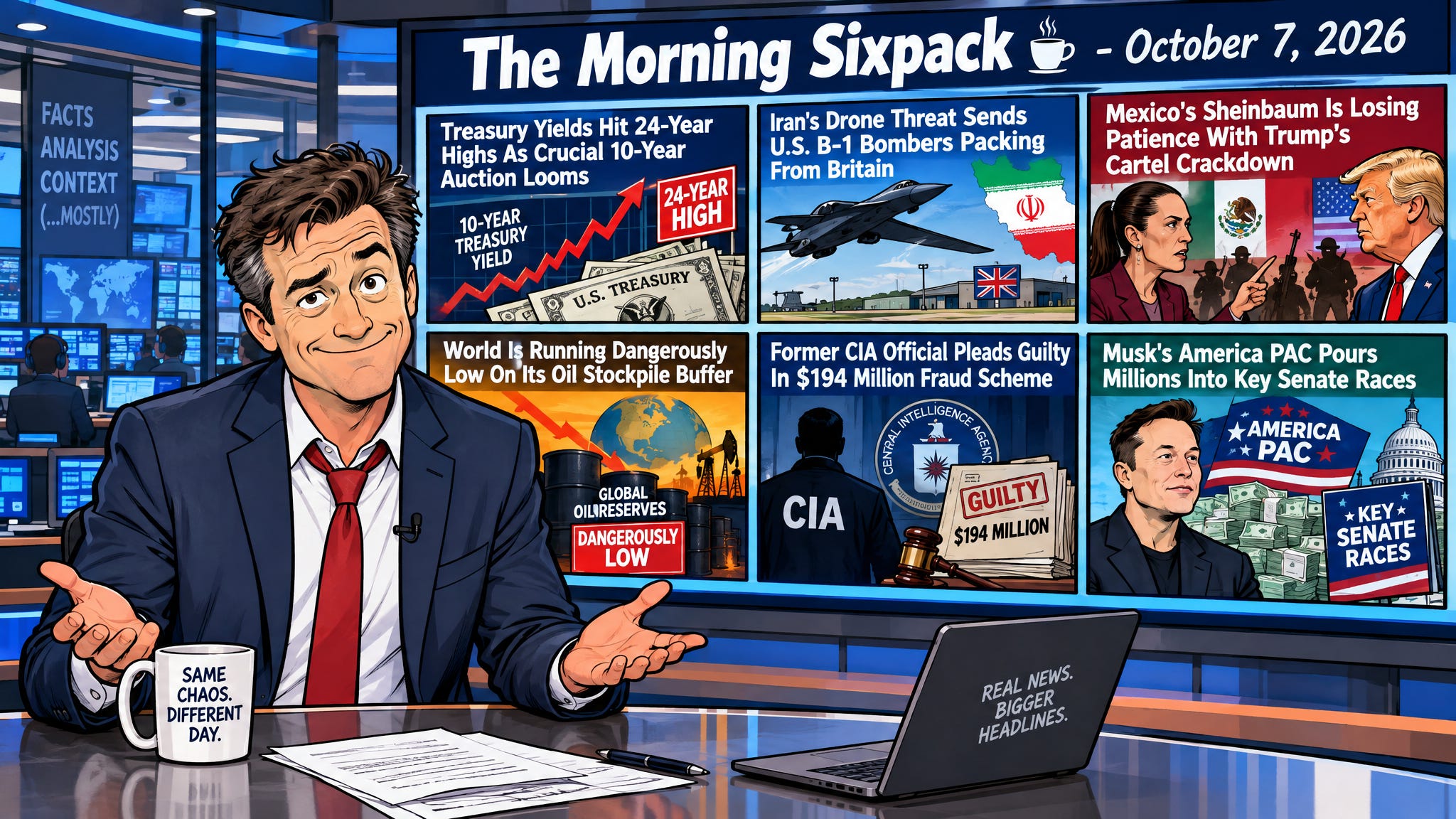
Treasury Yields Hit 24-Year Highs As Crucial 10-Year Auction Looms
U.S. Treasury yields surged Wednesday, with the benchmark 10-year yield climbing nearly 8 basis points to 5.35%, its highest level since 2002. The 30-year Treasury yield jumped 8.3 basis points to 5.724%, also reaching a 24-year high, while the 2-year yield rose 2.7 basis points to 4.818%. The latest move extends a brutal stretch for bonds as investors wrestle with inflation, rising energy prices, and concerns about the government’s growing debt load.
The immediate test comes Wednesday afternoon, when the Treasury Department auctions $39 billion in 10-year notes. Investors will be watching closely to see whether yields have climbed high enough to attract strong demand—or whether buyers will insist on an even bigger premium to absorb all that government debt. The results are due at 1 p.m. ET and could help set the tone for rates well beyond Wednesday’s trading session.
The auction is the second of three major Treasury sales this week. The government sold $58 billion in 3-year notes Tuesday and plans to sell $22 billion in 30-year bonds Thursday. BMO’s Head of U.S. Rates Strategy Ian Lyngen said Tuesday’s auction produced an encouraging reception, but cautioned that the 10-year sale is “far more relevant for setting the tone in US rates.” Treasury will also conduct a buyback Thursday targeting bonds with maturities between 20 and 30 years, with the liquidity-support operation totaling at least $4 billion.
The broader bond selloff has been fueled in part by persistent inflation concerns and sharply higher energy prices. The 10-year Treasury yield has risen about 60 basis points since the end of July, while U.S. crude prices have climbed roughly 20% over the same period. The pressure isn’t confined to the United States either: France’s 10-year bond yield jumped 12 basis points to 4.876%, while the U.K.’s 10-year gilt yield climbed 7 basis points to 5.447%.
Investors also have a pair of potentially market-moving economic signals coming Wednesday. The New York Fed will release its monthly consumer expectations survey at 11 a.m. ET, including inflation expectations over one-, three-, and five-year horizons. Then at 2 p.m. ET, the Federal Reserve will release minutes from its September meeting, when policymakers voted to raise interest rates for the first time since 2023. With yields already sitting near quarter-century highs, traders will be combing through every Fed sentence looking for clues about whether more tightening is coming.
Editor: When Uncle Sam needs buyers for another $39 billion in IOUs, 5.35% suddenly starts looking less like a yield and more like a sales pitch.
Source: CNBC
Iran may be badly outgunned, but it has discovered that making a superpower nervous can be almost as useful as beating one.
Iran’s Drone Threat Sends U.S. B-1 Bombers Packing From Britain
The United States quietly pulled a dozen B-1 bombers out of a British air base after intelligence warned that Iran might be preparing a potentially devastating swarm-drone attack. The evacuation from RAF Fairford came just days after Defense Secretary Pete Hegseth declared that the U.S. had “destroyed” Iran’s navy, air force, leadership, and defense base. The contrast underscored an uncomfortable reality: Iran may have lost much of its conventional military power, but it can still force Washington to react.
Iran has increasingly relied on asymmetric tactics—including drones, proxies, and threats of unconventional attacks—to create problems its battered conventional forces cannot. Iranian drone attacks have damaged U.S. bases in the Middle East and killed American troops, while Tehran’s Houthi allies have struck targets in Saudi Arabia. Iran has also targeted oil shipping in the Strait of Hormuz, where attacks hit more than 10 ships over the past week and helped give Tehran leverage over a critical artery for global energy supplies.
The Fairford episode shows just how effective the threat alone can be. U.S. officials said multiple intelligence streams suggested Iran might attempt something resembling Ukraine’s 2025 Operation Spider’s Web, which used small armed drones smuggled in trucks to destroy more than a dozen Russian military aircraft. British police became alarmed after three white cargo vans approached Fairford, but searches ultimately found no drones, explosives, or weapons—only gasoline canisters—and five detained suspects were released on bail.
The uncertainty hasn’t stopped Iran from scoring what former security officials described as at least a symbolic victory. Moving the bombers back to South Dakota and other U.S. bases means they would have to fly thousands of additional miles if American strikes against Iran resume, although former senior CIA official Norman Roule said the move does not meaningfully restrict U.S. military options. More broadly, Roule said Iran’s use of drones and cyber capabilities is forcing Western militaries to rethink how supposedly secure bases are protected.
Iran has also demonstrated that merely suggesting it can reach Western targets can have strategic value. Experts say Tehran increasingly relies on criminal proxies for sabotage operations in Britain, while an alleged Iranian assassination threat previously prompted extraordinary security measures to protect President Trump. International Crisis Group analyst Ali Vaez said the Fairford threat may have been designed less to produce an actual attack than to ensure Western intelligence agencies realized Iran could potentially extend the battlefield into Europe.
Editor: Declaring your enemy “decimated” hits a little differently when you’re simultaneously moving a dozen bombers thousands of miles farther away just in case.
Source: The Washington Post
Mexico’s president is learning that cooperating with Washington gets complicated when Washington starts sanctioning people connected to your own political party.
Mexico’s Sheinbaum Is Losing Patience With Trump’s Cartel Crackdown
Mexican President Claudia Sheinbaum is taking a harder line against the Trump administration as U.S. sanctions and corruption allegations increasingly target officials connected to her ruling Morena party. The latest confrontation came after the U.S. Treasury prepared sanctions against former Mexican officials accused of taking bribes to protect the Sinaloa cartel. Sheinbaum angrily challenged her own security officials over plans to freeze the officials’ Mexican bank accounts, questioning whether Washington had provided sufficient evidence. She ultimately approved the freezes, recognizing that refusing could further strain relations with the United States.
The dispute marks a notable shift for a president whose first two years featured close cooperation with American law enforcement. Sheinbaum has recently accused the U.S. of interfering in Mexican affairs while pushing back against President Trump’s repeated claims that Mexico is controlled by drug cartels. “We Mexicans don’t want interference, interventionism, or violations of our territorial integrity,” she told tens of thousands of supporters in Mexico City. At the same time, former Mexican security official Alberto Capella warned that cooperation with the U.S. remains essential to successfully fighting the cartels.
The latest Treasury action sanctioned 21 people allegedly connected to the Sinaloa cartel, including officials accused of accepting bribes to protect cartel operations at border crossings in Tijuana and Mexicali. At the center of the alleged operation is Carlos Torres, the former husband of Baja California Gov. Marina del Pilar Ávila. The Treasury described Torres as a political operator allied with a Sinaloa cartel boss who used his influence to shield cartel activity from law enforcement. Ávila herself was not sanctioned and has denied wrongdoing.
The sanctions are part of a growing series of U.S. actions involving figures connected to Morena. The Trump administration has also indicted former Sinaloa Gov. Rubén Rocha and revoked the U.S. visa of a son of former President Andrés Manuel López Obrador, Sheinbaum’s political mentor and predecessor. Sheinbaum forced Rocha to resign but has rejected an American request to extradite him, arguing that Mexico has not been given sufficient evidence supporting the accusations. “First they come for some, then for others, until offices of the Department of Justice decide elections in Mexico,” she warned earlier this year.
Mexico’s Financial Intelligence Unit nevertheless blocked accounts belonging to companies and individuals sanctioned by Washington after identifying what it called risky transactions and financial irregularities. That leaves Sheinbaum balancing two politically difficult positions: demonstrating that Mexico is serious about cartel corruption while resisting the appearance that Washington can dictate who gets investigated or punished inside Mexico. The dispute is becoming especially sensitive as allegations increasingly touch politicians and associates within her own governing coalition.
Editor: Fighting cartels together is apparently the easy part. Things get awkward when your partner starts pointing at people on your side of the table.
Source: The Wall Street Journal
The world spent its oil cushion getting through one crisis after another, and now winter is approaching with considerably less padding between “tight market” and “oh, crap.”
World Is Running Dangerously Low On Its Oil Stockpile Buffer
The global oil market is rapidly running through the inventories it normally relies on to cushion major supply disruptions, leaving energy prices increasingly vulnerable to another shock. Saudi Aramco CEO Amin Nasser said less than 6 billion barrels remain in commercial inventories worldwide, with most of that oil not practically available to the market. More than 1 billion barrels have already been released, primarily from onshore commercial inventories, since this year’s Middle East crisis began. Nasser said the system is already under significant strain.
The International Energy Agency is now preparing another 100-million-barrel release of crude oil and diesel in an effort to ease soaring diesel prices. But that amount represents roughly one day of global oil consumption, which the IEA estimates at about 102 million barrels per day. Nasser said negotiations over even that release were difficult because inventories are reaching stress levels and only 10% or less of existing stocks may actually be available. It is also unclear whether some of the announced 100 million barrels includes oil from the IEA’s record 400-million-barrel release in March that has not yet reached the market.
The problem is that the headline inventory number overstates how much usable oil is really sitting around waiting for an emergency. Some crude is effectively unavailable because it sits at the bottom of storage tanks or inside pipelines, while governments require minimum levels of strategic reserves to remain untouched. Chevron CEO Mike Wirth said the disappearance of these buffers has made the oil market more fragile and pushed up the floor underneath prices. Industry executives warned that rebuilding inventories while simultaneously satisfying normal global demand could take years.
That leaves the world increasingly dependent on oil continuing to flow out of the Middle East. Vitol CEO Russell Hardy said seaborne exports from the region will be critical to keeping markets balanced through the winter because there are essentially no additional inventories available to drain in the West. Saudi Aramco says there is already heavy demand worldwide for additional storage capacity, while Kuwait Petroleum Corporation is planning to expand storage both domestically and at overseas refineries.
The United States doesn’t have much room to brag about its emergency cushion either. Crude stocks in the U.S. Strategic Petroleum Reserve have fallen to their lowest level since October 1982, according to Department of Energy data. Natural gas inventories are also depleted, creating another potential pressure point if winter weather turns severe. Petronas CEO Tengku Muhammad Taufik warned that a bad winter could produce a “bloodbath” in the natural gas market during the first quarter of 2027 if storage falls to minimum levels.
Editor: Strategic reserves work wonderfully during emergencies. The tricky part comes when you have several emergencies in a row and discover “reserve” wasn’t supposed to mean “bottomless barrel.”
Source: Reuters
Inventing a classified CIA program is one way to build a Florida real-estate portfolio—right up until the FBI finds 300 gold bars in your basement.
Former CIA Official Pleads Guilty In $194 Million Fraud Scheme
A former senior CIA official pleaded guilty Tuesday to wire fraud after prosecutors said he abused his government authority to obtain luxury Florida properties, hundreds of gold bars, and other benefits in a scheme that cost taxpayers roughly $194 million. David J. Rush, 49, fabricated a “highly classified” government program to justify acquiring properties in Palm Beach and Hobe Sound that he intended to resell for personal profit. Prosecutors say he separately invented a “sensitive government activity” to obtain gold worth more than $40 million. He also authorized more than $1.8 million in privately chartered flights for his personal use at government expense.
Investigators eventually searched Rush’s Virginia home and found approximately 300 gold bars, about $2 million in cash, and roughly 35 luxury watches. Previous court filings valued the gold at approximately $46 million. Prosecutors said Rush had directed another person to transfer roughly $145 million from a government contract into a holding company created at his direction, then used the money to purchase four luxury properties in Florida. He also allegedly attempted to fraudulently authorize the release of another $100 million from a government contract.
Rush’s misconduct extended beyond money, according to prosecutors. During questioning, he admitted giving a foreign government official information identifying a secret U.S. government source, although court documents did not identify the foreign country involved. Prosecutors also said Rush used his legitimate government authority alongside fabricated credentials to convince colleagues and contractors that his invented programs were real and had approval from senior U.S. officials.
Authorities say Rush also lied extensively about his own background, claiming he had been a Navy pilot and had earned degrees from Clemson University and Rensselaer Polytechnic Institute. Investigators determined that he had not attended either school and had never served as a Navy pilot. Rush did serve in the Navy, enlisting in 1997 before eventually being honorably discharged from the Navy Reserve as a lieutenant in 2015. Prosecutors additionally accused him of fraudulently collecting tens of thousands of dollars in military-leave compensation after his discharge.
Rush pleaded guilty to one count of wire fraud and faces a maximum sentence of 20 years in prison when he is sentenced Jan. 28 in Alexandria, Virginia. CIA Director John Ratcliffe said the agency referred the matter to the FBI after an internal investigation uncovered evidence of wrongdoing. Attorney General Todd Blanche said federal employees are entrusted to serve the public rather than themselves. Rush has remained jailed without bond since his arrest.
Editor: When investigators find 300 gold bars, $2 million in cash, and 35 luxury watches at your house, “basically a nonissue” becomes a pretty ambitious defense strategy.
Source: NPR
Elon Musk’s political machine is spending less than it did in 2024, but this time it’s aiming the money like a laser at the Senate.
Musk’s America PAC Pours Millions Into Key Senate Races
Elon Musk’s America PAC has concentrated $21 million of its $26.7 million in 2026 election spending on just seven closely watched U.S. Senate races. The strategy represents a major shift from 2024, when the super PAC spent $261 million and devoted more than 90% of its spending to the presidential race. This year, the operation is heavily focused on helping Republicans hold the Senate, with more than three-quarters of its Senate spending going toward defending seats the GOP already controls.
America PAC is also spending far more money attacking Democrats than promoting Republican candidates. For every dollar the PAC has spent supporting a Republican, more than two dollars have gone toward opposing a Democrat, with the ratio rising to roughly three-to-one in Senate races. In Texas, the group has spent more than $7.6 million attacking Democratic candidate James Talarico while putting about $1.1 million behind Republican Ken Paxton. The PAC’s largest Texas expenditures include two $1.3 million digital advertising buys opposing Talarico.
The pattern extends to other battlegrounds. In Iowa, America PAC has spent 14 times more attacking Democrat Josh Turek than supporting Republican Ashley Hinson. In Ohio, it has spent roughly twice as much opposing former Democratic Sen. Sherrod Brown as it has supporting incumbent Jon Husted. Since late August, the PAC has poured $11.2 million into Texas and about $5 million apiece into the Ohio and Michigan Senate races.
The stakes could extend beyond ordinary partisan control of Congress for Musk himself. WIRED notes that a Democratic-controlled Senate could subject Musk to congressional investigations while potentially affecting his companies through legislation involving technology and artificial intelligence. Since the beginning of President Trump’s second term, America PAC has spent more than $83 million supporting Republican candidates and causes, including nearly $13 million in the 2025 Wisconsin Supreme Court race. Musk personally donated another $40 million to other Republican groups between June 2025 and May 2026.
One unanswered question is where America PAC’s latest burst of money is coming from. The group reported having just $274,171 in the bank at the end of June but has spent about $31 million since then. Its next campaign-finance report, due October 15, should disclose the donors who financed the difference. Through June, virtually all of the PAC’s funding had come from Musk.
Editor: Turns out $27 million can still qualify as the billionaire version of “cutting back.”
Source: WIRED